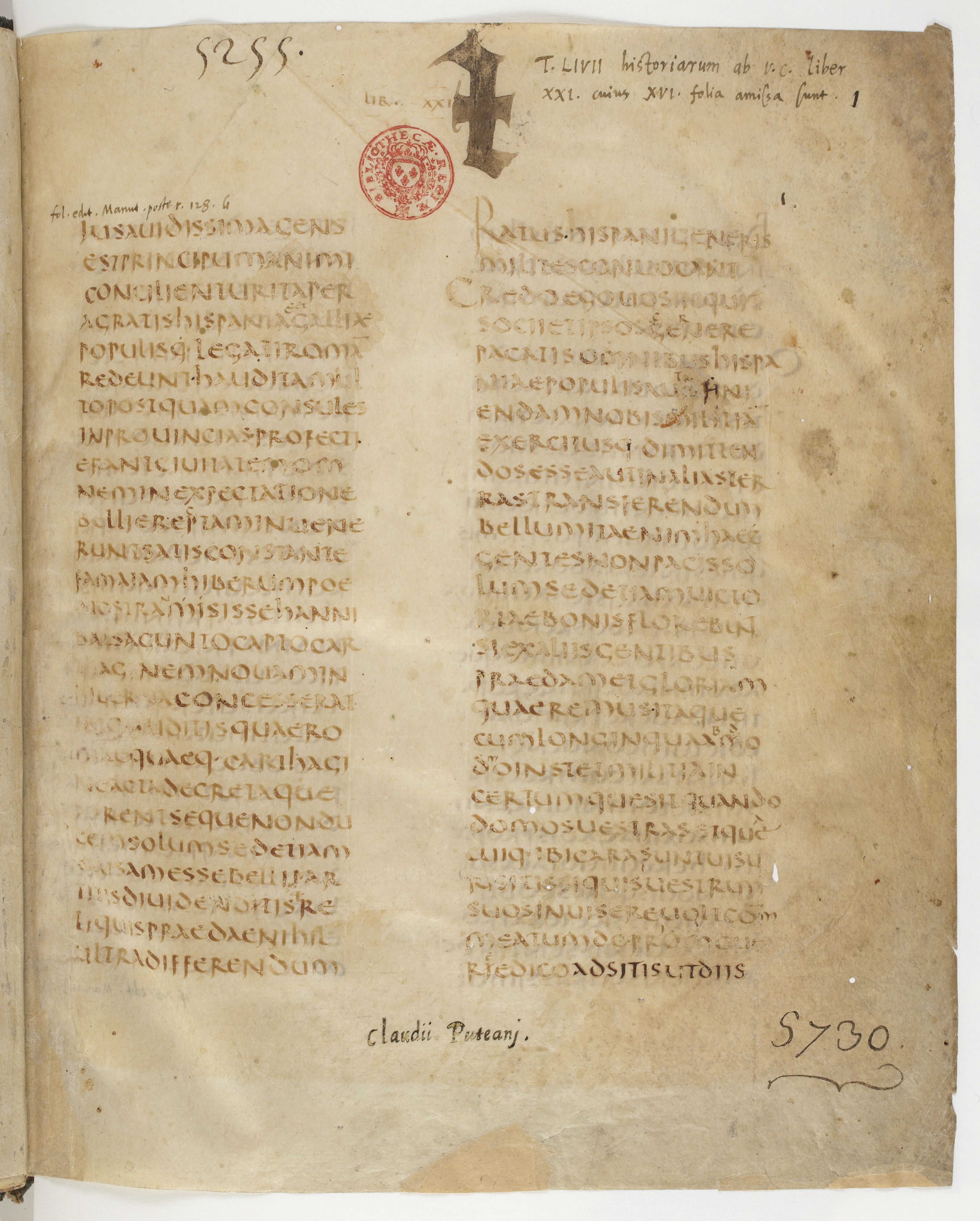
Paris, Bibliothèque nationale de France, lat. 5730 (Puteanus), a late antique manuscript of Livy's Third Decade

Ab Urbe Condita, Volume V: Books 21–22

Reading companion and full text of Livy's Ab Urbe Condita, Volume V (Books 21–22), translated by B. O. Foster — the opening of the Second Punic War, from Hannibal's oath through the crossing of the Alps, the battles of Trebia and Lake Trasimene, and the catastrophe of Cannae.
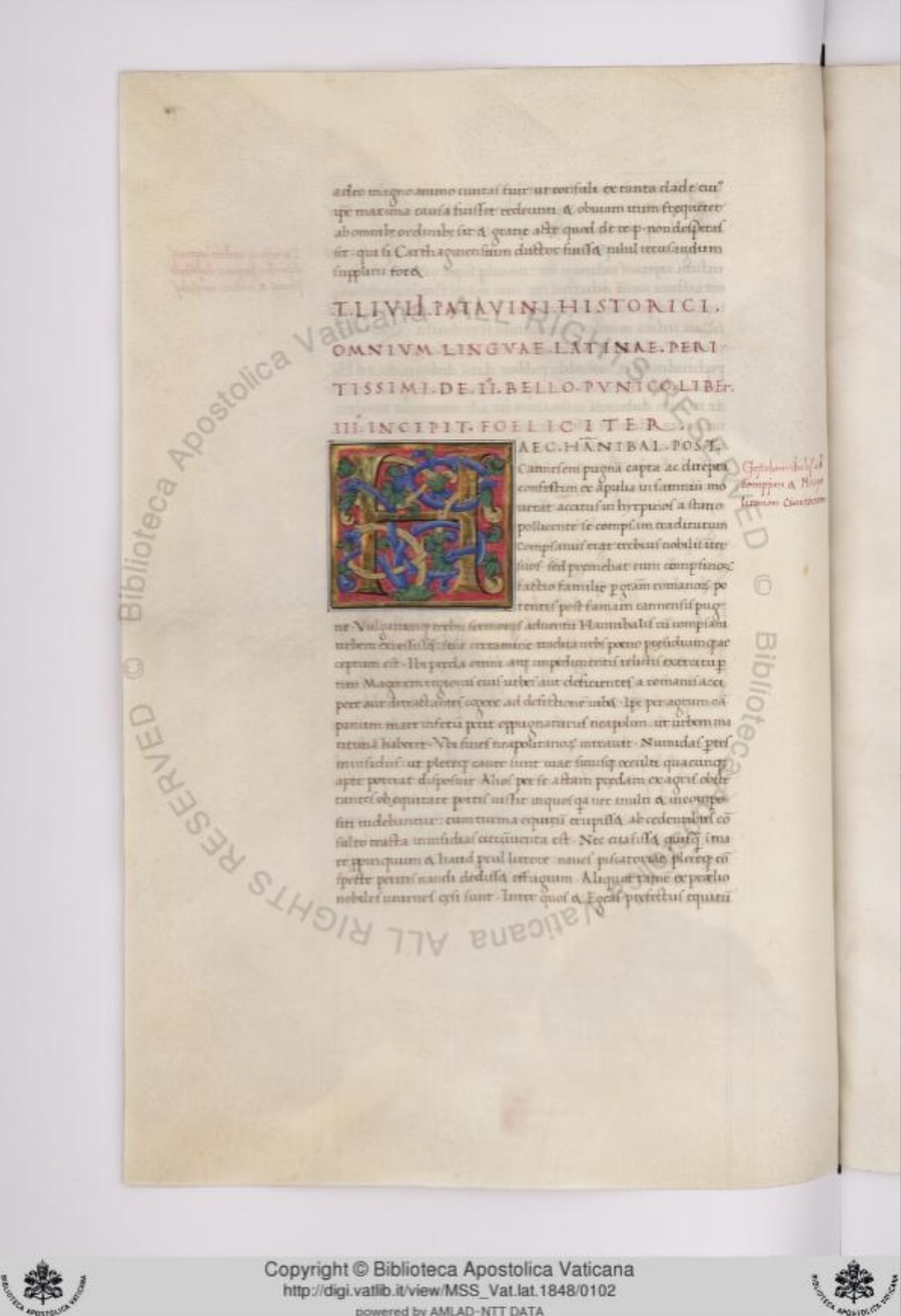
Biblioteca Apostolica Vaticana, Vat. lat. 1848, fol. 48v — opening of Livy Book 23, illuminated by Bartolomeo della Gatta, Rome, c. 1475–1480

Ab Urbe Condita, Volume VI: Books 23–25

Reading companion and full text of Livy's Ab Urbe Condita, Volume VI (Books 23–25), translated by F. G. Moore — the aftermath of Cannae, the defection and eventual siege of Capua, the fall of Syracuse and death of Archimedes, and the reverses in Spain.

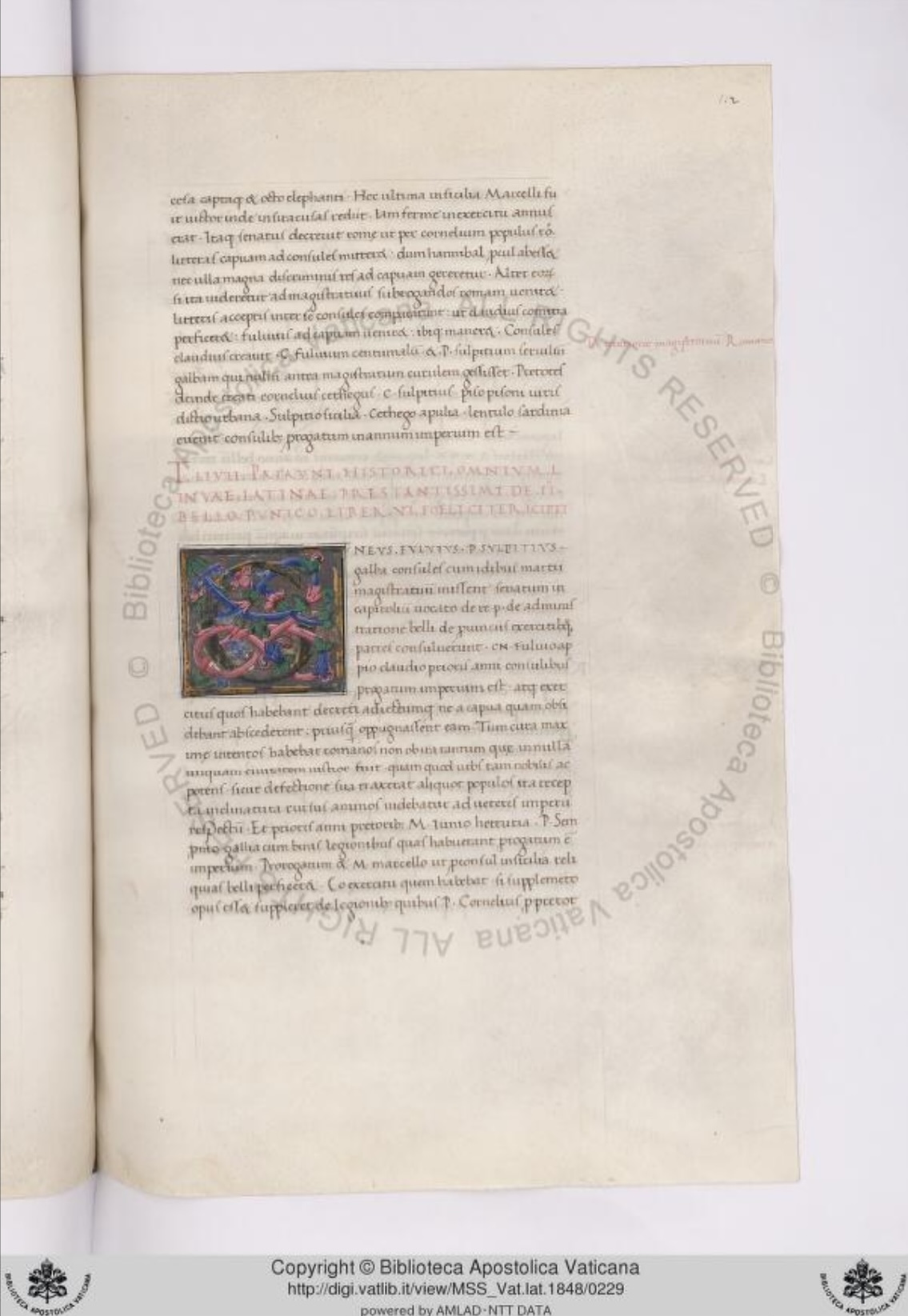
Biblioteca Apostolica Vaticana, Vat. lat. 1848, fol. 112r — opening of Livy Book 26, illuminated by Bartolomeo della Gatta, Rome, c. 1475–1480

Ab Urbe Condita, Volume VII: Books 26–30

Reading companion and full text of Livy's Ab Urbe Condita, Volume VII (Books 26–30), translated by F. G. Moore — the turn of the Second Punic War, from the rise of Scipio Africanus in Spain through the Battle of the Metaurus, the African campaign, and the final confrontation at Zama.

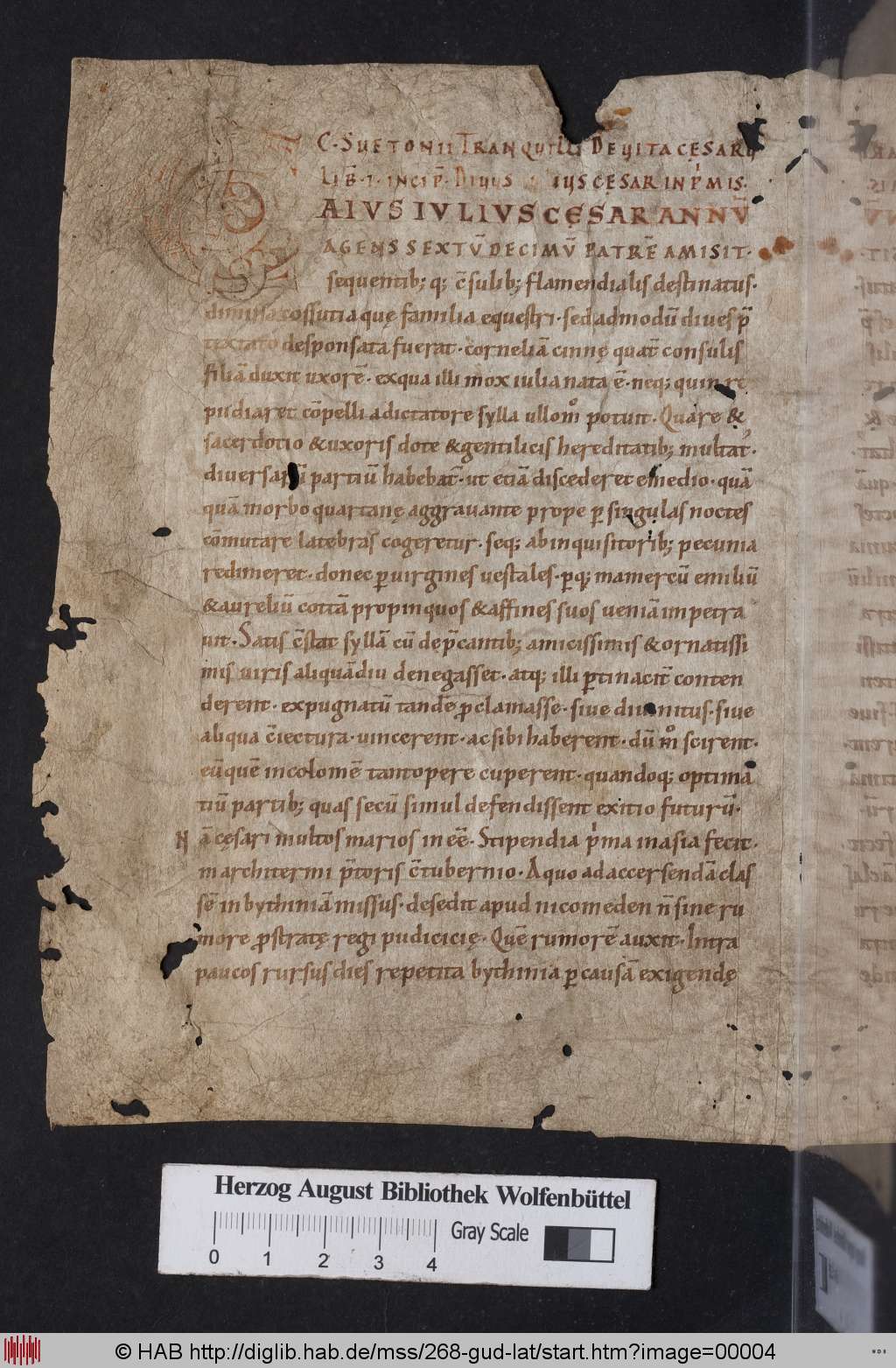
Fol. 1v of Cod. Guelf. 268 Gud. lat., opening of Suetonius's De vita Caesarum, Eichstätt, second half of the 11th century

The Lives of the Caesars, Volume I

Reading companion and full text of Suetonius's De Vita Caesarum (The Lives of the Caesars), Volume I, translated by J. C. Rolfe — biographies of Julius Caesar, Augustus, Tiberius, and Caligula, combining official record, anecdote, and scandal into the foundational portraits of Rome's first rulers.

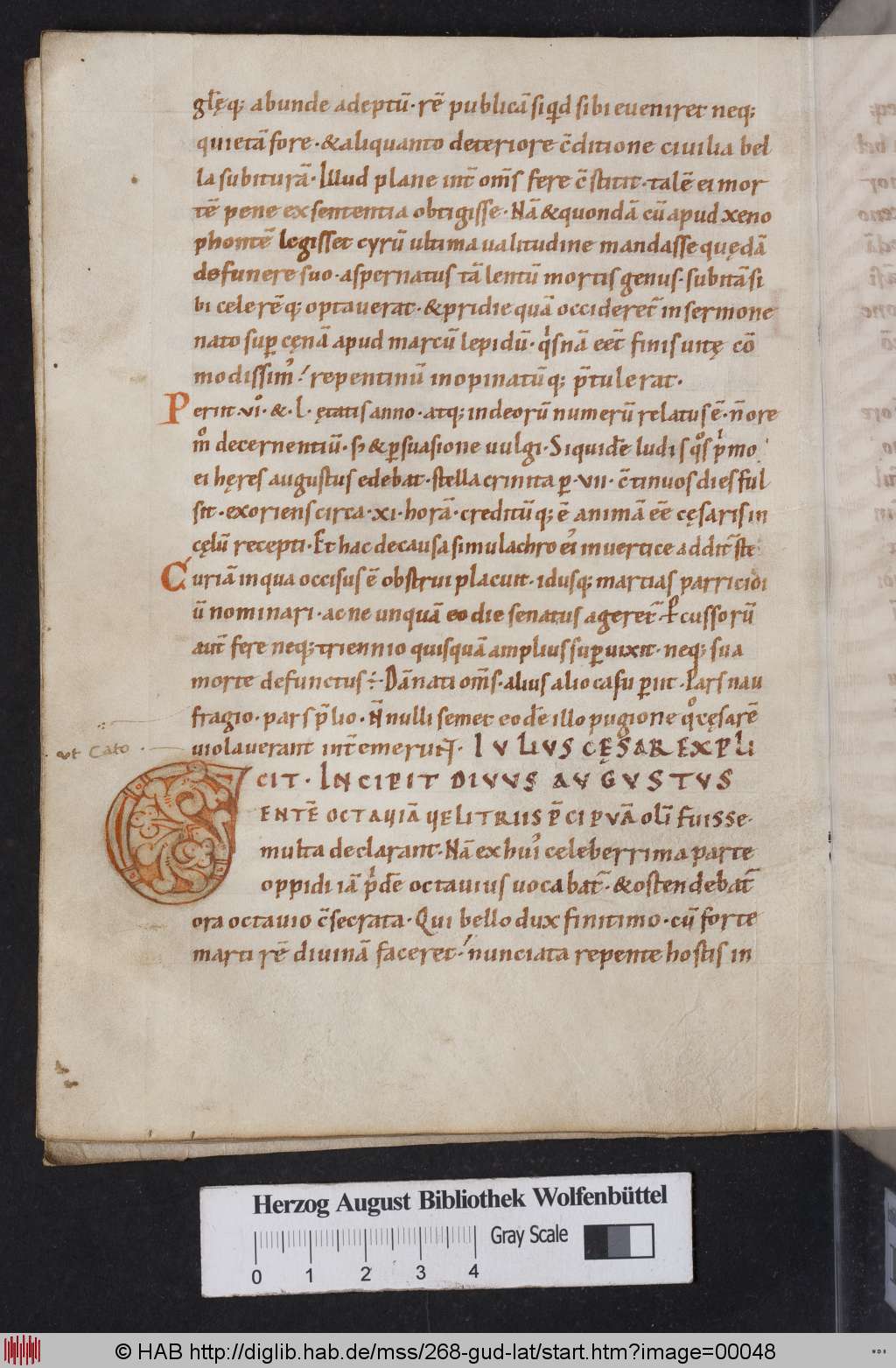
Fol. 23v of Cod. Guelf. 268 Gud. lat., opening of the Life of Augustus, Eichstätt, second half of the 11th century

The Lives of the Caesars, Volume II

Reading companion and full text of Suetonius's De Vita Caesarum (The Lives of the Caesars), Volume II, translated by J. C. Rolfe — biographies of Claudius, Nero, Galba, Otho, Vitellius, Vespasian, Titus, and Domitian, spanning the dissolution of the Julio-Claudian dynasty, the convulsions of 69 CE, and the rise and fall of the Flavians.

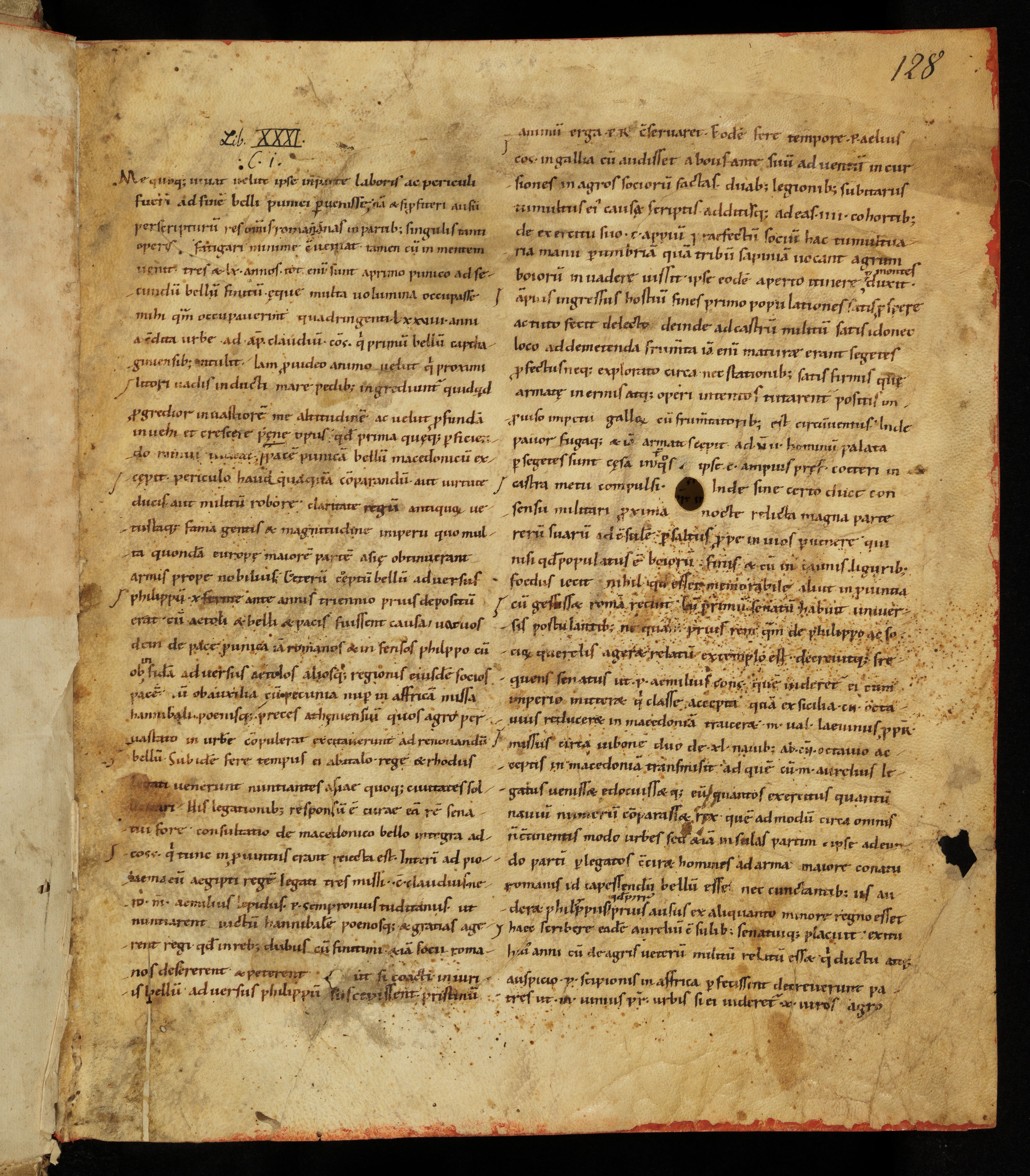
Bamberg, Staatsbibliothek, Msc.Class.35, fol. 128r — opening of Livy Book 31, Caroline minuscule, medieval

Ab Urbe Condita, Volume IX: Books 31–34

Reading companion and full text of Livy's Ab Urbe Condita, Volume IX (Books 31–34), translated by Evan T. Sage — the Second Macedonian War, from Rome's declaration against Philip V through Flamininus's decisive victory at Cynoscephalae and the proclamation of Greek freedom at the Isthmian Games.

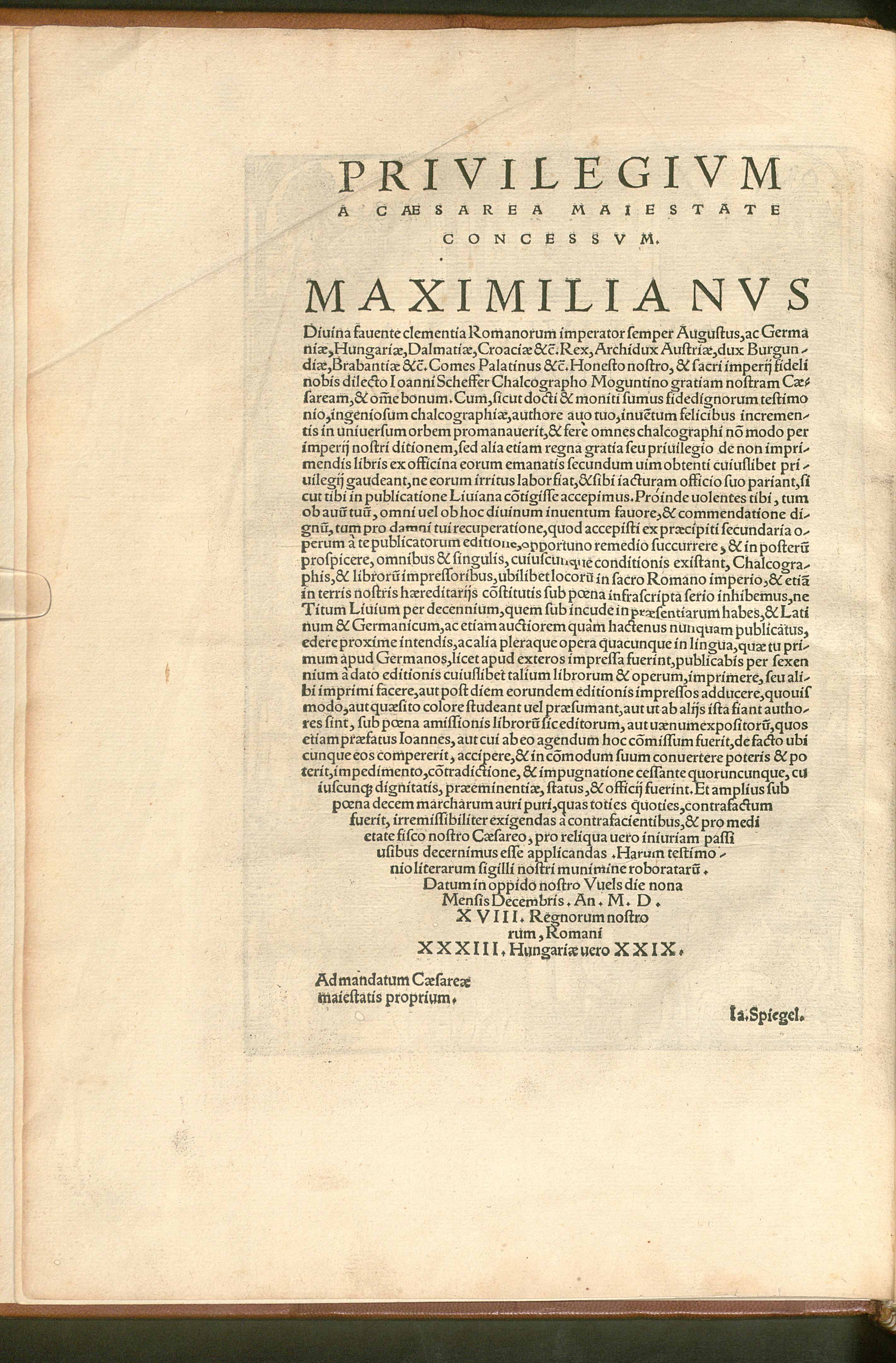
Privilegium page of the 1519 Editio Moguntina of Livy, imperial privilege granted by Maximilian I to Johannes Scheffer of Mainz — Bayerische Staatsbibliothek, Munich, Res/2 A.lat.b. 422

Ab Urbe Condita, Volume X: Books 35–37

Reading companion and full text of Livy's Ab Urbe Condita, Volume X (Books 35–37), translated by Evan T. Sage — the war with Antiochus III, from the Seleucid king's intervention in Greece through the Roman victories at Thermopylae and Magnesia that expelled him from Europe and Asia Minor.

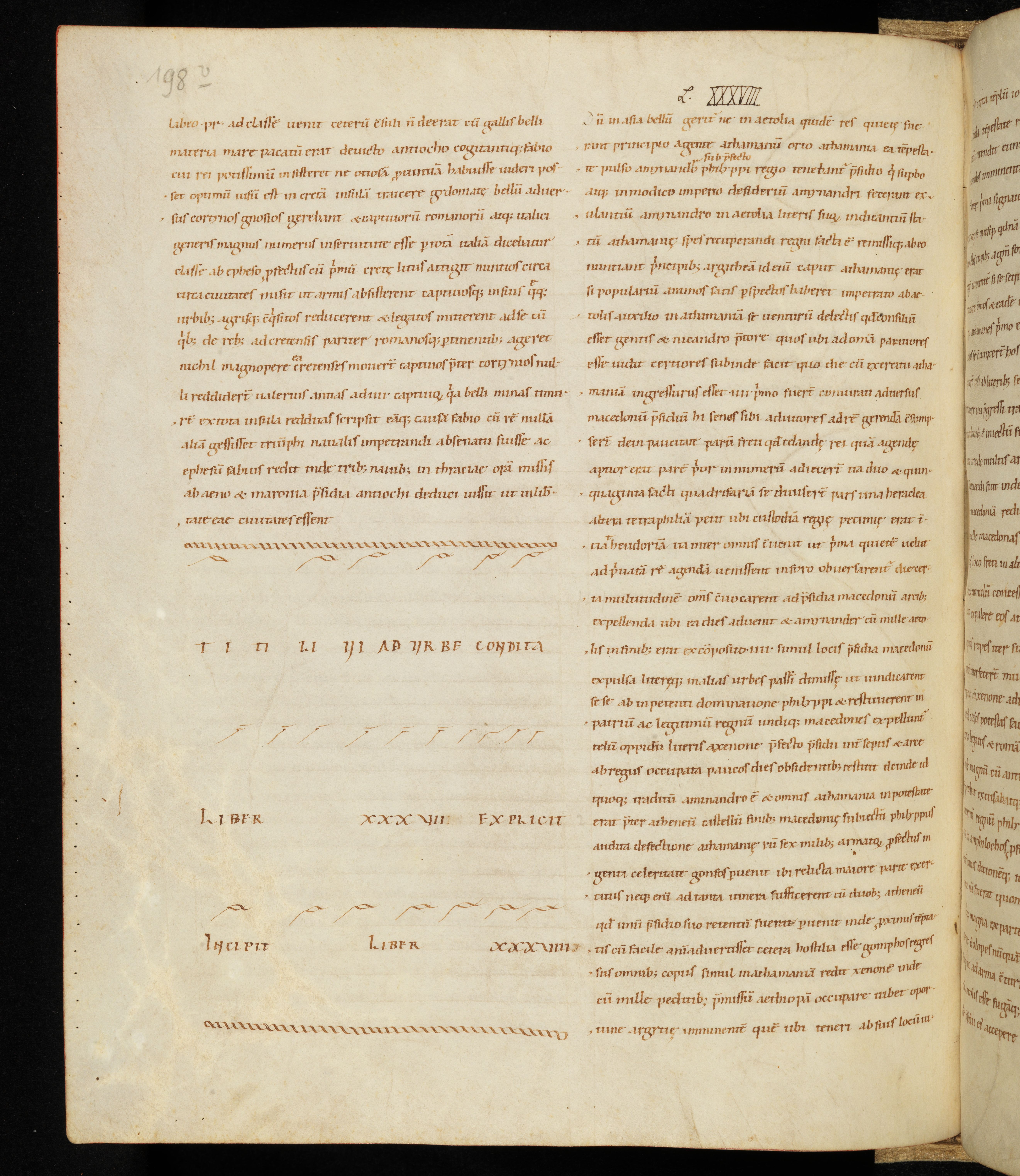
Bamberg, Staatsbibliothek, Msc.Class.35, fol. 198v — transition from Book 37 to Book 38 of Livy's Ab Urbe Condita, Caroline minuscule, medieval

Ab Urbe Condita, Volume XI: Books 38–39

Reading companion and full text of Livy's Ab Urbe Condita, Volume XI (Books 38–39), translated by Evan T. Sage — the settlement of the Syrian War and Manlius Vulso's campaign in Galatia, followed by the celebrated senatorial investigation into the Bacchanalian conspiracy of 186 BCE.

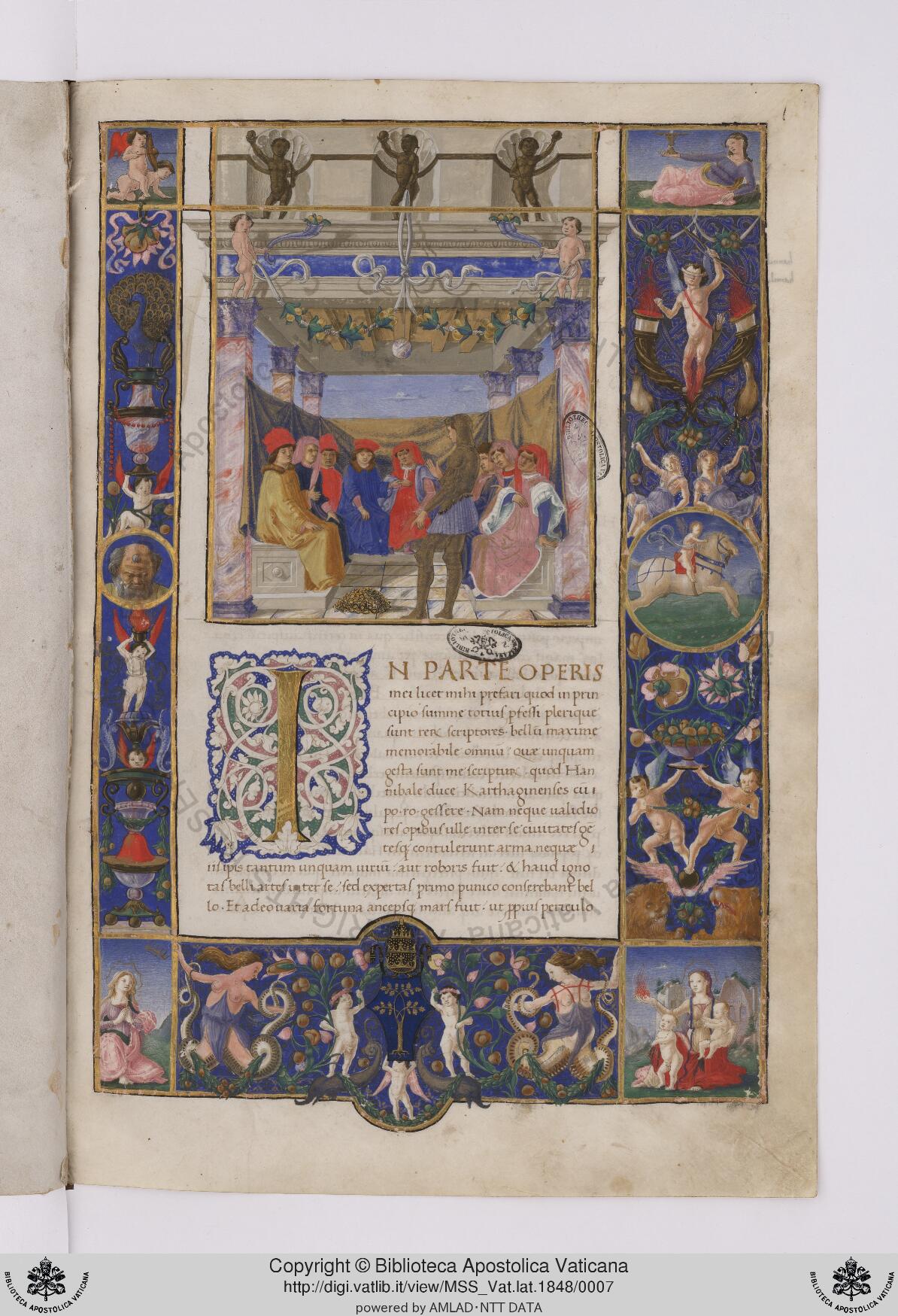
Biblioteca Apostolica Vaticana, Vat. lat. 1848, fol. 1r — incipit page of Livy's Third Decade, illuminated by Bartolomeo della Gatta, Rome, c. 1475–1480

Ab Urbe Condita, Volume XII: Books 40–42

Reading companion and full text of Livy's Ab Urbe Condita, Volume XII (Books 40–42), translated by Evan T. Sage and A. C. Schlesinger — the final years of Philip V, the accession of Perseus, and the opening moves of the Third Macedonian War.

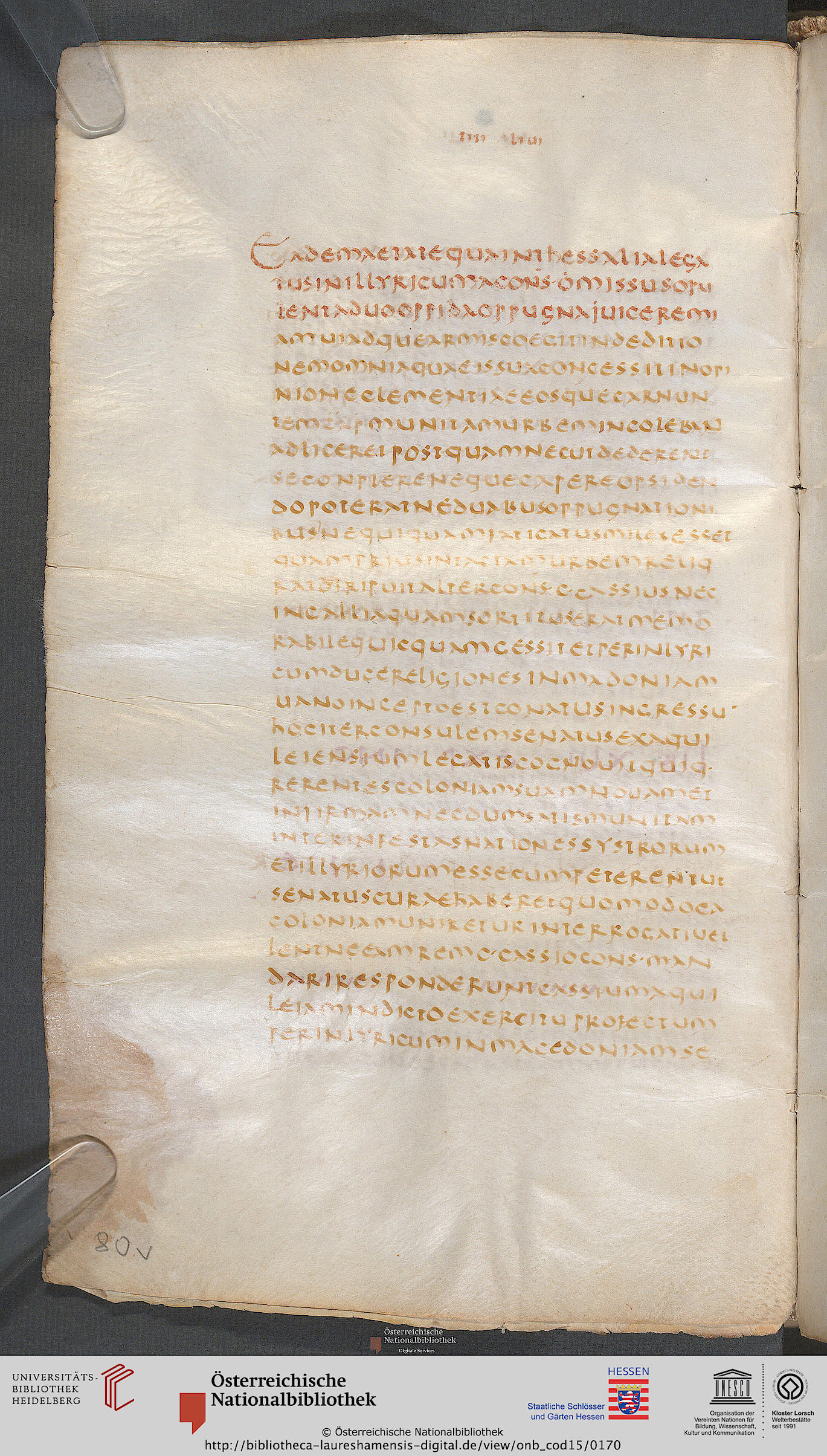
Vienna, Österreichische Nationalbibliothek, Cod. Vind. Lat. 15 (Codex Vindobonensis Lat. 15, the Lorsch Manuscript), fol. 80v — Book 42 text in Uncial script, 5th century

Ab Urbe Condita, Volume XIII: Books 43–45

Reading companion and full text of Livy's Ab Urbe Condita, Volume XIII (Books 43–45), translated by A. C. Schlesinger — the Third Macedonian War from its early campaigns through the decisive Battle of Pydna, the capture of Perseus, and the triumph of Lucius Aemilius Paullus, which ends both the war and the Macedonian monarchy.

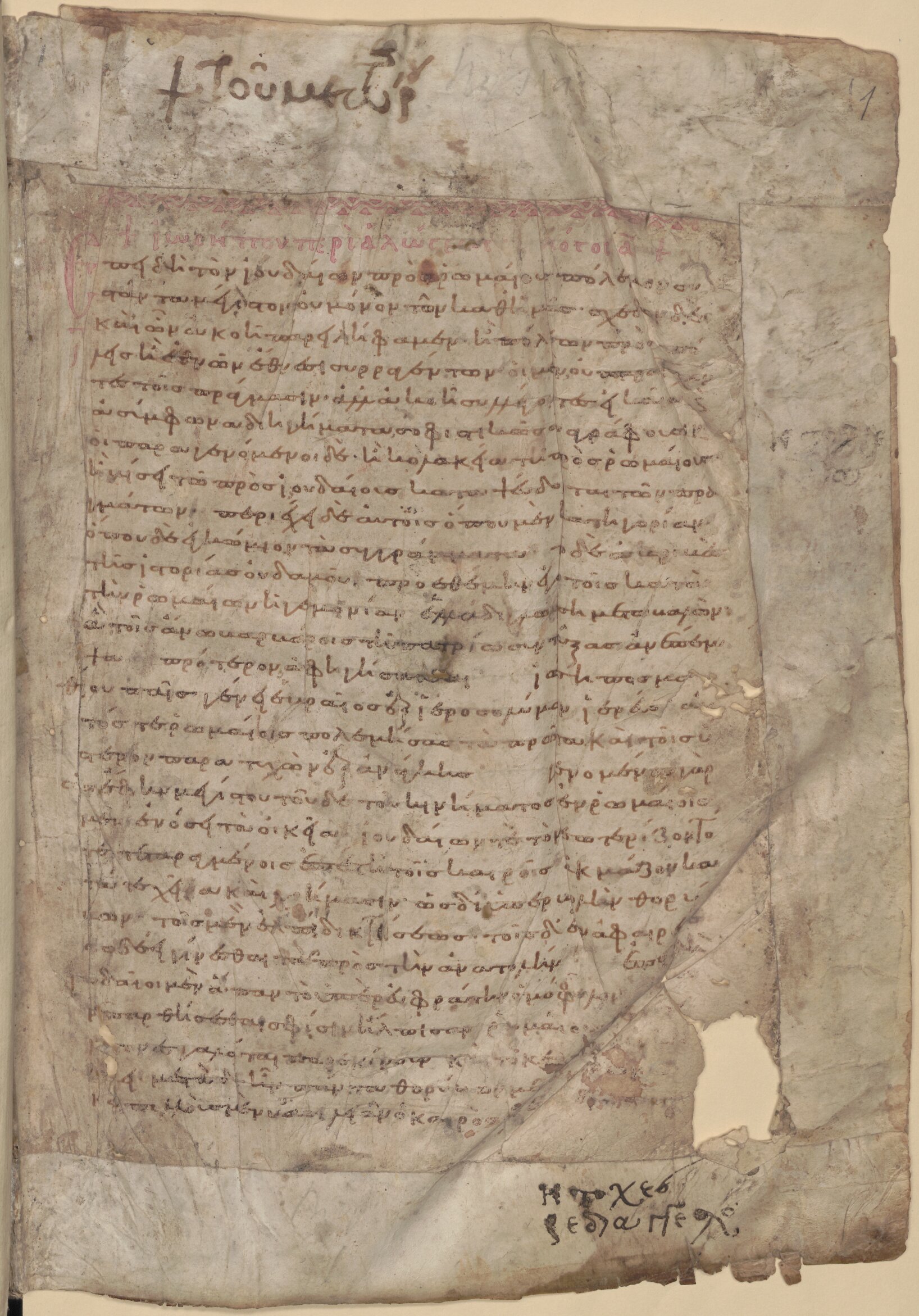
Fol. 1r of BSB Cod.graec. 639: the opening page of Josephus's Bellum Judaicum. The parchment is heavily worn and damaged, but the text is identifiable as the Proem (Preface) of the work.

The Jewish War

Reading companion for Bellum Judaicum — Josephus's eyewitness account of the Jewish revolt against Rome and the destruction of the Second Temple.

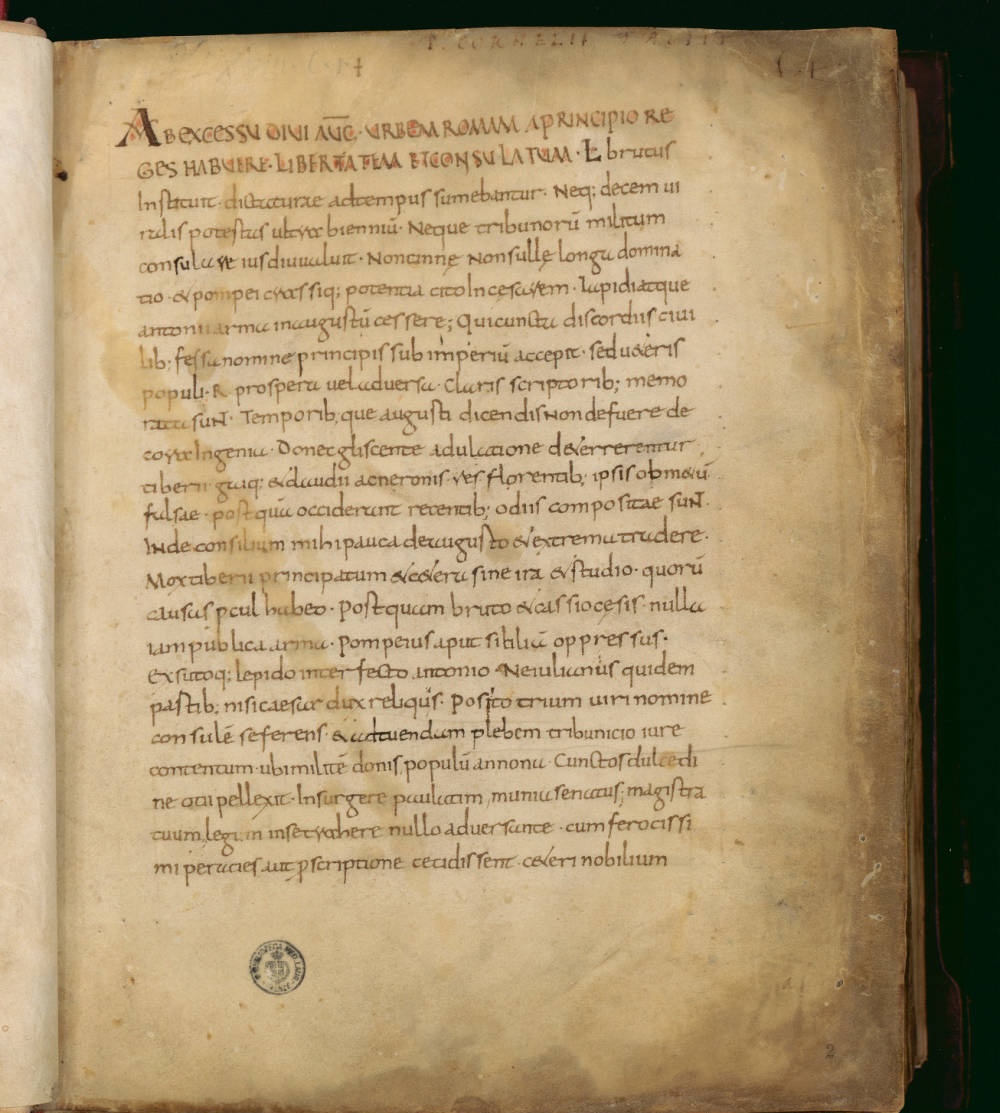
Manuscript of Cornelius Tacitus Annals (Plut. 68.1) at the Biblioteca Medicea Laurenziana, Florence — 11th century (1001–1100).

Annals

Reading companion for the Annals of Tacitus, covering the Julio-Claudian dynasty from the death of Augustus to the reign of Nero.

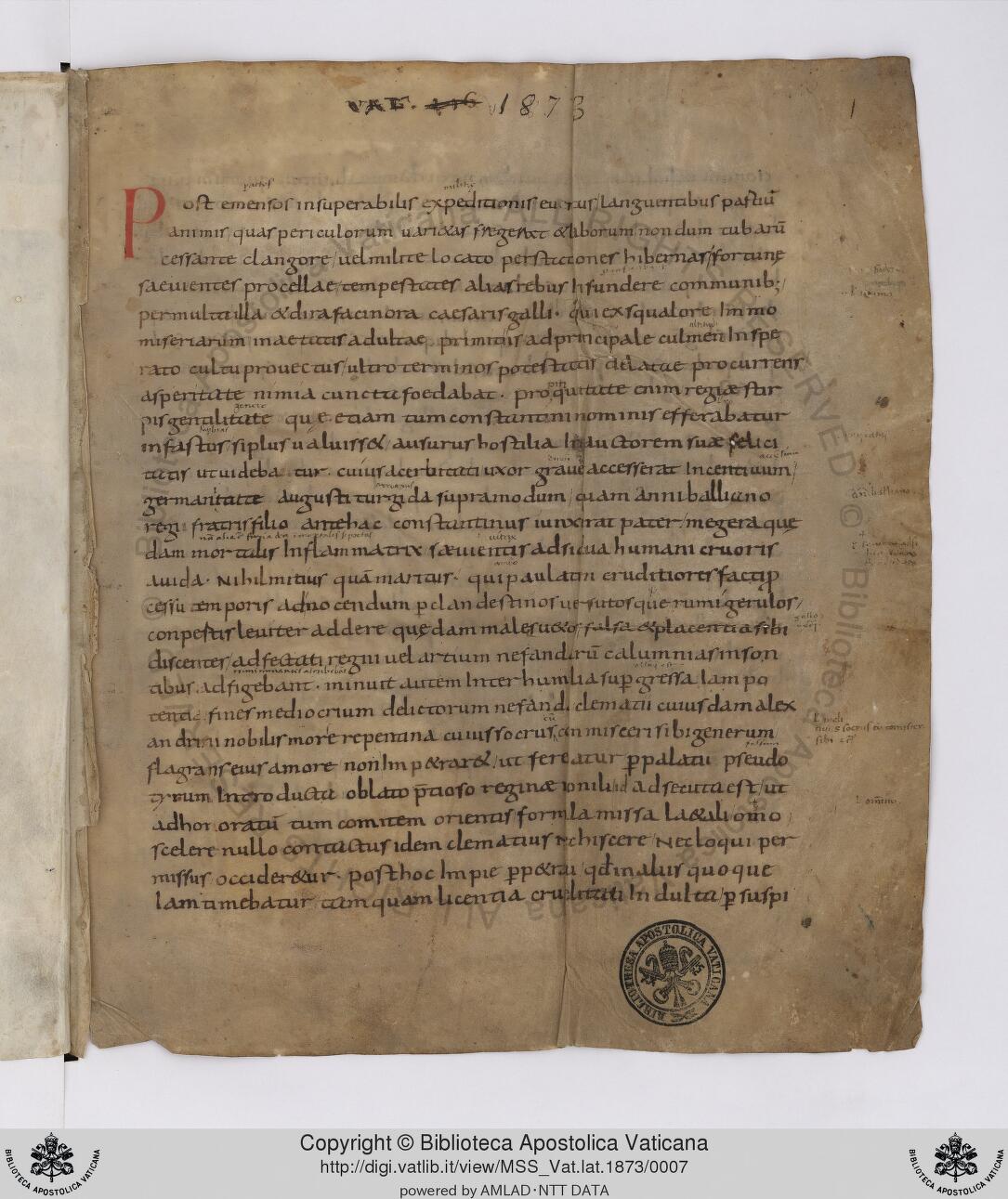
Folio 1r of the manuscript Vaticanus Latinus 1873, a 9th-century Carolingian codex of the Res Gestae by the Roman historian Ammianus Marcellinus. Known as the Codex Fuldensis (named for the Abbey of Fulda where it was rediscovered by humanist Poggio Bracciolini in 1417), it is the primary surviving source for the final 18 books of Ammianus’s history. This page marks the beginning of Book XIV, which chronicles the downfall of the Caesar Constantius Gallus. The large red initial P begins the word 'Post,' introducing the text: 'Post emensos insuperabiles expeditionum eventus...' ('After the outcome of insurmountable expeditions...'). The text is written in Carolingian minuscule, a clear and uniform script developed during the reign of Charlemagne to standardize European Latin texts. Because the first 13 books of Ammianus’s work are lost to history, this specific page represents the modern 'start' of one of the most important historical accounts of the late Roman Empire (covering 353–378 AD). You can see various marginal and interlinear notes (glosses) added by later scholars, including famous Renaissance humanists like Niccolò Niccoli and Giulio Pomponio Leto, who studied this exact volume to recover classical knowledge. Source: Biblioteca Apostolica Vaticana (Vat. lat. 1873)

Res Gestae (Ammianus Marcellinus, Rolfe Translation)

Full text of Ammianus Marcellinus' Res Gestae in the Loeb Classical Library edition (vols. 300, 315, 331), translated by John C. Rolfe — the standard 20th-century English rendering of the last great Latin historian of Rome.

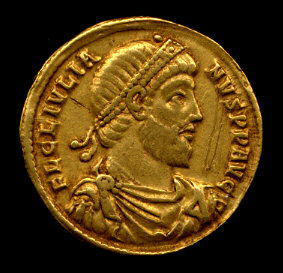
Gold Solidus of Julian (361–363), Byzantine, 361–363, Gold, The Metropolitan Museum of Art, New York — Gallery 301. Struck during the brief but consequential reign of Julian the Apostate, this gold solidus reflects the enduring power of Roman imperial coinage at a pivotal moment of transition. The emperor's portrait — rendered with classical precision on the obverse — evokes Julian's deliberate effort to revive pre-Christian Roman traditions, positioning himself as a philosopher-emperor in the mold of Marcus Aurelius. The solidus, introduced by Constantine I, had by this period become the backbone of Mediterranean commerce, its consistent gold purity a guarantee of imperial authority across vast distances. This coin stands as both a monetary instrument and a miniature monument — a gilded testament to a reign that lasted little more than two years, yet left an indelible mark on the history of the late Roman world.

Against the Galileans

Reading companion and full text of Contra Galilaeos — Emperor Julian's philosophical polemic against Christianity, preserved in fragments through Cyril of Alexandria's rebuttal.

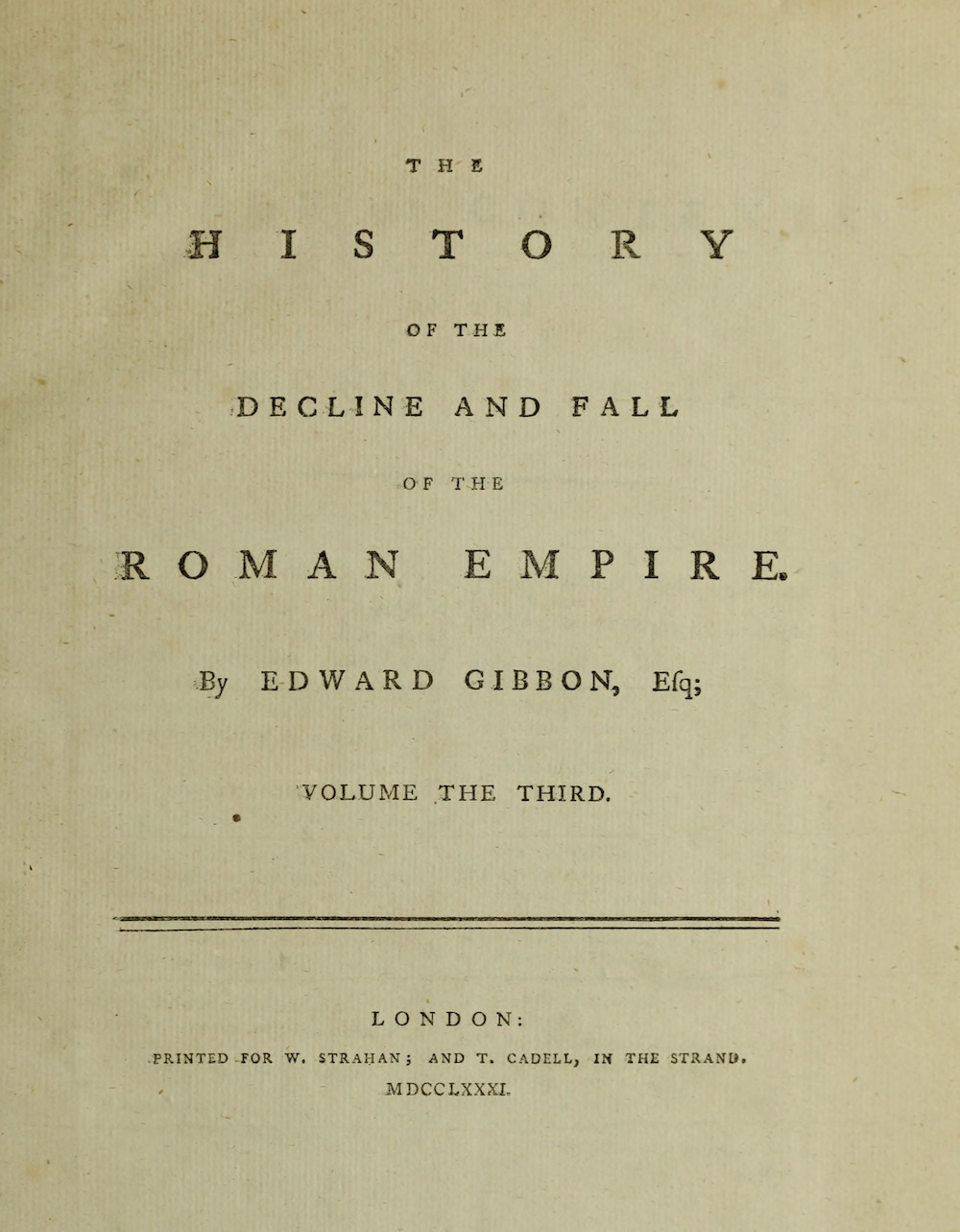
Title page of Vol. 3 of the 1781 edition, containing the General Observations.

General Observations on the Fall of the Roman Empire in the West

Edward Gibbon’s celebrated postscript to Chapter XXXVIII where he synthesizes the primary causes of Rome’s decay and reflects on the future of European civilization.

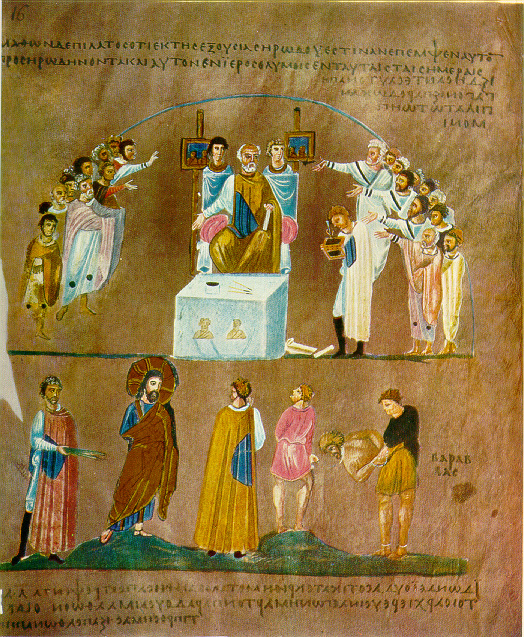
A Byzantine illuminated manuscript page depicting Christ before Pilate, from the Rossano Gospels, 6th century.

The Conduct of the Roman Government towards the Christians from the reign of Nero to that of Constantine

Chapter XVI of Edward Gibbon’s The History of the Decline and Fall of the Roman Empire examines the conduct of the Roman government toward the Christians from the reign of Nero to that of Constantine.

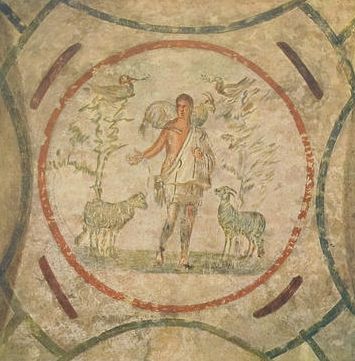
A fresco of the Good Shepherd from the Catacomb of Priscilla, Rome, 3rd century CE.

The Progress of the Christian Religion, and the Sentiments, Manners, Numbers, and Condition of the Primitive Christians

Chapter XV of Edward Gibbon's The History of the Decline and Fall of the Roman Empire examines the progress of the Christian religion and the sentiments, manners, numbers, and condition of the primitive Christians.

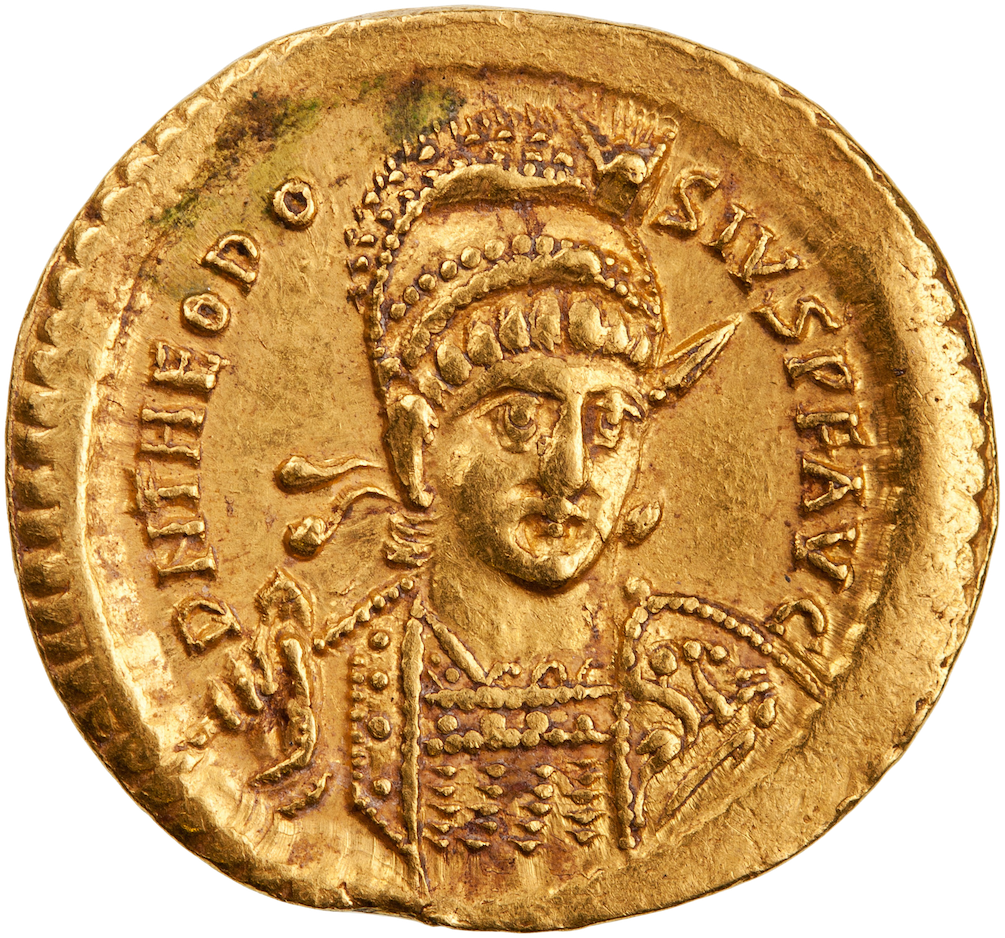
Gold Solidus of Theodosius II (425–429 AD).

History of the Later Roman Empire, Vol. 1

The first volume of J.B. Bury's authoritative history of the Later Roman Empire, covering the reigns from the death of Theodosius I through the accession of Anastasius — an age of barbarian pressure, dynastic crisis, and the definitive parting of East and West.

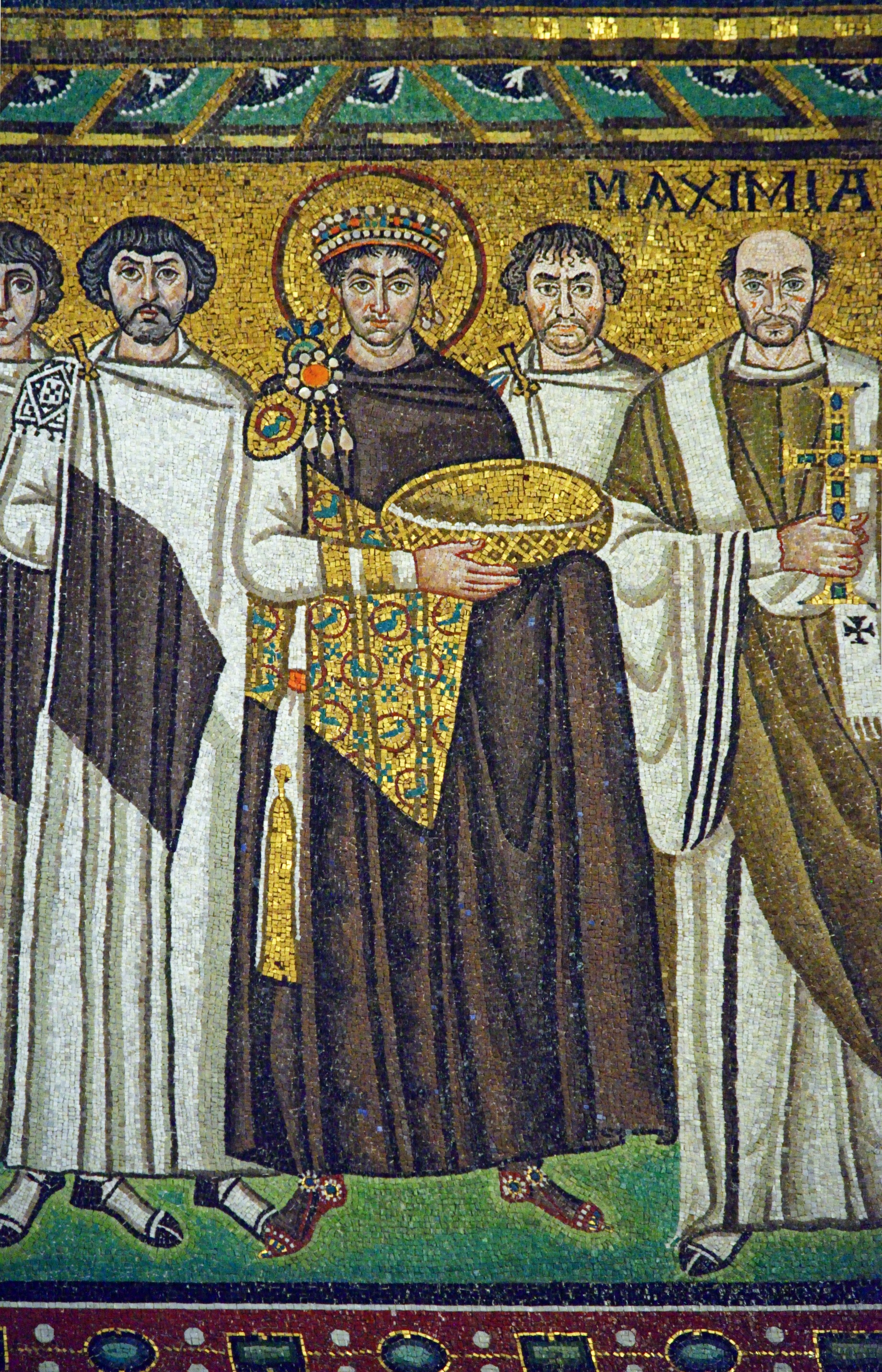
Emperor Justinian I and his retinue. Detail of the apse mosaic, Basilica of San Vitale, Ravenna, Italy, c. 547 AD.

History of the Later Roman Empire, Vol. 2

The second volume of J.B. Bury's authoritative history of the Eastern Empire, covering the reigns of Anastasius, Justin I, and Justinian — including the great reconquests of Africa and Italy under Belisarius and Narses.