AB URBE CONDITA
Volume XII: Books 40–42 · The Rise of Perseus
by Livy
Translated by Evan T. Sage and A. C. Schlesinger
INTRODUCTION
Volume XII of the Loeb Livy straddles a transition in both the historical narrative and the editorial history of the edition: Evan T. Sage, who translated Volumes IX through XI, gives way to A. C. Schlesinger beginning in the middle of this volume. Historically, Books 40–42 span the years 181–172 BCE — a period whose surface calm conceals the gathering forces of the Third Macedonian War. Philip V of Macedon, humiliated at Cynoscephalae and constrained by the Roman peace, is ageing and bitter; his younger son Perseus is accumulating military and diplomatic resources with a patience his father could not have managed; and in Rome, the senate watches with increasing unease as Macedon rebuilds its strength. Books 40–42 trace the arc from Philip's death to the formal outbreak of war between Rome and Perseus — a conflict that will end, in the next volume, with the destruction of the Macedonian monarchy.
The years covered by this volume are also marked by extensive Roman military activity in other theatres — Liguria, Sardinia, Spain — which Livy records in the annalistic fashion alongside the main Macedonian narrative. These campaigns, often dismissed as peripheral, are in fact important evidence for the scale of Roman military effort in the mid-second century and for the senate's capacity to manage simultaneous operations across the Mediterranean basin.
The Books in This Volume
Book 40 covers the years 181–179 BCE and is dominated by the tragic decline of Philip V. Philip's last years are consumed by the consequences of a dynastic choice: preferring his younger son Perseus over the elder Demetrius, who had spent years as a hostage in Rome and was consequently suspected of pro-Roman sympathies, Philip ordered Demetrius's execution. Livy presents this episode — which he narrates with evident dramatic feeling — as a case study in the corrupting effects of suspicion on a ruler's judgement. Philip died shortly afterwards, reportedly of grief at the discovery that he had been deceived into killing an innocent son. Book 40 also contains important material on Rome's censors and their public works, and on continued fighting in Liguria and Spain.
Book 41 covers 178–174 BCE and records the first years of Perseus's reign. Perseus inherits a Macedonian kingdom that is, on paper, bound by the Roman peace and shorn of territory; in practice, he moves quickly to rebuild Macedon's position, concluding alliances with neighbouring peoples, suppressing internal opposition, and cultivating goodwill among the Greek cities. The book also records the censorship of Marcus Aemilius Lepidus and Quintus Fulvius Flaccus, during which major infrastructure works were undertaken, and continued operations in Liguria — the long, grinding pacification of the Ligurian tribes that appears year after year in the annalistic record as a background of routine violence against which the more dramatic events of the east are set.
Book 42 brings the narrative to the eve of open war. Perseus's movements — his alliance with the Boeotians, his dealings with Carthage and with the Seleucid court, the embassy he sends to Rome — are presented by Livy through the lens of Roman anxiety: each step seems explicable in isolation, but the cumulative pattern looks like preparation for war. The decisive moment is the ambush Perseus allegedly planned against Eumenes of Pergamum at Delphi — where the king narrowly survived what appeared to be an assassination attempt — and the subsequent hardening of senatorial opinion against Perseus. Book 42 ends with the Roman declaration of war and the dispatch of an army to Greece.
Philip, Perseus, and the Logic of Empire
The Macedonian story that runs through Books 40–42 is, in Livy's hands, as much a study of character as of politics. Philip's paranoid destruction of his own house and Perseus's more calculating ambition are contrasted implicitly with the institutional stability of Roman decision-making: the senate debates, votes, sends embassies, and acts through established procedures. What this framework understates — and what modern scholars have noted — is the degree to which Roman pressure itself constrained Perseus's options and made aggressive Macedonian self-assertion both predictable and, perhaps, inevitable.
Transmission
Books 40–42 belong to the same medieval manuscript tradition as the rest of the Fourth and Fifth Decades, described in the introduction to Volume IX. The text of these books presents some of the more heavily emended passages in the surviving Livy, particularly in the annalistic sections covering the Ligurian and Spanish campaigns, where the manuscript tradition appears to have suffered damage or confusion in transmission. The narrative passages — particularly the dramatic account of Philip and Demetrius in Book 40 — are generally in better condition.
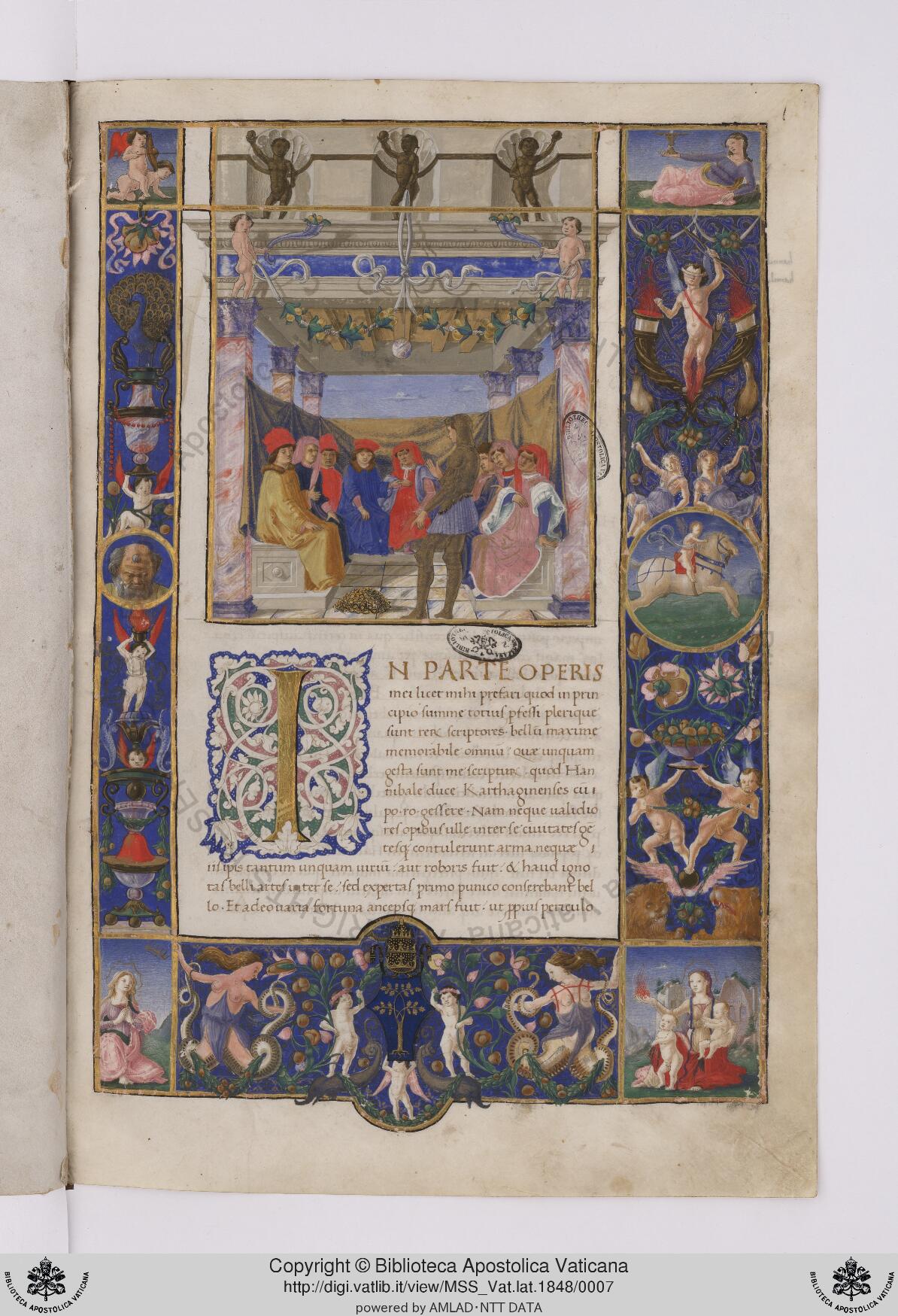
Book 40 sits at the boundary between the Fourth and Fifth Decades and marks a point where the manuscript tradition shifts character. The earliest witnesses to Books 40–42 specifically — their shelfmarks, dates, and relationships to the lost Carolingian archetype — are a question requiring the detailed stemmatic analysis in Michael Reeve's chapter on Livy in L. D. Reynolds (ed.), Texts and Transmission: A Survey of the Latin Classics (Oxford: Clarendon Press, 1983), pp. 205–214, which remains the standard reference for this part of the tradition. Cover image sourcing for this volume should be revisited once those witnesses have been identified.
This Translation
The translation is by Evan T. Sage (Books 40 and 41 and the first portion of Book 42) and Alfred Cary Schlesinger (the remainder of Book 42), published as Volume XII of the Loeb Classical Library edition of Livy (Loeb 332; Cambridge, MA: Harvard University Press, 1938). The Latin text faces the English translation throughout. The translation is in the public domain.
FULL TEXT
Book 40
[Book 40 opens in 181 BCE, with the ageing Philip V of Macedon and the accelerating crisis over his two sons.]
I. In the consulship of Publius Cornelius Cethegus and Marcus Baebius Tamphilus1, the kings of Macedon and Syria both sent embassies to Rome. Perseus, the son of Philip, came in person with a retinue appropriate to a prince; the Seleucid king Seleucus sent representatives. Both were received with courtesy, and both departed with responses that confirmed existing arrangements without conceding anything new. The senate's attention was fixed less on what these embassies said than on what they might portend: Perseus was known to be his father's heir, and Philip's behaviour in his last years had given Rome sufficient cause for unease.2
II. Among the matters that occupied Philip in this period was a dispute between his sons of a kind that destroys dynasties. Demetrius, the younger, had spent his youth as a hostage in Rome and had acquired there not only the Latin tongue and Roman habits of mind but — or so his enemies maintained — an excessive regard for Rome's goodwill and an insufficient regard for his father's interests. Perseus, the elder, presented these traits as a danger to Macedon and to the house of Antigonus; and Philip, whose defeats at Roman hands had left a residue of bitterness toward everything Roman, listened. The narrative of what followed — the forged letters, the false accusations, the manufactured evidence of treason — is one that Livy follows with evident care for the sources and evident sympathy for the victim.
Bibliography
Sage, Evan T., and A. C. Schlesinger, trans. Livy: Ab Urbe Condita, Volume XII (Books 40–42). Loeb Classical Library 332. Cambridge, MA: Harvard University Press, 1938.
Eckstein, Arthur M. Rome Enters the Greek East: From Anarchy to Hierarchy in the Hellenistic Mediterranean, 230–170 BC. Oxford: Blackwell, 2008.
Gruen, Erich S. The Hellenistic World and the Coming of Rome. 2 vols. Berkeley: University of California Press, 1984.
Hammond, N. G. L., and F. W. Walbank. A History of Macedonia, Volume III: 336–167 BC. Oxford: Clarendon Press, 1988.
Meloni, Piero. Perseo e la fine della monarchia macedone. Rome: L'Erma di Bretschneider, 1953.
Footnotes
-
The consuls of 181 BCE. This year also saw the death of Scipio Africanus — an event recorded in the Periochae of the lost Book 38 — and the beginning of the decade in which the last of the great commanders of the Hannibalic generation would pass from the scene. ↩︎
-
Philip V (238–179 BCE) had been defeated at Cynoscephalae in 197 BCE and subjected to a Roman peace that stripped him of his fleet, his overseas territories, and most of his army. The twenty years between that defeat and his death were spent in a constrained rebuilding of Macedonian power that Rome watched with increasing suspicion. ↩︎