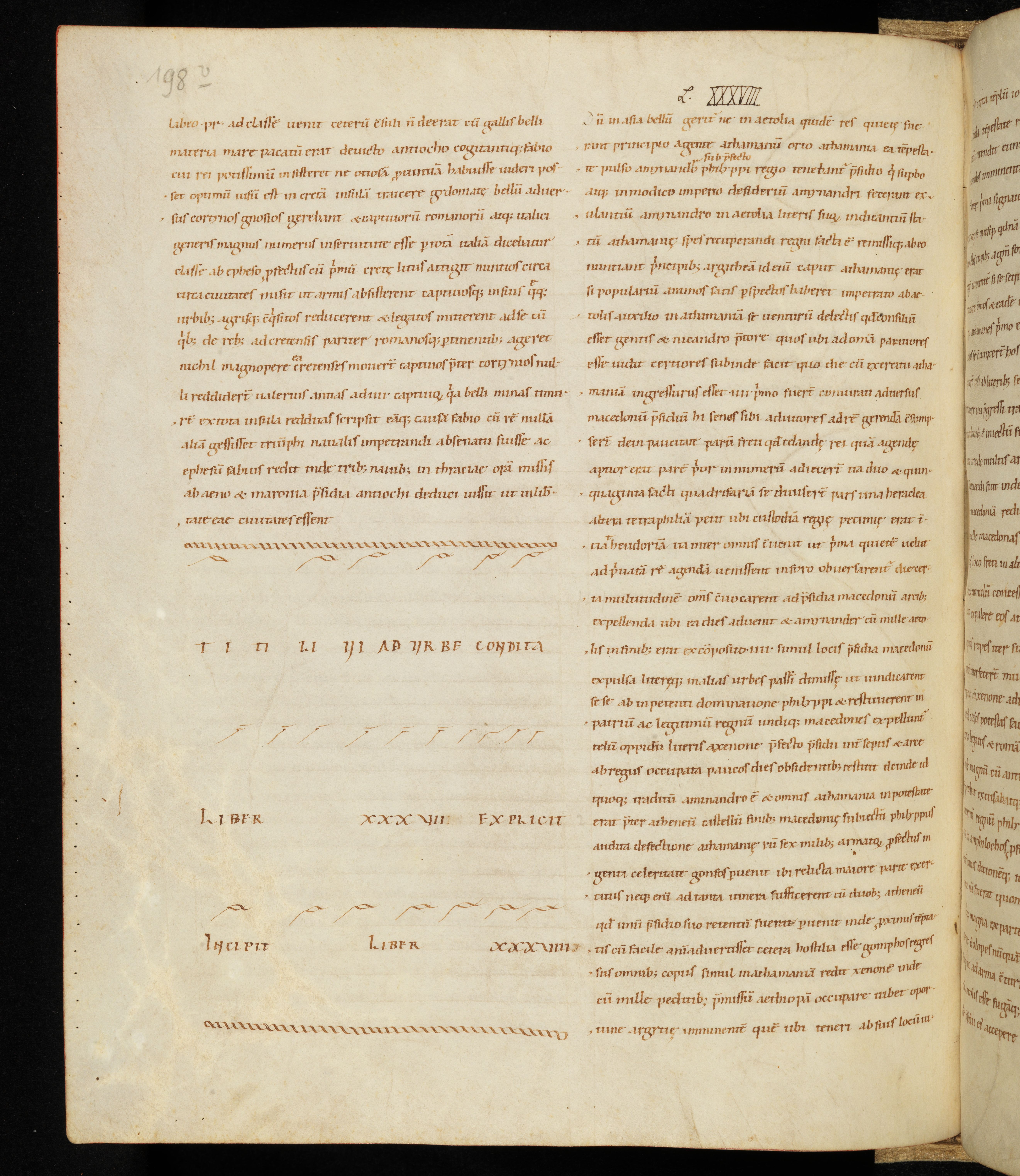
AB URBE CONDITA
Volume XI: Books 38–39 · Galatia and the Bacchanalia
by Livy
Translated by Evan T. Sage
INTRODUCTION
Volume XI of the Loeb Livy contains two books of markedly different character, connected by the theme of Rome's effort to define and police its own boundaries — geographical in Book 38, cultural and religious in Book 39. Book 38 closes out the eastern war and its chaotic aftermath: the consul Gnaeus Manlius Vulso's unauthorised and controversial campaign against the Galatians of Asia Minor, conducted after the peace with Antiochus was already effectively concluded, which raised serious constitutional questions about the limits of a Roman commander's licence for independent action. Book 39 turns the narrative entirely to Italy and to one of the most dramatic episodes in Roman domestic history: the senatorial investigation and suppression of the cult of Bacchus in 186 BCE, in which the senate claimed thousands of initiates were killed or imprisoned and the nocturnal rites of the god were subjected to permanent regulation.
Together, these two books present Rome in the years immediately following its emergence as the dominant Mediterranean power: a state managing the transition from republican restraint to imperial reach, anxious about both the moral effects of eastern luxury on Roman manners and the potential for private religious associations to develop into networks of loyalty outside senatorial control.
The Books in This Volume
Book 38 opens with the year 188 BCE and the aftermath of Magnesia. The Peace of Apamea, which formally ended the war with Antiochus, redistributed the territory he had controlled west of the Taurus between Rome's allies: Eumenes of Pergamum received the largest share, establishing that kingdom as the dominant power in Asia Minor for the next generation. The book's most politically charged episode is the campaign of the consul Manlius Vulso against the Galatians — Celtic peoples settled in central Asia Minor whose raiding had long troubled the Greek cities of the region. Manlius argued that the senatorial mandate to settle affairs in Asia covered operations against the Galatians; his critics at Rome argued he had conducted an independent war for plunder without authorisation. The ensuing debate in the Senate — in which Manlius's legates defended the campaign while hostile tribunes sought to deny him a triumph — is one of Livy's most detailed accounts of the interplay between military commanders in the field and senatorial oversight at home. Manlius got his triumph. Book 38 also records the prosecution of Scipio Africanus and his brother Lucius on charges of financial impropriety relating to the war indemnity received from Antiochus — an episode whose details are confused in our sources but whose significance is clear: even the greatest of Roman commanders was subject, in principle, to senatorial accountability.
Book 39 is one of the most remarkable books in the Ab Urbe Condita, and the one most often read in isolation as a document of Roman social history. The Bacchanalian affair of 186 BCE is known from Livy's account and from the survival of a senatorial decree — the Senatus Consultum de Bacchanalibus — inscribed on a bronze tablet found in Calabria in 1640 and now in Vienna, which provides an independent confirmation of Livy's narrative in unusual detail. The initiates into the mystery cult of Bacchus, Livy tells us, had reached the number of seven thousand or more across Italy; the nocturnal rites allegedly included sexual violence, murder of those who refused to participate in crimes, and the forging of false wills. The senate's response — arrests, executions, exile, and the imposition of strict regulations on any future worship of Bacchus — is presented by Livy as a justified defence of Roman mores against foreign corruption. Modern scholars have questioned how far the allegations were accurate and how far they reflect the senate's anxiety about any form of organised association outside its control; the Bacchanalian affair has become a central case study in debates about Roman religious tolerance and political repression.
Luxury, Corruption, and Roman Anxiety
The two books in this volume share an anxiety about the moral consequences of Rome's eastern victories that runs through much of the narrative of Books 31–45. Manlius Vulso's triumph is the occasion for Livy's most explicit statement of this concern: it was the army of Manlius, he writes, that first brought to Rome the luxury goods of Asia — bronze couches, expensive fabrics, banqueting furniture — and introduced the practice of female entertainers at dinner parties. This passage, one of the most famous in the later books of the Ab Urbe Condita, encapsulates the moralising framework Livy inherited from the annalistic tradition and adapted to the story of Roman imperial expansion: the very victories that made Rome great were also the mechanism by which the virtues that won them were eroded.
Transmission
Books 38–39 belong to the same medieval manuscript tradition as the rest of the Fourth Decade, described in the introduction to Volume IX. The text of Book 39, covering the Bacchanalia, can be cross-checked against the independent evidence of the Senatus Consultum de Bacchanalibus (CIL I² 581), which allows unusually direct verification of Livy's account of the senate's specific measures. This is one of the rare points in the Ab Urbe Condita where epigraphic evidence provides an external control on the manuscript tradition.
This Translation
The translation is that of Evan T. Sage, published as Volume XI of the Loeb Classical Library edition of Livy (Loeb 313; Cambridge, MA: Harvard University Press, 1936). Sage presents the Latin text on facing pages with his English translation. The translation is in the public domain.
FULL TEXT
Book 38
[Book 38 opens in 188 BCE with the arrangements for the Roman withdrawal from Asia following the Peace of Apamea.]
I. In the consulship of Marcus Valerius Messala and Gaius Livius Salinator1, the situation in Asia was as follows. The ten commissioners who had come from Rome were completing the settlement of affairs in that country; they assigned the territories taken from Antiochus partly to Eumenes and partly to the Rhodians in accordance with the merits of each in the war. The peoples who had paid tribute to Antiochus but had supported Rome were declared free. Eumenes received Lycia and Caria as far as the Maeander; the rest of the territory that had been Antiochus's went to the Rhodians, with the exception of Pamphylia, whose status was disputed between Eumenes and the Rhodians, and which the senate subsequently awarded to neither.2
II. While the commissioners were still occupied with these arrangements, the consul Gnaeus Manlius was conducting operations against the Galatians. That people inhabited the interior of Asia Minor between the Halys river and the kingdom of Pontus; descended from Gauls who had crossed into Asia three generations before, they had held their territory by the terror their name inspired and the ferocity of their raids against the Greek cities of the coast. Manlius judged — or asserted, for his critics said the distinction mattered — that the senatorial mandate to pacify Asia required the subjugation of those who had disturbed its peace. He marched his army into Galatia with what speed he could.
Bibliography
Sage, Evan T., trans. Livy: Ab Urbe Condita, Volume XI (Books 38–39). Loeb Classical Library 313. Cambridge, MA: Harvard University Press, 1936.
Beard, Mary, John North, and Simon Price. Religions of Rome. 2 vols. Cambridge: Cambridge University Press, 1998.
Gruen, Erich S. Studies in Greek Culture and Roman Policy. Leiden: Brill, 1990.
North, John A. "Religious Toleration in Republican Rome." Proceedings of the Cambridge Philological Society 25 (1979): 85–103.
Pailler, Jean-Marie. Bacchanalia: La répression de 186 av. J.-C. à Rome et en Italie. Rome: École française de Rome, 1988.
Footnotes
-
The consuls of 188 BCE. The year also saw the formal ratification of the Peace of Apamea and the beginning of the Roman settlement of Asia, which would shape the political geography of the region for a century. ↩︎
-
The redistribution of Antiochus's western territories among Rome's allies — principally Eumenes of Pergamum and the Rhodians — established the pattern of Roman indirect rule in the Greek east that would prevail until the creation of the province of Asia in 133 BCE. Rome itself took no territory at this stage, a point that ancient and modern commentators have read as evidence both of Roman restraint and of the senate's recognition that direct administration of distant territories was beyond its institutional capacity. ↩︎