Analecta Stoa is a reading companion dedicated to the literature of antiquity and the early medieval world. Its purpose is to make some of the great historical, philosophical, and rhetorical works of the ancient and post-classical traditions more accessible through careful summaries, annotated excerpts, and critical commentary — without sacrificing the intellectual rigour these texts demand.

The title draws on two traditions. Analecta (ἀνάλεκτα), from the Greek, denotes gathered fragments or selected readings — a term historically applied to collections of literary remains and excerpts. Stoa evokes both the colonnaded walkway of the ancient agora, a place of public discourse and instruction, and the Stoic philosophical school that flourished in precisely the period many of these texts concern.


A Personal Project

This site is, before anything else, a personal exercise. Reading the ancients slowly enough to summarise them faithfully, to commit their arguments and cadences to memory, and then to render that understanding in one's own words is a discipline in its own right — older than the university, older than print. The entries here are the record of that effort. If they prove useful to others, so much the better; but they are written first of all to force the writer to understand what he has read.

There is no pretence of exhaustiveness or institutional authority. What this site offers is attentiveness: to the text, to its context, and to the question of why any of it still matters.


Scope and Method

The works treated here span roughly fourteen centuries of writing in Greek and Latin, from the historians of the fifth century BCE through the chroniclers of the early medieval world. Primary attention is given to historical prose — the genre in which ancient and medieval writers most directly confronted questions of power, decline, memory, and moral judgment — though works of philosophy, biography, and oratory are treated where they illuminate the historical record.

Each entry aims to do several things at once: to summarise faithfully without flattening, to quote generously where the original voice is irreplaceable, and to situate each passage within its broader literary and historical context. Citations follow the standard conventions of classical and medieval scholarship. Where a work is short enough to permit it — as with Julian's Against the Galileans or Plato's Meno — and a suitable edition exists in the public domain, the text is given in full, together with the introduction and commentary of the editor or translator. The scholarly apparatus that surrounds a great text is itself part of its reception history, and is treated accordingly.

The Secondary Tradition

Alongside the primary texts, this site treats works about the works of antiquity: the scholarship, commentary, and intellectual history that has accumulated around these texts across centuries of reading. A history of Thucydides's reception is itself a document of how successive ages understood power and catastrophe. A close reading of Mommsen on Caesar, or of Gibbon on the late empire, or of Pierre Hadot on Marcus Aurelius, illuminates not only the ancient subject but the modern reader's own position before it.

Secondary literature is not treated as a substitute for the primary text — it is always subordinate to it — but the great works of classical scholarship are part of the tradition this site aims to represent.

Images and Material Evidence

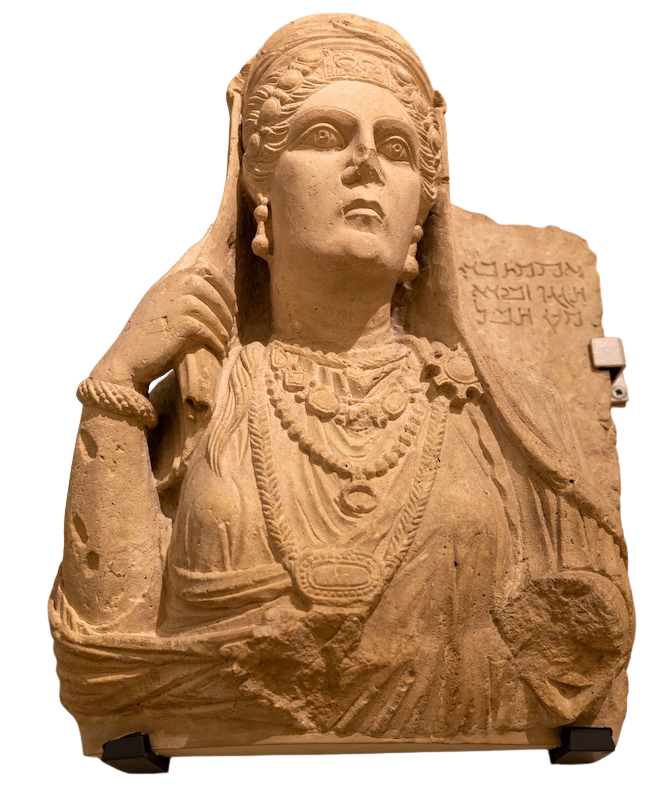
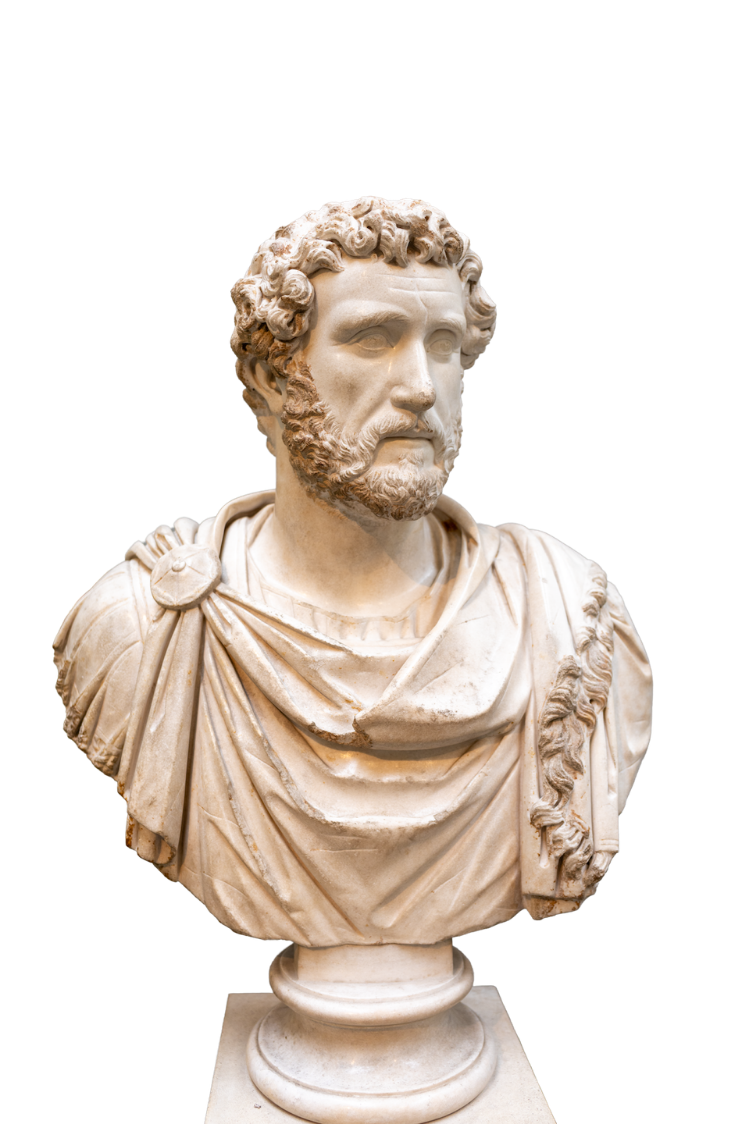
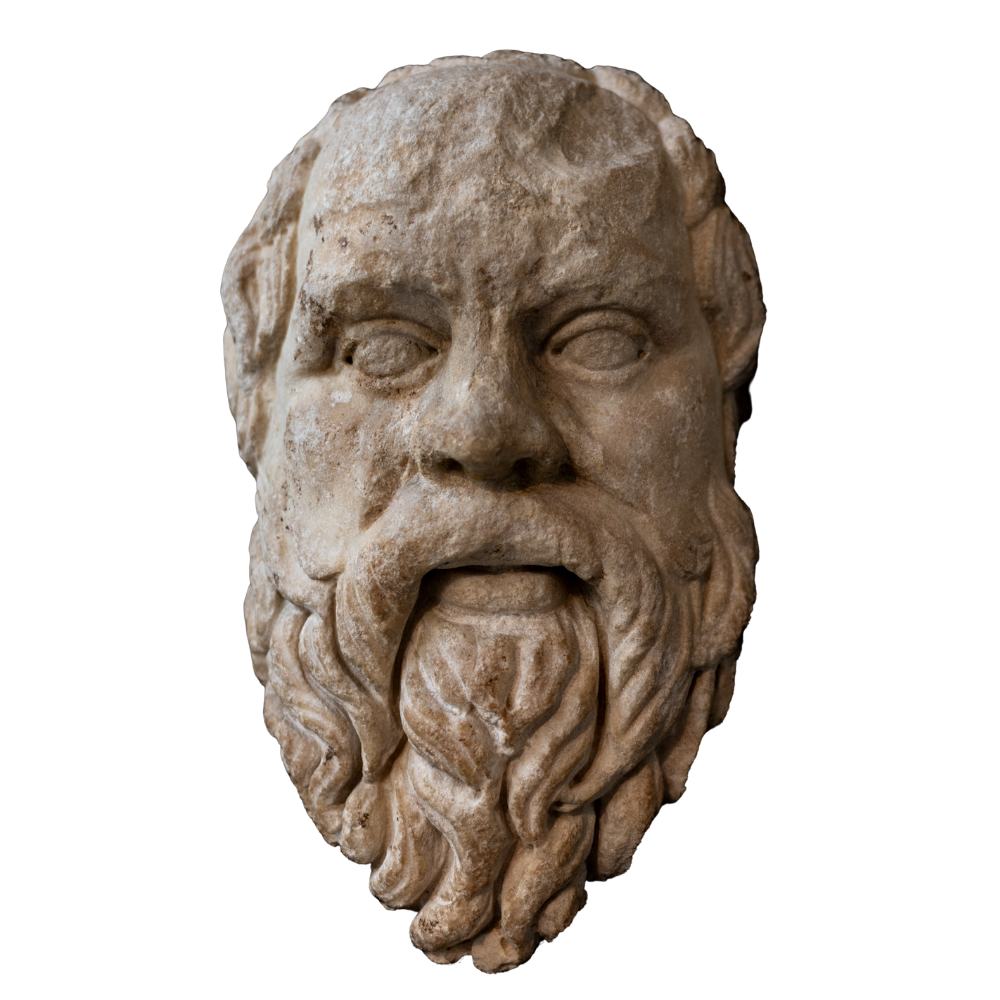
The ancient world did not only write; it built, painted, sculpted, and struck coin. Where images bear directly on the text under discussion — a portrait bust of the subject, a topographical view of a battlefield, a manuscript page, a relief carving that illuminates a scene — they are included alongside the verbal commentary. The image is not decoration. It is evidence of a different kind, and reading it requires the same care as reading a sentence.

The Ancient World and the Present

One reason to read Thucydides carefully is that he is a great writer. Another is that he is right about things — about the dynamics of imperial overreach, about the corruption of political language in civil conflict, about the gap between stated motives and actual ones — in ways that have not become less true with time. The same could be said of Tacitus on the pathologies of autocracy, of Epictetus on the limits of what any external power can actually take from a person, of Bede on how communities construct their own pasts.

This site does not strain for topical relevance, and it does not treat antiquity as a storehouse of lessons to be applied mechanically to the news cycle. But where a connection between an ancient text and a modern situation is genuine and illuminating — where the comparison sharpens rather than flattens — it is noted. The ancients thought in categories that are still operative, and pretending otherwise does them no honour.


The following texts are currently under active treatment on this site, or are planned for inclusion in the near term. They are presented here in chronological order of their composition or publication.

History

ThucydidesHistory of the Peloponnesian War (c. 400 BCE)
The foundational text of Western historiography, and still its most demanding. Thucydides's insistence on human causation, his formal speeches, and his unflinching account of the Athenian catastrophe in Sicily repay repeated reading.
Diodorus SiculusLibrary of History (Bibliotheca Historica) (c. 60–30 BCE)
An ambitious universal history in forty books, spanning from mythological origins to the campaigns of Julius Caesar. Unique among ancient historical works in its geographical and chronological breadth, the Bibliotheca draws on a wide array of sources — many of them now lost — making it an indispensable repository for traditions otherwise irrecoverable. Books I–V (on Egypt, Mesopotamia, North Africa, Greece, and the islands) and XI–XX (covering the classical and early Hellenistic periods) survive intact; the remainder is known only through fragments and excerpts. Diodorus is rarely praised for his prose style, but the scale of his undertaking and the sources he preserves give him a significance that more polished contemporaries cannot match.
JosephusThe Jewish War (Bellum Judaicum) (c. 75–79 CE)
An eyewitness account — and, in part, a participant's account — of the Jewish revolt against Rome (66–73 CE) and the destruction of the Second Temple. Written first in Aramaic and then in Greek, it occupies an unusual position between Roman apologetics and Jewish lamentation.
JosephusJewish Antiquities (Antiquitates Judaicae) (c. 93–94 CE)
A vast history of the Jewish people from creation to the eve of the revolt, self-consciously modelled on the Roman Antiquities of Dionysius of Halicarnassus. Books XVIII–XX are of particular interest for their tangled relationship to early Christian historiography.
TacitusHistories (Historiae) (c. 100–110 CE)
The earlier work, covering the catastrophic year 69 CE and the Flavian dynasty. More dramatic in pace than the Annals, and indispensable for understanding the fragility of the Principate.
TacitusAnnals (Ab Excessu Divi Augusti) (c. 115–120 CE)
The masterwork of Latin historiography. Tacitus's account of the Julio-Claudian dynasty — from the death of Augustus through the reign of Nero — is unmatched in its psychological acuity and its corrosive treatment of power. Written in a dense, asymmetric Latin that resists easy paraphrase.
SuetoniusThe Twelve Caesars (De Vita Caesarum) (c. 121 CE)
A counterpoint to Tacitus: anecdotal where Tacitus is analytical, titillating where Tacitus is austere. Indispensable precisely because of its difference in method and intent.
BedeEcclesiastical History of the English People (Historia Ecclesiastica Gentis Anglorum) (731 CE)
The foundational text of English historical writing, and the work that established the convention of dating years from the Incarnation. Composed at the monastery of Wearmouth-Jarrow in Northumbria, the Historia traces the Christianisation of Britain from the Roman mission of Augustine of Canterbury through to Bede's own era — a span of nearly seven centuries — organised not as mere chronicle but as providential narrative. It is at once a work of history, theology, hagiography, and political thought, and stands as the culmination of early medieval Latin scholarship in Britain.

Philosophy

PlatoMeno (c. 385 BCE)
A transitional Socratic dialogue exploring the nature of virtue (ἀρετή) and whether it can be taught. It introduces the theory of anamnesis (recollection) and contains the famous geometric demonstration with a slave boy.
AristotleNicomachean Ethics (Ἠθικὰ Νικομάχεια) (c. 349–347 BCE)
The most systematic and influential treatment of moral philosophy to survive from antiquity. Addressed to the question of how a human being should live — what constitutes eudaimonia, flourishing or happiness — the Ethics proceeds through an analysis of virtue (ἀρετή), practical wisdom (phronēsis), friendship (philia), and pleasure that remains philosophically alive in a way few ancient texts can claim. It is read here not only as a work of ethics but as a document of the Athenian intellectual world in which it was composed, and in productive tension with the Stoic tradition that both absorbed and contested its legacy.
EpictetusDiscourses and Enchiridion (c. 108 CE)
The teaching of the freed slave who became the most influential Stoic of his generation. The Enchiridion is among the most concise and demanding works of practical philosophy ever composed.
Marcus AureliusMeditations (Τὰ εἰς ἑαυτόν) (c. 161–180 CE)
Private philosophical notebooks, never intended for publication. The Meditations are the most direct window into Stoic practice available from antiquity, and are read here alongside the historical sources for the Antonine period.
JulianAgainst the Galileans (Contra Galilaeos) (c. 362–363 CE)
A polemical defense of Hellenic Neoplatonism against the rising influence of Christianity. Written by the last pagan emperor, it provides a crucial look at the late antique struggle between classical philosophy and the "new" faith.

New entries are added as reading and annotation permit. Suggestions for works to be treated may be directed to the site's author.