AB URBE CONDITA
Volume X: Books 35–37 · The War with Antiochus III
by Livy
Translated by Evan T. Sage
INTRODUCTION
Books 35–37 cover Rome's war with Antiochus III, king of the Seleucid empire — the most powerful monarch in the Hellenistic world and the first adversary Rome faced whose resources and territorial reach approached those of Carthage at its height. The war grew out of the settlement of the Macedonian question: once Philip V was neutralised, the question of what Antiochus intended with his armies in Thrace and his overtures to the discontented Greek states became urgent. The Aetolian League, disappointed that Rome had treated Philip leniently rather than destroying him, invited Antiochus into Greece as a liberator; Antiochus accepted, crossed into Europe with a modest force, and found himself at war with Rome almost before he was ready. Books 35–37 follow this miscalculation from its origins in diplomacy to its military resolution at Thermopylae (191 BCE) and Magnesia (190 BCE) — the two engagements that ended Seleucid power west of the Taurus mountains.
The presence of Scipio Africanus in these books — as a diplomatic figure, a participant in negotiations with Antiochus, and ultimately as the elder brother and guiding spirit of the consul Lucius Cornelius Scipio (who will earn the cognomen Asiaticus from this campaign) — gives the narrative an additional human dimension. The encounter between the two greatest commanders of their age, Scipio and Hannibal, who is living at Antiochus's court in exile, is one of the most celebrated anecdotes in these books.
The Books in This Volume
Book 35 covers the years 193–192 BCE, the period of rising tension before the war begins in earnest. Antiochus sends embassies to Rome; Rome sends embassies to Antiochus; the Aetolians agitate for intervention; and Hannibal, at the Seleucid court, argues for a co-ordinated strategy involving a Carthaginian fleet and an invasion of Italy. Livy records these diplomatic exchanges with a sense of the mutual misunderstanding at work: Antiochus underestimates the speed and scale of Rome's military response, while Rome underestimates Antiochus's ambitions. The book ends with the Aetolian vote for war and Antiochus's crossing into Greece.
Book 36 carries the war into Greece and to its first decisive engagement. The consul Manius Acilius Glabrio advances into Thessaly while Antiochus takes up a position at Thermopylae — the pass where Leonidas and his Spartans had held the Persian army in 480 BCE. Antiochus evidently hoped the historical resonance of the site would work in his favour; it did not. Roman forces, following the same route as the Persians, outflanked the Aetolian garrison on the heights, and Antiochus's army broke. He escaped with a remnant to Ephesus, abandoning Greece entirely. The Aetolians, left to face Roman anger alone, sued for terms. Book 36 also contains the naval operations in the Aegean, where Antiochus's fleet challenged Rome's Rhodian and Pergamene allies with limited success.
Book 37 follows the Roman crossing into Asia — the first time a Roman army operated east of the Hellespont — and the campaign that culminated in the Battle of Magnesia (190 BCE). The command was held nominally by the consul Lucius Scipio but effectively shaped by his elder brother Africanus, whose presence in Asia as a legate gave the campaign a personal dimension: Antiochus had briefly held Africanus's son as a prisoner and released him as a gesture of goodwill, an episode Livy records as evidence of the complicated codes of honour operating between the combatants. At Magnesia, Antiochus deployed a force of perhaps seventy thousand men against a Roman army of perhaps thirty thousand; the battle, nonetheless, was not close. The Roman legions broke the Seleucid centre while the cavalry held the wings, and the peace that followed — the Peace of Apamea (188 BCE) — expelled Antiochus from all territory west of the Taurus and imposed a crippling indemnity.
Scipio, Hannibal, and the Shape of the War
The most celebrated anecdote in these books — recorded by Livy as reported speech — is the supposed exchange between Scipio Africanus and Hannibal at the court of Antiochus, in which Scipio asks Hannibal whom he considers the greatest general in history. Hannibal names Alexander first, Pyrrhus second, and himself third. When Scipio asks where he would rank himself had he defeated Rome, Hannibal replies that he would in that case have placed himself above all others. The story, which may be apocryphal, captures something real about the relationship between the two commanders: a mutual recognition of excellence across the divide of the war they had fought against each other.
Transmission
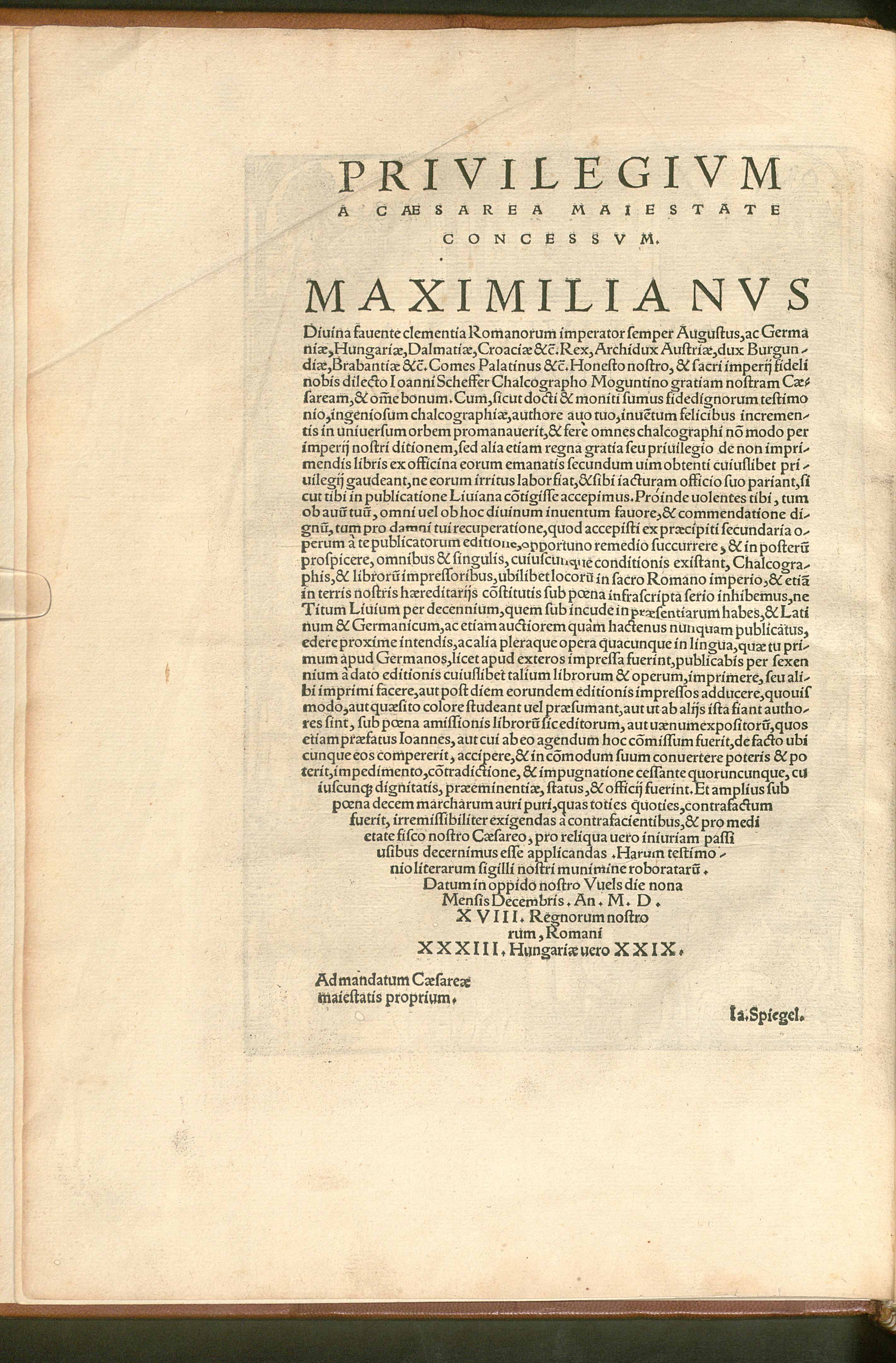
The text of Books 35–37 is shaped decisively by a discovery that constitutes one of the most significant events in the modern history of Livy's text. In the early sixteenth century, the scholar Nicolaus Carbachius found at Mainz an ancient manuscript — designated by scholars as the Moguntinus (Mg), apparently a fifth-century codex — containing portions of Livy absent from the entire Italian manuscript tradition. The Italian recentiores lacked Book 33 from chapter 17.6 onwards, and were deficient in other passages reaching through Book 40; the Moguntinus supplied these gaps, most critically restoring Book 33 from 33.17.6 to its end. Carbachius and Wolfgang Angst published the text recovered from the Moguntinus in the 1519 Editio Moguntina — T. Livius Patavinus Historicus Duobus Libris Auctus, printed at Mainz by Johannes Scheffer under an imperial privilege granted by Emperor Maximilian I on 9 December 1518. The Moguntinus disappeared shortly after the edition went to press. The 1519 printed text is consequently the sole surviving witness to the readings it alone preserved, and modern critical editions must treat it as a primary source — a printed book standing in place of a lost manuscript, occupying a role analogous to that of the Puteanus for the Third Decade.
For Books 35–37 specifically, the interplay between the Moguntinus tradition as transmitted through the Editio Moguntina and the medieval manuscript witnesses — including Bamberg, Staatsbibliothek, Msc.Class.35, which contains Books 31–38 — must be carefully negotiated by editors. The precise contribution of the Moguntinus to the text of each chapter is detailed in Michael Reeve's chapter on Livy in L. D. Reynolds (ed.), Texts and Transmission: A Survey of the Latin Classics (Oxford: Clarendon Press, 1983), pp. 205–214.
This Translation
The translation is that of Evan T. Sage, published as Volume X of the Loeb Classical Library edition of Livy (Loeb 301; Cambridge, MA: Harvard University Press, 1935). Sage presents the Latin text on facing pages with his English translation. The translation is in the public domain.
FULL TEXT
Book 35
[Book 35 opens in 193 BCE with the diplomatic manoeuvrings that will lead to the war with Antiochus.]
I. The consuls of that year were Lucius Quinctius Flamininus and Gnaeus Domitius Ahenobarbus1. At the beginning of their term, before the senate dealt with anything else, the question of the provinces was raised; and after all sides had been heard, Macedonia and Italy were assigned as the consular provinces. The reason for retaining a force in Macedonia was the uncertain intentions of Philip and of Antiochus: both kings were known to be arming, and their embassies to each other, the subject and outcome of which Roman agents could not discover with certainty, were a cause of anxiety. There were also reports that the Aetolians, always a restless people and at that moment additionally embittered by the peace Rome had granted Philip, were soliciting both kings with promises of a ready alliance if either of them chose to move against Rome.2
II. Embassies from many Greek peoples and kings came to Rome early in that year. From Antiochus came representatives with a reply to the embassy that Lucius Scipio had led to the king's court the previous year. The tenor of their instructions was vague: Antiochus wished for peace and friendship with Rome, was willing to conclude a formal treaty, and was prepared to discuss the situation of the Asian cities — though he maintained that Roman interference in Asian affairs was no more appropriate than Seleucid interference in Italian ones. The senate's response was equally careful: it welcomed Antiochus's desire for peace while noting that the freedom of the Greek cities in Asia, which Rome now considered her concern, was not negotiable.
Bibliography
Sage, Evan T., trans. Livy: Ab Urbe Condita, Volume X (Books 35–37). Loeb Classical Library 301. Cambridge, MA: Harvard University Press, 1935.
Bar-Kochva, Bezalel. The Seleucid Army: Organisation and Tactics in the Great Campaigns. Cambridge: Cambridge University Press, 1976.
Grainger, John D. The Roman War of Antiochos the Great. Leiden: Brill, 2002.
Gruen, Erich S. The Hellenistic World and the Coming of Rome. 2 vols. Berkeley: University of California Press, 1984.
Reeve, Michael D. "Livy." In L. D. Reynolds, ed., Texts and Transmission: A Survey of the Latin Classics, pp. 205–214. Oxford: Clarendon Press, 1983.
Sherwin-White, Susan, and Amélie Kuhrt. From Samarkhand to Sardis: A New Approach to the Seleucid Empire. London: Duckworth, 1993.
Footnotes
-
The consuls of 193 BCE. Lucius Quinctius Flamininus was the brother of Titus Quinctius Flamininus, the victor of Cynoscephalae and the proclaimer of Greek freedom at the Isthmian Games; his consulship placed the family at the centre of Roman policy in Greece for a second successive generation. ↩︎
-
The Aetolian League had been Rome's principal Greek ally in the First and Second Macedonian Wars but felt, with some justice, that Rome had not rewarded its contribution sufficiently at the peace with Philip. Their sense of grievance made them the natural vehicle for Antiochus's Greek ambitions. ↩︎