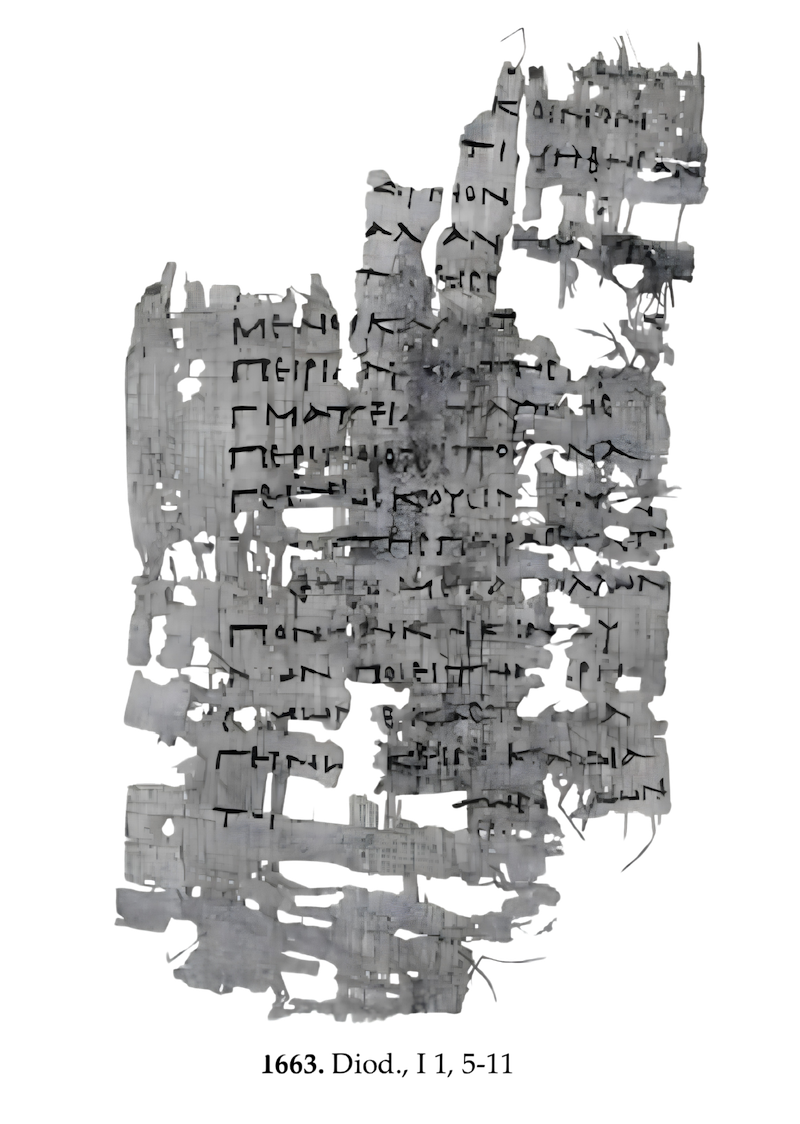
PSI Inv. 6 recto: a second-century CE papyrus fragment preserving the opening of Diodorus's Bibliotheca Historica (I.1.5–11) — among the earliest surviving manuscript witnesses to the work, almost certainly from the first column of the roll. LDAB 10472; MP³ 342.01.

Bibliotheca Historica

Reading companion for Diodorus Siculus's Bibliotheca Historica — the most ambitious universal history to survive from antiquity, the sole continuous Greek narrative of the wars of the Diadochi, and the largest single repository of lost Hellenistic historiography.
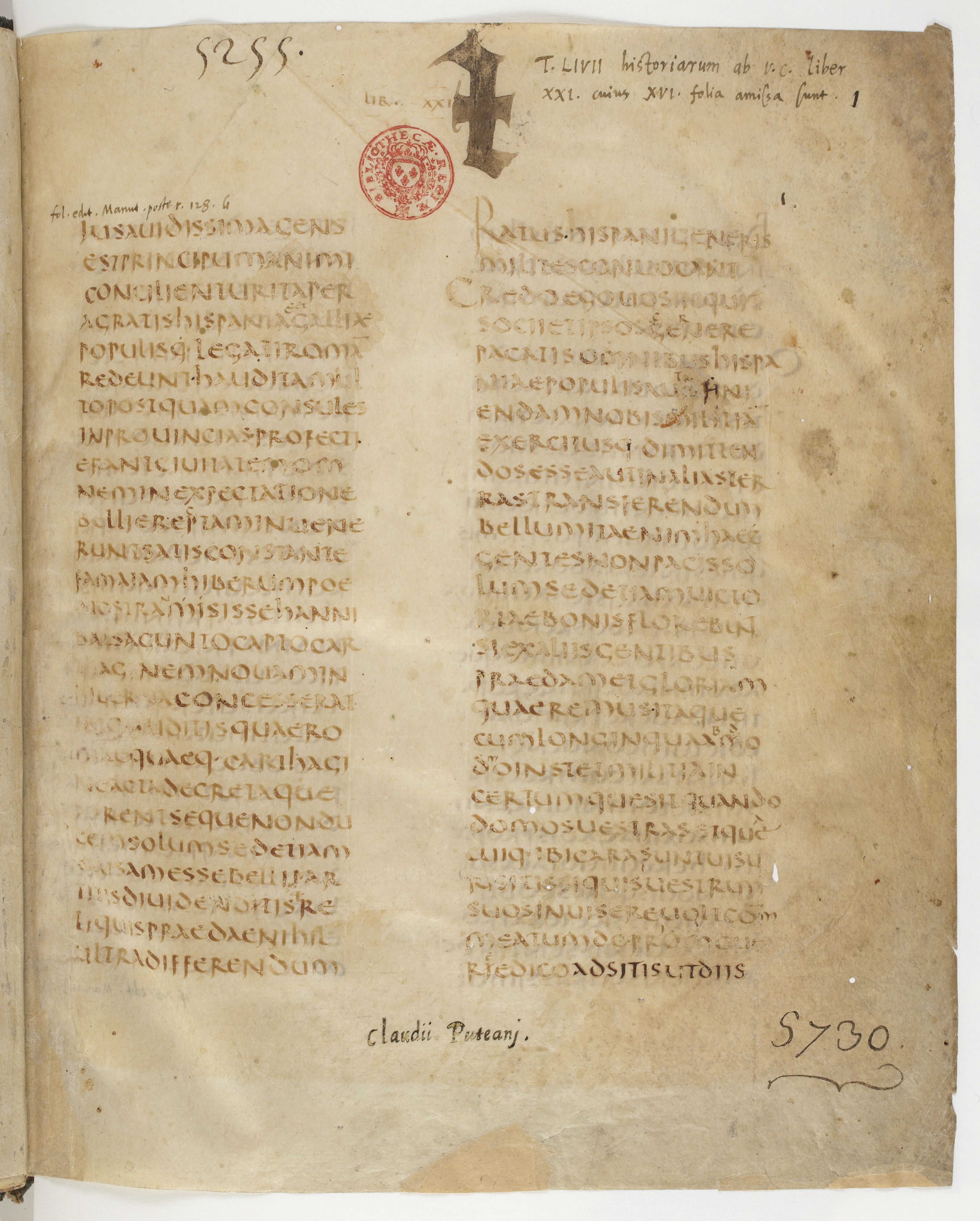
Paris, Bibliothèque nationale de France, lat. 5730 (Puteanus), a late antique manuscript of Livy's Third Decade

Ab Urbe Condita, Volume V: Books 21–22

Reading companion and full text of Livy's Ab Urbe Condita, Volume V (Books 21–22), translated by B. O. Foster — the opening of the Second Punic War, from Hannibal's oath through the crossing of the Alps, the battles of Trebia and Lake Trasimene, and the catastrophe of Cannae.

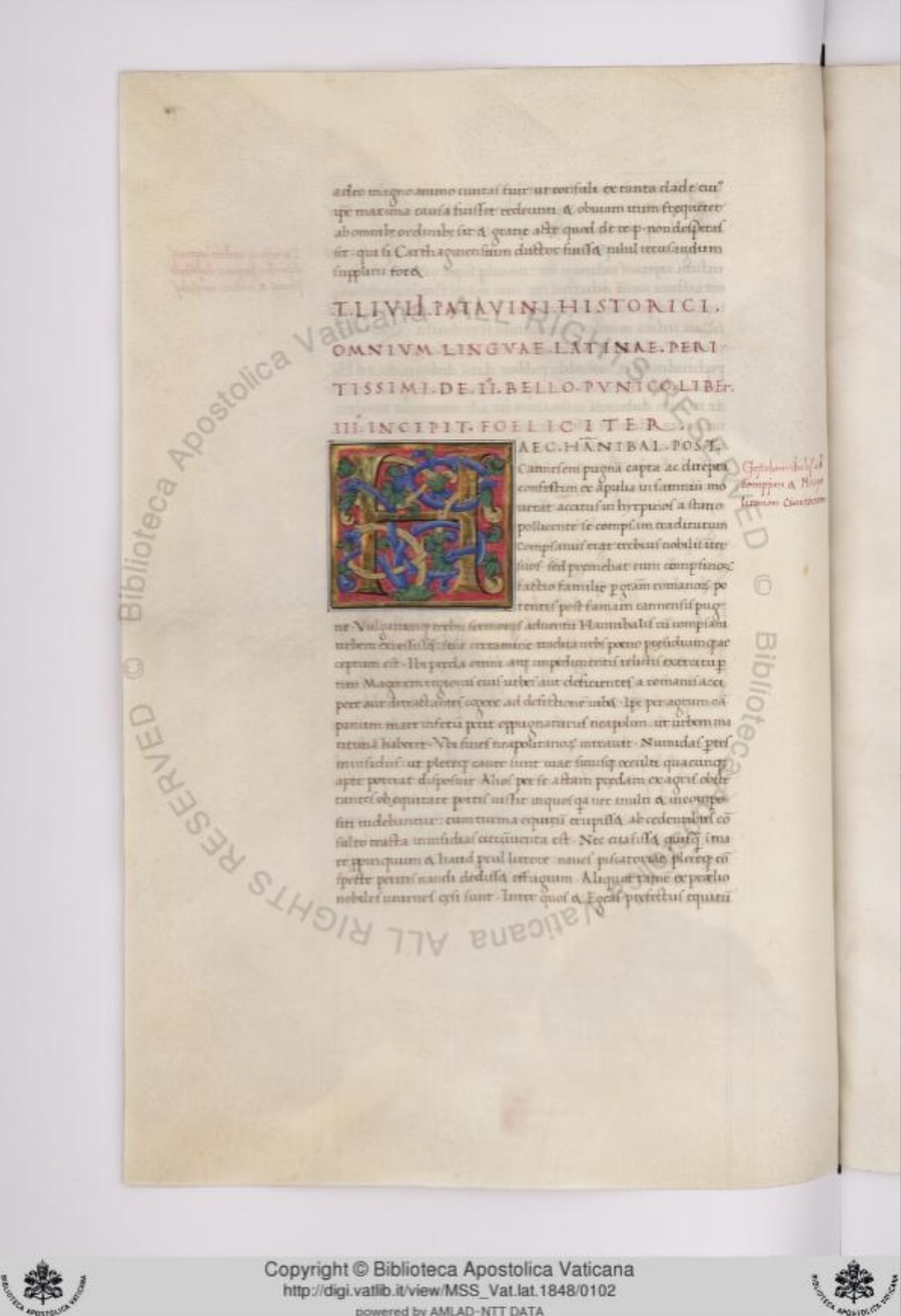
Biblioteca Apostolica Vaticana, Vat. lat. 1848, fol. 48v — opening of Livy Book 23, illuminated by Bartolomeo della Gatta, Rome, c. 1475–1480

Ab Urbe Condita, Volume VI: Books 23–25

Reading companion and full text of Livy's Ab Urbe Condita, Volume VI (Books 23–25), translated by F. G. Moore — the aftermath of Cannae, the defection and eventual siege of Capua, the fall of Syracuse and death of Archimedes, and the reverses in Spain.

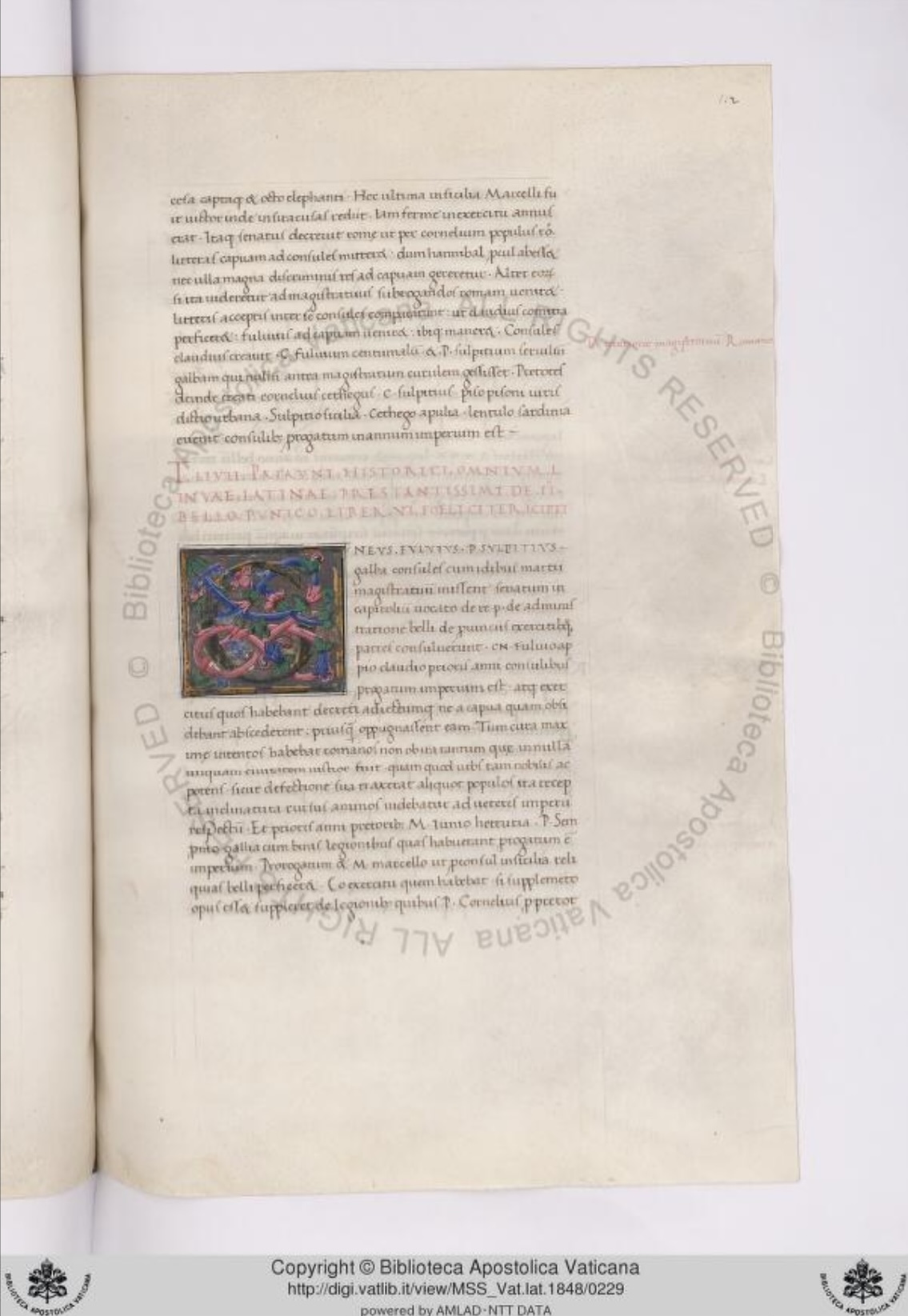
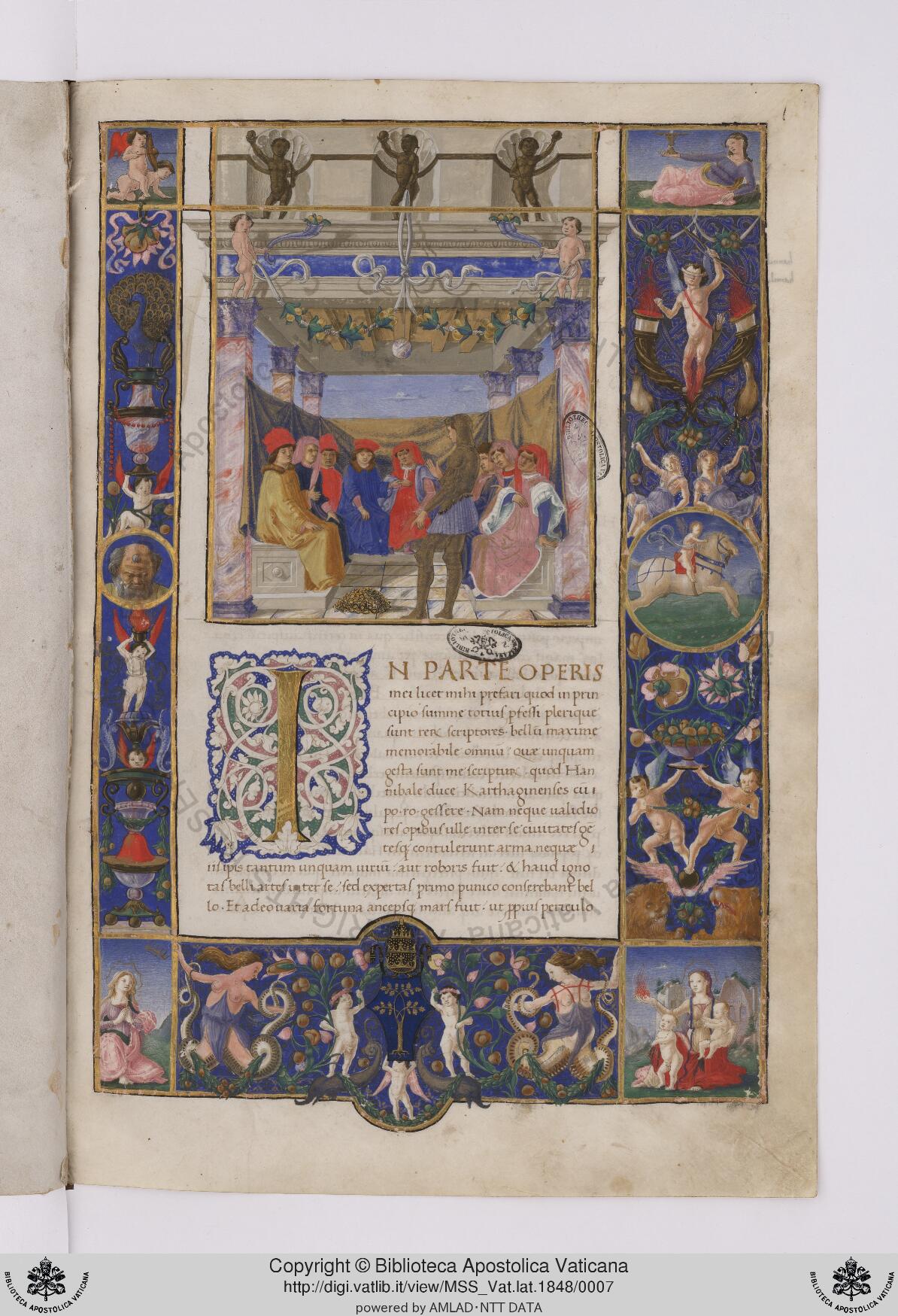
Biblioteca Apostolica Vaticana, Vat. lat. 1848, fol. 112r — opening of Livy Book 26, illuminated by Bartolomeo della Gatta, Rome, c. 1475–1480

Ab Urbe Condita, Volume VII: Books 26–30

Reading companion and full text of Livy's Ab Urbe Condita, Volume VII (Books 26–30), translated by F. G. Moore — the turn of the Second Punic War, from the rise of Scipio Africanus in Spain through the Battle of the Metaurus, the African campaign, and the final confrontation at Zama.

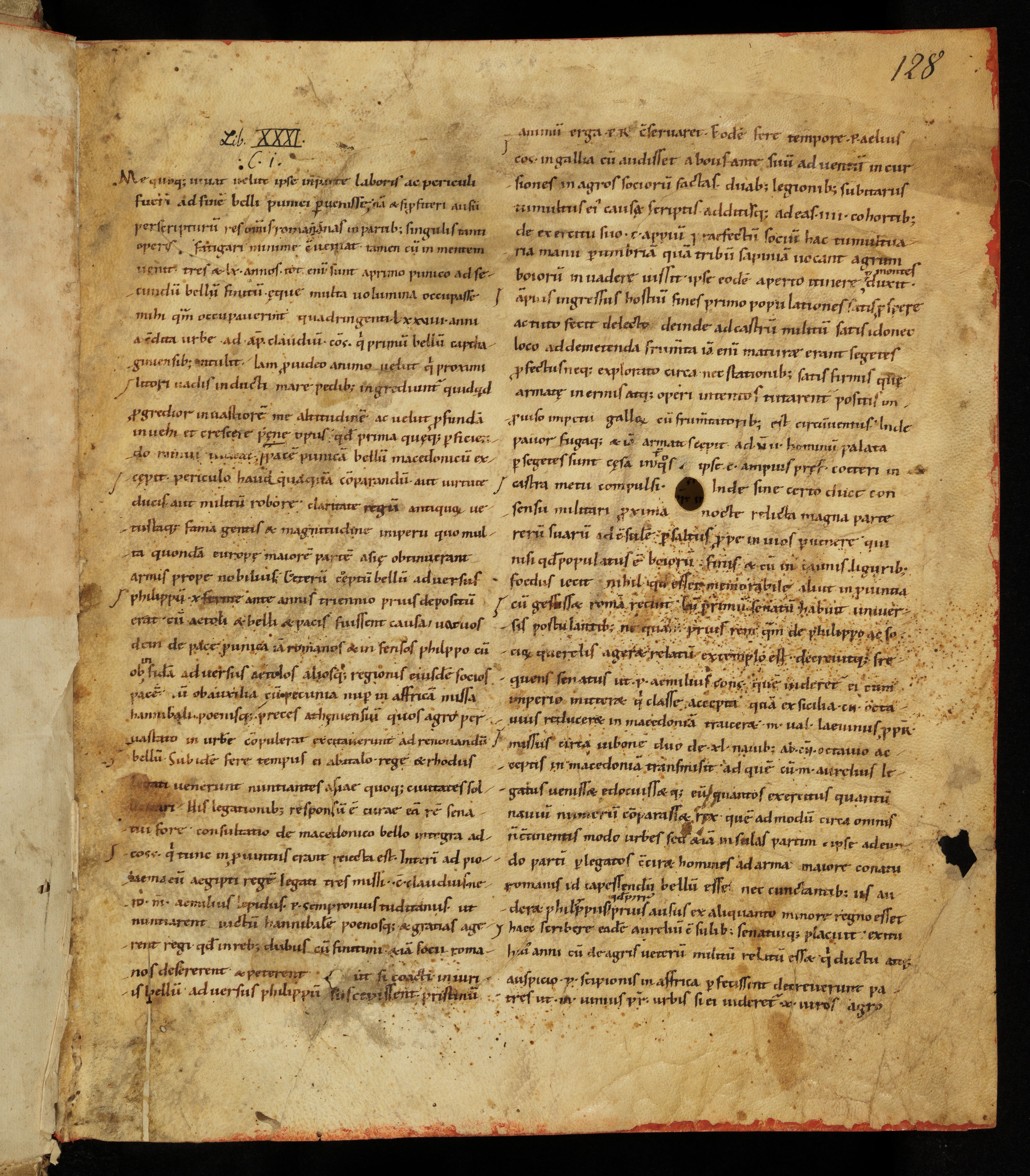
Bamberg, Staatsbibliothek, Msc.Class.35, fol. 128r — opening of Livy Book 31, Caroline minuscule, medieval

Ab Urbe Condita, Volume IX: Books 31–34

Reading companion and full text of Livy's Ab Urbe Condita, Volume IX (Books 31–34), translated by Evan T. Sage — the Second Macedonian War, from Rome's declaration against Philip V through Flamininus's decisive victory at Cynoscephalae and the proclamation of Greek freedom at the Isthmian Games.

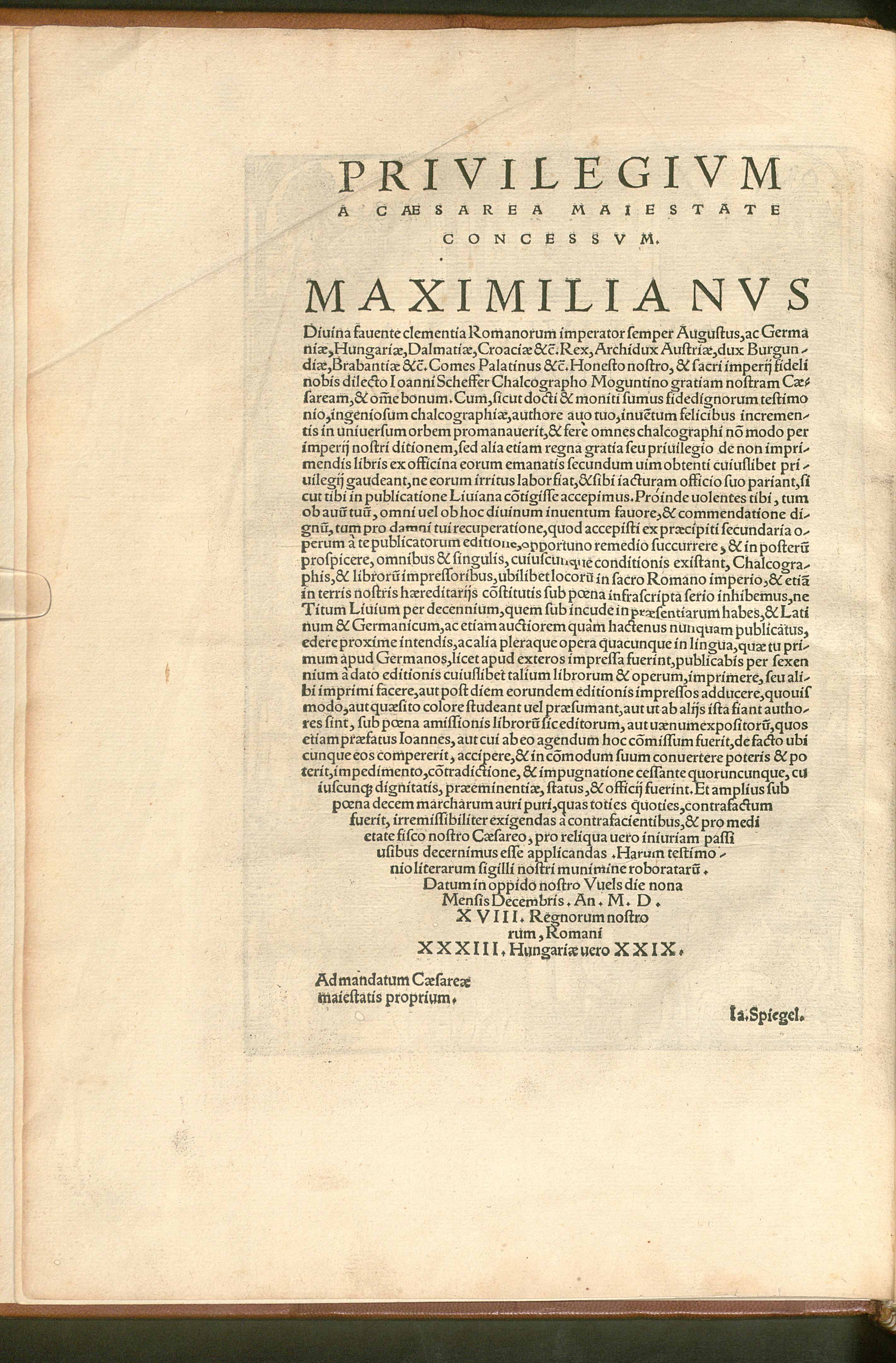
Privilegium page of the 1519 Editio Moguntina of Livy, imperial privilege granted by Maximilian I to Johannes Scheffer of Mainz — Bayerische Staatsbibliothek, Munich, Res/2 A.lat.b. 422

Ab Urbe Condita, Volume X: Books 35–37

Reading companion and full text of Livy's Ab Urbe Condita, Volume X (Books 35–37), translated by Evan T. Sage — the war with Antiochus III, from the Seleucid king's intervention in Greece through the Roman victories at Thermopylae and Magnesia that expelled him from Europe and Asia Minor.

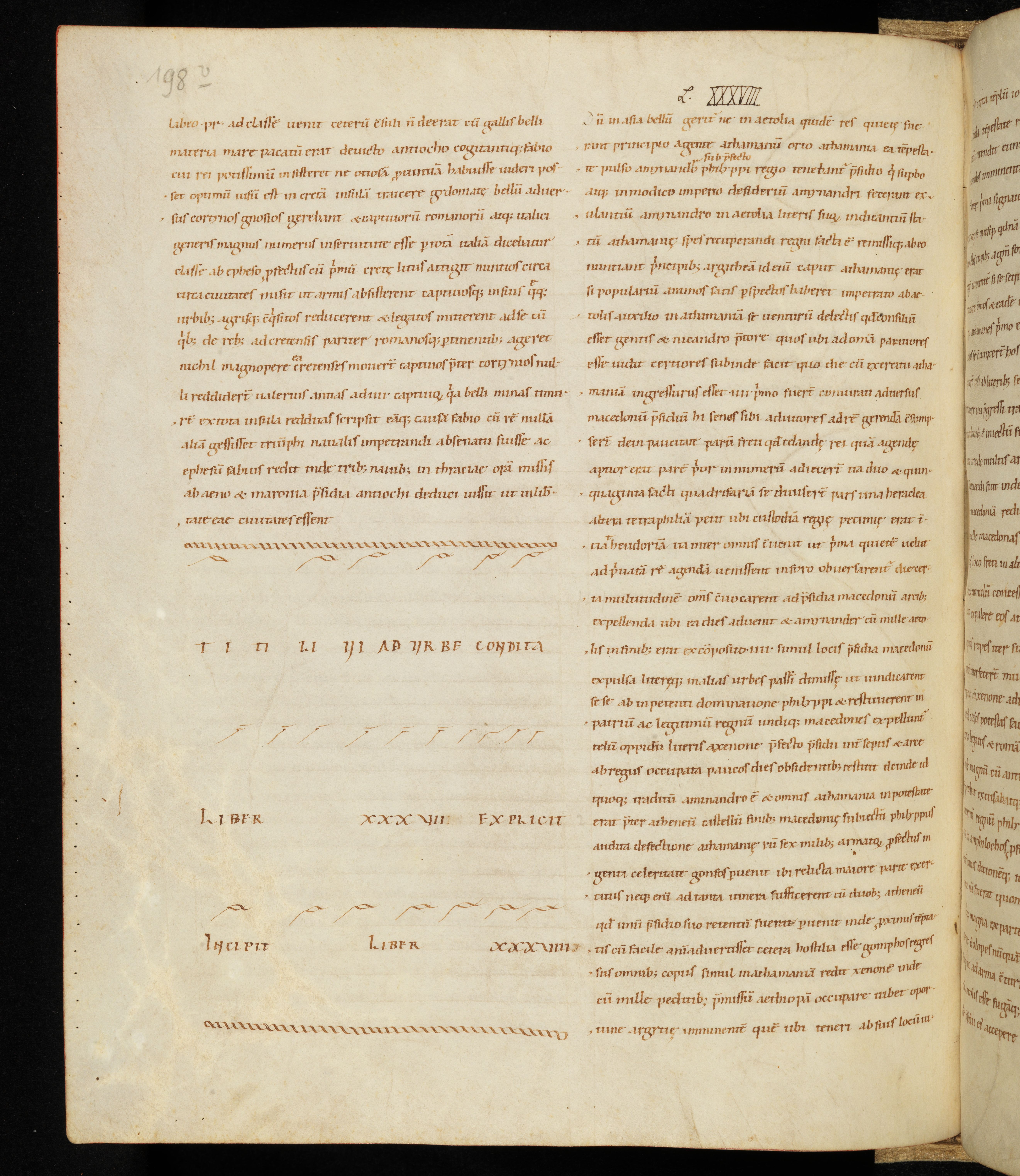
Bamberg, Staatsbibliothek, Msc.Class.35, fol. 198v — transition from Book 37 to Book 38 of Livy's Ab Urbe Condita, Caroline minuscule, medieval

Ab Urbe Condita, Volume XI: Books 38–39

Reading companion and full text of Livy's Ab Urbe Condita, Volume XI (Books 38–39), translated by Evan T. Sage — the settlement of the Syrian War and Manlius Vulso's campaign in Galatia, followed by the celebrated senatorial investigation into the Bacchanalian conspiracy of 186 BCE.

Biblioteca Apostolica Vaticana, Vat. lat. 1848, fol. 1r — incipit page of Livy's Third Decade, illuminated by Bartolomeo della Gatta, Rome, c. 1475–1480

Ab Urbe Condita, Volume XII: Books 40–42

Reading companion and full text of Livy's Ab Urbe Condita, Volume XII (Books 40–42), translated by Evan T. Sage and A. C. Schlesinger — the final years of Philip V, the accession of Perseus, and the opening moves of the Third Macedonian War.

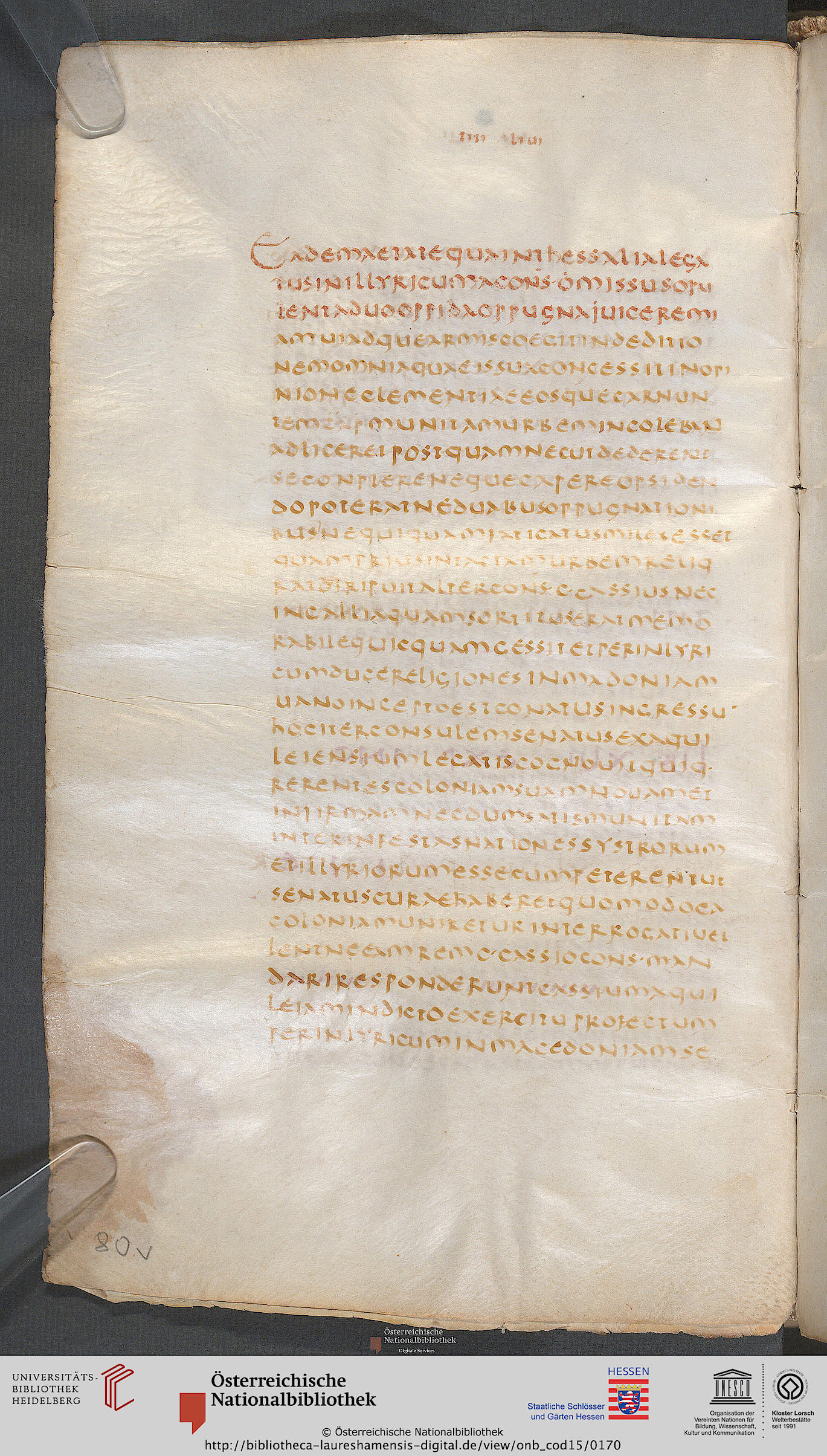
Vienna, Österreichische Nationalbibliothek, Cod. Vind. Lat. 15 (Codex Vindobonensis Lat. 15, the Lorsch Manuscript), fol. 80v — Book 42 text in Uncial script, 5th century

Ab Urbe Condita, Volume XIII: Books 43–45

Reading companion and full text of Livy's Ab Urbe Condita, Volume XIII (Books 43–45), translated by A. C. Schlesinger — the Third Macedonian War from its early campaigns through the decisive Battle of Pydna, the capture of Perseus, and the triumph of Lucius Aemilius Paullus, which ends both the war and the Macedonian monarchy.

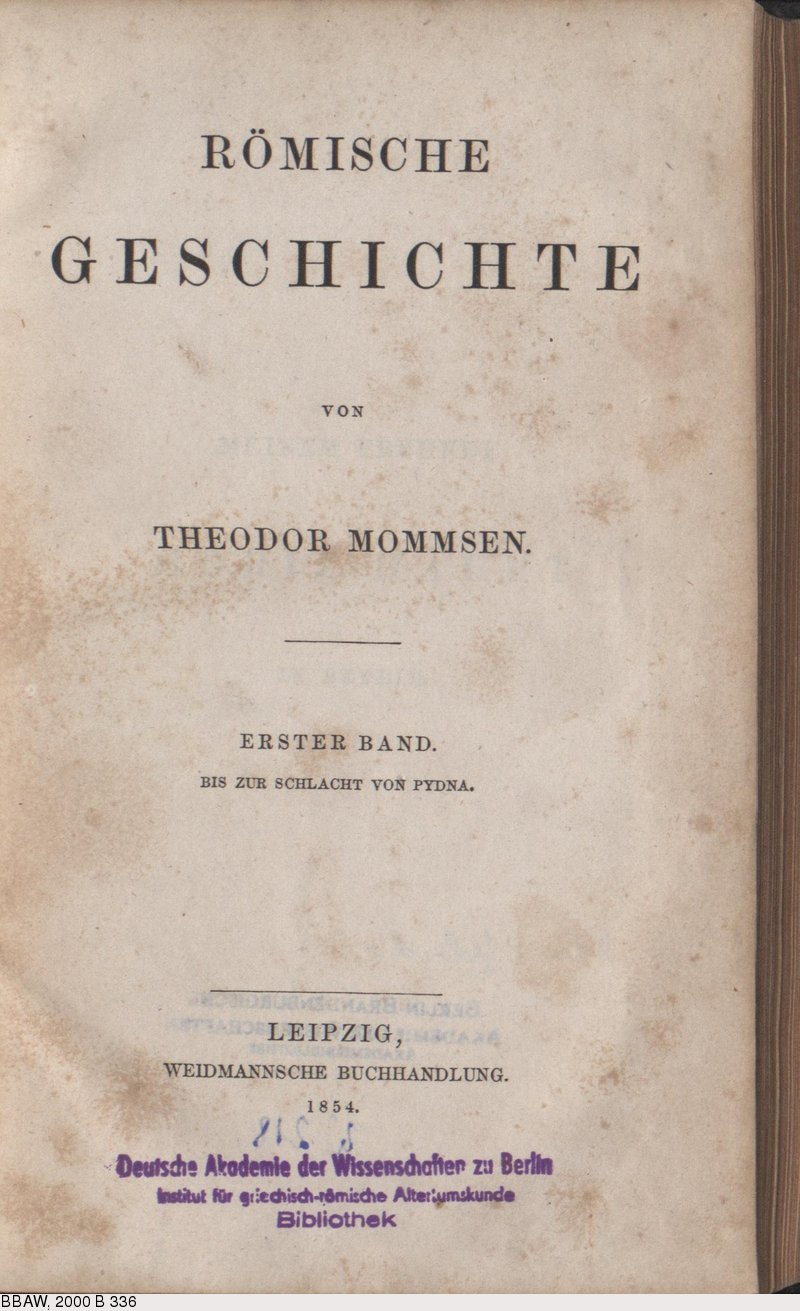
Title page of the first edition of Römische Geschichte, Band 1, published by Weidmann, Leipzig, 1854.

History of Rome: Volume 1

A survey of the Rise of the Roman Republic, focusing on the internal political struggles and the monumental shift from oligarchy to the rise of the Caesars.

Photographic portrait of Numa Denis Fustel de Coulanges.

The Ancient City: A Study on the Religion, Laws and Institutions of Greece and Rome

Fustel de Coulanges's landmark study tracing the origins of Greek and Roman civic life to their religious foundations, arguing that the ancient city was shaped above all by sacred rites, ancestor worship, and the domestic hearth.