AB URBE CONDITA
Volume IX: Books 31–34 · The Second Macedonian War
by Livy
Translated by Evan T. Sage
INTRODUCTION
With Book 31, the surviving text of Livy enters its second major arc. The Hannibalic War is over; the peace with Carthage is barely two years old; and Rome, exhausted and depleted by sixteen years of fighting in Italy, Spain, Sicily, and Africa, immediately confronts a new war — this time in the Greek east. The decision to declare war on Philip V of Macedon in 200 BCE was contested at the time and has been contested by historians ever since: Philip had done Rome genuine harm by allying with Hannibal in 215 BCE, but the threat he now posed was limited, and the Roman people, when first consulted, voted against the war. Books 31–34 follow the course of the Second Macedonian War from that reluctant beginning to the battle of Cynoscephalae (197 BCE), which effectively destroyed the Macedonian phalanx as a fighting force and ended Philip's ambitions in Greece, and then to one of the most celebrated moments in Roman history: Titus Quinctius Flamininus's proclamation of the freedom of the Greeks at the Isthmian Games of 196 BCE.
Evan T. Sage, who translates Volumes IX through portions of XII, brings to the text a careful scholar's attention to the Greek world whose history now enters Livy's narrative. The Loeb format, with Latin and English on facing pages, allows readers to observe Livy negotiating the unfamiliar proper names and political institutions of the Hellenistic kingdoms.
The Books in This Volume
Book 31 opens the new war with an account of the senatorial debates, the people's initial refusal to vote for war, and the ultimate decision, pushed through by a combination of senatorial pressure and appeals to Roman honour, to resume hostilities. Philip had been raiding the coasts of Attalus of Pergamum and Rhodes — Roman allies — and had concluded a secret treaty with Antiochus III of the Seleucid empire that Rome interpreted as directed against Egypt and potentially against Roman interests. The declaration of war passed; the consul Publius Sulpicius Galba crossed to Greece; and Rome began what would prove to be a permanent engagement with the affairs of the Hellenistic world.
Book 32 follows the campaigns of 199–198 BCE. The war in Greece is slow-moving: the terrain is difficult, Philip defends the passes of Macedonia with skill, and the Roman allied Greek states are cautious about committing themselves. The arrival of Flamininus as proconsul in 198 BCE changes the dynamic. Younger, more diplomatically flexible, and evidently fascinated by the Greek world in a way his predecessors were not, Flamininus opens negotiations with Philip while simultaneously outflanking his positions. Book 32 records the inconclusive peace conference at Nicaea, at which Philip proves unwilling to concede enough to avoid continued war.
Book 33 contains the decisive engagement: the Battle of Cynoscephalae (197 BCE), fought in the hills of Thessaly in conditions of fog and confusion that initially favour neither side. The outcome was decided when the Roman legions, more flexible than the Macedonian phalanx in broken terrain, broke Philip's right wing and then wheeled against his left before it could reform. It was the first time a Roman consular army had met a Macedonian phalanx in a pitched battle and won, and the implications for the balance of power in the eastern Mediterranean were immediately understood by all parties. The book closes with the terms imposed on Philip and with the celebrated scene at the Isthmian Games, where Flamininus's herald proclaimed that Rome was leaving all the Greek cities free, ungarrisoned, and subject to their own laws. The crowd's roar, Livy records, was so great that birds fell from the sky.
Book 34 covers the immediate aftermath of the Macedonian settlement, including the complex question of what "freedom" meant in practice for cities that now found themselves in Rome's orbit rather than Macedon's. It also records the debate over the repeal of the Oppian Law — a sumptuary law restricting women's display of luxury goods, passed during the crisis years of the Hannibalic War — which Livy treats as a set-piece of political oratory, giving full speeches to both sides. The debate is one of the most-discussed passages in Livy for what it reveals about Roman attitudes toward women in public life.
Rome and the Greek World
Books 31–34 mark a decisive shift in the character of Livy's history. The Hannibalic War had been fought on Roman and Italian soil, with the survival of the state at stake; the Macedonian and later wars are wars of choice, fought far from Italy, whose rationale is never as simple as self-defence. Livy is attentive to this shift and records the debates in the Senate and among the people with a fairness that allows the reader to see the imperial logic at work. His portrait of Flamininus is sympathetic — he presents the proclamation of Greek freedom as a genuine act of Philhellenism — but the narrative of the following decades will reveal what Greek freedom under Roman protection actually amounted to.
Transmission
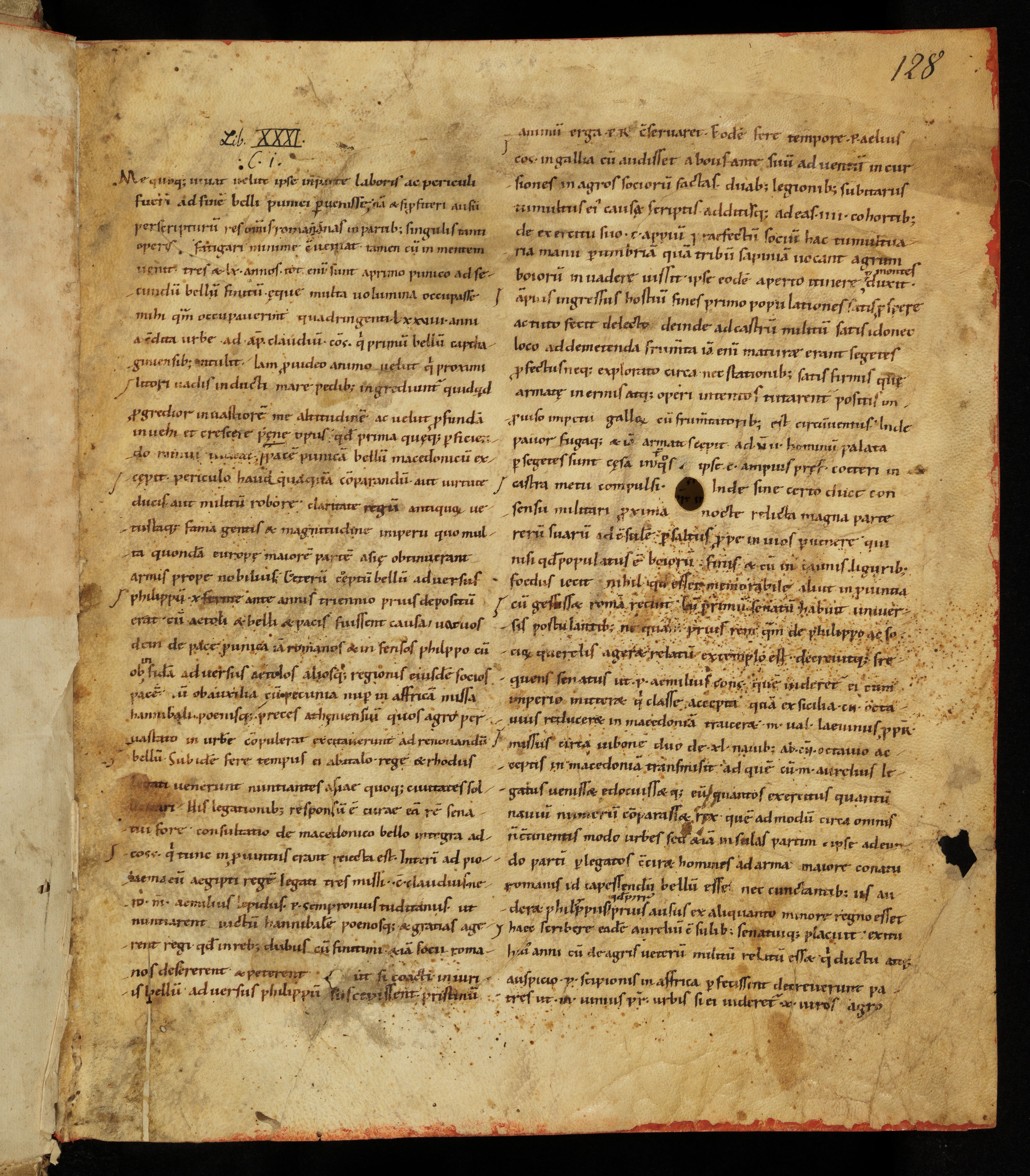
The Fourth Decade (Books 31–45) survives in a different and generally less favourable manuscript tradition than the Third. Where the Third Decade had the Puteanus — a single late antique manuscript of exceptional quality — the Fourth and Fifth Decades depend on a group of medieval copies of varying quality, most deriving ultimately from a lost archetype that may have been a Carolingian manuscript. The most important witnesses include manuscripts in Bamberg, Florence, and Paris, none of which is earlier than the ninth century. The absence of a late antique manuscript means that the text of these books is more heavily emended and more editorially uncertain than that of Books 21–30.
This Translation
The translation is that of Evan T. Sage, published as Volume IX of the Loeb Classical Library edition of Livy (Loeb 295; Cambridge, MA: Harvard University Press, 1935). Sage presents the Latin text on facing pages with his English translation. The translation is in the public domain.
FULL TEXT
Book 31
[Book 31 opens with the year 200 BCE, as Rome turns from the concluded Punic War to the question of Macedonia.]
I. I am aware that this part of my work will perhaps seem less worthy of careful attention than the accounts of earlier periods, since I have now come to the period which followed the Second Punic War. But the wars which I am now describing are in fact of very great importance: they brought under Roman sway Macedonia, Asia, and the entire East, along with Spain and Africa south of the Libyan desert. And yet these wars were waged against states less powerful than Carthage, against Antiochus and Philip and the Aetolians, none of whom were a match for Rome in military strength. The reader should consider what the outcome would have been if the Macedonian and Syrian wars had broken out while Hannibal still held Italy: that imagination supplies what I cannot narrate.1
II. The consuls of the year were Publius Sulpicius Galba and Gaius Aurelius Cotta2. At the beginning of the year the senate decreed that the consuls should present to the people a question about the war with Macedon, and that they should determine by lot which of them should conduct it. When the people were asked whether it was their will and command that war be declared on King Philip and the Macedonians, the Centuriate Assembly voted against it — the desire for peace after so long and hard a war prevailed, and the soldiers above all refused to take on a new burden so soon after the last. The consul Sulpicius, to whom the Macedonian command had fallen, reconvened the assembly and spoke at length before the centuries were asked again; this time the vote for war passed.
Bibliography
Sage, Evan T., trans. Livy: Ab Urbe Condita, Volume IX (Books 31–34). Loeb Classical Library 295. Cambridge, MA: Harvard University Press, 1935.
Eckstein, Arthur M. Rome Enters the Greek East: From Anarchy to Hierarchy in the Hellenistic Mediterranean, 230–170 BC. Oxford: Blackwell, 2008.
Errington, R. Malcolm. A History of the Hellenistic World, 323–30 BC. Oxford: Blackwell, 2008.
Gruen, Erich S. The Hellenistic World and the Coming of Rome. 2 vols. Berkeley: University of California Press, 1984.
Walbank, F. W. Philip V of Macedon. Cambridge: Cambridge University Press, 1940.
Footnotes
-
This passage, in which Livy reflects on the comparative scale of the wars he is now narrating, is one of the most self-aware moments in the Ab Urbe Condita and is sometimes read as an apology for the relative lesser-known status of the Greek war narratives compared to the Hannibalic books. ↩︎
-
The consuls of 200 BCE. Sulpicius Galba had commanded against Philip before, during the First Macedonian War (211–205 BCE), and his experience was one reason for his assignment to the new war. ↩︎