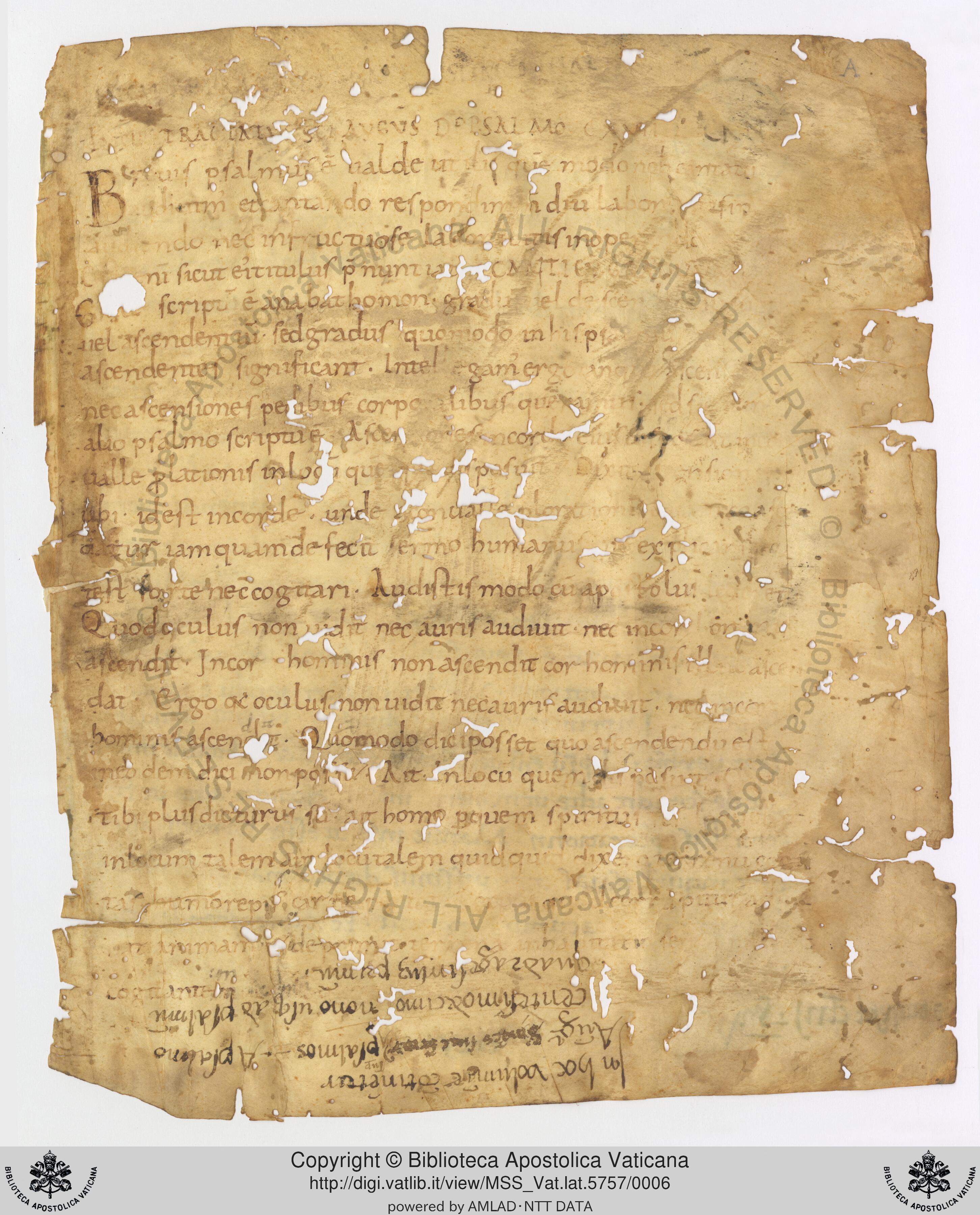
DE RE PUBLICA
by Cicero
Translated by Clinton W. Keyes
INTRODUCTION
De Re Publica (On the Republic) is among the most ambitious of Cicero's philosophical works and among the most dramatically unfortunate in its transmission. Composed between 54 and 51 BCE, during the final decade of the Roman Republic whose collapse Cicero did not survive, it is cast as a dialogue across three days of the Latin Festival (Feriae Latinae) of 129 BCE — set, that is, a generation before Cicero's own birth, at the height of Rome's unchallenged Mediterranean dominance. The principal speaker is Publius Cornelius Scipio Aemilianus (Scipio Africanus the Younger), the destroyer of Carthage and Numantia, surrounded by a circle of friends that includes Gaius Laelius, Spurius Mummius, Quintus Mucius Scaevola, and others: men whom Cicero presents as the embodiment of the Roman virtue he feared was already passing from the world.
The work is modelled consciously and openly on Plato's Republic, a dialogue Cicero had translated in his youth, but the relationship is one of argument as much as imitation. Where Plato constructs an ideal city from first principles and entrusts it to philosopher-kings, Cicero's Scipio insists that the best constitution is not a theoretical construction but an historical achievement — that Rome itself, refined across generations by the practical wisdom of its senators and magistrates, represents the nearest approximation to the ideal that political experience has produced. This is a distinctively Roman claim, and Cicero makes it with care: the dialogue is not a piece of patriotic complacency but a sustained inquiry into what makes Rome's mixed constitution — balancing monarchical, aristocratic, and democratic elements in the consuls, the Senate, and the popular assemblies — superior to any of its pure forms taken alone.
Books and Contents
The six books cover distinct but interlocking themes. Book I opens with a prologue in which Cicero, writing in his own voice, defends the duty of the philosopher to engage in public life — a defense that has autobiographical weight, as Cicero was composing the work at a moment of enforced political retirement. Scipio then sets out the typology of constitutions: the three pure forms (monarchy, aristocracy, democracy) and their corresponding corruptions (tyranny, oligarchy, mob rule), and argues for the mixed constitution as the form most resistant to degeneration.
Book II is the most historically substantial of the surviving portions. Scipio traces the constitutional development of Rome from Romulus through the expulsion of the kings, treating the history of the Roman state as itself a philosophical argument — each reign and each reform a lesson in what constitutions require in order to survive. This developmental account of Rome's res publica as the product of accumulated experience rather than single-minded legislation is one of Cicero's most original contributions to political thought.
Book III survives only in fragments but is known from later sources to have contained the dialogue's most contested philosophical argument: a debate on justice (iustitia) conducted between Laelius, who argues that genuine justice is the only secure foundation of the state, and an unnamed interlocutor — represented in the tradition as Philus — who takes the sceptical case that justice is a convention of the weak, that Roman imperialism is conquest by another name, and that states invariably act unjustly when it serves their interest. Cicero's answer through Laelius — that natural law binds all rational beings and that the commonwealth cannot survive without justice — is a foundational statement of natural law theory.
Books IV and V survive only in scattered fragments and citations. They appear to have treated the education and character of the ideal statesman (rector rei publicae), elaborating what qualities — philosophical, rhetorical, moral — the person who guides the commonwealth must possess. The ideal is not the Platonic philosopher-king but something more recognisably Roman: a man of broad culture and proven civic virtue, formed by the traditions of the mos maiorum, and capable of both speech and action.
Book VI is known almost entirely through its closing section, the Somnium Scipionis — the Dream of Scipio — which survived intact throughout the medieval period because Macrobius made it the basis of an elaborate Neoplatonic commentary in the early fifth century CE. In it, Scipio Africanus the Elder appears to his grandson in a dream and shows him the structure of the cosmos from the celestial spheres downward, impressing on him the smallness of the earth and the brevity of earthly fame. The soul is immortal and of divine origin; it belongs naturally to the heavens; and the statesman who has served his commonwealth faithfully will, after death, return to the company of those who have preceded him in that service. It is at once an eschatological vision, a meditation on cosmic scale, and a vindication of the active life — the closest thing in Latin prose to the myth of Er that closes Plato's Republic, and almost certainly designed as its conscious counterpart.
Transmission and the Vatican Palimpsest
De Re Publica was read and cited throughout late antiquity — Augustine quotes it extensively in The City of God — but by the early medieval period the complete text had ceased to circulate, and only the Somnium Scipionis, preserved by Macrobius, and a collection of fragments embedded in later authors survived. For over a thousand years the work was known only in these traces.
In 1820, Cardinal Angelo Mai, then Prefect of the Vatican Library, discovered that a ninth-century manuscript of Augustine's commentary on the Psalms (Vaticanus Palatinus Latinus 1775) was a palimpsest — a manuscript whose original text had been scraped away and written over. Beneath Augustine's commentary lay a substantial portion of De Re Publica, which Mai was able to read through the overwriting and published in 1822. The recovered text amounts to roughly one-third of the original work, weighted toward Books I through III; Books IV and V remain almost entirely lost. The palimpsest is now held in the Biblioteca Apostolica Vaticana and remains the primary manuscript witness to the text.
This Translation
The translation is that of Clinton W. Keyes, published in 1928 as Volume XVI of the Loeb Classical Library (Series No. 213, ISBN 0 674 99235 0), which also includes De Legibus (On the Laws). Keyes presents the Latin text on facing pages with his English translation and supplies a full index. The translation is in the public domain.
FULL TEXT
Proem
[The opening of Book I survives with a lacuna. Cicero writes in his own voice before the dialogue begins.]
BOOK I
The equivalent of about ten pages in this edition is lost at the beginning. Our manuscript commences in the midst of Cicero's preface to the dialogue; at this point he is evidently combating the Epicurean hostility to patriotism and the life of a statesman.
I. [Without active patriotism]1...[never] have delivered [our native land] from attack; nor could Gaius Duelius, Aulus Atilius, or Lucius Metellus2have freed [Rome] from her fear of Carthage; nor could the two Scipios3 have extinguished with their blood the rising flames of the Second Punic War; nor, when it broke forth again with greater fury, could Quintus Maximus4 have reduced it to impotence or Marcus Marcellus have crushed it; nor could Publius Africanus5 have torn it from the gates of this city and driven it within the enemy's walls.
Marcus Cato again, unknown and of obscure birth6 —by whom, as by a pattern for our emulation, all of us who are devoted to the same pursuits are drawn to diligence and valour-might surely have remained at Tusculum in the enjoyment of the leisurely life of that healthful spot so near to Rome. But he, a madman as our friends7 maintain, preferred, though no necessity constrained him, to be tossed by the billows and storms of our public life even to an extreme old age, rather than to live a life of complete happiness in the calm and ease of such retirement. I will not speak of the men, countless in number, who have each been the salvation of this republic; and as their lives do not much antedate the remembrance of the present generation, I will refrain from mentioning their names, lest someone complain of the omission of himself or some member of his family. I will content myself with asserting that Nature has implanted in the human race so great a need of virtue and so great a desire to defend the common safety that the strength thereof has conquered all the allurements of pleasure and ease.
II. But it is not enough to possess virtue, as if it were an art of some sort, unless you make use of it. Though it is true that an art, even if you never use it, can still remain in your possession by the very fact of your knowledge of it, yet the existence of virtue depends entirely upon its use; and its noblest use is the government of the State, and the realization in fact, not in words, of those very things that the philosophers, in their corners, are continually dinning in our ears. For there is no principle enunciated by the philosophers-at least none that is just and honourable-that has not been discovered and established by those who have drawn up codes of law for States. For whence comes our sense of duty? From whom do we obtain the principles of religion? Whence comes the law of nations, or even that law of ours which is called "civil"?8 Whence justice, honour, fair-dealing? Whence decency, self-restraint, fear of disgrace, eagerness for praise and honour? Whence comes endurance amid toils and dangers? I say, from those men who, when these things had been inculcated by a system of training, either confirmed them by custom or else enforced them by statutes. Indeed Xenocrates, one of the most eminent of philosophers, when asked what his disciples learned, is said to have replied: "To do of their own accord what they are compelled to do by the law." Therefore the citizen who compels all men, by the authority of magistrates and the penalties imposed by law, to follow rules of whose validity philosophers find it hard to convince even a few by their admonitions, must be considered superior even to the teachers who enunciate these principles. For what speech of theirs is excellent enough to be preferred to a State well provided with law and custom? Indeed, just as I think that "cities great and dominant,"9 as Ennius calls them, are to be ranked above small villages and strongholds, so I believe that those who rule such cities by wise counsel and authority are to be deemed far superior, even in wisdom, to those who take no part at all in the business of government. And since we feel a mighty urge to increase the resources of mankind, since we desire to make human life safer and richer by our thought and effort, and are goaded on to the fulfilment of this desire by Nature herself, let us hold to the course which has ever been that of all excellent men, turning deaf ears to those who, in the hope of even recalling those who have already gone ahead, are sounding the retreat.
Bibliography
Keyes, Clinton W., trans. Cicero: De Re Publica. De Legibus. Loeb Classical Library 213. London: William Heinemann; Cambridge, MA: Harvard University Press, 1928. 10th printing. 544 pp.
Mai, Angelo, ed. M. Tullii Ciceronis de Republica quae supersunt. Rome: Typis Vaticanis, 1822.
Zetzel, James E. G., ed. Cicero: De Re Publica. Selections. Cambridge Greek and Latin Classics. Cambridge: Cambridge University Press, 1995.
Zetzel, James E. G., trans. Cicero: The Republic and The Laws. Oxford World's Classics. Oxford: Oxford University Press, 1998.
Footnotes
-
Conjectural restorations of the sense in fragmentary passages are enclosed in brackets. ↩︎
-
For these and other persons mentioned in the text, consult the Index. ↩︎
-
Publius Cornelius Scipio (consul 218) and his brother Gnaeus Cornelius Scipio Calvus (consul 222). ↩︎
-
Quintus Fabius Maximus Cunctator. ↩︎
-
Publius Cornelius Scipio Africanus Minor. ↩︎
-
A novus homo is a man who is the first of his family to hold high office. ↩︎
-
The Epicureans, whose ideal of a guiet life free from pain made them discountenance participation in politics. ↩︎
-
The ius gentium (law of nations) is that common to all peoples; the ius civile is the Roman private law. ↩︎
-
Probably a quotation from the Annales of Ennius. ↩︎