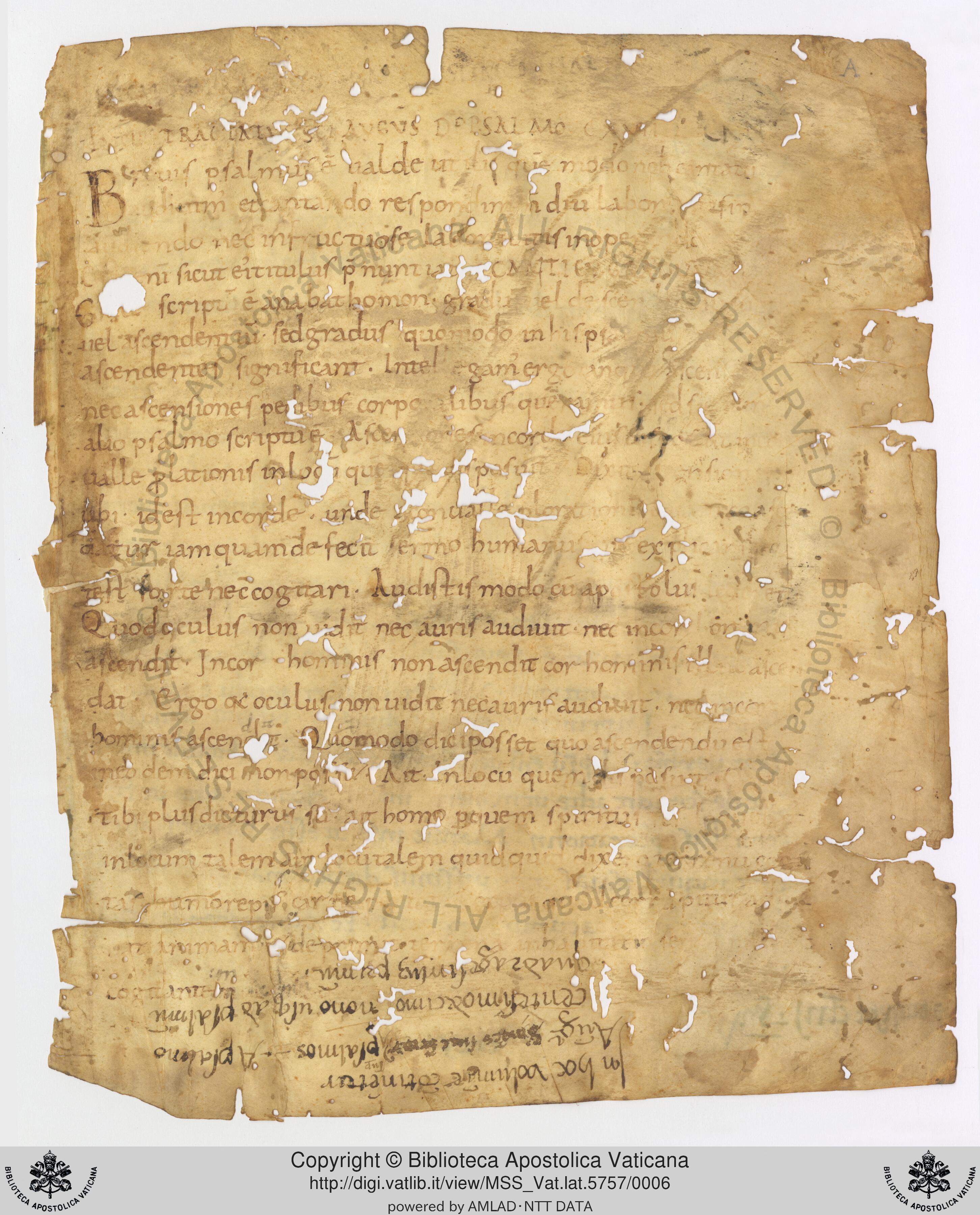
First page of Vat. lat. 5757, a palimpsest manuscript from Bobbio

De Re Publica

Reading companion and full text of Cicero's De Re Publica (On the Republic), translated by Clinton W. Keyes — a dialogue in six books examining the best form of government, the nature of justice, and the duties of the ideal statesman, culminating in the celebrated Dream of Scipio.
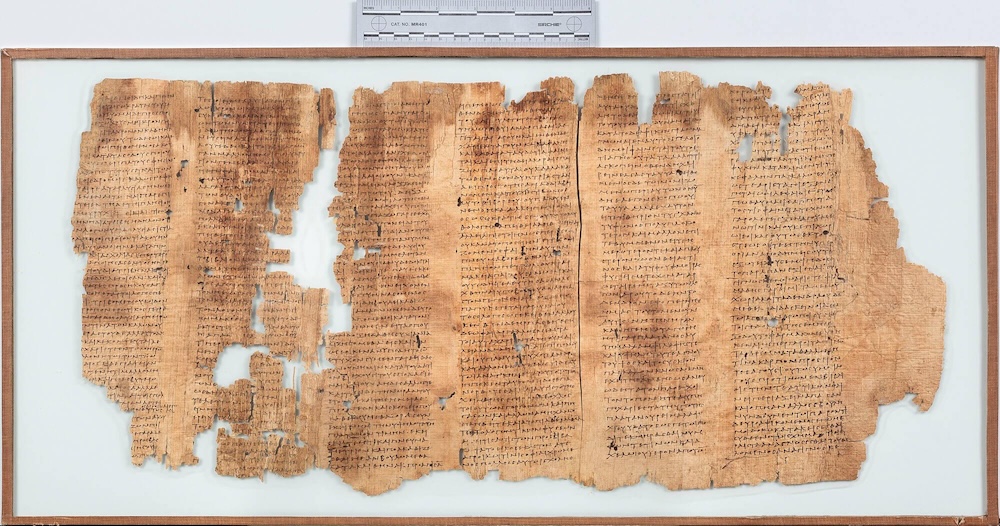
Papyrus Oxyrhynchus VII 1016 (P.Oxy. VII 1016), held at the Toledo Museum of Art (object no. 1915.38, gift of Edward Drummond Libbey), is a Greek papyrus excavated at Al-Bahnasa (ancient Oxyrhynchus), Egypt, dating to the mid-3rd century CE. It consists of four joined sheets measuring approximately 27.5 × 57.9 cm overall, written in India ink on papyrus. The reverse (Oxyrhynchus no. 1016) preserves six columns of the introduction to Plato's Phaedrus (sections 233c–234b and 242d–244c), covering the opening scene (227a–230e) in which Socrates meets Phaedrus outside the walls of Athens, and the two make their way to the banks of the Ilissus to discuss a speech by the orator Lysias on love and rhetoric. The obverse (Oxyrhynchus no. 1044) contains a tax list dated to 235 CE. Published by Arthur Hunt in volume VII of The Oxyrhynchus Papyri (1910).

Phaedrus

Reading companion and full text of Plato's Phaedrus, a Socratic dialogue exploring the nature of love, the immortality and structure of the soul, the requirements of true rhetoric, and the limits of written discourse.

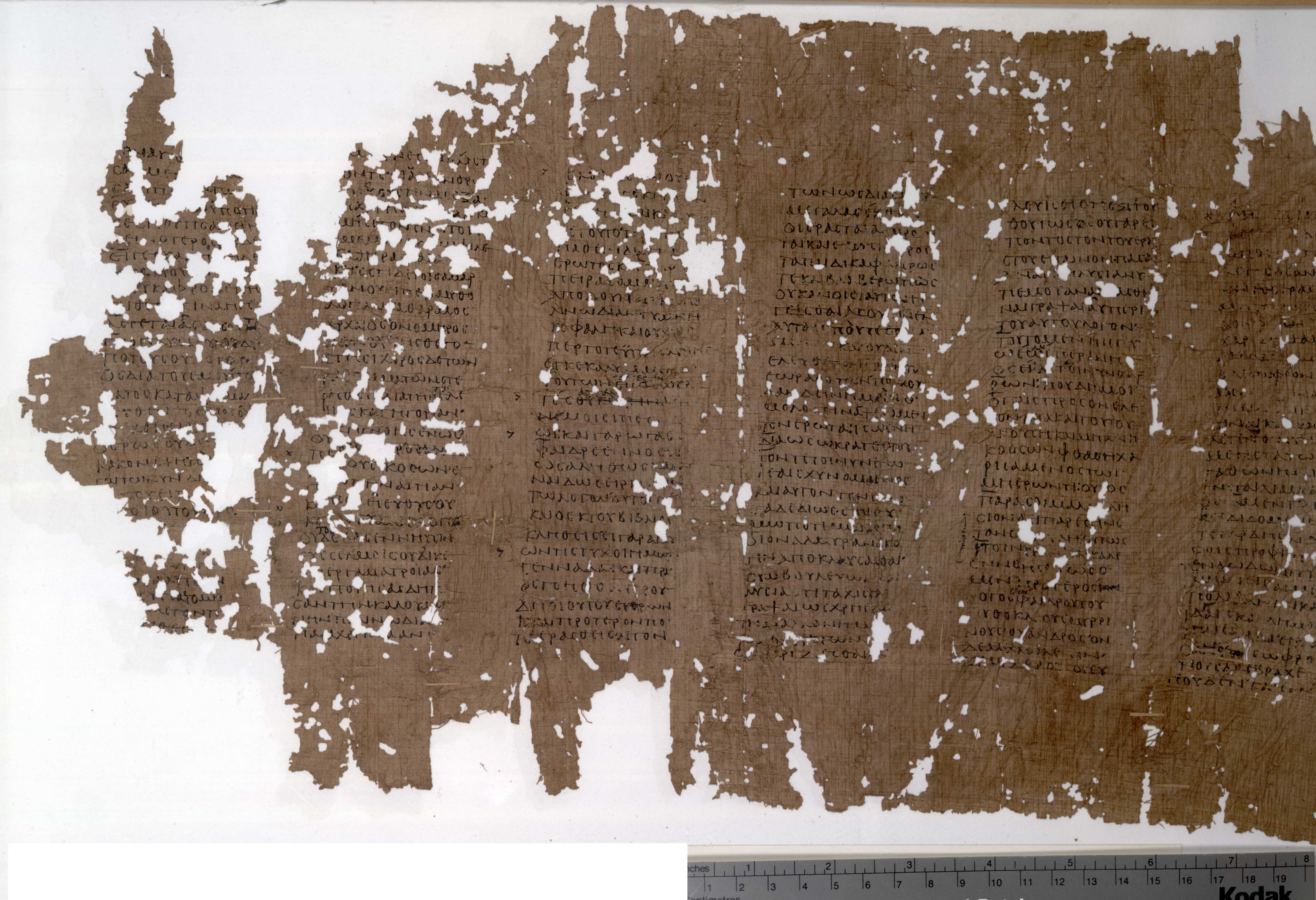
Papyrus Oxyrhynchus XVII 2102 (P.Oxy. XVII 2102), held at Oxford, is a Greek papyrus from Oxyrhynchus, Egypt, dating to the late second century AD — likely its second half — and one of three Oxyrhynchus witnesses to Plato's Phaedrus. This recto image shows nine consecutive columns (the last three very fragmentary) from a roll measuring 25.4 cm in height, written in a round, upright literary hand of medium size with short lines of approximately 5 cm set in columns 15 cm tall, slightly inclined to the right. A second hand is frequently in evidence, introducing corrections and variant readings from a different exemplar, inserting accents, breathings, marks of elision and quantity, and marginal signs; punctuation by high and medial dots, paragraphi, and colons marking changes of speaker is also largely secondary. A coronis at column v, line 21 marks the end of a section. The original scribe was careless and made numerous errors, most of which the corrector caught; despite this, the text is a reasonably good one, collated against Burnet's edition. It was discovered during the excavations of Bernard Grenfell and Arthur Hunt at Oxyrhynchus and published in volume XVII of The Oxyrhynchus Papyri.

Phaedo

Reading companion and full text of Plato's Phaedo, a Socratic dialogue set on the day of Socrates' death, in which he and his companions explore four arguments for the immortality of the soul.

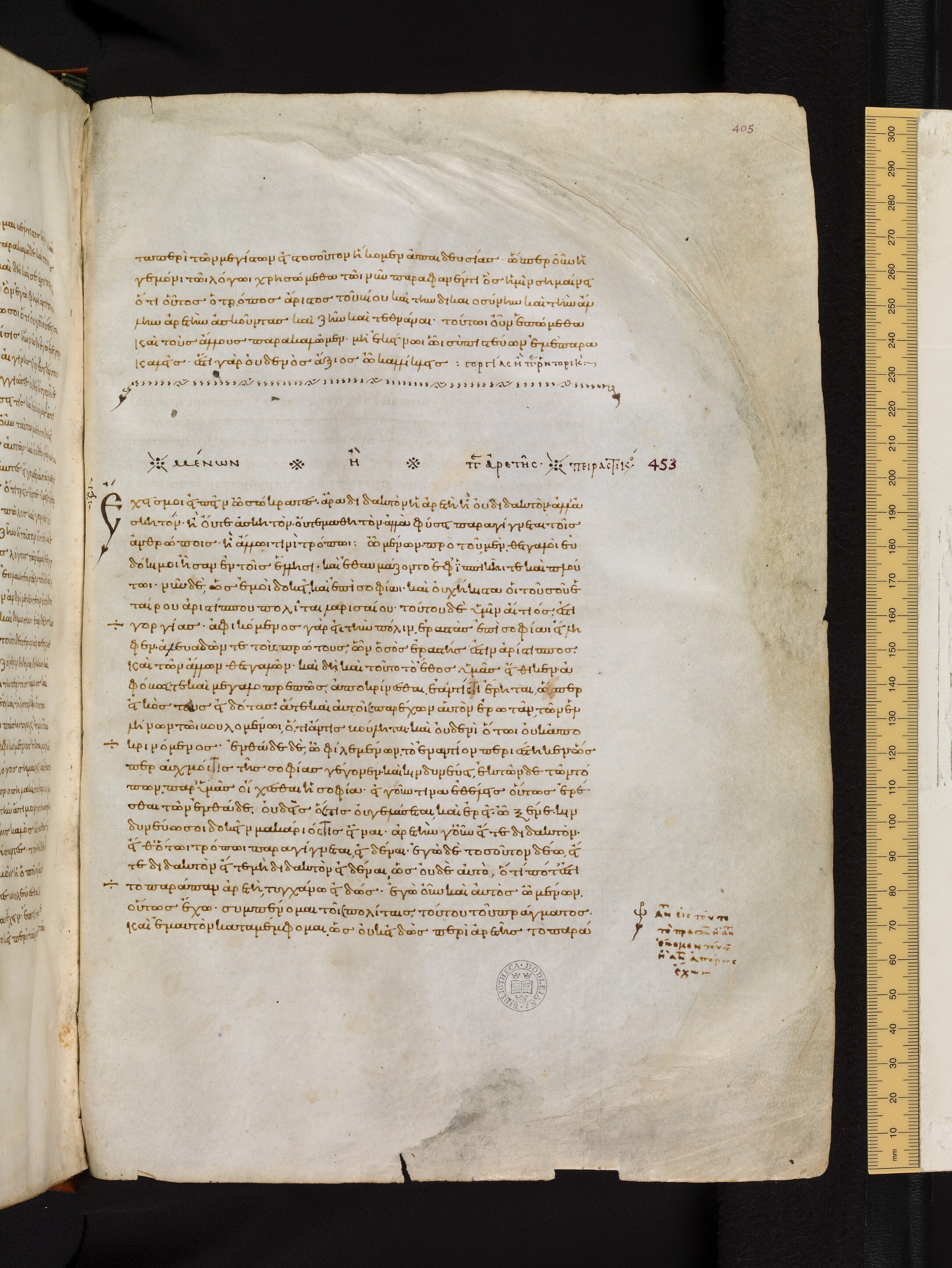
The Codex Clarkianus (Bodleian Library MS. E. D. Clarke 39), or Clarke Plato, is a crucial 9th-century Greek manuscript written in 895 AD in Constantinople for Arethas of Patrae by John the Calligrapher. As the oldest, most comprehensive witness for 24 of Plato's dialogues, it is central to reconstructing the text of Meno and other key works. This is the exact page where Plato's Meno begins. The top third of the page contains the conclusion of the Gorgias. You can see a decorative horizontal divider (a coronis) and a series of dots marking the end of that dialogue. Just below the divider, the title is written in red uncials: ΜΕΝΩΝ Η ΠΕΡΙ ΑΡΕΤΗΣ ΠΕΙΡΑΣΤΙΚΟΣ (Meno, or On Virtue, Tentative).

Meno

Reading companion and full text of Plato's Meno, a Socratic dialogue exploring whether virtue can be taught, and introducing the theory of recollection as a model of knowledge.