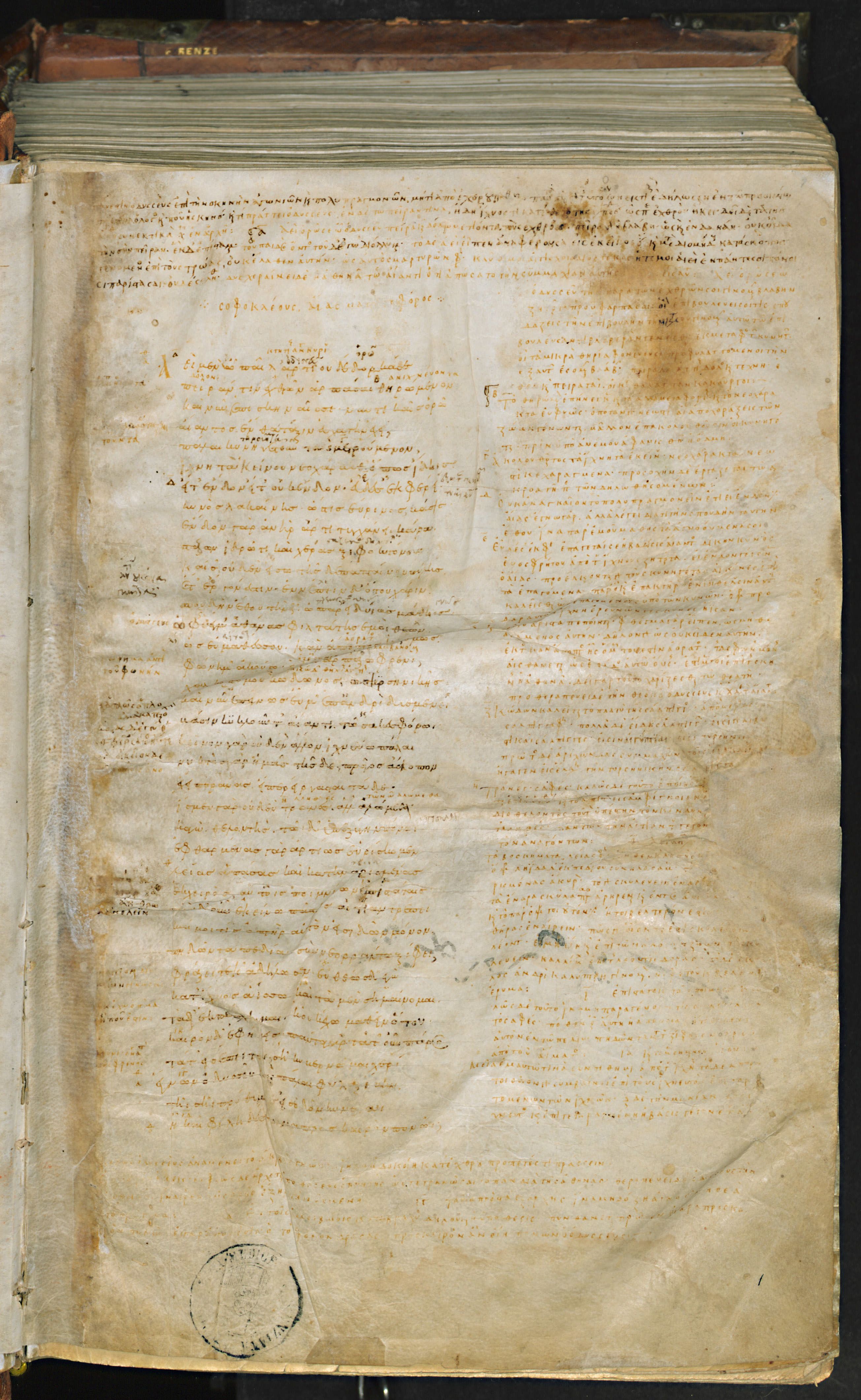
THE ORESTEIA
by Aeschylus
Translated by Herbert Weir Smyth
The Oresteia is the only complete tragic trilogy to survive from classical antiquity. Performed at the Great Dionysia in Athens in 458 BCE — two years before Aeschylus's death — it won first prize and immediately established itself as the supreme achievement of the Greek tragic form. Its three plays are sequential and inseparable: Agamemnon, The Libation Bearers (Choephoroi), and The Eumenides. A fourth play, the satyr drama Proteus, followed in performance and is lost.
The trilogy begins with the return of Agamemnon, king of Argos, from the sack of Troy, and ends with the acquittal of his son Orestes at a newly constituted court in Athens. Between these two poles, Aeschylus traces a movement from the archaic logic of blood vengeance — where each killing demands another, world without end — to the civic logic of justice administered by law, argument, and vote. The Furies themselves, ancient goddesses of retribution, are transformed by the trilogy's close into the Eumenides, the Kindly Ones, honored in Athens's earth. It is a vision of human civilization acquiring, through suffering, the institutions that make it possible.
The Oresteia is the founding document of Western tragedy, of the philosophy of justice, and of political thought about the relationship between divine order and civic life. It is also, in the Agamemnon above all, the source of some of the most overwhelming verse in any language.
Further Reading
Translations
Richmond Lattimore (University of Chicago Press, 1953) — the standard translation for most of the twentieth century, and still the most widely assigned in university courses. Lattimore preserves Aeschylean compression and metrical weight more faithfully than most competitors; his Agamemnon chorus odes, in particular, communicate something of the originals' terrifying density. The price is difficulty: Lattimore's English does not smooth over the places where Aeschylus is obscure.
Robert Fagles (Viking, 1975; Penguin Classics) — the most widely read modern translation, animated by Fagles's gift for dramatic momentum and colloquial power. More accessible than Lattimore and better suited for reading alongside a performance. Bernard Knox's introduction remains one of the finest short accounts of the trilogy in English.
Ted Hughes, The Oresteia (Faber, 1999) — a poet's free version rather than a scholar's translation, compressed and visceral in ways that illuminate the primal energies the plays release. Hughes is least faithful to the Greek and most interesting as a literary object in its own right.
Alan H. Sommerstein (Loeb Classical Library, 2008) — the standard bilingual scholarly edition, with Greek text on facing pages. Sommerstein's prose translation is less literary than Lattimore or Fagles but more reliable at contested points, and his introductions engage seriously with textual and dramatic problems.
Anne Carson, An Oresteia (Faber, 2009) — Carson's version includes only the Agamemnon from the trilogy (paired with Sophocles' Electra and Euripides' Orestes). Her approach, characteristically, is oblique and exacting — more interested in the strangeness of Aeschylean syntax than in producing a smooth reading text. Valuable for advanced readers already familiar with the work.
Introductions and General Studies
Simon Goldhill, Aeschylus: The Oresteia (Cambridge, 1992) — the best short introduction to the trilogy as a whole, covering its dramatic structure, theology, political dimensions, and language with unusual lucidity. Goldhill situates the plays in their civic and religious context without reducing them to historical documents.
Hugh Lloyd-Jones, The Justice of Zeus (California, 1971; second edition 1983) — a landmark account of divine justice in Greek epic and tragedy. Lloyd-Jones's reading of the Oresteia — arguing against those who find in it a straightforwardly progressive theology — remains the most important intervention in the trilogy's interpretive tradition and cannot be bypassed by serious readers.
Oliver Taplin, The Stagecraft of Aeschylus (Oxford, 1977) — the definitive study of how Aeschylus's plays work as theatrical performances rather than literary texts. Taplin's attention to entrances, exits, props, and the deployment of the chorus is essential for understanding how the Oresteia achieves its effects in the theatre.
Michael Gagarin, Aeschylean Drama (California, 1976) — a careful examination of the ethical and legal dimensions of the Oresteia, particularly its engagement with the concept of dike (justice). Gagarin argues persuasively that the trilogy marks a decisive moment in Greek thinking about the relationship between human and divine law.
Froma Zeitlin, "The Dynamics of Misogyny: Myth and Mythmaking in the Oresteia," in Playing the Other (Chicago, 1996) — the most searching feminist reading of the trilogy, analyzing the displacement of the female in Aeschylus's civic vision: the marginalization of Clytemnestra, the redefinition of kinship, and Apollo's extraordinary argument at Orestes's trial. Essential for any reckoning with what the trilogy's resolution actually costs.
Commentaries
Eduard Fraenkel, Agamemnon (Oxford, 1950; 3 vols.) — the greatest classical commentary of the twentieth century, and arguably the greatest on any work of Greek literature. Fraenkel's command of the language, metre, and cultural context of the Agamemnon is simply without parallel. Not a work for beginners, but for those prepared to read it, its rewards are inexhaustible.
A. F. Garvie, Choephori (Oxford, 1986) — the standard scholarly commentary on The Libation Bearers, careful and well-judged. Garvie is particularly good on the play's relationship to its Homeric and Pindaric sources and on the extraordinary kommos (lyric exchange) at the centre of the action.
A. H. Sommerstein, Eumenides (Cambridge, 1989) — the best commentary on the final play, combining philological precision with genuine engagement with the dramatic and political dimensions of the Areopagus trial and the transformation of the Furies.
The Oresteia in Performance and Reception
Edith Hall, Aeschylus: Persians, Seven Against Thebes, Suppliants, Prometheus Bound, Oresteia (Cambridge Companions, 2010) — situates the Oresteia within Aeschylus's career and in the broader history of ancient drama. Hall is especially attentive to questions of performance history and the plays' modern afterlives.
Peter Stein's production (Schaubühne, Berlin, 1980) — widely considered the defining twentieth-century staging of the trilogy, running six hours and performed partly outdoors. The production drew on Peter Mommsen's German translation and was documented extensively; the prompt book and critical responses to it illuminate what the plays demand of directors and audiences.