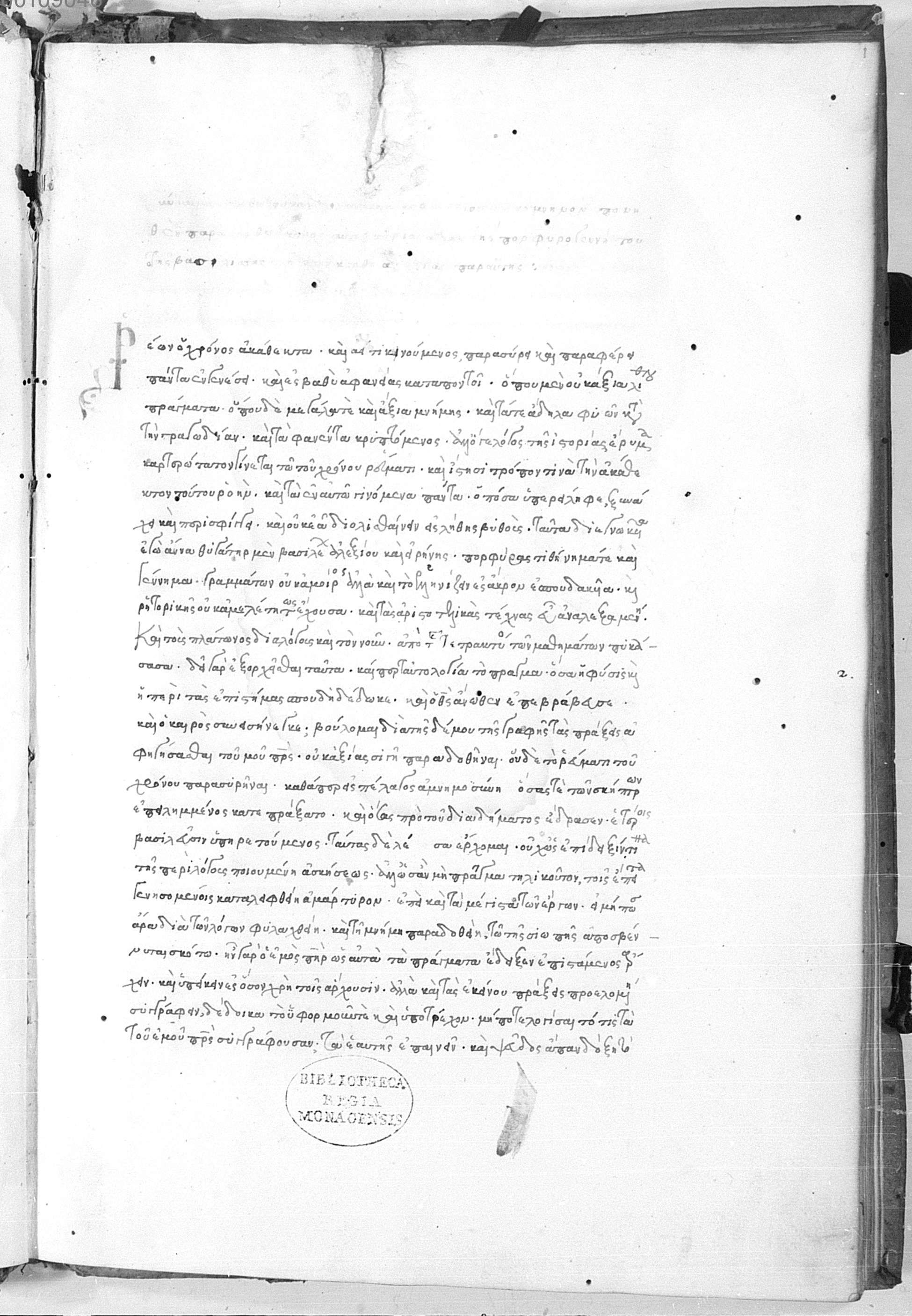
THE ALEXIAD
by Anna Comnena
Translated by Elizabeth A. S. Dawes (1928)
Introduction
The Work
The Alexiad is one of the most extraordinary documents to survive from the medieval world. Written in Byzantine Greek in the mid-twelfth century by Anna Comnena, eldest daughter of Emperor Alexios I Komnenos, it is a history in fifteen books of her father's reign (1081–1118) — the military campaigns, the diplomatic manoeuvres, the theological controversies, and the upheavals that attended the first generation of Crusaders passing through Byzantine territory on their way to Jerusalem. It is also the only major historical work composed by a woman in the entire medieval period, East or West, and this fact alone would guarantee it a permanent place in any history of historical writing. But the Alexiad earns its importance many times over on its own terms: as a work of historical analysis, political portraiture, and Greek prose, it stands with the finest products of Byzantine literary culture.
Anna was born in 1083, the firstborn child of Alexios and his wife Irene Doukaina, and was for a time the designated heir to the throne. She received an education exceptional even by Byzantine aristocratic standards — philosophy, rhetoric, medicine, and above all the classical Greek historians whose style and methods she consciously imitated. She was betrothed in childhood to Constantine Doukas, the previous emperor's son, but when Alexios's son John was born and the succession shifted, she was instead married to the Caesar Nikephoros Bryennios, himself a historian of some distinction whose unfinished chronicle of an earlier period she would later incorporate into her own work. After her father's death in 1118, she conspired — unsuccessfully — to place her husband on the throne in preference to her brother John II. The plot failed, and Anna spent the remaining decades of her life in the Kecharitomene convent in Constantinople, where she assembled the Alexiad from documentary sources, oral testimony, and her own memory. She completed the work around 1148, in her mid-sixties. The voice that opens the preface — measuring her grief in the figures of Homer, lamenting that she has nothing left of her losses but words — is not rhetorical decoration. It is the condition under which the history was written.
The Historical Context
The reign of Alexios I was a period of acute crisis and remarkable recovery for the Byzantine Empire. When Alexios came to power in 1081, the empire faced simultaneous pressure from the Normans in the west (Robert Guiscard had just seized Dyrrachium), the Pečenegs and Cumans in the north, and the Seljuk Turks in the east, who had held most of Asia Minor since the catastrophic Byzantine defeat at Manzikert in 1071. Alexios spent the better part of three decades fighting on all these fronts, financing his campaigns through currency debasement and confiscation of Church property, and navigating the fractious aristocratic politics of Constantinople with a combination of dynastic marriage, selective patronage, and ruthless pragmatism. By the end of his reign, the empire had stabilised its frontiers and recovered portions of western Anatolia. Whether this amounted to genuine renewal or merely arrested decline remained, and remains, a matter of historical debate.
Into this context arrived the First Crusade. In 1095, having appealed to Pope Urban II for Western military assistance against the Turks, Alexios received something rather different from what he had requested: an enormous, poorly coordinated, and theologically inflamed popular movement followed by several major armies under independent commanders, all passing through Byzantine territory, requiring provisioning and management, and pursuing goals — the liberation of Jerusalem and the establishment of Latin principalities — that were not straightforwardly compatible with Byzantine strategic interests. The Alexiad is the only extended account of these events written from the Byzantine side. Its portrait of the Crusade leaders — Godfrey of Bouillon, Bohemund of Taranto, Raymond of Saint-Gilles — is invaluable precisely because it is hostile, shrewd, and based on direct observation: Anna met many of these men as a child in her father's court, and her account of Bohemund in particular, Norman prince and intermittent enemy of Byzantium, has a vivid ambivalence that no Latin source can match.
Anna as Historian
Anna situates herself consciously within the classical tradition of Greek historical writing. Her preface invokes the convention of the historian's obligation to truth; her methods — the use of documentary sources, the interviewing of eyewitnesses, the attention to speeches and letters — follow Thucydidean precedent; her prose style, elaborate and allusive, aspires to the register of Attic Greek that Byzantine literary culture held in the highest esteem. This classicising programme has sometimes been treated as mere ornament, or worse, as evasion — a rhetorical screen that keeps the historian at one remove from her material. Recent scholarship has largely reversed this judgment. Anna's classical framework is itself a historical argument: she is writing about a reign she regards as comparable in importance to the great subjects of ancient historiography, and she is claiming for her father a place among the figures who shaped the destiny of civilisations.
The question of bias cannot be set aside. Anna loved her father and hated her brother; her account of John II's accession is pointedly thin; her portrait of Alexios is explicitly encomiastic in places and shaped throughout by filial loyalty. But the same charge of interested perspective can be levelled at Thucydides's account of Pericles or Caesar's account of Caesar, and it does not diminish those works. What matters is that Anna's partiality is legible, and that behind it lies a genuine historical intelligence — one capable of criticising Alexios when his theological interventions seem to her excessive, of acknowledging reverses as well as victories, and of rendering the complexity of Byzantine court politics with a precision that no outside observer could have achieved.
The Alexiad is our primary source for some of the most consequential decades in medieval history. It should be read critically, as all primary sources must, and it rewards that effort with an intimacy of access to the Byzantine world that no modern reconstruction can replicate.
This Translation
Elizabeth A. S. Dawes's 1928 translation, published by Kegan Paul, Trench, Trübner & Co., was the first complete English rendering of the Alexiad and remained the standard for decades. Dawes worked from the Reifferscheid edition of the Greek text and produced a version that, while formal in register, is accurate in substance and careful with the work's rhetorical texture. It has since been supplemented by E.R.A. Sewter's Penguin Classics translation (1969, revised by Peter Frankopan in 2009), which is more idiomatic and benefits from subsequent textual scholarship. For readers coming to the Alexiad for the first time, the Dawes translation offers a faithful entry into the work; for close study, Sewter-Frankopan is now preferred.
Further Reading
Translations
Elizabeth A. S. Dawes (Kegan Paul, 1928) — the first complete English translation and the text presented here. Formal in tone and faithful to the Greek; a reliable guide to the work's argument and structure even where its prose has dated.
E.R.A. Sewter, revised by Peter Frankopan (Penguin Classics, 2009) — the current standard translation for English readers, benefiting from Frankopan's expertise in Byzantine-Crusader relations and from revisions to contested passages. Frankopan's introduction is the best brief orientation to the work in any language. Sewter's 1969 original remains useful, but the revised edition is to be preferred.
Anna Comnena and Her World
Leonora Neville, Anna Komnene (Cambridge, 2016) — the most important recent monograph on Anna as a historical thinker and writer. Neville argues against readings of the Alexiad as straightforwardly encomiastic and reads it instead as a work of genuine historical analysis, shaped by Byzantine literary conventions that modern readers tend to mistake for mere flattery. Essential for any serious engagement with the text.
Thalia Gouma-Peterson (ed.), Anna Komnene and Her Times (Garland, 2000) — the best essay collection on the Alexiad and its contexts, bringing together contributions from Byzantinists, historians of gender, and literary scholars. The essays by Mullett and Howard-Johnston on Anna's historiographical methods are particularly valuable.
Michael Mullett, "Aristocracy and Patronage in the Literary Quarters of Komnene Constantinople," in The Byzantine Aristocracy (BAR, 1984) — situates the Alexiad within the literary culture of the Komnenian court, where history, philosophy, and theological controversy were practised by the same overlapping circle of educated aristocrats.
The Komnenian Empire
Paul Magdalino, The Empire of Manuel I Komnenos, 1143–1180 (Cambridge, 1993) — the defining study of the generation after Alexios. Magdalino's account of Komnenian ideology, court culture, and imperial self-presentation provides essential context for understanding what the Alexiad was doing and for whom it was written.
Michael Angold, The Byzantine Empire, 1025–1204: A Political History (Longman, second edition 1997) — the most reliable political narrative of the period the Alexiad covers, indispensable for readers orienting themselves in the complex events of Alexios's reign.
John Birkenmeier, The Development of the Komnenian Army, 1081–1180 (Brill, 2002) — a technical study of Byzantine military organisation under the Komnenoi. Invaluable for readers following the Alexiad's extensive military narrative, which presupposes a familiarity with Byzantine tactical and logistical practice that most modern readers lack.
The First Crusade from Byzantium
Peter Frankopan, The First Crusade: The Call from the East (Bodley Head, 2012) — the most sustained recent argument for reading the First Crusade from the Byzantine perspective rather than the Latin one. Frankopan draws heavily on the Alexiad and makes a strong case for Alexios's initiative in precipitating the Crusade. Its revisionism has been contested, but it is essential reading for any student of the period.
Jonathan Harris, Byzantium and the Crusades (Hambledon, 2003; second edition 2014) — a measured and comprehensive account of Byzantine-Crusader relations across two centuries, with substantial attention to the First Crusade and to the Alexiad's testimony. Harris is more cautious than Frankopan and provides a useful counterweight.
Ralph-Johannes Lilie, Byzantium and the Crusader States, 1096–1204 (Oxford, 1993) — the standard scholarly account of Byzantine policy toward the Latin principalities established in the Crusade's wake. Lilie's analysis of Alexios's dealings with Bohemund of Taranto is a necessary complement to Anna's own charged portrait of that relationship.