Overview
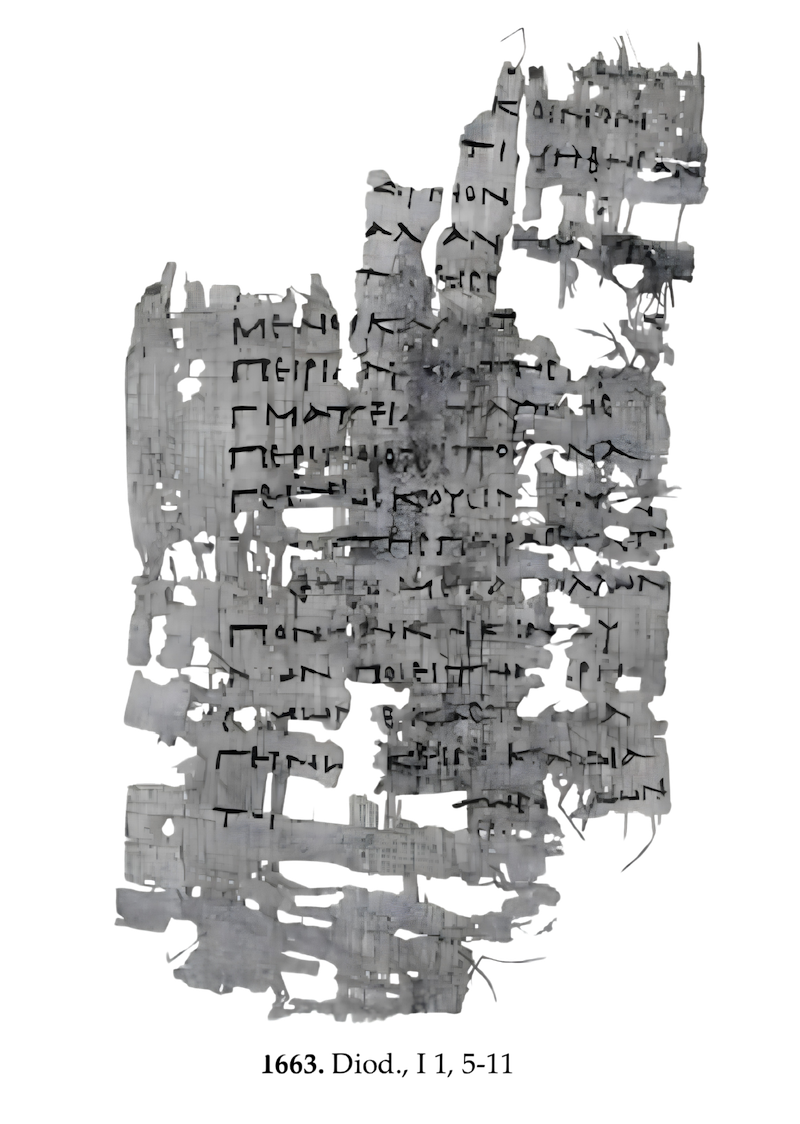
Diodorus Siculus's Bibliotheca Historica — literally the Historical Library — is the most ambitious work of universal history to survive from antiquity. Composed in Greek over roughly thirty years in the middle and later first century BCE, it set out to encompass the entire human past available to its author: the mythology and ethnography of the peoples of the known world before the Trojan War, the continuous political and military history of the Greek and Mediterranean world from the Trojan War through the death of Alexander, and the history of the successor kingdoms and the rise of Rome down to roughly 60 BCE, on the eve of Caesar's Gallic War. The work originally ran to forty books and would have constituted, had it survived complete, the single largest historical narrative to come down from classical antiquity. As it stands, only Books 1–5 and 11–20 — fifteen books out of forty — have come down to us in continuous form; the remainder is preserved in fragments, primarily through the great tenth-century Byzantine excerpts compiled at the order of Constantine VII Porphyrogenitus.
What survives, even in this damaged form, is irreplaceable. The Bibliotheca is the only continuous Greek narrative of the fifth century BCE besides Herodotus and Thucydides themselves, the principal ancient source for much of Sicilian history, the largest surviving repository for the lost histories of Ephorus and Timaeus, and — most consequentially — the sole extant continuous account of the years between Alexander's death and the establishment of the Hellenistic kingdoms (Books 18–20), drawing on the now-vanished history of Hieronymus of Cardia. To excise Diodorus from the surviving corpus of ancient historiography would be to remove the structural backbone of several centuries of Mediterranean political history.
For most of the modern period Diodorus was scorned. The scholarly consensus from roughly 1850 to 1970 treated him as a slow-witted compiler who excerpted his sources mechanically without understanding them, and whose value lay only in the lost authors he preserved. Since the 1990 publication of Kenneth Sacks's Diodorus Siculus and the First Century, that consensus has steadily eroded. Diodorus is now read as a historian with a coherent moral and intellectual project of his own — a Sicilian Greek writing under the political reality of Roman supremacy, attempting to give his Greek-speaking readers a usable past at the moment when the autonomous Greek city had ceased, finally, to be a meaningful political form. The work remains less elegant than Thucydides, less philosophically searching than Polybius, less narratively brilliant than Xenophon. But it is no longer treated as the work of a fool.
The Author
What we know of Diodorus's life comes almost entirely from incidental remarks in his own work and a single line from Jerome's Chronicon. He was born at Agyrium in Sicily (modern Agira, in the interior of the island east of Enna), a town of some antiquity but no great political importance, and the obscurity of his birthplace is itself relevant — Diodorus is one of the few major surviving classical historians who is not an Athenian, a Roman, or a citizen of one of the great commercial capitals. He writes with particular care about Sicily throughout the Bibliotheca, and the local pride of an Agyrian who insists, against all aesthetic reason, on giving his hometown's myths their due is one of the small charms of reading him.
His dates can be approximated. He tells us he visited Egypt during the 180th Olympiad — between 60 and 57 BCE — and witnessed at first hand a political crisis involving the Ptolemaic court. He refers to events as late as the deification of Julius Caesar (42 BCE), and the work appears to have been substantially complete by around 30 BCE, the year that for most ancient historians marked the symbolic close of the Hellenistic age. He claims in his preface to have spent thirty years on the project, to have traveled widely to gather material, and to have consulted records in Rome. Beyond this we know nothing. Jerome simply notes under the year corresponding to 49 BCE that "Diodorus of Sicily, a writer of Greek history, became illustrious"; no ancient biography of him survives; no inscription securely identifies him.
What kind of writer was he? A Greek of the Roman provinces, a man of modest means and unmistakable energy, working in a language whose political center of gravity had moved away from the old city-states without yet finding a new one. He is not an aristocrat like Thucydides or a participant like Polybius; he is, more nearly, a scholar — a reader of immense breadth who attempts to do for history what the Library of Alexandria had attempted to do for literature: gather, organize, and transmit. The very title he chose for his work, Bibliotheca, signals the project. He is not writing a history. He is writing a library of history.
Composition and Sources
A Universal History
The Bibliotheca's most consequential innovation is structural. Before Diodorus, Greek historiography had been overwhelmingly local or thematic. Herodotus had written a single conflict; Thucydides a single war; Xenophon's Hellenica picked up where Thucydides left off; Polybius had written the symploke — the interweaving of Mediterranean affairs in the rise of Rome. Ephorus of Cyme, in the fourth century BCE, had attempted a more comprehensive Greek history and is often considered the inventor of universal history; his work is lost. What Diodorus produced was the first universal history in the full sense to survive intact — a work organized chronologically by Olympiad year and Roman consular year, juxtaposing events in Greece, Italy, Sicily, Egypt, and the Near East within the same annalistic frame, on the premise that history was one thing: one process, one human community, one developing story.
The premise was philosophical. In his proem to Book I, Diodorus writes that universal history makes its readers virtuous — that to see the whole sweep of human affairs is to perceive the patterns of fortune and folly that govern them, and that this knowledge is more useful than the deepest study of any single people or any single war. He thus inherits and transforms a tradition of universal historiography that runs through Stoic providential thought and the Hellenistic cosmopolitanism which the Roman imperium had now made political fact. The decision to begin with mythography and ethnography, surveying the peoples of the world before the Trojan War, was not antiquarianism: it was the assertion that the history of mankind began in the same moment everywhere, and that the historian's task was to honor that simultaneity.
Method and Sources
Diodorus's method is to follow a single principal source for each major section of his narrative, switching when chronology demands it. He acknowledges this practice openly. The result is a Bibliotheca that is, in effect, a collage — and the modern scholarly fascination with him long consisted in trying to identify which portions came from which lost authority. The traditional reconstructions, all of them contested:
- For Egyptian and Eastern ethnography (Book I; much of Books II–III): Hecataeus of Abdera and Agatharchides of Cnidus.
- For Greek mythology and the survey of the West (Books IV–VI): a range of mythographers, with substantial use of local Sicilian tradition.
- For Greek history from the Persian Wars to the mid-fourth century (Books XI–XV, and probably much of XVI): Ephorus of Cyme — Diodorus's heaviest single debt, and the principal reason students of fifth- and fourth-century Greece must read him.
- For Sicilian affairs throughout: Timaeus of Tauromenium.
- For Alexander (Book XVII): a tradition close to Cleitarchus, the so-called "Vulgate" Alexander tradition.
- For the Successors (Books XVIII–XX): Hieronymus of Cardia, the eyewitness historian of the Diadochi, whose work is otherwise lost almost in its entirety.
- For the later books (XXI–XL): a shifting mixture, with Polybius likely prominent for the period of the Punic Wars and the Roman expansion into the East, and Posidonius for the late Hellenistic.
The older scholarly attitude treated Diodorus's reliance on these sources as a kind of automatism — he is "transcribing Ephorus" — and dismissed the work accordingly. Recent scholarship has emphasized instead what Diodorus chose to include, omit, emphasize, and editorially frame: the moral judgments scattered through the text, the recurrent insistence on the workings of Tyche (fortune) and providence, the prefaces to individual books which lay out themes of his own, the comparisons across the centuries that no single source would have made. He is a compiler, but he is also a thinker.
Transmission and Survival
The work was composed and circulated in the last decades of the Roman Republic and the very beginning of the Augustan principate. Diodorus's preface, often dated to the late 30s BCE, suggests publication in stages; certain internal references push some books slightly later. The Bibliotheca was known and quoted in late antiquity (Eusebius cites it, Jerome notes its author), but no continuous transmission of the full forty books survives.
What we have:
- Books 1–5, the mythological and ethnographic survey, transmitted in a single principal Byzantine family of manuscripts (the primary witness is Vat. gr. 130, of the tenth century).
- Books 11–20, the Greek and Hellenistic history from the Persian Wars to 302 BCE, transmitted in a separate family (the primary witness is Coislin 150, also tenth century).
- Books 6–10 and 21–40, lost in continuous form but partially preserved through three filters:
- The Constantinian Excerpts (mid-tenth century CE), a vast Byzantine anthological project commissioned by the emperor Constantine VII Porphyrogenitus, which extracted passages from Greek historians under thematic headings such as On Embassies, On Virtues and Vices, On Stratagems, and On Sentences. A substantial proportion of what we know of Diodorus's lost books reaches us through these excerpts.
- The Bibliotheca of Photius (ninth century CE), which summarises portions of the work.
- Quotations and paraphrases in later Greek authors, especially Eusebius, Synesius, and the scholiasts.
This pattern of survival — half-preserved, half-shattered — has shaped scholarly engagement with Diodorus more profoundly than is sometimes acknowledged. The complete books can be read as continuous narrative; the fragmentary books must be reconstructed, dated, and contextualized excerpt by excerpt. The two halves of the Bibliotheca are in effect different objects of study, and the techniques required for each are not always the same.
The Three Parts of the Work
In his proem Diodorus describes his work as falling into three large divisions, corresponding to the three eras into which he believed human history naturally fell.
Part I — From the Origins to the Trojan War (Books I–VI)
The first six books are devoted to mythography and ethnography — the affairs of mankind before what Diodorus considers the first secure chronological anchor, the Trojan War. The treatment is not arranged chronologically (chronology in this era being uncertain) but geographically and ethnographically. Book I covers Egypt — its geography, its gods, its kings, its customs, its laws — and remains one of the most extensive surviving ancient accounts of Egyptian civilization, second only to Herodotus's Book II in scope and in some respects more systematic. Book II covers Assyria, Media, India, Scythia, and Arabia. Book III covers Ethiopia, the peoples of the African coast, and the gold-mining regions of Nubia (drawn extensively from Agatharchides of Cnidus's lost On the Erythraean Sea). Books IV–VI turn to Greek mythology proper: the labours of Heracles, the Argonautic expedition, the Trojan cycle, and the genealogies of the heroic age, with particular attention to the myths of Sicily and the Greek West. Book VI is largely lost.
This section is the most ethnographically valuable portion of the Bibliotheca. The Sicilian mythography in particular is unique to Diodorus and represents the principal surviving channel through which the local traditions of the Greek West reach us.
Part II — From the Trojan War to the Death of Alexander (Books VII–XVII)
The second division begins around 1184 BCE — Diodorus's date for the Trojan War — and runs to the death of Alexander in 323 BCE. Books VII–X, which would have covered the period from the heroic age to the early fifth century, are lost in continuous form and preserved only in fragments. Books XI–XVII are extant.
These books are the historiographical heart of the surviving Bibliotheca. Book XI opens with Xerxes' invasion of Greece in 480 BCE — the same year Herodotus's narrative ends — and provides the only continuous Greek narrative of the Persian Wars from a vantage point outside Herodotus. Books XII–XIII cover the Pentecontaetia and the Peloponnesian War, often paralleling and occasionally diverging from Thucydides. Books XIV–XV cover the period of Spartan and Theban hegemonies, the Corinthian War, the King's Peace, and the rise of Macedonia. Book XVI covers the reign of Philip II and the rise of Macedonian power. Book XVII is the great Alexander book, the longest single book in the Bibliotheca and the principal surviving representative of the so-called "Vulgate" tradition on Alexander, parallel to and in some respects independent of Arrian and the Quintus Curtius tradition.
Part III — From the Death of Alexander to Caesar (Books XVIII–XL)
The third division covers the Hellenistic age and the rise of Rome down to roughly 60 BCE. Books XVIII–XX are extant and irreplaceable: the only continuous narrative we possess of the wars of the Diadochi — the brutal four-decade struggle among Alexander's generals that produced the Hellenistic kingdoms. Diodorus's source here is almost certainly Hieronymus of Cardia, who served first Eumenes, then Antigonus the One-Eyed, then Demetrius Poliorcetes, and whose lost history was the great contemporary account of the period. Without Diodorus, the Diadochi years would be among the darkest stretches of Greek historiography.
Books XXI–XL are lost in continuous form but preserved fragmentarily through the Constantinian Excerpts. They covered the period from 301 BCE to roughly 60 BCE: the establishment of the Hellenistic kingdoms, the campaigns of Pyrrhus, the Punic Wars, the Roman conquest of the Greek East, and the dynastic struggles of the late Republican period in Italy. The fragments are uneven — sometimes a single sentence, sometimes a substantial set piece — but they are often our only direct source for events that no other surviving narrative covers in detail.
The Loeb Edition
The Loeb Classical Library edition of Diodorus Siculus runs to twelve volumes, completed over a span of nearly thirty-five years by four different translators. C. H. Oldfather produced the first six volumes covering Books 1 through 15.19; Charles L. Sherman translated Volume VII (Books 15.20–16.65); C. Bradford Welles translated Volume VIII (Books 16.66–17, the Alexander book); Russel M. Geer translated Volumes IX and X (Books 18–20, the Diadochi); and Francis R. Walton translated Volumes XI and XII (the fragments of Books 21–40, with a general index in Volume XII).
The full sequence:
- Volume I · Loeb 279 (C. H. Oldfather, 1933) — Books 1–2.34: the proem on universal history, Egypt, and the beginning of the Assyrian section.
- Volume II · Loeb 303 (C. H. Oldfather, 1935) — Books 2.35–4.58: the Eastern and African ethnographies (India, Scythia, Arabia, Ethiopia, the African coast) and the beginning of the Greek mythographic material.
- Volume III · Loeb 340 (C. H. Oldfather, 1939) — Books 4.59–8: Greek mythology, the islands and peoples of the West, and the fragments of the early Greek historical books.
- Volume IV · Loeb 375 (C. H. Oldfather, 1946) — Books 9–12.40: the fragments of the early historical books, the Persian Wars, and the Pentecontaetia.
- Volume V · Loeb 384 (C. H. Oldfather, 1950) — Books 12.41–13: the Peloponnesian War, including the Sicilian Expedition and its aftermath.
- Volume VI · Loeb 399 (C. H. Oldfather, 1954) — Books 14–15.19: the Thirty Tyrants, the Corinthian War, and the rise of Theban power. Oldfather's last volume; he died the year of its publication.
- Volume VII · Loeb 389 (Charles L. Sherman, 1952) — Books 15.20–16.65: the Theban hegemony of Epaminondas, the Sacred War, and the early reign of Philip II.
- Volume VIII · Loeb 422 (C. Bradford Welles, 1963) — Books 16.66–17: the final years of Philip II and the entirety of the reign of Alexander the Great.
- Volume IX · Loeb 377 (Russel M. Geer, 1947) — Books 18–19.65: the first wars of the Successors after Alexander's death, including the campaigns of Eumenes.
- Volume X · Loeb 390 (Russel M. Geer, 1954) — Books 19.66–20: Antigonus the One-Eyed, Agathocles of Syracuse and his African expedition, and the consolidation of the Hellenistic kingdoms through 302 BCE.
- Volume XI · Loeb 409 (Francis R. Walton, 1957) — Fragments of Books 21–32: from 301 BCE through Pyrrhus, the Punic Wars, and the Roman expansion in the East, to the mid-second century BCE.
- Volume XII · Loeb 423 (Francis R. Walton, 1967) — Fragments of Books 33–40, with a general index to the whole Bibliotheca: from the late second century BCE down to the eve of Caesar's Gallic War.
The Loeb translations are generally workmanlike rather than literary: Oldfather is accurate, methodical, and unobjectionable in style; Welles is more nimble in the Alexander book; Walton's introductions and notes in the fragment volumes are among the most useful pieces of scholarly apparatus in the whole Loeb Diodorus. The Greek text printed on the facing pages of the early volumes is now considerably outdated, having been progressively superseded by the Budé editions for individual books (see below); for serious textual work the Budé and other modern editions have become standard. For the working reader, however, the Loeb remains the only complete English translation of the Bibliotheca available in a uniform series.
Key Themes
The Moral Use of History
Diodorus is more explicit than almost any other ancient historian about the moral function of his work. In his proem he writes that history is "the prophetic voice of truth" — that it teaches by example, that the deeds and sufferings of the past constitute a continuous instructional resource, and that the historian's task is not merely to record events but to set them within an evaluative frame. The judgments are scattered throughout: bad rulers brought low by their pride, good ones rewarded by their moderation, cities saved by piety and ruined by impiety, treated leniently by gracious conquerors and brutalized by ungenerous ones. The relentless moralization of the narrative was, for nineteenth-century scholars, a sign of unsophistication; for more recent scholarship it is a coherent intellectual position, with deep roots in Stoic ethics and in the Hellenistic philosophical literature on kingship.
Tyche and Providence
The recurrent presence of Tyche (fortune) and pronoia (providence) in the Bibliotheca gives the work its characteristic theological texture. Diodorus is not a religious enthusiast; his gods are nearly invisible as direct actors. But the patterns of rise and fall, of unmerited reversal and unexpected restoration, are repeatedly attributed to an ordering force that lies behind events — a force that is not exactly divine in any cultic sense but that gives the universe a moral shape. This theme connects Diodorus to the Stoic providential thought of his age and supplies his moralizing with its philosophical foundation: history teaches because there is something to be taught.
Sicily and the Greek West
Diodorus is the great surviving ancient historian of Sicily. The island's affairs receive disproportionate attention throughout the Bibliotheca, and his Sicilian material — drawn principally from Timaeus of Tauromenium — preserves an extensive narrative tradition that would otherwise have been lost almost entirely. The Carthaginian wars in Sicily, the long tyrannies of Dionysius I and II of Syracuse, the liberation campaigns of Timoleon, the brief and brutal career of Agathocles: for most of this material Diodorus is the principal or sole continuous source. The Sicilian books are also where Diodorus's local affinities are most evident — the historian of Agyrium writing the history of his own island, and giving it a place in the universal narrative denied it by mainland-Greek writers.
Cultural Comparison and the Ethnographic Vision
The opening books of the Bibliotheca enact a vision of cultural comparison that no other surviving ancient work matches in scope. Diodorus surveys Egypt, Mesopotamia, India, Scythia, Arabia, Ethiopia, the African coast, and the islands of the Mediterranean and the West — treating each as a coherent civilization with its own laws, customs, religion, and history, and resisting some (though not all) of the Greek-centered hierarchies that structure most classical writing. The treatment is not always sympathetic; Diodorus retains the prejudices of his time and his sources. But the structural decision to grant extensive narrative space to the non-Greek peoples, and to begin the history of mankind with their stories rather than with the Greek heroic age, is itself a powerful intellectual gesture.
Rome and the Greek Present
Diodorus wrote during the death of the Roman Republic and the founding of the Augustan order — Caesar was assassinated when Diodorus was perhaps forty, Augustus consolidated his power as Diodorus was nearing the end of his project. The Bibliotheca does not directly address Roman politics, but Rome looms throughout the work, often through significant silence. The annalistic frame is structured by Roman consular years from Book XI onward, even as the narrative concerns Greek events. The pre-Trojan ethnographic survey makes a place for Italy among the world's peoples. The lost later books would have brought the narrative to within decades of Diodorus's own lifetime, into the Roman civil wars themselves. For a Sicilian Greek of the late first century BCE, writing universal history meant — could only mean — accounting for the fact that the world now had a Roman center, and that the old Greek city-state order was finished. The Bibliotheca is, among other things, the largest surviving Greek meditation on what Greek history means after Greek independence has ended.
Selected Excerpts and Set Pieces
The Proem on Universal History (Book I, §1–5) The most theoretically self-conscious passage of the work — and the most ambitious surviving statement of what history is for from any ancient historian. Diodorus argues that universal history is more useful than local history, that it makes its readers virtuous by exhibiting the full range of human action, and that it serves as a "common school" for the educated reader of any age.
Egyptian Civilization (Book I, §10–98) The single largest ancient ethnographic account of Egypt after Herodotus and the principal vector through which many later writers' images of the Egyptian past reach us. The geography of the Nile, the priestly class and its system of justice, the embalming practices, and the catalog of the dynasties all come down through this section.
The Death of Sardanapalus (Book II, §27) The famous death of the last king of Assyria, who when besieged in Nineveh by the Medes burned himself with his wives and concubines on a great pyre — the archetype of the Eastern tyrant's self-immolation that fascinated Greek imaginations from the Persian Wars onward.
The Indian and Arabian Surveys (Book II, §35–60; Book III, §42–48) Drawn principally from Megasthenes (for India) and Agatharchides (for the Erythraean Sea), these passages remain valuable as our chief surviving vector of preservation for both lost authors. Diodorus's account of Indian social organization, including a description of what is recognisably the caste system, is among the most extensive in ancient literature.
The Labours of Heracles (Book IV, §8–39) Diodorus's mythographic narrative of Heracles is the most systematic continuous account of the hero's career in surviving classical literature, and a principal source for Renaissance and Baroque iconography.
The Battle of Salamis (Book XI, §17–19) Diodorus's version of Salamis, drawn principally from Ephorus, differs in significant details from Herodotus's account and is the second-most-detailed ancient narrative of the battle.
The Athenian Disaster at Syracuse (Book XIII, §1–33) A sustained narrative of the Sicilian Expedition (415–413 BCE) which parallels Thucydides Book VII and preserves a substantial body of additional detail on the Syracusan side, drawn from Ephorus and from local Sicilian historiography. The reader who has read Thucydides on Syracuse should read Diodorus next; the differences in emphasis are revealing of both historians.
The Career of Alexander (Book XVII) The longest book in the Bibliotheca and the principal representative of the so-called "Vulgate" Alexander tradition — closer in spirit to Quintus Curtius than to Arrian, more interested in the king's psychological evolution and his interactions with Persian women and Persian customs, more openly skeptical of his deification. An essential supplement to Arrian for any serious student of Alexander.
The Death of Eumenes (Book XIX, §11–44) Drawn from Hieronymus of Cardia, who had served Eumenes personally, and one of the most powerful pieces of historical narrative in the surviving Bibliotheca. The betrayal of Eumenes by his own Silver Shields, his composed final speech to his captors, and his execution by Antigonus are recounted with a controlled pathos rare in Diodorus and almost certainly attributable to Hieronymus's original.
The Career of Agathocles of Syracuse (Books XIX–XX) The most extended ancient account of one of the most extraordinary figures of the early Hellenistic age — a Sicilian Greek tyrant who invaded Carthaginian Africa, fought himself to a draw with the wealthiest empire of his day, and proclaimed himself king at the moment when the title was beginning to be claimed by the eastern Diadochi. Diodorus's portrait is hostile but extensive.
Further Reading
Greek Text and Critical Editions
- C. T. Fischer and F. Vogel, eds., Diodori Bibliotheca Historica (Teubner, 1888–1906). The standard nineteenth-century critical edition of the Greek, long the basis for scholarly citation and still the only complete critical text available in a single uniform series.
- Various editors, Diodore de Sicile, Bibliothèque historique (Paris: Les Belles Lettres, 1972–). The ongoing French Budé series — a separate volume for each book of the Bibliotheca, edited by leading specialists, with substantial introductions and notes — has progressively replaced the older Teubner as the working scholarly text. Volumes are available for, among others, Book I (Yvonne Vernière), Books XII–XIV (Michel Casevitz and others), Book XV (Claude Vial), Book XVII (Paul Goukowsky), and Books XVIII–XX (Paul Goukowsky, Frances Bizière).
English Translations and Modern Commentaries
- Peter Green, Diodorus Siculus, Books 11–12.37.1: Greek History, 480–431 BCE — The Alternative Version (University of Texas Press, 2006). The most useful single volume in English on the period of the Pentecontaetia. Green provides a fresh translation, copious notes, and a sustained argument for taking Diodorus seriously as an independent witness to fifth-century Greek history.
- Peter Green, Diodorus Siculus, The Persian Wars to the Fall of Athens: Books 11–14.34 (480–401 BCE) (University of Texas Press, 2010). The companion volume covering down through the end of the Peloponnesian War.
- C. H. Oldfather et al., trans., Diodorus of Sicily (Loeb Classical Library, 12 vols., 1933–1967). The only complete English translation of the Bibliotheca. See the detailed discussion above.
- P. J. Stylianou, A Historical Commentary on Diodorus Siculus, Book 15 (Oxford University Press, 1998). The most extensive English commentary on any single book of the Bibliotheca and the model for what such a commentary should be.
General Studies
- Kenneth S. Sacks, Diodorus Siculus and the First Century (Princeton University Press, 1990). The book that, more than any other, transformed modern scholarly understanding of Diodorus. Sacks argues — against more than a century of dismissive consensus — that Diodorus is a coherent historical thinker whose moral and political vision must be taken seriously on its own terms, and that the Bibliotheca is a unified work, not a mechanical collage. The starting point for any serious engagement with Diodorus.
- Lisa I. Hau, Moral History from Herodotus to Diodorus Siculus (Edinburgh University Press, 2016). A study of moralising as a structural feature of Greek historiography, with Diodorus as the central case. Hau's analysis of how Diodorus deploys moral judgment is the most careful treatment of the subject.
- **Catherine Rubincam, articles in Phoenix, American Journal of Philology, and Classical Quarterly across the 1970s, 1980s, and 1990s. Rubincam's quantitative and structural studies of Diodorus's compositional methods — chronological notations, numerical formulae, citation practices — constitute a body of essential technical work without which any source-critical argument about Diodorus is now incomplete.
- Iris Sulimani, Diodorus' Mythistory and the Pagan Mission (Brill, 2011). A focused study of the mythographic and ethnographic books, with attention to how Diodorus deploys figures such as Heracles and Dionysus as proto-civilising heroes.
On Sources and Composition
- Robert Drews, "Diodorus and his Sources," American Journal of Philology 83 (1962): 383–392. The classic short statement of the older "compiler" position, against which subsequent scholarship has had to argue.
- Jonas Palm, Über Sprache und Stil des Diodoros von Sizilien (Lund, 1955). The fundamental linguistic study of Diodorus's prose style, used by Sacks and others to argue for unified authorship across the surviving books.
On the Hellenistic Material (Books XVII–XX)
- Jane Hornblower, Hieronymus of Cardia (Oxford University Press, 1981). The standard study of the lost source for Diodorus Books XVIII–XX, with extensive attention to how Hieronymus is recoverable from Diodorus.
- Paul Goukowsky, Essai sur les origines du mythe d'Alexandre (2 vols., Nancy, 1978–1981). The most thorough investigation of the Alexander traditions on which Diodorus XVII draws.
- A. B. Bosworth, The Legacy of Alexander (Oxford University Press, 2002). Indispensable for the period of the Successors and for evaluating Diodorus's account against the other surviving sources.
Reception and Context
- Anthony Grafton, What Was History? The Art of History in Early Modern Europe (Cambridge University Press, 2007). Includes important discussion of Diodorus's role in the early modern construction of universal history.
- John Marincola, ed., A Companion to Greek and Roman Historiography (Blackwell, 2007). The standard reference volume, with substantial chapters on universal history and on Diodorus's intellectual context.