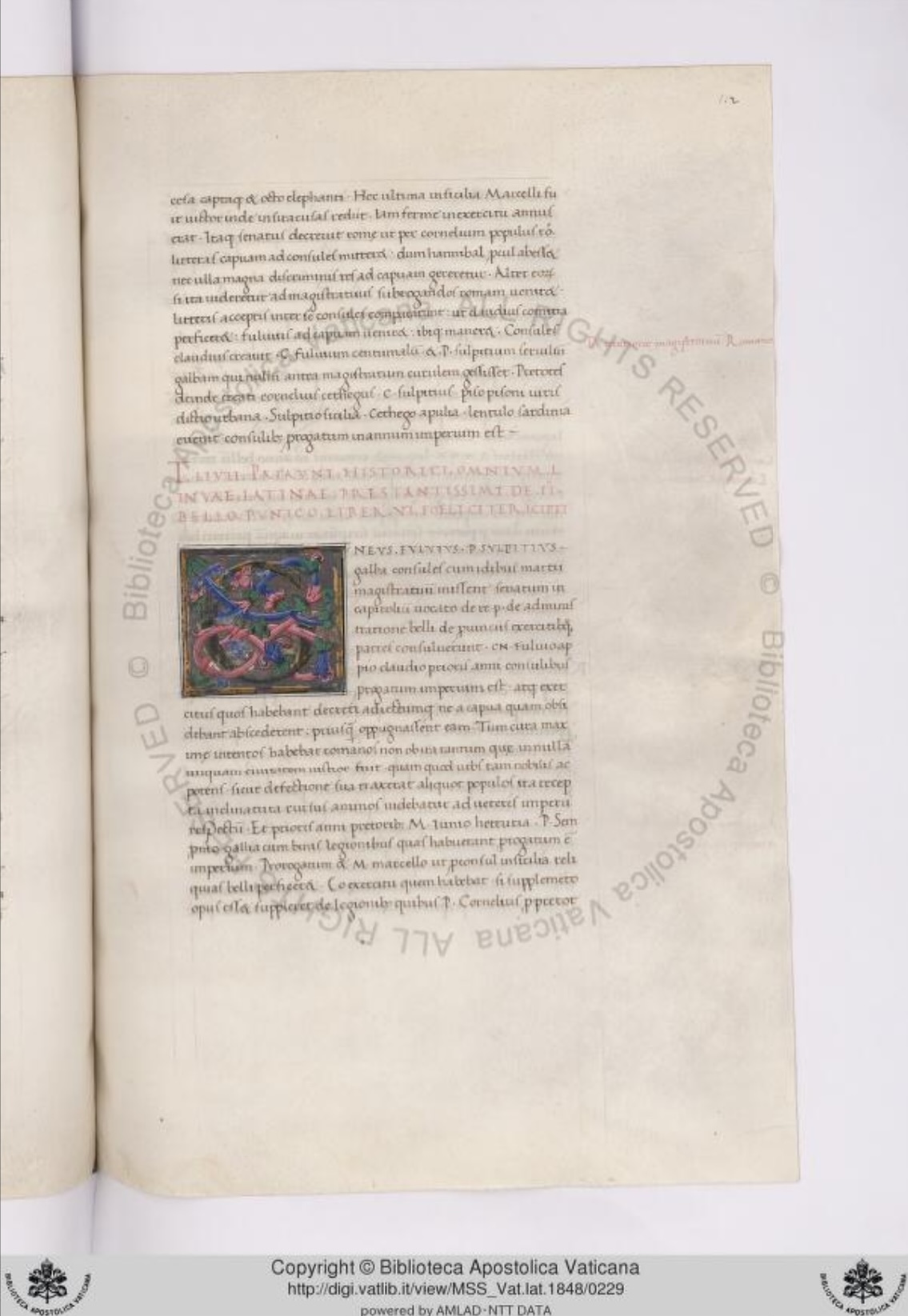
AB URBE CONDITA
Volume VII: Books 26–30 · The Second Punic War III
by Livy
Translated by F. G. Moore
INTRODUCTION
Volume VII of the Loeb Livy completes the Third Decade and with it the account of the Second Punic War. Books 26–30 carry the narrative from the midpoint of the war — when Hannibal still ranges freely through southern Italy but can no longer compel the decisive engagement he needs — to its conclusion in the peace of 201 BCE. The arc of these five books is the arc of Rome's recovery: the emergence of Publius Cornelius Scipio as the dominant Roman commander, the clearing of Spain, the defeat of Hannibal's brother Hasdrubal at the Metaurus, the carrying of the war to Africa, and the final battle at Zama. Livy's Third Decade, read as a whole, moves with something of the shape of a tragedy that is also a triumph: from the hubris of Hannibal's early victories, through the long central ordeal, to a resolution in which the virtues Livy has been cataloguing — Roman endurance, institutional resilience, the refusal to acknowledge defeat — are vindicated at last.
The Books in This Volume
Book 26 opens with the military situation of 211 BCE: Hannibal's spectacular march on Rome — a feint that fails to break the siege of Capua — and the subsequent fall of Capua to the Roman consuls. The recovery of Capua, Rome's most significant defected ally, is a turning point the narrative marks with care. The book also records the appointment of the twenty-five-year-old Publius Cornelius Scipio to command in Spain — an extraordinary departure from Roman constitutional practice, since Scipio held no magistracy — and his rapid capture of Carthago Nova (Cartagena), the Carthaginian headquarters in Spain, in a single day's assault that Livy renders as a set piece of both military daring and religious theatre: Scipio presents the capture as divinely aided and himself as a man of special relationship with the gods.
Book 27 follows the war on multiple fronts across 209–207 BCE. In Italy, the most dramatic event is the crossing of the Alps by Hannibal's brother Hasdrubal with a new army from Spain, intended to reinforce Hannibal and together deliver the blow that Cannae alone had not. The battle of the Metaurus (207 BCE), in which the consuls Gaius Claudius Nero and Marcus Livius Salinator intercept and destroy Hasdrubal's army before it can link up with Hannibal, is one of the decisive engagements of the war. The first news Hannibal receives of his brother's fate is when Roman soldiers throw Hasdrubal's severed head into his camp. Livy records Hannibal's reaction — the recognition that Carthage's fortune was finished — with characteristic economy.
Book 28 covers Scipio's remaining campaigns in Spain (206 BCE), culminating in the decisive Battle of Ilipa, after which Carthaginian power in the peninsula effectively collapses. Livy also records Scipio's meeting with the Numidian prince Masinissa, who will prove essential to the African campaign, and the mutiny of Roman troops in Spain which Scipio suppresses with a combination of firmness and clemency that Livy presents as characteristic of his genius for command.
Book 29 follows Scipio's return to Rome, his election to the consulship, and the political struggle over his proposal to carry the war to Africa. The opposition of Fabius Maximus — who argues that Rome should drive Hannibal from Italy before taking risks abroad — and Scipio's eventual triumph in the Senate form the political drama of the book, while its military narrative follows Scipio's crossing to Africa and his early operations there, including his alliance with the Numidian king Masinissa.
Book 30 brings the war to its end. Hannibal is recalled to Africa to face the invasion he has spent fifteen years in Italy trying to forestall. The two commanders — who had never previously met — hold a parley before the battle, in which Livy imagines an exchange on the nature of fortune and the limits of power that reads almost as a philosophical dialogue. Zama (202 BCE) reverses Cannae: where Hannibal at Cannae had turned Roman tactical strength against itself, Scipio uses Numidian cavalry to break the Carthaginian flanks, and the infantry engagement that follows is decided by the discipline and endurance Livy has been praising in Roman soldiers since Book 21. The peace terms, the debate at Carthage, and Hannibal's reported final journey into exile close the Third Decade.
Scipio and the Transformation of Roman Command
Books 26–30 are in large part the portrait of a new kind of Roman commander. Scipio Africanus — the cognomen he will earn from this campaign — combines the traditional Roman virtues of virtus and pietas with qualities Livy associates with Hellenistic generalship: personal charisma, strategic boldness, and a calculated use of his own reputation for divine favour. Livy admires him but watches him carefully: the charges of kingly ambition that shadow Scipio in later life are registered, and the narrative of his consulship and African command is marked by the tension between his extraordinary effectiveness and the constitutional norms a Roman commander was expected to observe.
Transmission
Books 26–30 are the final portion of the Third Decade preserved in the Puteanus (Paris, BnF, lat. 5730), the fifth-century uncial manuscript described in the introductions to Volumes V and VI. The later books of the decade show somewhat heavier wear and more frequent lacunae than the earlier ones, and the text of Book 30 in particular has passages where the manuscript tradition is uncertain. The Puteanus remains, nonetheless, the primary witness throughout. Modern critical editions also draw on a small number of medieval copies and on the Periochae (epitomes) for orientation in disputed passages.
This Translation
The translation is that of Frank Gardner Moore, published as Volume VII of the Loeb Classical Library edition of Livy (Loeb 367; Cambridge, MA: Harvard University Press, 1943). Moore presents the Latin text on facing pages with his English translation. The translation is in the public domain.
FULL TEXT
Book 26
[Book 26 opens with the year 211 BCE and Hannibal's march toward Rome, the most dramatic moment of the Italian war.]
I. In the consulship of Gnaeus Fulvius Centumalus and Publius Sulpicius Galba1, while war was being waged in many regions simultaneously and the issue was still uncertain, that year brought a great and memorable event of a nature peculiar to the period: the arrival at the walls of Rome of Hannibal with his army. This was the boldest of his attempts in Italy — and the one that brought him closest to the goal to which he had devoted fifteen years of war — yet it came to nothing, and the spectacle of a Carthaginian army before the gates of Rome passed without the city's walls being stormed or the citizens' spirits broken.
II. Hannibal had marched from Capua — for the consuls had drawn their forces tight around that city, and hunger as much as the sword was pressing the Campanians to surrender. He had decided to try whether the threat to Rome itself might not draw the siege away. From Capua he advanced rapidly, sending a flying column ahead to ravage the country along the Latin Way as far as the city's outskirts. The panic this caused was immense: men ran through the streets of Rome crying that the enemy was at the gates, that the walls were already under assault; women shrieked from their rooftops and the temples were crowded with suppliant crowds. But the two consuls before Capua did not stir.2
Bibliography
Moore, F. G., trans. Livy: Ab Urbe Condita, Volume VII (Books 26–30). Loeb Classical Library 367. Cambridge, MA: Harvard University Press, 1943.
Goldsworthy, Adrian. Scipio Africanus: Rome's Greatest General. London: Weidenfeld & Nicolson, 2006.
Hoyos, Dexter. Hannibal's Dynasty: Power and Politics in the Western Mediterranean, 247–183 BC. London: Routledge, 2003.
Lazenby, J. F. Hannibal's War: A Military History of the Second Punic War. Warminster: Aris & Phillips, 1978.
Scullard, H. H. Scipio Africanus: Soldier and Politician. London: Thames & Hudson, 1970.
Footnotes
-
The consuls of 211 BCE. Publius Sulpicius Galba went on to command against Philip V of Macedon; the year is thus a hinge between the Hannibalic War and the wars that follow it in the eastern Mediterranean. ↩︎
-
The march on Rome is one of the most famous episodes of the Second Punic War and one of the most debated strategically: whether Hannibal intended a serious assault, a demonstration to break the siege of Capua, or something more psychological, is a question ancient and modern sources answer differently. Livy presents it as a calculated gamble that failed because Roman discipline held. ↩︎