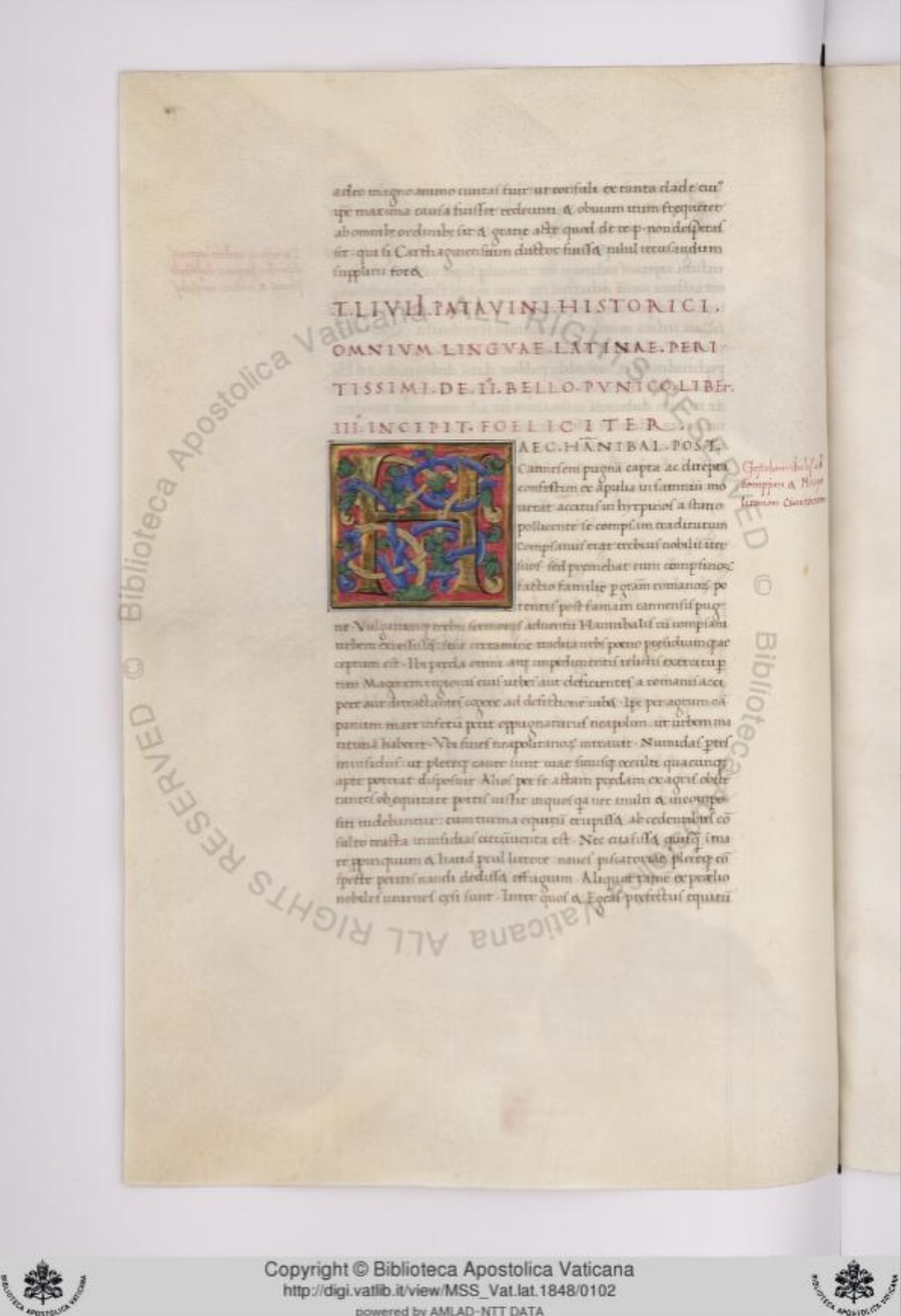
AB URBE CONDITA
Volume VI: Books 23–25 · The Second Punic War II
by Livy
Translated by F. G. Moore
INTRODUCTION
Volume VI of the Loeb Livy takes up the history of the Second Punic War at the moment of Rome's deepest crisis. The catastrophe of Cannae (216 BCE), which closed Book 22, had destroyed the largest army Rome had yet put into the field and left Hannibal master of much of southern Italy. Books 23–25 follow the war through its most complicated middle phase: the Italian theatre, in which Rome holds on while Hannibal fails to press his advantage to the point of decision; the Sicilian theatre, in which Syracuse defects to Carthage and is eventually retaken after a celebrated siege; and the Spanish theatre, where Roman arms first advance and then suffer a devastating reversal. These three books are connected not by a single dramatic arc but by the logic of attrition — the grinding, multi-front character of a war neither side can yet win.
F. G. Moore, who takes over from B. O. Foster as translator beginning with this volume, renders Livy's Latin with scrupulous care for both accuracy and the rhythms of the original prose. His notes, while spare in the Loeb fashion, identify the most important textual and historical difficulties, and his Latin text follows the best available witnesses to the Third Decade.
The Books in This Volume
Book 23 opens in the immediate aftermath of Cannae, in the Roman Senate. Livy's account of the Senate in these sessions — the determination not to ransom the prisoners, the refusal to acknowledge defeat publicly, the measures taken to replenish the legions — is one of his most admired passages, a portrait of institutional resolve under catastrophic pressure. The book then turns to the consequence that Hannibal had anticipated: the defection of Capua, the second city of Italy and the most significant ally to abandon Rome in the wake of Cannae. Hannibal winters at Capua — giving rise to the tradition of Capua corrumpens, the softening of his army by the city's luxury, a moralising reading Livy inherits and partly questions. The book also records Philip V of Macedon's treaty with Hannibal, the first indication that the war is widening beyond Italy.
Book 24 shifts the narrative focus principally to Sicily, where the death of the aged Hiero II of Syracuse triggers a dynastic crisis. His young successor Hieronymus abandons the alliance with Rome that had held since the First Punic War and negotiates with Carthage; his assassination quickly leads to further confusion and eventually to Syracuse's open defection. Livy traces these Syracusan political convulsions with evident interest in the dynamics of a small state caught between great powers. The book also follows events in Spain, where Gnaeus and Publius Scipio — the father and uncle of the future Scipio Africanus — continue to extend Rome's position north of the Ebro.
Book 25 contains the siege and fall of Syracuse, the most celebrated episode in these three books and one of the most famous in the whole of Livy. The consul Marcus Claudius Marcellus conducts the siege, but his forces are repeatedly frustrated by the war-machines devised by Archimedes — catapults, cranes, and grappling devices that lift Roman ships from the water and dash them against the walls. Livy's account of Archimedes is more restrained than the anecdotal tradition but preserves the essential image of a single mathematician holding a city against a Roman army. Syracuse eventually falls through treachery rather than assault; Archimedes is killed by a Roman soldier, against Marcellus's explicit orders, while working on a mathematical problem — in Livy's version, absorbed in figures he had drawn in the dust. Book 25 closes with the deaths of both Gnaeus and Publius Scipio in Spain, a double catastrophe that leaves the Roman position in the peninsula exposed and sets the stage for the remarkable appointment of the young Publius Cornelius Scipio to command there.
The War's Middle Phase
The three books of this volume present the war at its most intractable. Hannibal cannot deliver the decisive blow that would bring Rome's remaining allies over to his side en masse; Rome cannot drive him from Italy. The strategic significance of Sicily and Spain — both of which Livy follows in parallel with the Italian narrative — lies in their role as theatres where the war's balance might be tilted without a direct confrontation in Italy. Livy handles this multi-front narrative by moving between theatres in a way that respects the annalistic year-by-year structure of his sources while maintaining enough narrative continuity within each theatre for the reader to follow the developing situation. The result is a text that rewards patient reading: episodes that seem complete in themselves turn out to be parts of a larger pattern whose resolution is still three volumes away.
Transmission
The text of Books 23–25, like that of the whole Third Decade, rests primarily on the Puteanus (Paris, BnF, lat. 5730), the fifth-century uncial manuscript described in the introduction to Volume V. The Puteanus is supplemented by a group of medieval copies, some of which preserve readings independent of the main tradition, and by citations in later authors. The text of the Spanish campaigns in Book 25 is among the more uncertain passages of the decade, where the Puteanus is sometimes damaged or unclear and where the copyists of the medieval tradition appear to have introduced additional corruptions.
This Translation
The translation is that of Frank Gardner Moore, published as Volume VI of the Loeb Classical Library edition of Livy (Loeb 355; Cambridge, MA: Harvard University Press, 1940). Moore presents the Latin text on facing pages with his English translation. The translation is in the public domain.
FULL TEXT
Book 23
[Book 23 opens in Rome immediately after the news of Cannae, before turning to the defection of Capua.]
I. After the disaster of Cannae, Apulia, Samnium — all of it except the Pentri — went over to the Carthaginians; similarly the Bruttians and Lucanians, and, a little later, the Uzentini and almost all the Greek communities along the shore of the sea — the Tarentines, the Metapontines, the Crotonians, the Locrians — and all the Cisalpine Gauls.1 But neither the disasters which had occurred nor the defection of so many peoples moved the Romans either to mention peace or to cease from their preparations for war, so great was the spirit of the state; so that Hannibal himself after his victory, as is recorded by many writers, said to those who were congratulating him that he saw how to win a victory but not how to use one.
II. On the day following the battle of Cannae, the leaders of the Carthaginian army, who had been sitting and resting, were brought before Hannibal while still spattered with blood. When Maharbal2 urged him to follow up the victory, saying that within five days he would be feasting on the Capitol, and asked for the cavalry, Hannibal praised his readiness but said he needed time to consider so great a matter. Then Maharbal said: "Truly the gods have not given all things to one man: you know how to conquer, Hannibal, but not how to use your victory."
Bibliography
Moore, F. G., trans. Livy: Ab Urbe Condita, Volume VI (Books 23–25). Loeb Classical Library 355. Cambridge, MA: Harvard University Press, 1940.
Goldsworthy, Adrian. The Fall of Carthage: The Punic Wars 265–146 BC. London: Cassell, 2003.
Hoyos, Dexter. Hannibal's Dynasty: Power and Politics in the Western Mediterranean, 247–183 BC. London: Routledge, 2003.
Lazenby, J. F. Hannibal's War: A Military History of the Second Punic War. Warminster: Aris & Phillips, 1978.
Scullard, H. H. Scipio Africanus: Soldier and Politician. London: Thames & Hudson, 1970.
Footnotes
-
This catalogue of defections, which opens Book 23, is one of the most important passages for understanding the scale of the crisis after Cannae. It also establishes the limitation of the disaster: Rome's Latin allies and the communities of central Italy remained loyal, which ultimately proved decisive. ↩︎
-
Maharbal was Hannibal's commander of cavalry and one of his most trusted officers. The exchange between Maharbal and Hannibal — "you know how to conquer but not how to use your victory" — became one of the most famous sayings in ancient literature, endlessly cited in discussions of strategic missed opportunity. ↩︎