AB URBE CONDITA
Volume V: Books 21–22 · The Second Punic War I
by Livy
Translated by B. O. Foster
INTRODUCTION
Ab Urbe Condita (From the Foundation of the City) is the monumental history of Rome composed by Titus Livius (c. 64/59 BCE – 17 CE) of Patavium (modern Padua) across the last decades of the Republic and the first years of the Principate. In its original form it comprised 142 books, covering Roman history from the arrival of Aeneas in Italy to the death of Drusus in 9 BCE; of these, 35 survive complete — Books 1–10 and 21–45 — while the remainder are known only through later epitomes called the Periochae. The surviving books fall naturally into two great arcs: the early history and the wars of the middle Republic (Books 1–10), and the period of Rome's Mediterranean dominance (Books 21–45). Volume V of the Loeb edition opens the second arc at its most celebrated point: the beginning of the Second Punic War.
Books 21 and 22 are among the most intensely read books in all of Latin literature. They open with one of the great set-pieces of ancient historiography — Hannibal's crossing of the Alps — and carry the reader through a sequence of Roman catastrophes unmatched in the annals of the Republic: the defeat at the Trebia, the ambush at Lake Trasimene, and finally the annihilation at Cannae. That Rome survived all three, reconstituted its armies, and ultimately prevailed is a fact the reader knows in retrospect; Livy's achievement is to make that survival feel improbable, hard-won, and morally significant at every stage.
The Books in This Volume
Book 21 opens with a famous preface in which Livy declares the Second Punic War the most memorable conflict ever fought, and immediately establishes its origin in the hatred that Hamilcar Barca, Hannibal's father, carried out of the First Punic War. The oath Hamilcar extracts from the young Hannibal — that he will be Rome's enemy when he comes of age — frames the entire war as a personal as well as a national vendetta. The book then follows Hannibal's rapid campaign against Saguntum, a Spanish city allied to Rome, whose fall provides the formal casus belli; Rome's declaration of war; and the extraordinary feat of the march from Spain across the Pyrenees, through Gaul, and over the Alps in late autumn, with elephants and an army of ninety thousand infantry and twelve thousand cavalry reduced by cold, starvation, and ambush to something like half that number by the time they descended into the Po valley. The Alpine crossing is Livy's most sustained piece of geographical and military description, drawing on Polybius and on the dramatic tradition of the periplus narrative; it is also one of the most contested passages in ancient topography, as scholars have argued for centuries over which pass Hannibal actually used. The book closes with the Battle of the Trebia, Rome's first major field defeat of the war.
Book 22 follows without pause. Its opening carries the Roman disasters from bad to catastrophic: the consul Gaius Flaminius, ignoring the omens, marches into Etruria and is ambushed by Hannibal at Lake Trasimene — an engagement in which an entire Roman army of perhaps twenty-five thousand men is destroyed in under three hours, and Flaminius himself is killed. Rome responds by appointing Quintus Fabius Maximus dictator; Fabius's strategy of avoiding pitched battle while harassing Hannibal's supply lines and cutting off stragglers earns him the cognomen Cunctator (the Delayer) and the undying contempt of those who mistake inaction for cowardice. The book culminates in Cannae, on 2 August 216 BCE — arguably the most tactically perfect battle in ancient history, in which Hannibal enveloped a Roman army of approximately seventy thousand and killed perhaps fifty thousand of them in an afternoon. Livy's account of Cannae, drawing again on Polybius, is measured and devastating: he records the numbers, the movements, and then the scene of horror on the plain afterwards, the senators going through the bodies, the rings stripped from the dead.
Livy's Method and Sources
Livy is above all a literary historian: his commitment is to a morally shaped narrative in which Rome's rise and its vicissitudes alike reflect the character of the Roman people — their ancestral virtues when they prevail, their lapses when they fail. He is explicit about this in the preface to Book 1: the purpose of history is to set before readers examples of conduct to imitate and to avoid. In the Second Punic War books, this moral framework generates the central contrast between the gloria and virtus of figures like Scipio and Fabius on the one hand, and the rashness of Flaminius and the later Varro at Cannae on the other.
For the factual content of Books 21–22, Livy draws heavily — sometimes almost literally — on the Greek historian Polybius, whose account of the Hannibalic War survives in substantial portions and who had access to participants and to Carthaginian documents. Livy supplements Polybius with the Roman annalistic tradition and with earlier Latin historians such as Valerius Antias and Claudius Quadrigarius, whose reliability Livy himself sometimes questions. The result is a narrative that is often more vivid and rhetorically polished than Polybius, though also more prone to dramatic exaggeration of numbers and to moralising interpretation. The two accounts should be read alongside each other wherever possible.
Transmission
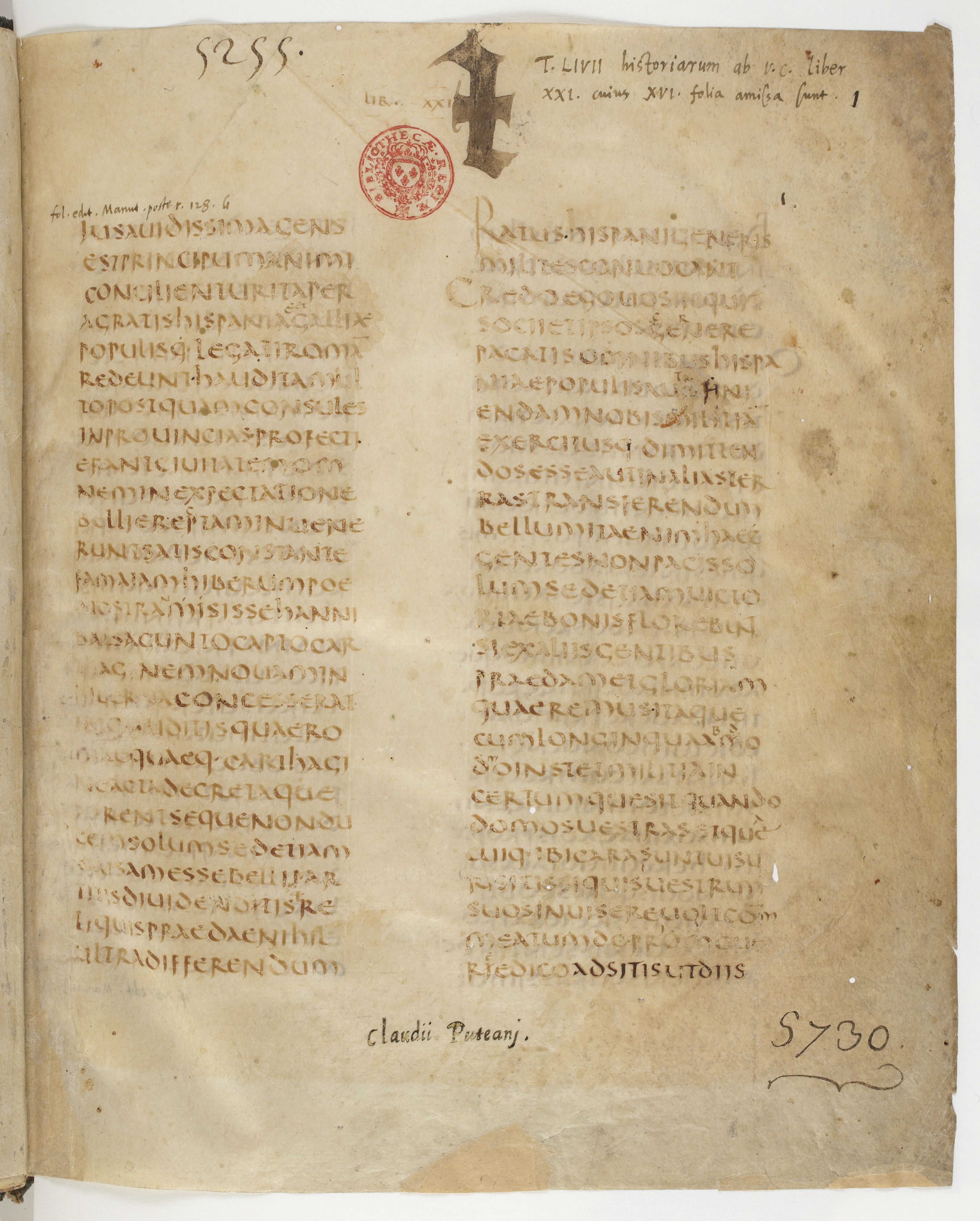
Livy's Ab Urbe Condita suffered one of the most severe losses of any major classical text: of 142 original books, 107 are entirely lost. What survives does so in two distinct traditions that reflect the accidents of medieval copying. The Third Decade — Books 21–30, covering the Second Punic War — owes its survival primarily to the Puteanus (Paris, BnF, lat. 5730), a fifth-century uncial manuscript of exceptional quality and antiquity, the oldest substantial Livy manuscript in existence. Named for its sixteenth-century owner Claude Dupuy, the Puteanus was already old when the medieval copies of the Third Decade were made from it or from its relatives, and it remains the foundation of all modern critical editions of Books 21–30. The editio princeps of Livy was printed at Rome in 1469 by Sweynheym and Pannartz, one of the earliest classical texts to reach print.
This Translation
The translation is that of Benjamin Oliver Foster, published as Volume V of the Loeb Classical Library edition of Livy (Loeb 233; Cambridge, MA: Harvard University Press, 1929). Foster presents the Latin text on facing pages with his English translation. The translation is in the public domain.
FULL TEXT
Book 21
[Livy opens with a preface before proceeding to the origins of the war in Hamilcar's campaigns in Spain and the oath of the young Hannibal.]
I. In this part of my history I shall be permitted to preface it with an observation which most historians have made at the outset of their works: that the war which I am about to describe is the most memorable of all wars that have ever been waged — I mean the war which the Carthaginians, under Hannibal's leadership, maintained with the Roman people. For no states, no nations ever met in arms greater than these, and never were these states themselves stronger in resources and power than at this time; nor were the signals employed by either side unknown — these states had been drawn close by the First Punic War — and so well matched were the two sides in the vicissitudes of fortune that those who ultimately won were brought closer to destruction. And the Carthaginians fought with hatred almost greater than their power. So great was the exertion of both sides that the fortunes of either depended more on the excellence of their commanders than on the strength of their forces.1
II. I am aware that many historians have been careless of the truth in recording the origin of this war, but I will pass by Fabius2, who is the author most trusted by the Romans. The origin, which nearly all writers agree upon, was the siege of Saguntum3 and the crossing of the Ebro by the Carthaginians, contrary to a treaty. My first concern is to explain what Hamilcar's aims were, which he formed and nurtured, and how the hatred of Rome, which began with himself, was passed on, multiplied as it were by inheritance, to his son. It is agreed that when Hamilcar was about to cross with his army into Africa4, after the conclusion of the peace following the First Punic War, Hannibal, then about nine years old, was childishly importuning his father to take him along to Spain, and that Hamilcar, about to offer sacrifice to pray for a successful outcome, led him to the altar and made him swear, with his hand upon the offerings, that as soon as he was old enough he would be the enemy of Rome.
Bibliography
Foster, B. O., trans. Livy: Ab Urbe Condita, Volume V (Books 21–22). Loeb Classical Library 233. Cambridge, MA: Harvard University Press, 1929.
Caven, Brian. The Punic Wars. London: Weidenfeld & Nicolson, 1980.
Hoyos, Dexter. Hannibal's Dynasty: Power and Politics in the Western Mediterranean, 247–183 BC. London: Routledge, 2003.
Lazenby, J. F. Hannibal's War: A Military History of the Second Punic War. Warminster: Aris & Phillips, 1978.
Walbank, F. W. A Historical Commentary on Polybius. 3 vols. Oxford: Clarendon Press, 1957–1979.
Footnotes
-
Livy's preface to Book 21 is the closest he comes, in the surviving books, to a second general proem; the actual preface to the whole work survives at the opening of Book 1. The assertion that the Punic War surpassed all previous conflicts was a commonplace of the Roman historical tradition and appears also in Polybius. ↩︎
-
Quintus Fabius Pictor (c. 254–201 BCE), the earliest Roman historian, who wrote in Greek. He was a contemporary of the Second Punic War and a primary source for both Livy and Polybius, though Livy considers him a partisan of Roman interests. ↩︎
-
Saguntum (modern Sagunto, near Valencia) was an Iberian city that had placed itself under Roman protection, probably around 226 BCE. Hannibal besieged and took it in 219 BCE, provoking Rome's declaration of war, though the legal question of whether Saguntum lay within Carthage's permitted sphere under the Ebro treaty was disputed in antiquity and remains debated. ↩︎
-
After the First Punic War (241 BCE), Hamilcar commanded the Carthaginian forces in Sicily; he led his army back to Africa after the peace, then left for Spain, where he spent the remainder of his life building a Barcid empire. He died in battle in Spain in 229 or 228 BCE. ↩︎