AB URBE CONDITA
Volume XIII: Books 43–45 · The Battle of Pydna
by Livy
Translated by A. C. Schlesinger
INTRODUCTION
Volume XIII of the Loeb Livy contains the last three books of the surviving text — Books 43, 44, and 45 — and with them the conclusion of the Third Macedonian War, the destruction of the Macedonian monarchy, and the triumph of Lucius Aemilius Paullus. After Book 45, the text of the Ab Urbe Condita breaks off: Books 46–142 are entirely lost, and what remains of them are the Periochae, brief chapter-summaries that give the bare outlines of content without the narrative or the rhetoric. Reading Volume XIII is therefore reading Livy's surviving text to its end — and that end is one of the most resonant in classical historiography: the humiliation of a king, the dissolution of a kingdom, and the triumph of a Roman commander who is also one of the last exemplars of the old Republican virtues Livy has been holding up throughout the work.
A. C. Schlesinger completes the translation of the Loeb Livy with these three books. His rendering of the climactic battle narrative and of the extended account of Aemilius Paullus's triumph — one of the longest descriptions of a Roman triumph in ancient literature — is careful and alert to the literary as well as the historical dimensions of Livy's text.
The Books in This Volume
Book 43 covers the years 169–168 BCE, the period of Rome's military difficulties before the appointment of Aemilius Paullus. The early campaigns against Perseus had gone badly: a series of Roman commanders had failed to bring the Macedonians to a decisive engagement, supply lines were disrupted, and the army in Greece was demoralised. The senate's response — the appointment of the experienced and distinguished Lucius Aemilius Paullus to the Macedonian command — is recorded by Livy as a turning point whose significance was immediately understood at Rome. Book 43 also records the military situation in other theatres (Liguria, Spain, Illyricum) and the proceedings of the censors of 169 BCE, including their controversial handling of public contracts — one of the most detailed accounts of Roman financial administration in the surviving text.
Book 44 is the book of Pydna. Aemilius Paullus crosses to Greece, reorganises the Roman army with the firm discipline for which he was famous, and manoeuvres Perseus into a position from which retreat is impossible. The battle of Pydna (22 June 168 BCE) is fought near the coast of Macedonia in the early afternoon; it is over within an hour. The Macedonian phalanx, advancing over level ground, breaks the Roman front initially, but when the pursuit carries it onto broken terrain the phalanx loses cohesion and the Roman maniples, able to fight in the gaps, destroy it piece by piece. Perseus escapes by sea but has nowhere to go. Book 44 also contains Livy's account of a lunar eclipse on the night before the battle — observed by a Roman military tribune who had read enough Greek astronomy to reassure the soldiers that the eclipse was natural rather than ominous — a passage sometimes cited as evidence for the practical penetration of Greek science into the Roman military world.
Book 45 follows the aftermath of Pydna: the capture of Perseus, the Roman settlement of Macedonia (which is divided into four independent republics rather than annexed as a province), the punishment of states that had shown sympathy for Perseus during the war, and the long, detailed account of Aemilius Paullus's triumph at Rome. The triumph lasted three days. Livy enumerates its contents with the care of someone who had access to a written record: the gold and silver plate, the coins, the arms and armour, the statues, the captive princes and their attendants, and finally Perseus himself, walking in chains before the chariot of the man who had defeated him. The book — and the surviving text — closes with the death of Aemilius Paullus and his funeral eulogy. The Ab Urbe Condita does not so much end as stop.
The Last Exemplar
Aemilius Paullus is Livy's final great Roman in the mould of the ancestral virtue he has been celebrating and lamenting since the preface to Book 1. The portrait in Books 44–45 emphasises his severity, his learning (he took time after Pydna to tour Greece and visit its monuments), his generosity to defeated enemies, and his refusal to profit personally from his victory — he added nothing to his own patrimony from the enormous wealth that flowed through his triumph. His two sons died within days of each other, just before and just after the triumph, and the speech Livy puts in his mouth at the funeral — accepting the deaths as Fortune's demand for a counterweight to so great a success — reads as a meditation on the relationship between public glory and private suffering that gives the end of the surviving text an elegiac gravity it could not have been planned to have, since Livy did not know where his history would break off.
Transmission
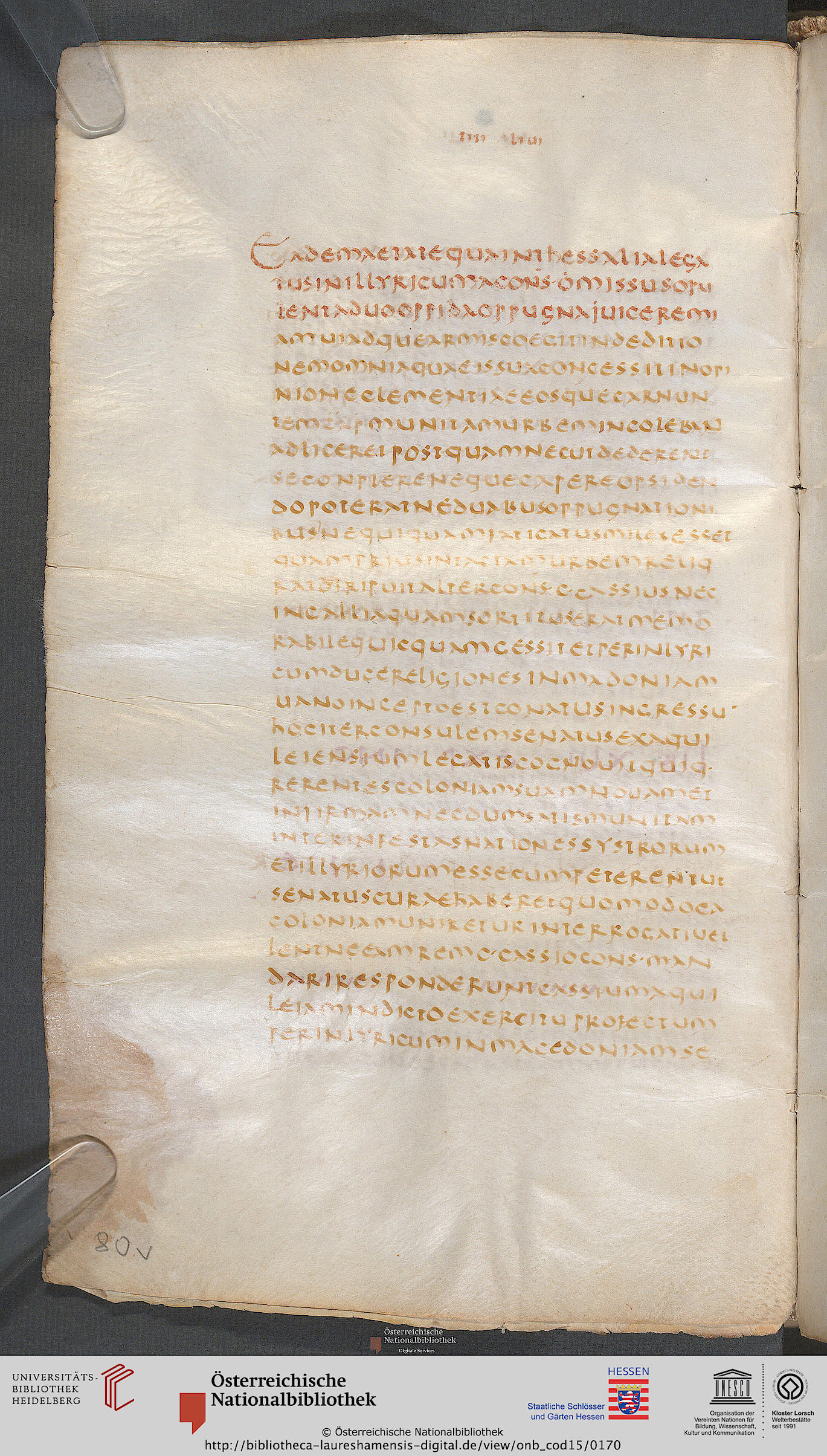
The transmission of Books 43–45 — and of Books 41–45 as a whole — is among the most dramatic stories in classical scholarship. For over a thousand years these books were entirely absent from the manuscript tradition: no medieval copy circulated, no humanist had read them, and by the fifteenth century scholars assumed they might be lost forever. In 1527 a single ancient manuscript was found in the library of Lorsch Abbey (Kloster Lorsch), a Carolingian foundation in Hesse, Germany, that had preserved the volume through the intervening centuries including the Viking raids that sacked the abbey in 882 CE. That manuscript — the Codex Vindobonensis Lat. 15 (Cod. Vind. Lat. 15), now in the Österreichische Nationalbibliothek, Vienna, and known as the Lorsch Manuscript — is written in late antique Uncial script and dated to approximately the fifth century CE.
It is a codex unicus: the sole surviving ancient witness to Books 41–45. There is no second manuscript, no parallel tradition, no independent line of transmission against which its readings can be checked. Every modern critical edition of these five books — including the present Loeb volume — rests entirely on what is written on its pages. Where the ink has faded, where the parchment is damaged, where a scribe made an error, editors must emend without the safety net of a second witness; where the manuscript is clear, its authority is absolute and unreviewable. The bleed-through, faded iron gall and cinnabar inks, and physical damage visible throughout its folios are not merely signs of age but direct constraints on what can be known about Livy's text of Books 43–45.
The manuscript is digitised through the Bibliotheca Laureshamensis Digital project, a collaboration between the Österreichische Nationalbibliothek and the Universitätsbibliothek Heidelberg, and is freely accessible online. The Periochae of the lost Books 46–142, which survive independently through a separate tradition, begin immediately after the break in Book 45 and confirm that the surviving text does not correspond to the end of a natural narrative unit — the history was still very far from finished when the manuscript tradition stops. The precise editorial treatment of the Lorsch Manuscript's readings in Books 43–45 is set out in Michael Reeve's chapter on Livy in L. D. Reynolds (ed.), Texts and Transmission: A Survey of the Latin Classics (Oxford: Clarendon Press, 1983), pp. 205–214.
This Translation
The translation is that of Alfred Cary Schlesinger, published as Volume XIII of the Loeb Classical Library edition of Livy (Loeb 396; Cambridge, MA: Harvard University Press, 1951). Schlesinger presents the Latin text on facing pages with his English translation. The translation is in the public domain.
FULL TEXT
Book 43
[Book 43 opens in 169 BCE, the second year of the Third Macedonian War, with Rome's military position in Greece deteriorating and the appointment of Aemilius Paullus under discussion.]
I. The consuls of this year were Quintus Marcius Philippus and Gnaeus Servilius Caepio1. At the opening of the year the senate heard reports from Macedonia with mounting concern. The army in the field had failed to press its advantages; the consul's operations of the previous year had yielded territory that could not be held; and Perseus, far from being reduced, appeared to be gaining in confidence. The allies of Rome in Greece watched with the calculation of those who have not yet decided on which side their interest lies. The senate resolved that the Macedonian command must be entrusted to a man of the first quality, and the name of Lucius Aemilius Paullus was raised.
II. Paullus was at that time sixty years old, or thereabouts, and had held both consulships already2; he was known as a man of strict discipline, of deep learning — he had given his sons the best available Greek education — and of that old-fashioned severity that, in the opinion of those who praised him, the present generation had largely abandoned. He himself had said nothing publicly about Macedonia. But when the people assembled in the Centuriate Assembly to elect the commanders, he was called forward and spoke with a directness that silenced opposition: the man who criticises a general's conduct, he told them, ought to be prepared to take command himself. He was elected.
Bibliography
Schlesinger, A. C., trans. Livy: Ab Urbe Condita, Volume XIII (Books 43–45). Loeb Classical Library 396. Cambridge, MA: Harvard University Press, 1951.
Champlin, Edward. "Creditur Vulgo: Suetonius and Livy on the Death of Aemilius Paullus." Classical Quarterly 30 (1980): 170–173.
Hammond, N. G. L., and F. W. Walbank. A History of Macedonia, Volume III: 336–167 BC. Oxford: Clarendon Press, 1988.
Reiter, William. Aemilius Paullus: Conqueror of Greece. London: Croom Helm, 1988.
Walbank, F. W. "The Causes of the Third Macedonian War: Recent Views." Ancient Macedonia 2 (1977): 81–94.
Footnotes
-
The consuls of 169 BCE. Neither distinguished themselves in Macedonia; the failure of Quintus Marcius Philippus's campaign there was among the considerations that led to the appointment of Aemilius Paullus as commander for 168 BCE. ↩︎
-
Lucius Aemilius Paullus (c. 229–160 BCE) had held the consulship in 182 and 168 BCE. He was the father-in-law of Scipio Africanus (his daughter Papiria had married the elder Africanus) and the natural father of Scipio Aemilianus — the destroyer of Carthage and Numantia — who was adopted into the Scipionic family. He thus stood at the intersection of the two great families of the middle Republic. ↩︎