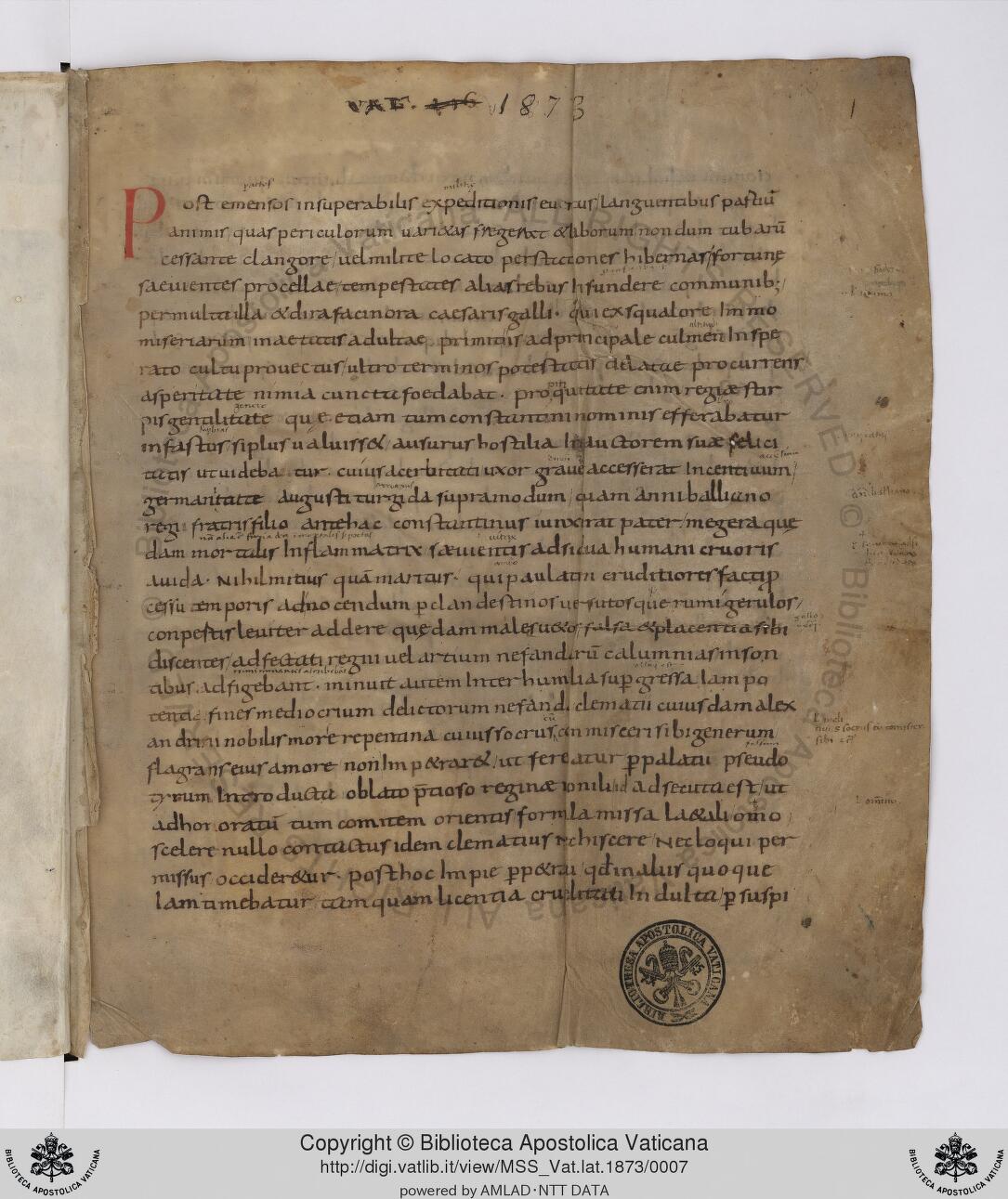
Latin text and section numbering follow the Loeb Classical Library edition (vols. 300, 315, 331). References cite book and chapter in the standard form (e.g., XIV.6). The three volumes cover Books XIV–XIX (1935), XX–XXVI (1937), and XXVII–XXXI (1940).
Overview
The Work
Ammianus Marcellinus wrote the last great Latin history of ancient Rome — a continuation of Tacitus, covering the years 96 to 378 CE, of which only the later books (XIV–XXXI, narrating the years 353–378) survive. He wrote as a soldier and an eyewitness: he had served on the eastern frontier under Julian, wintered in Antioch, and was present, if not at Adrianople itself, close enough to report on its aftermath with the authority of a man who knew what defeat in the field looked like. The Res Gestae is the work of a mind formed by military experience and sustained reading in equal measure — a historian who could describe the tactics of a siege and the malice of a court official, the theology of an emperor and the geology of a volcanic island, with the same dense, baroque, profoundly idiosyncratic Latin that has defeated and rewarded readers ever since.
The surviving books open in 353 CE, with the court of Constantius II at its most paranoid — a world of informers, treason trials, and midnight arrests that Ammianus describes with barely suppressed fury. They close in 378 CE with the disaster at Adrianople, where the Emperor Valens and the flower of the eastern Roman army were destroyed by the Visigoths in a battle Ammianus clearly regards as a civilizational turning point. Between these termini the reader passes through Julian's Persian campaign (including Ammianus himself as a participant), the brief reign of Jovian, the division of the empire under Valentinian and Valens, the wars on the Rhine and Danube frontiers, and the first Gothic crossing of the lower Danube that culminated at Adrianople. The work is at once the most important narrative source for this critical quarter-century and one of the most demanding and richly rewarding texts in Latin literature.
The Edition
The 1935–1940 Loeb Classical Library edition, translated by John Carew Rolfe (1858–1943), was the standard English scholarly rendering of Ammianus for the greater part of the twentieth century. It replaced Philemon Holland's 1609 translation — a remarkable Elizabethan achievement but by then remote from both the Latin scholarship and the English idiom of its time — and C.D. Yonge's 1862 version, which had served Victorian readers but was showing its age by the interwar period. Rolfe's edition presented the Latin text and English translation on facing pages in the standard Loeb format, with brief marginal notes and an introduction to the historian's life, sources, and style.
The three volumes appeared across five years: Volume 1 (Books XIV–XIX) in 1935, Volume 2 (Books XX–XXVI) in 1937, and Volume 3 (Books XXVII–XXXI) in 1940. The first volume was later revised, with new printings appearing in 1963 and 1964. The edition is catalogued as Loeb Classical Library numbers 300, 315, and 331.
The Author
Ammianus Marcellinus was born around 330 CE, almost certainly at Antioch in Syria, though he is reticent about his own biography. He was of Greek mother tongue — his Latin, however formidable its ambitions, carries the signature of a writer who learned the language as an adult — and received an education sufficient to produce a historian of vast reading. He served as a military officer (protector domesticus) under the general Ursicinus from around 354 CE and accompanied him on campaigns in Gaul and on the Persian frontier. He was present during Julian's Persian expedition of 363 CE and survived the disastrous retreat after Julian's death. He eventually settled in Rome, probably in the 380s, where he delivered public readings of his history and completed the Res Gestae.
He wrote, as he says, as a former soldier (miles quondam et Graecus) — a Greek who wrote Latin, a pagan who outlived the pagan empire, an easterner who spent his mature life in the Latin West. These displacements inform every aspect of his style and his vision of history. He admired Julian with a fervour that stops just short of hagiography. He loathed the corruption of the senatorial aristocracy he observed in Rome. He was capable of profound fairness toward the enemies of Rome — his ethnographic digressions on the Persians, the Huns, and the Goths are among the most sophisticated analyses of non-Roman peoples in ancient literature — and equally capable of a scorn for imperial bureaucrats and court favourites that reads like controlled rage.
The date of his death is unknown. The Res Gestae was probably completed in the early 390s CE.
The Translation
John Carew Rolfe was an American classical scholar, long associated with the University of Pennsylvania, best known in his day for his work on Sallust and Suetonius. His Ammianus, produced late in his career, was praised on publication for its accuracy and its reliable handling of the Latin. A review in Classical Philology commended it as a substantial improvement on Yonge and a trustworthy guide to a difficult text.
Rolfe's English is of its period: clear, Latinate in syntax, competent but not literary. It does not attempt to reproduce the rhythmic density of Ammianus' prose — the elaborate periodic sentences, the glancing allusions, the sudden darkening of tone — and readers coming to Ammianus first through Rolfe may be surprised to discover, when they encounter Walter Hamilton's Penguin translation or the original Latin, how much colour the Loeb rendering leaves behind. What Rolfe provides is fidelity and accessibility: a translation that allows the scholar to check the Latin and the general reader to follow the narrative without losing the thread.
For most of the twentieth century, Rolfe's was the Ammianus. The appearance of John Carew Rolfe's three Loeb volumes on a library shelf was as much a fixture of classical scholarship as the crimson bindings themselves. The edition has since been supplemented — though not fully replaced — by Hamilton's readable Penguin abridgement (1986), covering Books XIV–XXXI, and by the more recent translations and commentaries produced by the scholarship that followed the revival of late antique studies in the 1970s and 1980s.
Publication Details
| Full title | Ammianus Marcellinus, with an English Translation by John C. Rolfe |
| Translator | John Carew Rolfe |
| Publisher | Harvard University Press (Cambridge, MA); W. Heinemann Ltd. (London) |
| Date | 1935–1940 |
| Volumes | 3 (Loeb Classical Library nos. 300, 315, 331) |
| Vol. 1 | Books XIV–XIX · 1935 · revised printings 1963, 1964 |
| Vol. 2 | Books XX–XXVI · 1937 |
| Vol. 3 | Books XXVII–XXXI · 1940 |
| Format | Latin text with facing English translation |
| Period covered | 353–378 CE |
| Predecessor translations | Philemon Holland (1609); C.D. Yonge (1862) |
Full Text
Volume 1 (Books XIV–XIX), 1935 — via Internet Archive:
Further Reading
The Latin Text
Wolfgang Seyfarth, Rerum Gestarum Libri Qui Supersunt (Teubner, 1978, 2 vols.) — the standard critical text of Ammianus, replacing the older editions of Gardthausen (1874–1875) and Clark (1910–1915). Seyfarth's apparatus reflects the advances in manuscript scholarship of the twentieth century and is the basis for most subsequent translations and commentaries.
Translations
Walter Hamilton (Penguin Classics, 1986) — a readable, selective translation covering Books XIV–XXXI, with introduction and notes by Andrew Wallace-Hadrill. Hamilton's English is more idiomatic than Rolfe's and better captures the satirical edge and narrative momentum of Ammianus; the Wallace-Hadrill introduction is an excellent orientation to the historical and literary context. The standard recommendation for general readers.
C.D. Yonge (Bohn's Classical Library, 1862) — the Victorian predecessor to Rolfe, now of mainly historical interest but available in full online. Yonge's English has period charm and is more energetic in places than Rolfe, but his text was less reliable and his handling of the technical military vocabulary inconsistent.
Introductions and Studies
John Matthews, The Roman Empire of Ammianus (Johns Hopkins University Press, 1989) — the most comprehensive modern study of Ammianus in English. Matthews reads the Res Gestae as both a historical source and a literary text, attending closely to Ammianus' methods, sources, digressions, and blind spots. The chapters on the digressive excursuses — geography, ethnography, natural phenomena — are especially illuminating. Essential for any serious engagement with the historian.
Gavin Kelly, Ammianus Marcellinus: The Allusive Historian (Cambridge University Press, 2008) — a study of Ammianus' relationship to his literary predecessors, particularly Tacitus and Livy. Kelly argues that Ammianus is a far more self-conscious and allusive stylist than older scholarship recognised, and that the apparent roughness of his Latin is often deliberate archaism or literary quotation. Rewarding for readers who come to the Res Gestae with some background in Latin historiography.
Noel Lenski, Failure of Empire: Valens and the Roman State in the Fourth Century AD (University of California Press, 2002) — the definitive modern study of the reign of Valens (364–378), the period that Ammianus narrates in his final books and that ends at Adrianople. Lenski reads Ammianus alongside papyri, inscriptions, laws, and archaeological evidence, and provides indispensable context for the military and political history of the period.
Guy Sabbah, La méthode d'Ammien Marcellin (Paris, 1978) — a major French study of Ammianus' historical methodology, narrative technique, and use of sources. Not translated into English but widely cited in Anglophone scholarship; accessible to readers with research French.
On the Period
Peter Heather, The Fall of the Roman Empire (Macmillan, 2006) — a narrative account of the fifth-century collapse with deep roots in the period Ammianus covers. Heather's treatment of the Hunnic migrations and the Gothic crisis of 376–378 provides essential context for the final books of the Res Gestae.
Adrian Goldsworthy, How Rome Fell (Yale University Press, 2009) — a study of the structural military and political weaknesses of the later empire, providing background for the world Ammianus describes. More focused on internal Roman dynamics than Heather; useful as a complement.
Guy Halsall, Barbarian Migrations and the Roman West, 376–568 (Cambridge University Press, 2007) — the most historically rigorous account of the migration period. Halsall is usefully sceptical of the narrative sources, including Ammianus, and provides a necessary corrective to readings of the Res Gestae that take its dramatic framing too literally.