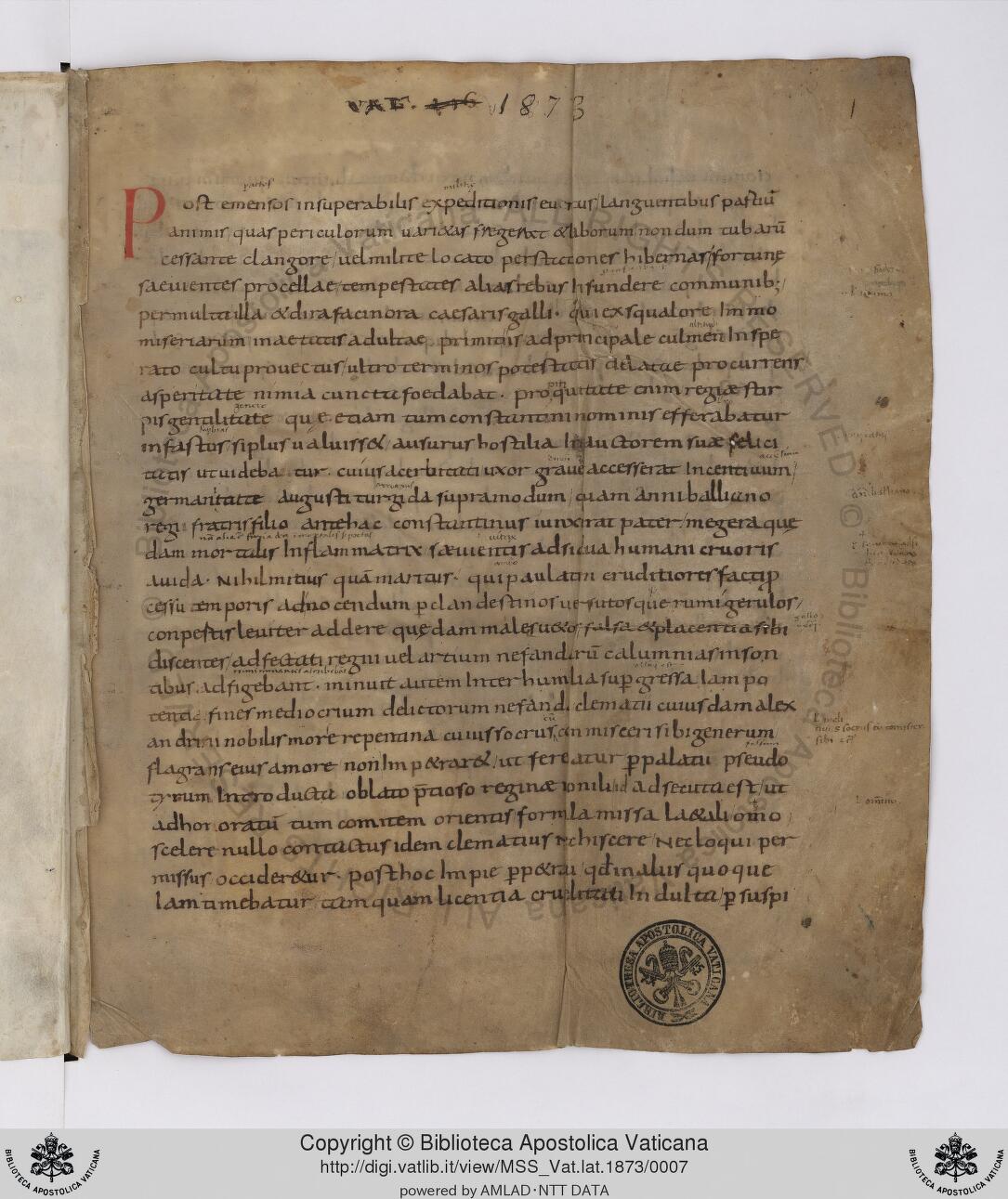
Folio 1r of the manuscript Vaticanus Latinus 1873, a 9th-century Carolingian codex of the Res Gestae by the Roman historian Ammianus Marcellinus. Known as the Codex Fuldensis (named for the Abbey of Fulda where it was rediscovered by humanist Poggio Bracciolini in 1417), it is the primary surviving source for the final 18 books of Ammianus’s history. This page marks the beginning of Book XIV, which chronicles the downfall of the Caesar Constantius Gallus. The large red initial P begins the word 'Post,' introducing the text: 'Post emensos insuperabiles expeditionum eventus...' ('After the outcome of insurmountable expeditions...'). The text is written in Carolingian minuscule, a clear and uniform script developed during the reign of Charlemagne to standardize European Latin texts. Because the first 13 books of Ammianus’s work are lost to history, this specific page represents the modern 'start' of one of the most important historical accounts of the late Roman Empire (covering 353–378 AD). You can see various marginal and interlinear notes (glosses) added by later scholars, including famous Renaissance humanists like Niccolò Niccoli and Giulio Pomponio Leto, who studied this exact volume to recover classical knowledge. Source: Biblioteca Apostolica Vaticana (Vat. lat. 1873)

Res Gestae (Ammianus Marcellinus, Rolfe Translation)

Full text of Ammianus Marcellinus' Res Gestae in the Loeb Classical Library edition (vols. 300, 315, 331), translated by John C. Rolfe — the standard 20th-century English rendering of the last great Latin historian of Rome.
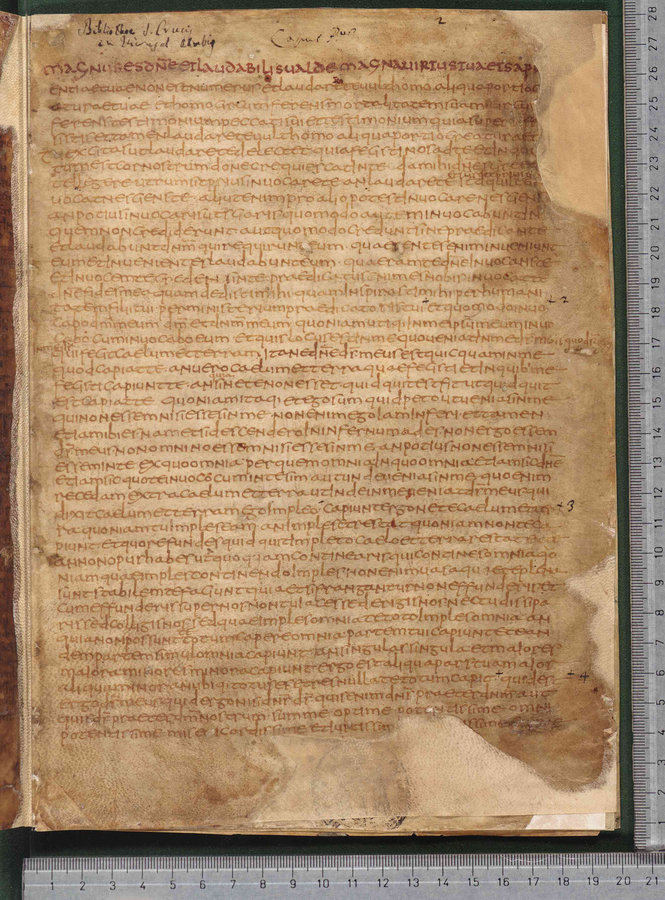
9th-century semi-uncial Latin manuscript page of Augustine's Confessions, the oldest known witness, with large display capitals and dense cursive text on aged parchment.

Confessions

A reading companion for Augustine's Confessions — the foundational autobiography of the Western spiritual tradition, exploring memory, time, restlessness, and the soul's return to God.