Overview
The Annals (Annales) is the major historical work of Publius Cornelius Tacitus, composed in the early second century AD, probably between c. 109 and 120. It narrates the history of the Roman Empire from the death of Augustus in AD 14 to the death of Nero in AD 68, covering the reigns of Tiberius, Caligula, Claudius, and Nero — the four successors of the first emperor and the last of the Julio-Claudian dynasty. The work originally comprised eighteen books (though ancient authorities differ on the precise total), of which roughly half survive. The Annals stands alongside the Histories as the fullest extant account of early imperial Rome and is the foundational text for any serious study of the Principate. In the Latin literary tradition it occupies a position of the highest importance: Tacitus is regarded as one of the supreme Latin prose stylists, and the Annals — dense, ironic, and relentlessly political — is his masterpiece.
The Author
Gaius (or Publius) Cornelius Tacitus was born c. AD 56–57, probably in Gallia Narbonensis or Cisalpine Gaul. He pursued a senatorial career with distinction, serving as praetor in AD 88, suffect consul in AD 97, and ultimately proconsul of Asia c. AD 112–113. He was thus an intimate observer of the imperial system he described — old enough to have lived through Domitian's reign of terror and to have watched the Senate's collective humiliation at that emperor's hands. His friendship with Pliny the Younger is well attested through their surviving correspondence.
In the Annals, Tacitus projects the persona of an austere, disillusioned senator writing under the difficult conditions imposed by autocracy. The famous phrase of the preface — sine ira et studio, without anger or partiality — presents the work as dispassionate chronicle, though his prose bristles with barely suppressed moral judgment on nearly every page. His experience of senatorial complicity under Domitian appears to have shaped, and sharpened, his analysis of how the Senate degraded itself under the Julio-Claudians.
Structure and Survival
The Annals is organized annalistically — year by year — in the tradition of the Republican annales maximi, treating military, political, and domestic affairs in sequence for each consular year. The work as originally composed appears to have run to eighteen books, though the division and total remain disputed.
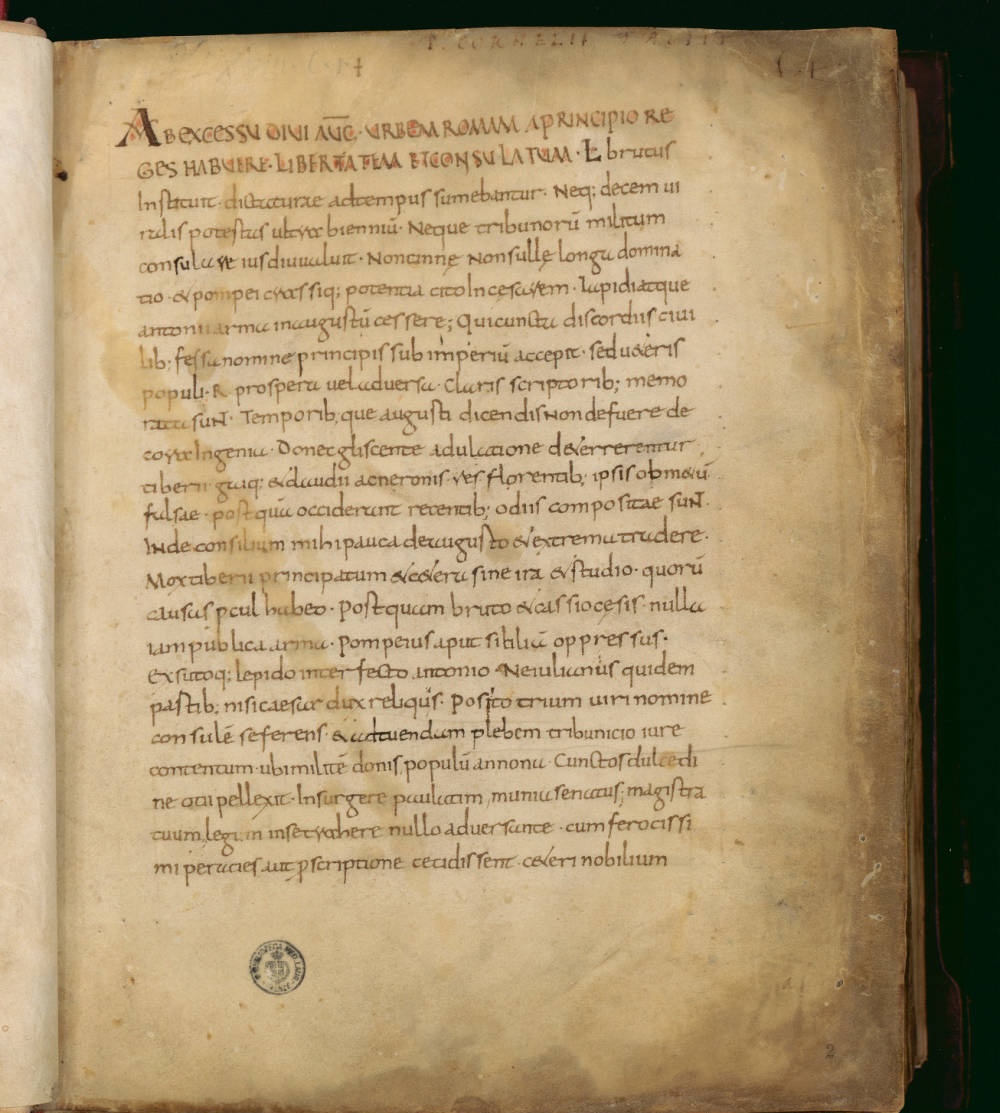
The survival of the text is complicated and incomplete. Books I–VI (covering Tiberius) survive via a single Carolingian manuscript, the Codex Mediceus I (Florence, Biblioteca Medicea Laurenziana, Plut. 68.1), copied at Fulda in the ninth century and brought to Italy by Poggio Bracciolini around 1508. Book V is partially lost, and the opening of Book VI is also missing. Books XI–XVI (covering Claudius and Nero) survive via a second manuscript, the Codex Mediceus II (Plut. 68.2), also Carolingian and originating at Montecassino. Book XI begins imperfectly, and Book XVI breaks off abruptly mid-narrative. Books VII–X, covering the reign of Caligula, are entirely lost, as is whatever material completed Book XVI and any books that may have followed it.
Books
Book I — The Succession of Augustus
Book I opens with one of the most celebrated passages in Latin literature: a compressed and sardonic survey of Roman constitutional history from the kings through the Republic and the rise of Augustus. Tacitus then turns to the death of Augustus at Nola in AD 14, the mechanics of the succession, and the first acts of Tiberius. The bulk of the book covers the mutinies of the Pannonian and Rhine legions — soldiers demanding better pay and conditions, exploited by agitators, and suppressed through a mixture of concession and severity by Germanicus and Drusus. Germanicus's campaign across the Rhine and his visit to the site of the Varian disaster — the Teutoburg Forest, AD 9 — provide some of the most atmospheric writing in the work.
Selected Excerpts
The opening sentence (Annals I.1): Urbem Romam a principio reges habuere — "The City of Rome from its inception was held by kings." The bluntness is deliberate. In a single sentence Tacitus compresses Rome's constitutional history into an inexorable cycle: kings, consuls, temporary dictators, and now — implicitly — kings again. The preface that follows is a masterpiece of compressed political analysis, establishing the terms on which the whole work will proceed.
The death of Augustus (Annals I.5–9): Tacitus reports competing rumors about whether Livia hastened Augustus's death to secure Tiberius's succession, then presents the range of public reactions to Augustus's reign — admiration, criticism, mixed assessment — in a series of reported speeches that function as a kind of posthumous trial. The passage is a model of the Tacitean method: events are related, interpretations are multiplied, and certainty is withheld.
More Selected Excerpts
The first act of the new principate was the slaughter of Postumus Agrippa, unawares and unarmed, whom a centurion, despite bracing himself in spirit, dispatched only with difficulty. Tiberius did not speak about the matter in the senate: he was pretending there were orders from his father, in which he had written in advance to the tribune assigned to the guard that the latter should not hesitate in putting Agrippa to death whenever he himself consummated his final day.
But at Rome there was a rush into servitude from consuls, fathers, equestrians. The more illustrious each was, the more false and frantic, and, with their looks composed to avoid delight at the passing—and too much gloom at the commencement—of a princeps, they blended tears with joy and mourning with sycophancy.
This was the condition of City affairs when mutiny befell the Pannonian legions, not from any novel causes except that it was a change of princeps which offered the license for disruption and, resulting from civil war, the hope of prizes.
News of these events drove Tiberius—though reclusive and especially given to concealing all the grimmest matters—to dispatch his son Drusus along with community leaders and two praetorian cohorts, with no particularly fixed instructions but to make decisions in the light of the situation.
During the course of almost the same days, and from the same causes, the German legions were disrupted—all the more violently, given their greater numbers, and with high hopes that Germanicus Caesar would be unable to suffer the command of another and would entrust himself to the legions, who would handle everything by their own force.
Meanwhile Germanicus, who (as we have said) was being responsible for a census throughout the Galliae, received the news that Augustus had passed away.
The memory of Drusus among the Roman people was considerable, and it was believed that, if he had been in charge of affairs, he would have given them back their freedom. Hence goodwill toward Germanicus, and the same hope. For the young man had the instinct of an ordinary citizen and a remarkable affability quite different from Tiberius' conversation and look, arrogant and dark as they were.
It was neither in battle nor from opposing camps but from the same beds that men—whom the day had found eating together and the night resting together—split into factions and thrust in their weapons.
On entering the camp soon after, Germanicus described the event, with very many tears, not as a cure but a disaster, and he ordered the bodies to be cremated. Into their minds, which even then were still callous, there flew the desire of going against the enemy as an expiation of their madness: the shades of their fellow soldiers would be appeased, they said, only if they sustained honorable wounds on their impious breasts. Caesar fell in with the soldiers' fervor, and, once a bridge had been connected, sent across twelve thousand from the legions, twenty-six allied cohorts, and eight wings of cavalry, whose self-control in that mutiny was undefiled.
Caesar divided his hungry legions into four wedges, to enlarge their pillage; fifty miles was the area he devastated with fire and sword. Neither sex nor age aroused pity; things profane and sacred alike, including the temple most celebrated by those peoples (which they called Tanfana's), were leveled to the ground. His soldiers were left without a wound, after slaying folk who were half-asleep, unarmed, or straying about.
News of all this affected Tiberius with delight and concern: he rejoiced at the suppression of the mutiny, but, because Germanicus had won the soldiers' goodwill by lavishing money and speeding their discharge, and also owing to his warlike glory, he was tense. Nevertheless he reported to the senate on the man's achievements and commemorated his courage in a lengthy account whose verbal embellishments were aimed too much at display for it to be believed that he felt deeply. He praised Drusus and the end of the Illyrian disturbance in fewer words, but more earnestly and in a convincing speech. And every indulgence of Germanicus he upheld also among the Pannonian armies.
They entered the sorrowful site, grotesque to behold and for its memories. First there was Varus' camp, with its wide perimeter and headquarters measured out, demonstrating the handiwork of the three legions; then, in the half-destroyed rampart, in a shallow ditch, their remnants, now cut to pieces, had evidently huddled together. In the middle of the plain there were whitening bones, scattered or piled up, exactly as men had fled or resisted. Nearby lay fragments of weapons and horses' limbs, and also, on the trunks of trees, skulls were impaled. In the neighboring groves were barbarian altars, at which they had sacrificed tribunes and first-rank centurions. And survivors of the disaster, who had slipped away from the fight or their bonds, reported that here the legates had fallen, there the eagles been seized; where Varus' first wound had been driven home, where he had met his death by a blow from his own luckless right hand; from which tribunal Arminius had harangued; how many gibbets there had been for the captives, and which were the pits; and how in his haughtiness he had mocked the standards and eagles.
Not long afterward Granius Marcellus, praetor of Bithynia, was arraigned for treason by his own quaestor, Capio Crispinus, with the supporting signature of Romanius Hispo. He entered upon a form of life which afterward was made notoriously common by the wretchedness of the times and the boldnesses of men: needy, nameless, and restless as he wormed his way, using his secret documents, into the princeps's savagery, he subsequently made defendants of all the most brilliant people and, having achieved power in his dealings with one man and hatred in his dealings with everyone, set an example which was followed by those who, transformed into the rich and dreaded from being poor and contemptible, contrived ruin for others and, ultimately, themselves.
Not sated with the trials held by the fathers, he [Tiberius] sat in on the courts (at the edge of the tribunal, to avoid evicting the praetor from his curule chair), and in his presence many decisions were made in the face of bribery and the prayers of the powerful. But the contribution to truth was the corruption of freedom.
Numerous decrees were passed, of which the most distinctive were that a senator should not enter the homes of pantomimes, that Roman equestrians should not surround them when they went out in public, nor should they put on a spectacle anywhere other than in the theater, and that praetors should be empowered to penalize by exile the unrestraint of spectators.
Book II
Book II continues Germanicus's campaigns in Germany and his celebrated victories — Idistaviso, the Angrivarian Wall — which Tiberius watches with growing unease. The book then pivots east: Germanicus is dispatched to the Orient, where he reorganizes the provinces of Asia and Syria, comes into conflict with the governor Gnaeus Calpurnius Piso, and visits Egypt in defiance of Augustus's ruling that senators required imperial permission to enter that strategically vital province. Germanicus falls ill at Antioch and dies in AD 19, convinced he has been poisoned by Piso on Tiberius's orders. His deathbed speech and the grief of his companions are rendered with exceptional pathos.
Selected Excerpts
The same night brought a welcome slumber to Germanicus: he saw himself performing ritual sacrifice and, his praetexta having become spattered with sacred blood, receiving another one, more beautiful, from the hands of his grandmother, Augusta. Augmented by the omen, and with the auspices' approval, he called a meeting and spoke of what his wise precautions had been, and other words suited to the looming fight: the Roman soldier would find it was not only plains that were good for battle but, if calculation were applied, woods and denes: amid the trunks of trees and brushwood springing from the ground, the barbarians' immense shields and outsize spears could not be handled in the same way as javelins and swords and coverings clinging to the body: they must pack their strikes and aim for the face with their tips. The German had neither breastplate nor helmet nor even shields reinforced with iron or ribbing, but plaited wickerwork or thin and color-dyed boards; his first line was somehow equipped with spears, but the rest had only scorched or short weapons; as for his body, though brutal to behold and effective for a short attack, it had no toleration of wounds: without shame at the outrage, without concern for their leaders, they would depart or flee, panicking in adversity and, amid success, mindful of neither divine nor human law. If in their weariness of journeys and the sea his men desired an end, this battle was the preparation for it: the Albis was now closer than the Rhine, nor would there be a war beyond, if only they should set him as victor in the same country where he was now treading in the footsteps of his father and uncle. — The soldiers fell in fervently with their leader's speech, and the signal for the fight was given.
Nor had Arminius or any of the other German aristocrats been neglecting to call upon their own men to witness that these Romans were the fastest runaways of the Varian army, who, to avoid facing war, had invested in mutiny: in some cases it was backs burdened with wounds that they were pitting a second time against a ferocious enemy and adverse gods, in others it was limbs broken by billows and storms, and neither had hope of success. They had had recourse to a fleet and the trackless Ocean, to prevent anyone from obstructing their arrival or from following up their flight; but, when they fought hand to hand, vain would be the help from winds or oars for the vanquished. They themselves had only to remember the enemy's greed, cruelty, and haughtiness; did they have anything else left except to hold on to their freedom or to die before servitude?
That was a great victory and not gory for us. From the fifth hour of the day until night the enemy were slaughtered, and their corpses and arms covered ten thousand paces — with the discovery, among their spoils, of chains which they had been carrying for the Romans, as if the outcome were not in doubt.
The enemy was shut in at the rear by the marsh, the Romans by the river or mountains. For both of them there was constraint in their location, hope in valor, salvation from victory; nor were the Germans any the less spirited, but they were overcome by the type of both fight and weapons, since the mighty crowd in the confined location could neither extend nor retract their overlong spears nor take advantage of dashes and their natural swiftness, compelled as they were into a standing battle; on the other hand, the soldiery, whose shields were pressed to their chests and hands resting on their hilts, pierced the barbarians' ample limbs and bare faces and opened up a way through the wreckage of the enemy — Arminius being now unavailable owing to the constant danger, or else his recently received wound had slowed him down. Inguiomerus too, though flying along the whole line, was deserted by fortune rather than by valor. Germanicus, to make himself more recognizable, had pulled the covering from his head and was begging his men to press home the slaughter: they had no need of captives, he said; only the annihilation of the race would bring an end to the war. And, it being now late in the day, he withdrew a legion from the line to make camp; the others sated themselves on the enemy's gore until night. The cavalry contest was ambiguous.
Yet, while the report of the fleet's loss roused the Germans to hope for war, it roused Caesar to pen them in. He commanded C. Silius with thirty thousand infantry and three thousand cavalry to go against the Chatti; he himself with greater forces burst upon the Marsi, whose leader, Mallovendus, recently received in surrender, informed him that the eagle of a Varian legion was interred in a neighboring grove and guarded by only a modest garrison. A unit was dispatched immediately to entice the enemy from the front, and others to go around the back and open up the ground; and each was attended by good fortune. All the readier on that account, Caesar proceeded inward, pillaging and extirpating an enemy who did not dare to engage or, whenever he did stand his ground, was immediately beaten and never (as was known from captives) more panicked. They pronounced the Romans unconquerable and not to be overcome by any hazards: their fleet destroyed, their arms lost, after the shores had been strewn with the bodies of their horses and men, they had burst upon them with the same courage, equal defiance and seemingly augmented in number.
With C. Caelius and L. Pomponius as consuls, on the seventh day before the Kalends of June, Germanicus Caesar triumphed over the Cherusci, Chatti, Angrivarii, and the other nations who live as far as the Albis. Carried in the procession were spoils, captives, and representations of mountains, rivers, and battles; and the war, because he had been prevented from concluding it, was accepted as concluded. The sight of the onlookers was intensified by the exceptional scene of the man himself and by his chariot's burden of five children; but there was an undercurrent of hidden alarm, as they reflected that the goodwill of the public had been disadvantageous in the case of Drusus, his father, that his uncle Marcellus had been snatched away in mid-youth from the burning devotion of the plebs, and that brief and unpropitious were the loves of the Roman people. As for Tiberius, in Germanicus' name he gave to the plebs three hundred sesterces a man and marked himself out as colleague in his consulship. Yet he did not thereby gain credibility for the soundness of his affection and, determined to dislodge the young man by a display of honor, he manufactured reasons or seized on those offered by chance.
Caesar was roused briefly to hope, but then, with his body exhausted, and when the end was approaching, he addressed his friends standing by in this way: "If I were succumbing to fate, my indignation even at the gods would be justified, for snatching me — in my youth, by a premature departure from parents, children, and fatherland. As it is, I have been cut off by Piso's and Plancina's crime, leaving these as my last prayers in your hearts: relay to my father and brother the embitterments with which I have been tormented, the snares by which I have been surrounded, as I end my most pitiable life by the worst of deaths. Anyone who was moved by my hopes, by kindred blood, even by resentment toward me during my lifetime — they will shed tears that a once flourishing survivor of so many wars has fallen to womanly foul play. But it is you who will have the chance of complaining before the senate, of invoking the laws. It is not the principal responsibility of friends to serve the deceased by means of idle complaints but to remember his wishes and to observe his instructions. Germanicus will be wept for even by strangers; but it is you who will avenge him, if it was me rather than my fortune that you befriended. Show to the Roman people the granddaughter of Divine Augustus, who is likewise my spouse; count out our six children. Pity will be on the side of the accusers; and those fabricating criminal instructions will either not be believed by men or not forgiven." His friends, touching the right hand of the dying man, swore that they would sooner give up breath than revenge.
As for Agrippina, although exhausted by grief and physically ill, but nevertheless intolerant of anything which might delay her revenge, she boarded a fleet accompanied by the ashes of Germanicus and by her children — to universal pity that a lady preeminently noble, with but recently the finest marriage, and accustomed to the gaze and veneration of well-wishers, was now bearing in her lap the remains of a burial, uncertain of revenge, tense for her own sake and exposed so many times to fate because of her unfortunate fertility.
I discover among writers of those same times that a letter of Adgandestrius, princeps of the Chatti, was read out in the senate, in which he promised Arminius' death if poison for accomplishing the execution were sent to him; and the reply was that the Roman people took vengeance on their enemies not by foul play or concealment but openly and armed. Nevertheless Arminius, who on the Romans' withdrawal and Maroboduus' banishment was aspiring to kingship, had opposition from his compatriots' love of liberty and became the target of their arms, and, while his struggle with them was meeting with variable fortune, he fell to the cunning of his kinsmen. The liberator of Germany without doubt, and one who challenged not the formative stages of the Roman people, like other kings and leaders, but the empire at its most flourishing, equivocal in battles but not defeated in war, he consummated thirty-seven years of life, twelve of power, and is still sung among barbarian races, though unknown to the annals of the Greeks, who marvel only at their own, and not celebrated duly in the Roman, since we extol the distant past, indifferent to the recent.
Book III
The third book opens with Agrippina the Elder's return to Rome bearing Germanicus's ashes — a scene of popular grief that Tacitus presents as an implicit reproach to Tiberius, who does not go to meet the procession. The trial of Piso for the poisoning of Germanicus occupies the center of the book; his suicide before the verdict spares the emperor a further embarrassment. Tacitus surveys African affairs, various prosecutions under the lex maiestatis (treason law), and the progressive deterioration of senatorial independence. The book closes with a brief meditation on the virtuous deaths of distinguished men — a recurring elegiac motif throughout the work.
Selected Excerpts
Without having interrupted her voyage on the wintry sea, Agrippina reached the island of Corcyra, situated opposite the shores of Calabria. There she spent a few days composing her mind, violent in her grief as she was and unfamiliar with enduring. Meanwhile on the news of her arrival all her most intimate friends and numerous military men who had each done service under Germanicus, and many unknowns too from neighboring municipalities (some deeming it their duty to the princeps, the majority following them), rushed to the town of Brundisium, which for a voyager was the quickest and trustiest for mooring. And, the first moment the fleet was seen out at sea, not only the harbor and inshore waters but the walls and roofs and wherever afforded the farthest view filled up with a crowd of the sorrowful, asking one another repeatedly whether to receive her disembarkation in silence or with some utterance or other. And there was still no sufficient agreement as to what suited the occasion, when the fleet gradually neared — not with eager rowing, as is customary, but with everything composed for sadness. When, on disembarking from the ship with her two children and holding the funeral urn, she cast her eyes downward, there was the same groan from everyone and you could not distinguish relatives from others, the breast-beating of men or women, except that Agrippina's company, exhausted by its long sorrow, was outstripped by those meeting her and fresh to the pain.
The day on which the remains were carried into the tomb of Augustus was sometimes desolate in its silence, sometimes restless with sobbing. The streets of the City were full, torches shining out across the Plain of Mars. There soldiers with arms, magistrates without insignia, and the people in their tribes kept shouting that the state had collapsed and no vestige of hope remained — doing so too readily and too obviously for you to believe that they were mindful of those in command of them. Yet nothing penetrated Tiberius more than men's burning enthusiasm for Agrippina, whom they called the glory of her fatherland, the sole blood of Augustus, the one and only manifestation of ancient times, and, turning to heaven and the gods, they prayed that her progeny would be untouched and would outlive those prejudiced against her.
On the day of the senate Caesar delivered a speech with considered balance: Piso had been his father's legate and friend and had been given by himself, on the senate's authority, to Germanicus as his helper in the administration of affairs in the East. Whether he had there stung the young man by his truculence and tussles and had been merely delighted at his departing, or whether he had extinguished his life by some crime, must be judged with an open mind. "If the legate cast aside the boundaries of his office and his compliance toward his commander and was delighted at his death (and at my grief too), I shall reject him and bar him from my house and thus it will not be as princeps that I shall avenge a private antagonism; but, if a deed is uncovered which in the case of the killing of any mortal whatsoever would require vengeance, you for your part must visit both the children of Germanicus and us his parents with the consolation we deserve."
Plancina experienced the same resentment but had greater influence; and for that reason it was held to be doubtful how much opposition to her Caesar would be allowed. She herself, while Piso's hopes remained poised, promised that she would be his partner in whatever fortune and, if it should come to this, his companion in extermination; but, when by Augusta's secret pleas she obtained pardon, she began gradually to separate herself from her husband and to detach her defense. When the accused realized that this meant his extermination, and he hesitated whether he should still face trial, with the encouragement of his sons he hardened his spirit and again entered the senate. And, though he suffered to the full the renewed accusations, the ferocious cries from the fathers and every hostility and savagery, nothing terrified him more than the sight of Tiberius — without pity, without anger, blocked and closed against being breached by any emotional appeal. Having been carried back home, as if considering his defense for the next day, he wrote a few words, sealed them, and handed them to a freedman. Then he carried out the usual routines for bodily care. Later, after much of the night had passed, his wife having left the bedroom, he ordered the doors to be shut and covered; and at the start of daylight he was discovered with his throat stabbed through, a sword lying on the ground.
And because Considius Aequus and Caelius Cursor, Roman equestrians, had made the praetor Magis Caecilianus the target of fabricated charges of treason, they were punished on the princeps's initiative and by decree of the senate. Yet each of these two factors was interpreted to the credit of Drusus: it was by his appearances at men's gatherings and conversations in the City, they said, that the effects of his father's seclusion were being mitigated.
But at Rome it was believed that not only the Treveri and Aedui but the sixty-four communities of the Galliae had defected, that the Germans had been enlisted into an alliance, and that the Spains were wavering — and every belief, as is the custom with rumor, was exaggerated. All the best people sorrowed in their concern for the state; many, in their hatred of the present and desire for change, were delighted even at dangers to themselves and they berated Tiberius because, during such a great commotion of affairs, he was devoting his energy to the documents of the accusers. Yet, composing himself into an even more emphatic attitude of unconcern, Tiberius went through those days without changing either location or demeanor — whether through loftiness of spirit or because he had discovered that the affair was more limited than had been publicized.
Recounting proposals has not been my established practice, except those distinguished by honorableness or of noteworthy discredit, which I deem to be a principal responsibility of annals, to prevent virtues from being silenced and so that crooked words and deeds should be attended by the dread of posterity and infamy. Yet those times were so tainted and contaminated by sycophancy that not only community leaders (whose own brilliance had to be protected by compliance) but all the consulars, a majority of former praetors, and many pedestrian senators too competed with one another in rising and delivering their foul and excessive suggestions. It is transmitted to memory that, whenever Tiberius went out of the curia, he became accustomed to call out in Greek words in this fashion: "Ah! Men primed for slavery!" Evidently even he, who disliked public freedom, was averse to such prompt and prostrate passivity in the servile.
Book IV
Book IV marks a formal turning point, signaled by Tacitus himself: the influence of Sejanus, the praetorian prefect, now begins to dominate the narrative. Sejanus systematically destroys Germanicus's family and the circle of their friends through treason prosecutions. Tiberius retires increasingly from public life, withdrawing at last to Capri in AD 27. The book contains Tacitus's famous reflection on whether such history — a chronicle of cruelty — is worth writing at all. The trial of the historian Cremutius Cordus, condemned for praising Brutus and calling Cassius the last of the Romans, illustrates the full reach of political censorship.
Selected Excerpts
Tiberius was experiencing his ninth year with the state calm and his household flourishing (Germanicus' death he reckoned among the successes), when suddenly fortune started to turn disruptive and the man himself savage — or to present control to savages. The beginning and reason lay with Aelius Sejanus, prefect of the praetorian cohorts, about whose powerfulness I recalled above; now I shall expound his origin, behavior, and the act by which he moved to seize mastery. Begotten at Vulsinii, his father being Seius Strabo (a Roman equestrian), in his early youth he was a regular follower of C. Caesar (grandson of Divine Augustus) and rumored to have offered the sale of illicit sex to the rich and prodigal Apicius; later, by various means, he shackled Tiberius to such an extent that the latter, dark as he was toward others, was rendered uniquely unguarded and unprotected in respect of Sejanus himself — this not so much by artfulness (indeed it was by the same means that he was vanquished) as by the anger of the gods against the Roman cause, for whose extermination he alike thrived and fell. His body was enduring of toil, his mind daring. Always self-concealing, he was an accuser of others. Sycophancy coexisted with haughtiness. Outwardly he had a calm reserve; internally, a lust for acquiring supremacy — and for that reason there was sometimes lavishing and luxuriousness, but more often industry and vigilance, no less harmful when they are molded toward the procurement of kingship.
In transmitting Drusus' death I have recorded what has been recalled by most authors and those of the greatest credibility; but I am not inclined to neglect from those same times a rumor so effective that it has not yet abated. It was said that, after corrupting Livia into crime, Sejanus by means of illicit sex had constrained the heart of the eunuch Lygdus too, since, because of his age and good looks, he was dear to his master and among his leading servants. Then, when the place and time of the poisoning had been agreed between the accomplices, Sejanus had advanced to such a pitch of daring that he changed things and by means of anonymous information ensured that Drusus was accused of aiming to poison his father and that Tiberius was warned to avoid the first drink offered to him when dining at his son's house. Taken in by the deception, the old man on entering the party had handed to Drusus the cup he received; and he for his part had unknowingly drained it (as a young man would), increasing the suspicion that through dread and shame he was inflicting upon himself the death he had set up for his father.
That much of what I have recorded, and of what I shall record, seems perhaps insignificant and trivial I am not unaware; but no one should compare my annals with the writing of those who compiled the affairs of the Roman people of old. Mighty wars, stormings of cities, routed and captured kings — or, whenever they turned their attention to internal matters, discord between consuls and tribunes, agrarian and grain laws, and contests of plebs and optimates — it was these which they recalled and had the freedom to explore. My work, on the other hand, is confined and inglorious: peace was immovable or only modestly challenged, affairs in the City were sorrowful, and the princeps indifferent to extending the empire. It will nevertheless not be without benefit to have gained an insight into what at first sight are trivialities, from which the movements of great affairs often spring.
With Cornelius Cossus and Asinius Agrippa as consuls, Cremutius Cordus was arraigned on a charge which was new and heard only then for the first time — that, having published annals and praised M. Brutus, he had spoken of C. Cassius as the last of the Romans. The prosecutors were Satrius Secundus and Pinarius Natta, clients of Sejanus. That was ruinous for the accused, as was the callous look with which Caesar received his defense, on which Cremutius, fixed upon leaving life, embarked in this fashion: "It is my words, conscript fathers, that are criticized, so completely am I innocent of deeds; but not even they were directed at the princeps or the princeps's parent, whom the law of treason embraces. I am said to have praised Brutus and Cassius, whose achievements, though many have compiled them, no one has recalled without honor. Titus Livius, quite brilliant as he is for eloquence and credibility, first of all elevated Cn. Pompeius with such praises that Augustus called him 'a Pompeian'; and that was no obstacle to their friendship. Scipio, Afranius, this very Cassius himself, this very Brutus — nowhere did he name them as 'bandits' and 'parricides' (the designations which are now imposed) but often as distinguished men."
Then, leaving the senate, he ended his life by fasting. The cremation of his books by the aediles was proposed by the fathers; but they survived, having been concealed and published. Wherefore it is pleasant to deride all the more the insensibility of those who, by virtue of their present powerfulness, believe that the memory even of a subsequent age too can be extinguished. On the contrary, the influence of punished talents swells, nor have foreign kings, or those who have resorted to the same savagery, accomplished anything except disrepute for themselves and glory for their victims.
Meanwhile, having long considered and quite frequently postponed his plan, Caesar at last withdrew into Campania, in a show of dedicating temples to Jupiter at Capua and to Augustus at Nola, but fixed upon living far from the City.
Book V — (Partially Lost)
The surviving portion of Book V covers AD 29–31 and the downfall of Agrippina the Elder and her sons Nero Caesar and Drusus Caesar, all destroyed through Sejanus's machinations. The text then breaks off before the dramatic fall of Sejanus himself in AD 31 — one of the most significant events of the reign, and a crucial loss. The opening of Book VI resumes the narrative after Sejanus's execution, leaving a gap in Tacitus's account that ancient readers did not share.
Selected Excerpts
With Rubellius and with Fufius as consuls, each of whom had the nomenclature Geminus, Julia Augusta met her death in extreme old age, a woman of the most brilliant nobility through her Claudian family and by adoption into the Livii and Julii.
Thenceforward it was sheer, oppressive despotism. With Augusta safe and sound, there had still been a refuge, because Tiberius' compliance toward his mother was deep-rooted and Sejanus would not dare to overrun her parental authority; but now, as if released from harness, they charged ahead, and a letter was sent against Agrippina and Nero which the public believed had been delivered previously and withheld by Augusta. It contained words of studied sharpness, yet the princeps cast against his grandson imputations of neither armed force nor enthusiasm for revolution but of love affairs with young men and immorality. Against his daughter-in-law he dared not fabricate even that, censuring her arrogance of tongue and her truculent spirit — with the senate in considerable panic and silence, until a few who had nothing to hope for from honorableness (and public misfortunes are interpreted by individuals as an opportunity for seeking favor) demanded that a motion be put.
Book VI
Book VI covers the final years of Tiberius's reign (AD 31–37) and is among the most relentlessly grim sections of the Annals. Tiberius, now isolated on Capri and reportedly given to the vices Tacitus catalogues with evident distaste, conducts his affairs through letters, trials, and executions. Macro replaces Sejanus as the dominant figure at Rome. The deaths of distinguished men accumulate. Tiberius himself dies in AD 37, and Tacitus's obituary notice is merciless: the emperor is said to have progressively abandoned all pretense of virtue as the constraints of his position fell away.
Selected Excerpts
It was decided after this that measures should be taken against the remaining children of Sejanus (though the anger of the plebs was vanishing and many had been assuaged by the earlier reprisals). So there were transported to prison his son, intuiting the inevitable, and a girl so unaware that she asked frequently for what felony and to what place she was being dragged off: she would not do it again, she said, and could be admonished by a child's beating. Authors of the time transmit that, because it was held to be unheard of for a virgin to have the triumviral reprisal inflicted on her, she was violated by the executioner alongside the noose; then, their throats crushed, the bodies despite their tender ages were thrown onto the Gemonians.
Cn. Domitius and Camillus Scribonianus had embarked on the consulship when Caesar, having crossed the strait which washes between Capri and Surrentum, was skirting Campania, in two minds whether to go into the City — or, because he had already decided otherwise, simulating a scene of impending arrival. And, having landed often in the neighborhood and approached the gardens by the Tiber, he retreated again to his rocks and the solitude of the sea, in shame at the crimes and unbridled lusts with which he was so inflamed that, in the manner of a king, he polluted freeborn youngsters in illicit sex.
This was a particularly baleful phenomenon generated by those times, when leaders of the senate were performing even the lowest denouncements, some quite openly, many in secret; and you could not distinguish relatives from others, unknowns from friends, what was recent from what was obscured by age. Whatever the subject of their talk, whether in the forum or at a dinner party, men were censured because each individual was frantic to forestall someone else in marking out a defendant — some as a protection for themselves, the majority tainted as if by a contagious illness.
After them, Sex. Marius, the richest man in the Spains, was denounced for incest with his daughter and cast down from the Tarpeian Rock; and, so there should be no doubt that it was the magnitude of his money which had rebounded on him so calamitously, his gold and silver mines (though they were publicly confiscated) were set aside by Tiberius for himself. Spurred by these reprisals, he ordered all who were being held in prison accused of association with Sejanus to be executed. The wreckage stretched indefinitely — every sex, every age, illustrious, ignoble, scattered, or heaped. Nor were relatives or friends allowed to stand by, to shed tears or even to gaze for too long, but the guards posted round, intent on each person's sorrow, escorted the putrefying bodies until they were dragged into the Tiber, where, floating about or beached on the banks, no one dared either cremation or contact. The dealings which are the human lot had fallen to the power of dread, and, as savagery swelled, pity was banished.
Thus did Tiberius end, in the seventy-eighth year of his life. His father was Nero and on each side his origin was that of the Claudian family, although his mother by adoptions crossed into the Livian and subsequently the Julian clan. His fortunes from early infancy were equivocal. Having followed his proscribed father into exile, on entering Augustus' household as his stepson he contended with numerous rivals while Marcellus and Agrippa, then subsequently Gaius and Lucius Caesar, thrived; also, his brother Drusus was held more favorably in the affection of the citizens. But his life was especially slippery after his taking of Julia in matrimony, enduring as he did his wife's immorality or evading it. Then, on his return from Rhodes, he remained in possession of the princeps's now vacant hearth for twelve years and subsequently of jurisdiction over Roman interests for almost three and twenty. In his behavior too there were differing phases: one exceptional in life and reputation as long as he was a private individual or in commands under Augustus; one secretive and guileful in its fabrication of virtues while Germanicus and Drusus survived; simultaneously a blend of good and evil during his mother's lifetime; infamous for his savagery, but with his lusts cloaked, inasmuch as he felt love or fear respectively for Sejanus; and lastly he erupted into crimes and degradations alike when at last, with his shame and dread removed, he had only himself to rely on.
Books VII–X — (Lost)
These books, covering the reign of Caligula (AD 37–41) and the early years of Claudius, do not survive.
Book XI — (Fragmentary)
The surviving portion of Book XI (the text begins imperfectly, mid-narrative, in AD 47) covers the later years of Claudius. The dominant theme is the disgraceful influence of the emperor's freedmen — Narcissus and Pallas in particular — and his wife Messalina, whose increasingly brazen conduct culminates in her public bigamous marriage to C. Silius while Claudius was at Ostia. The exposure of the affair and Messalina's execution (AD 48) close the book on a note of both scandal and pathos.
Selected Excerpts
Yet Claudius investigated no further but sent (along with soldiers hurrying as though to stifle a war) Crispinus, prefect of the praetorian, by whom Asiaticus was discovered at Baiae and, clapped in chains, swept off to the City. He was given no chance of the senate: he was heard in a bedroom, before Messalina, and with Suillius hurling at him imputations of corrupting the soldiers (who, he alleged, had been obligated by money, illicit sex, and every outrage), and then of adultery with Poppaea, and finally of physical softness — at which the accused, conquering his silence, burst out and said "Ask your own sons, Suillius! They will acknowledge that I am a man!" And having embarked on his defense, though he moved Claudius to a greater degree, he drew tears even from Messalina. Leaving the bedroom to wipe them away, she warned Vitellius not to allow the accused to slip off. She for her part hastened to destroy Poppaea, supplying men who by the terror of imprisonment would drive her to a voluntary death — Caesar being so unaware of it that he asked of her husband Scipio, who was dining with him a few days later, why he had reclined at table without his wife, and the other replied that she had succumbed to fate.
Book XII
Book XII narrates Claudius's marriage to his niece Agrippina the Younger and her systematic consolidation of power: securing the adoption of her son Nero over Claudius's own son Britannicus, removing rivals, and preparing the succession. The book also covers significant military affairs, including operations in Britain under Ostorius Scapula and Aulus Didius Gallus, and the annexation of client kingdoms. It closes with the death of Claudius in AD 54 — apparently poisoned by Agrippina — and Nero's accession.
Book XIII — Nero
The opening of Book XIII presents Nero's accession in deceptively promising terms. Under the guidance of Seneca and Burrus the young emperor performs well; Tacitus describes this period as the quinquennium Neronis, the five good years. But the narrative begins to darken: Nero falls under the influence of Poppaea Sabina and tires of his mother's dominance. The murder of Britannicus occurs early in the book. Agrippina's power is curtailed. Foreign affairs — the Parthian question and the disputed kingdom of Armenia — are introduced, setting up the extended eastern narrative that runs through subsequent books.
Book XIV
Book XIV opens with Nero's protracted and grotesque effort to murder Agrippina the Younger, culminating in her assassination in AD 59. This fratricide is the hinge on which Nero's reign turns in Tacitus's presentation: after it, any pretense of legitimate rule becomes impossible. The book also covers operations in Britain, notably the great revolt of Boudica (Boudicca) and its savage suppression by Suetonius Paulinus — one of the most extended treatments of provincial affairs in the Annals. The removal and death of Burrus, and the displacement of Seneca, further mark the disintegration of any moderating influence on the emperor.
Book XV — The Fire of Rome
Book XV contains two of the most celebrated passages in classical historiography. The first is the great fire of Rome in AD 64, which Tacitus describes in vivid detail — the speed of its spread, the displacement of the population, and the accusations leveled at Nero, who allegedly watched from a distance singing of the sack of Troy. Whether Nero caused the fire Tacitus declines to resolve. The second is the persecution of the Christians, whom Nero scapegoated for the disaster: Tacitus's brief notice is the most important non-Christian source for the persecution and for the historicity of Christ's execution under Pontius Pilate. The book also covers the Pisonian conspiracy of AD 65 — the most serious plot against Nero — and the forced suicides of its members, including, memorably, that of Seneca.
Book XVI — (Incomplete)
The surviving portion of Book XVI (AD 65–66) is dominated by death — specifically, the deaths of men of culture and distinction commanded by Nero out of jealousy, paranoia, or caprice. The Stoic martyr Thrasea Paetus is tried for treason; his suicide, along with that of Barea Soranus, is narrated with great solemnity. Petronius's death — unhurried, elegant, composed — is one of the most famous scenes in the work. The text breaks off abruptly before the end of AD 66, apparently mid-sentence in some manuscripts, and the remainder of the Annals — Nero's final years, the revolt of AD 68, and the death of the dynasty — is lost.
Key Themes
Liberty and tyranny. The central question of the Annals is what becomes of a political community when free institutions are hollowed out. Tacitus watches the Senate debase itself before each successive emperor, and his analysis of this debasement is unsparing. He does not simply blame the emperors; he also indicts the senators who made themselves their accomplices. The concept of libertas — freedom, specifically the freedom of the governing class to deliberate and act without terror — haunts the work from its opening pages to its last surviving lines.
The corruption of the Senate. Tacitus repeatedly documents the Senate's transformation from a deliberative body into an instrument of flattery, prosecution, and informing. He catalogs the men who distinguished themselves through sycophancy and contrasts them, elegiacally, with those who maintained dignity in the face of autocracy. The Senate's degradation is not merely a political observation; it is a moral one.
The role of informers. The delatores — professional accusers who brought charges under the treason law — are among the most sinister presences in the Annals. Tacitus charts how the lex maiestatis, originally a law against sedition, was expanded under successive emperors to criminalize words, gestures, and even silence. The informer system made private trust impossible and public life dangerous; Tacitus presents it as one of the defining pathologies of the Principate.
The limits of historical truth. Tacitus is unusually self-conscious about the difficulties of writing contemporary history under autocracy. Sources have been corrupted by fear or flattery; official accounts distort; survivors remember selectively. He frequently signals uncertainty about reported facts — particularly regarding secret decisions made within the emperor's household — and this epistemological caution is part of what makes his narrative feel so modern. His famous claim to write sine ira et studio is both a genuine methodological aspiration and, given the bitterness of his prose, something of an irony.
The great individual against the system. Alongside its political themes, the Annals is populated by figures of exceptional force — Germanicus, Agrippina the Elder, Sejanus, Agrippina the Younger, Seneca — whose ambitions, virtues, and vices Tacitus renders with psychological intensity. The tension between private character and public role, between what people are and what the Principate makes of them, is one of the work's most searching preoccupations.
Further Reading
Texts and Commentaries The standard critical text remains that of C.D. Fisher (Oxford Classical Texts, 1906), though Erich Koestermann's Teubner edition (1965–1968) is preferred for detailed scholarly work. Henry Furneaux's two-volume commentary (Oxford, 1884–1907) remains valuable for its philological depth. More recent commentary work on individual books includes studies by F.R.D. Goodyear (Annals I–II), Anthony Woodman and Ronald Martin (Annals III–IV), and F.H. Santoro L'Hoir and others on later books.
Translations Michael Grant's Penguin translation (revised 1971) remains accessible and readable. Anthony Woodman's translation for Hackett (2004) is the most philologically precise modern version and the one recommended for serious study; the excerpts here are drawn from this edition. The Oxford World's Classics translation by J.C. Yardley (2008) provides a serviceable alternative.
Secondary Literature Ronald Syme's Tacitus (Oxford, 1958) is the indispensable starting point: a two-volume monument of classical scholarship that situates the historian in his social and political world. Anthony Woodman's Tacitus Reviewed (Oxford, 1998) collects important essays on Tacitean historiography and style. Miriam Griffin's Nero: The End of a Dynasty (1984) provides essential historical background for the later books. For the Tiberian period, Barbara Levick's Tiberius the Politician (1976; revised 1999) offers a valuable revisionist corrective to the Tacitean portrait. Rhiannon Ash's Ordering Anarchy: Armies and Leaders in Tacitus' Histories (1999), though focused on the Histories, illuminates Tacitean narrative method throughout. For the Latin style, Clarence Mendell's Tacitus: The Man and His Work (1957) remains a useful survey, while more recent work on Tacitean irony and intertextuality can be found in the essays collected in A.J. Woodman and A.G. Wiseman, eds., The Cambridge Companion to Tacitus (2009).