THE LIVES OF THE CAESARS
Volume II: Claudius · Nero · Galba · Otho · Vitellius · Vespasian · Titus · Domitian
by Suetonius
Translated by J. C. Rolfe
INTRODUCTION
Volume II of the Loeb Lives of the Caesars completes Suetonius's gallery of Rome's first twelve rulers. Where Volume I traced the founding dynasty from Julius Caesar through Caligula — the arc of the Julio-Claudians in their prime and in their increasingly disordered extension — Volume II covers the dynasty's final two representatives, the catastrophe of 69 CE, and the Flavian dynasty that emerged from it. The eight lives collected here span one of the most turbulent half-centuries in Roman imperial history: from the reign of Claudius (41–54 CE), with its administrative consolidation and its murky court intrigues, through the burning of Rome and the spectacular self-destruction of Nero (54–68 CE), the brief and violent interlude of three emperors in a single year, and finally the comparative stability and darkness of Vespasian, Titus, and Domitian (69–96 CE).
Suetonius's method, described in the introduction to Volume I, continues unchanged across these lives, but the material it works with grows increasingly difficult. For the earlier lives, particularly Caesar and Augustus, Suetonius had access to imperial archives and to a rich tradition of published historical and biographical writing. For the later lives — the three short reigns of 69 CE, and even Claudius and Nero — the documentary record is thinner and the senatorial tradition more overtly partisan. Tacitus, writing at roughly the same time and drawing on many of the same sources, provides an indispensable counterpoint: where Tacitus shapes events into moral and political drama, Suetonius accumulates individual detail, and comparing the two authors on overlapping material is one of the most instructive exercises classical historiography offers.
The Julio-Claudian Finale
Claudius is in some respects Suetonius's most humanly sympathetic subject, and also one of the most contested in the historical tradition. The stammering, limping, apparently absent-minded younger son of the dynasty, excluded from public life under Augustus and Tiberius and left alive under Caligula apparently because he seemed too ridiculous to threaten anyone, was proclaimed emperor by the Praetorian Guard in the chaos following Caligula's assassination — found, according to a famous story, hiding behind a curtain in the palace. His reign of thirteen years was marked by genuine administrative accomplishment: the invasion and partial conquest of Britain, the extension of Roman citizenship, the reform of the central bureaucracy through the use of freedmen secretaries, and a serious antiquarian engagement with Roman law and history that Suetonius, himself a scholar, records with evident respect. Against this, Suetonius sets the portrait of a man dominated by his wives and freedmen, credulous, easily manipulated, and capable of spectacular judicial cruelty when panicked or deceived. The life of Claudius is a study in the gap between institutional achievement and personal inadequacy, and Suetonius is careful not to collapse one into the other.
Nero is the most elaborately constructed of the later lives and the one in which Suetonius's characteristic before-and-after structure — deployed already in the life of Caligula — receives its fullest development. Suetonius divides Nero's reign explicitly into two phases, treating the early years of relative good government (the quinquennium Neronis praised even by later hostile tradition) before turning to what he presents as an almost systematic catalogue of vices: the murder of Britannicus, the killing of his mother Agrippina, the repudiation and later execution of Octavia, the passion for public performance and the stage, the Great Fire of 64 CE and the subsequent persecution of the Christians, the Pisonian conspiracy and the executions that followed, and finally the chaotic end — Nero fleeing the city, deserted by his guard, and dying by his own hand with the reported words qualis artifex pereo ("what an artist dies with me"). The life is one of the most gripping in the corpus, and Suetonius's method of thematic enumeration here achieves something close to moral portrait painting: the accumulated particulars produce a coherent and devastating character.
The Year of the Four Emperors
The three short lives of Galba, Otho, and Vitellius cover the convulsions of 69 CE, the year in which four men held the title of emperor in succession. They are the briefest lives in the collection, necessarily so given the brevity of the reigns they describe, but they are not mere summaries. Each life presents a character study as well as a narrative: Galba the aged and rigid disciplinarian whose avarice and severity alienated the troops who had declared for him; Otho the former companion of Nero who cultivated a reputation for soft luxury and then died with unexpected Stoic dignity after the defeat at Bedriacum; Vitellius the glutton and sybarite who mistook the emperorship for an invitation to continuous feasting and was dragged through the streets of Rome and killed when the Flavian armies arrived. Tacitus covers the same year in his Histories with far greater narrative sweep; Suetonius's contribution is the close-focus character sketch, the revealing anecdote, the detail that fixes a man in the memory.
The Flavian Dynasty
Vespasian opens the Flavian section and is among the most attractively drawn of Suetonius's subjects. A man of municipal Italian origins, blunt in manner, coarse in humour, and almost aggressively unpretentious, Vespasian had risen through military competence and administrative reliability rather than through birth or patronage. His reign of ten years (69–79 CE) restored financial solvency to an empire bankrupted by Nero's extravagance, rebuilt the physical fabric of Rome following the fire and the civil war, and began the Colosseum. Suetonius records his wit with evident pleasure — Vespasian's jokes, including his reported deathbed remark that he felt himself becoming a god, circulated widely and Suetonius collects them with the care of a connoisseur. The portrait is of a man who understood power clearly and exercised it without pretension, and it is one of the warmer characterisations in the corpus.
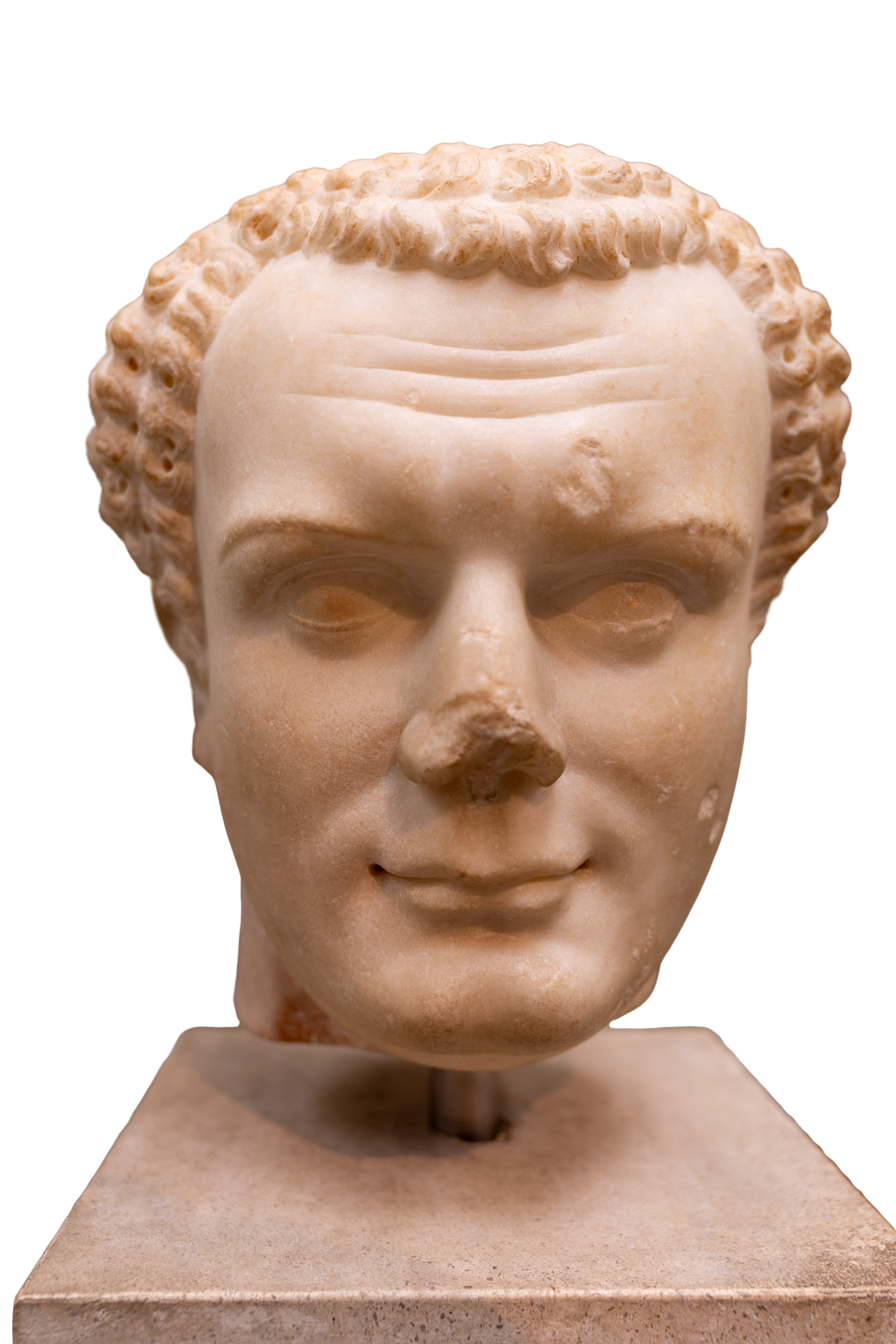
Titus, who reigned for barely two years (79–81 CE), appears in Suetonius as almost too good to be true: generous, beloved, militarily distinguished (it was Titus who had commanded the siege and destruction of Jerusalem in 70 CE, before his accession), and strikingly free from the vices that had marked most of his predecessors. His reign was shadowed by catastrophe — the eruption of Vesuvius in 79 CE destroyed Pompeii and Herculaneum, and a devastating fire and plague struck Rome the following year — but Titus's response to each was characterised by personal generosity and administrative energy. Suetonius notes that he was called the amor ac deliciae generis humani, "the love and delight of the human race," and the life carries an elegiac undertone: a brief, bright interval before the long shadow of Domitian.
Domitian, the final life in the corpus, closes the collection with the darkest portrait Suetonius draws. The younger son of Vespasian, who had chafed throughout his brother's reign at a subordinate role he considered insufficiently honoured, became on Titus's death an emperor of considerable administrative competence — Suetonius acknowledges his rigorous enforcement of public morality and his care for provincial governance — but also, in the later years of his reign, a figure of mounting paranoia and cruelty. The executions of senators, the revival of treason trials, the insistence on divine honours during his own lifetime (he required correspondence to begin with the formula dominus et deus noster, "our lord and god"), and the climate of terror that Tacitus, who lived through it, describes in the preface to the Agricola as "fifteen years of silence" — all these find their place in Suetonius's final account. Domitian was assassinated in 96 CE in a palace conspiracy, and Suetonius, writing under Hadrian, had no reason to moderate the hostile tradition that his senatorial sources had formed. The life ends as the corpus ends: with an emperor killed by those closest to him, and the implicit question of whether the institution of one-man rule can ever escape the logic of its own violence.
The Problem of the Later Lives
A long-standing observation in Suetonian scholarship is that the later lives — from Galba onward, and possibly from Nero — show a perceptible change in texture: they are shorter, less richly documented, less attentive to the kind of primary source citation that distinguishes the lives of Caesar and Augustus. One influential explanation, associated with the scholar Friedrich Leo and developed by subsequent scholars including Andrew Wallace-Hadrill, connects this change to Suetonius's loss of his secretarial position at court around 122 CE. If, as seems plausible, his access to the imperial archives was a function of his official role, then his dismissal may have interrupted his research at a point when the later lives were still in a more summary condition. The work as we have it may, on this reading, be slightly unfinished — the earlier lives polished, the later ones not yet brought to the same density of documentation. This remains a hypothesis; but it accounts for much that is otherwise puzzling in the distribution of evidence across the twelve lives.
Transmission
The transmission history of De Vita Caesarum is described in full in the introduction to Volume I. The medieval manuscript tradition derives from a lost Carolingian archetype and preserves all twelve lives, though with the ordinary corruptions of a text copied over many centuries. Suetonius was among the first classical authors to reach print, with the editio princeps appearing at Rome around 1470.
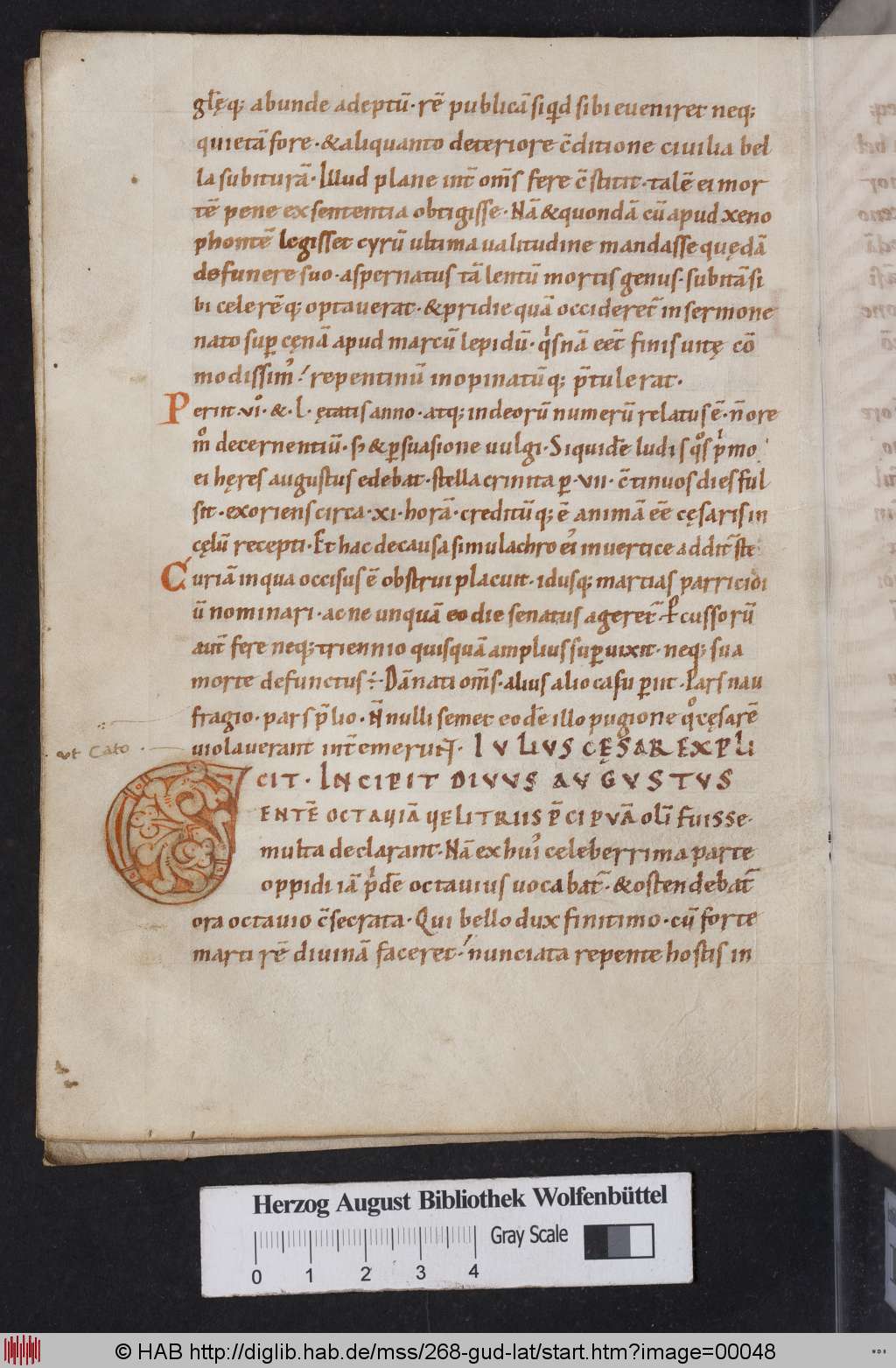
The manuscript reproduced on the cover of this volume is again Cod. Guelf. 268 Gud. lat. (Herzog August Bibliothek, Wolfenbüttel), the same eleventh-century Eichstätt codex that provides the cover image for Volume I. The folio reproduced here — fol. 23v — marks the opening of the Life of Augustus, the second book of the De vita Caesarum, and bears a decorated splitting strip initial with stalked trifoils, the only other major illuminated initial in the manuscript beside the opening initial on fol. 1v. That the scribe chose to mark the transition to Augustus with the same class of ornament as the opening of the whole work reflects the structural logic of the Caesares as Suetonius and his medieval transmitters understood it: Julius Caesar and Augustus as the twin foundations of everything that followed. The lives contained in the present volume — Claudius through Domitian — occupy the remainder of the manuscript's 173 leaves, copied by the same succession of hands identified by Hoffmann and Pokorny and forming a single unbroken witness to the complete corpus.
This Translation
The translation is that of John Carew Rolfe, published as Number 38 of the Loeb Classical Library (Cambridge, MA: Harvard University Press, 1914), the companion volume to Loeb 31. Rolfe presents the Latin text on facing pages with his English translation and supplies an index of names. The translation is in the public domain.
FULL TEXT
The Life of Claudius
[The life opens with Claudius's family and the unusual circumstances of his exclusion from public life under the early Principate.]
I. The father of Claudius Caesar, Drusus1, who was at first called Decimus and later Nero, was born of Livia after she had been taken to wife by Augustus, and within three months of the marriage. There was accordingly a suspicion that he was begotten in adultery by his stepfather. At any rate this verse was at once in circulation:
The lucky have three-month children.2
This Drusus, while holding the offices of quaestor and praetor, commanded in the Rhaetian and thereafter in the German war, and was the first of Roman generals to sail the northern Ocean3. He made beyond the Rhine certain vast works4, which to this day are called by his name. After he had defeated the enemy in many battles and driven them far into the wilds of the interior, he did not cease from his operations until the apparition of a barbarian woman of superhuman size5 presented itself to him in the Latin tongue and forbade him to press his victories farther. On account of these achievements he received the honour of an ovation and the triumphal regalia; and immediately after his praetorship he became consul and resumed the campaign, but died in his summer quarters, which were in consequence called "The Accursed Camp."6 The senate, among other honours, voted him a triumphal arch of marble, and the surname Germanicus for himself and his descendants in perpetuity.
II. He is believed to have been a man of no less love for the Republic than his son. For he had left behind writings in which he said that he had intended, as soon as he had the power, to restore the old form of government. Ever after people were in the habit of maintaining that Augustus was afraid that Drusus would actually restore liberty, and that this was why he called him off before his time. This Drusus had by Antonia Minor7 three children: Germanicus, Livilla, and Claudius.
Bibliography
Rolfe, J. C., trans. Suetonius: Lives of the Caesars, Volume II. Loeb Classical Library 38. Cambridge, MA: Harvard University Press, 1914. Revised edition with new introduction by K. R. Bradley. 1998.
Baldwin, Barry. Suetonius. Amsterdam: Adolf M. Hakkert, 1983.
Jones, Brian W. The Emperor Domitian. London: Routledge, 1992.
Levick, Barbara. Claudius. London: Batsford, 1990.
Levick, Barbara. Vespasian. London: Routledge, 1999.
Wallace-Hadrill, Andrew. Suetonius: The Scholar and His Caesars. London: Duckworth, 1983.
Warmington, B. H. Nero: Reality and Legend. London: Chatto & Windus, 1969.
Westphal, Stefanie. "Cod. Guelf. 268 Gud. lat." In Die illuminierten Handschriften der Herzog August Bibliothek, Teil 1: 6. bis 11. Jahrhundert (in progress). Wolfenbüttel: Herzog August Bibliothek. Preliminary description available at diglib.hab.de.
Footnotes
-
Nero Claudius Drusus (38–9 BCE), younger son of Livia and her first husband Tiberius Claudius Nero, stepson of Augustus, and father of the emperor Claudius. His elder brother became the emperor Tiberius. ↩︎
-
The implication of the verse is that a child born within three months of a mother's second marriage was conceived before that marriage — that is, by the previous husband or, in Livia's case, by Augustus. The joke was a commonplace piece of Augustan gossip. ↩︎
-
The North Sea. Drusus conducted a series of campaigns into Germany between 12 and 9 BCE and was the first Roman commander to reach the mouth of the Elbe. ↩︎
-
These earthworks, canals, and fortifications along the Rhine formed part of the earliest Roman defensive infrastructure in Germany. Some remained visible in Suetonius's time. ↩︎
-
The apparition of a supernatural female figure warning a Roman commander away from further conquest is a recurring motif in accounts of the German campaigns; a similar story is told of Drusus in other sources. ↩︎
-
Castra Scelerata. Drusus died in 9 BCE from injuries sustained after a fall from his horse, in his campaign quarters east of the Rhine. ↩︎
-
Antonia Minor (36 BCE – 37 CE), younger daughter of Mark Antony and Octavia (Augustus's sister). Through her children she was grandmother to the emperor Caligula, great-grandmother to the emperor Nero, and mother of the emperor Claudius. ↩︎