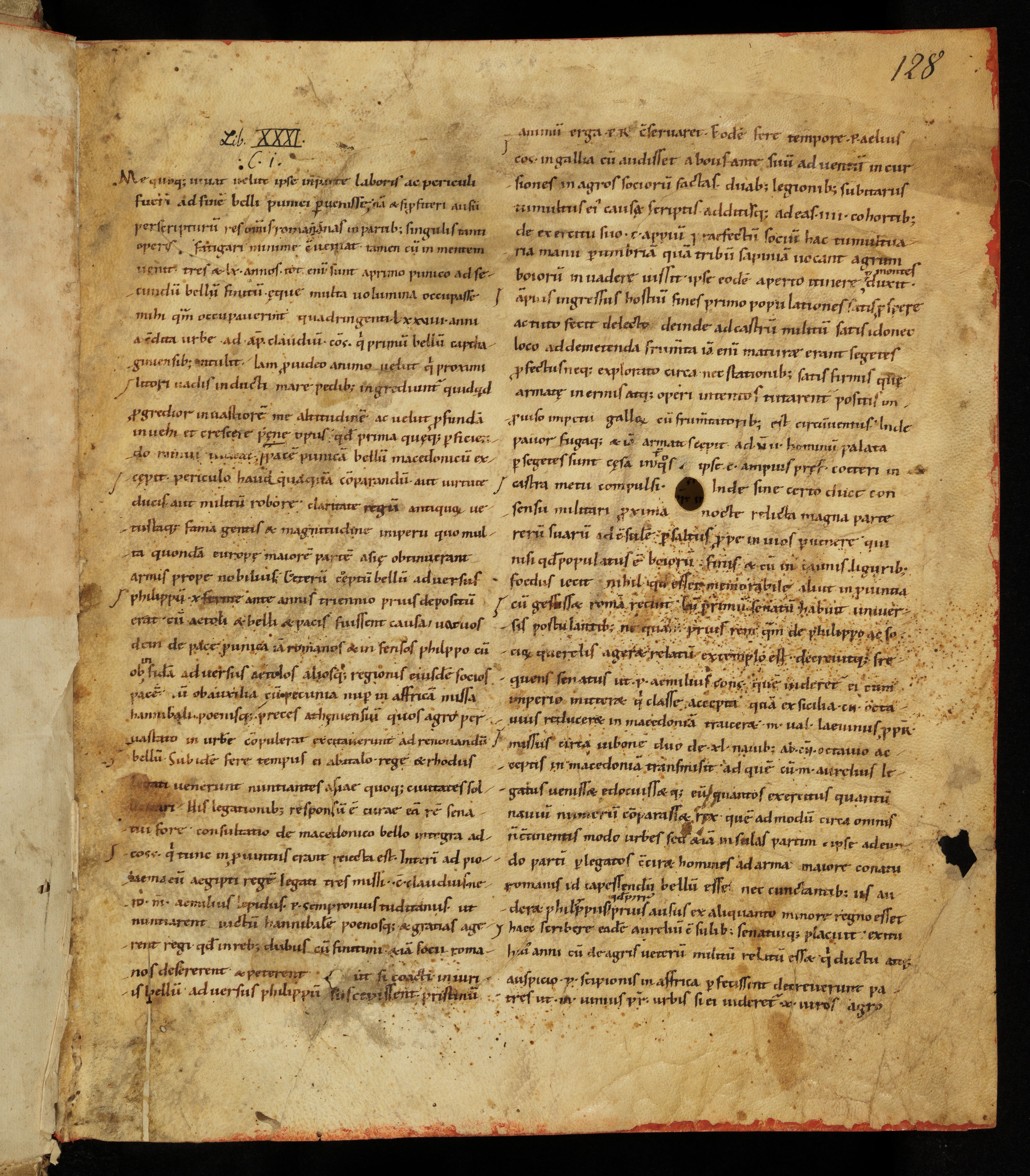
Bamberg, Staatsbibliothek, Msc.Class.35, fol. 128r — opening of Livy Book 31, Caroline minuscule, medieval

Ab Urbe Condita, Volume IX: Books 31–34

Reading companion and full text of Livy's Ab Urbe Condita, Volume IX (Books 31–34), translated by Evan T. Sage — the Second Macedonian War, from Rome's declaration against Philip V through Flamininus's decisive victory at Cynoscephalae and the proclamation of Greek freedom at the Isthmian Games.
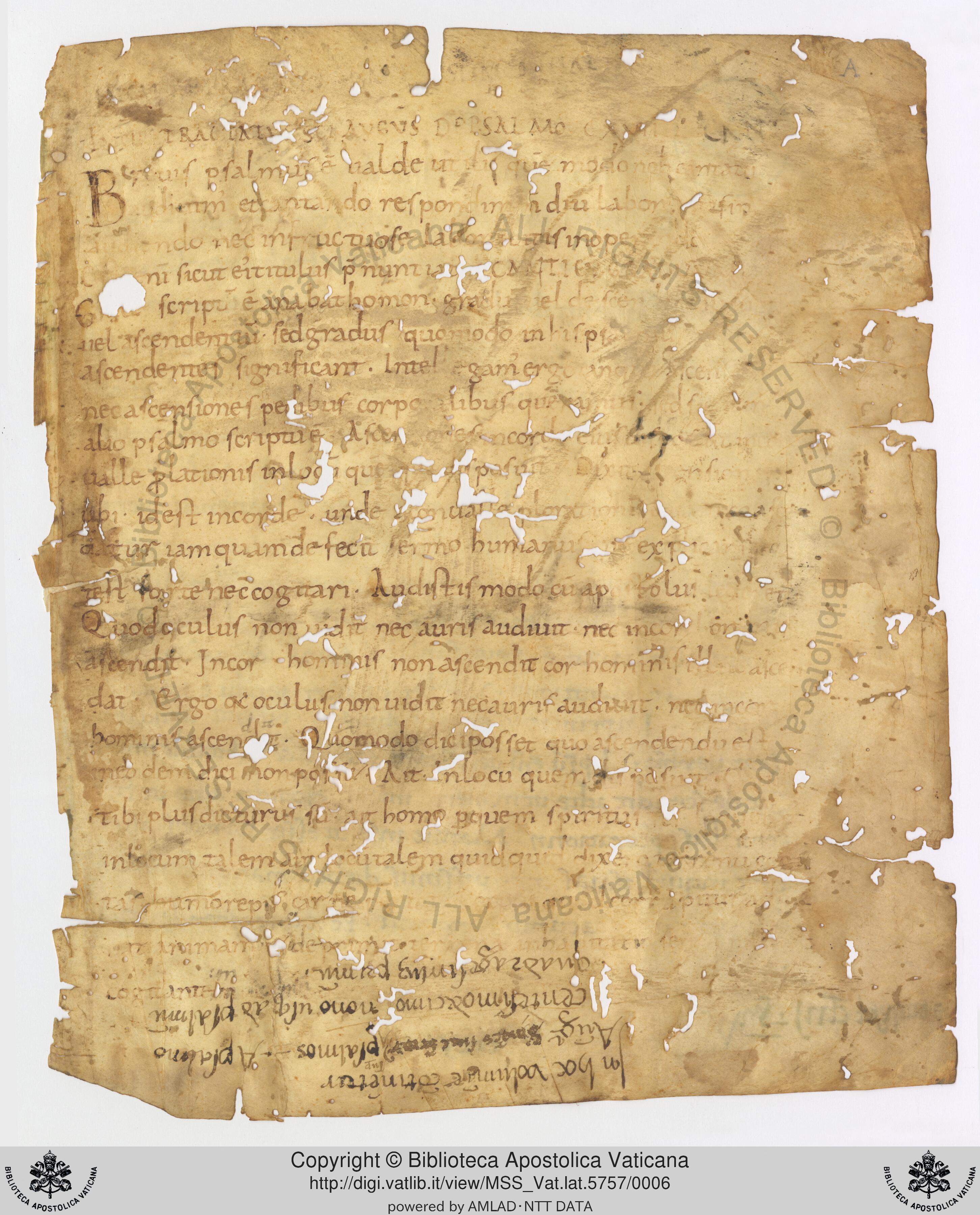
First page of Vat. lat. 5757, a palimpsest manuscript from Bobbio

De Re Publica

Reading companion and full text of Cicero's De Re Publica (On the Republic), translated by Clinton W. Keyes — a dialogue in six books examining the best form of government, the nature of justice, and the duties of the ideal statesman, culminating in the celebrated Dream of Scipio.

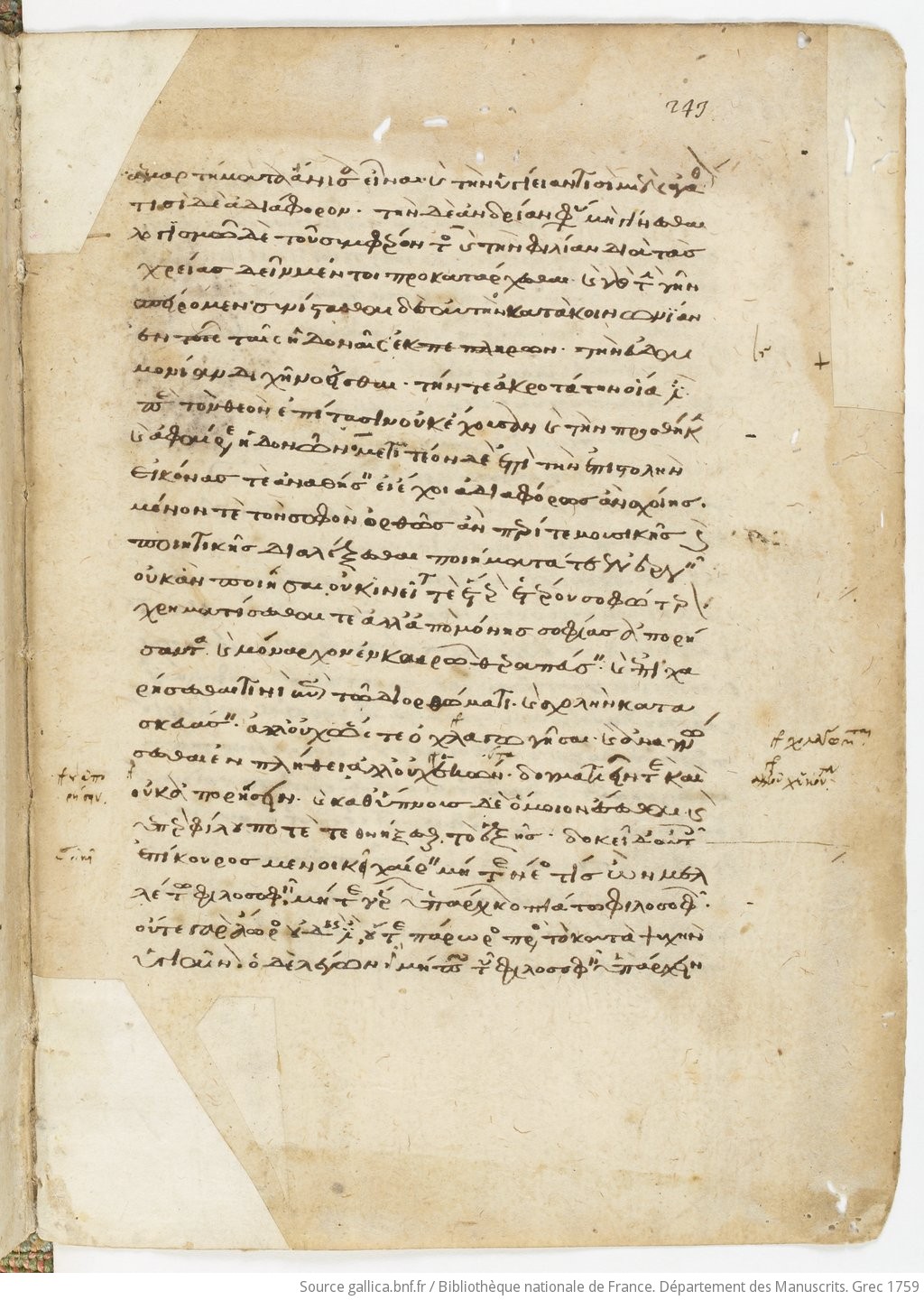
Folio 249 of Codex Parisinus gr. 1759, a 14th-century Greek paper manuscript held at the Bibliothèque nationale de France

Letter to Menoeceus

Reading companion and full text of Epicurus's Letter to Menoeceus, translated by Robert Drew Hicks — a concise statement of Epicurean ethics covering the gods, the fear of death, the nature of desire, and pleasure as the beginning and end of the blessed life.

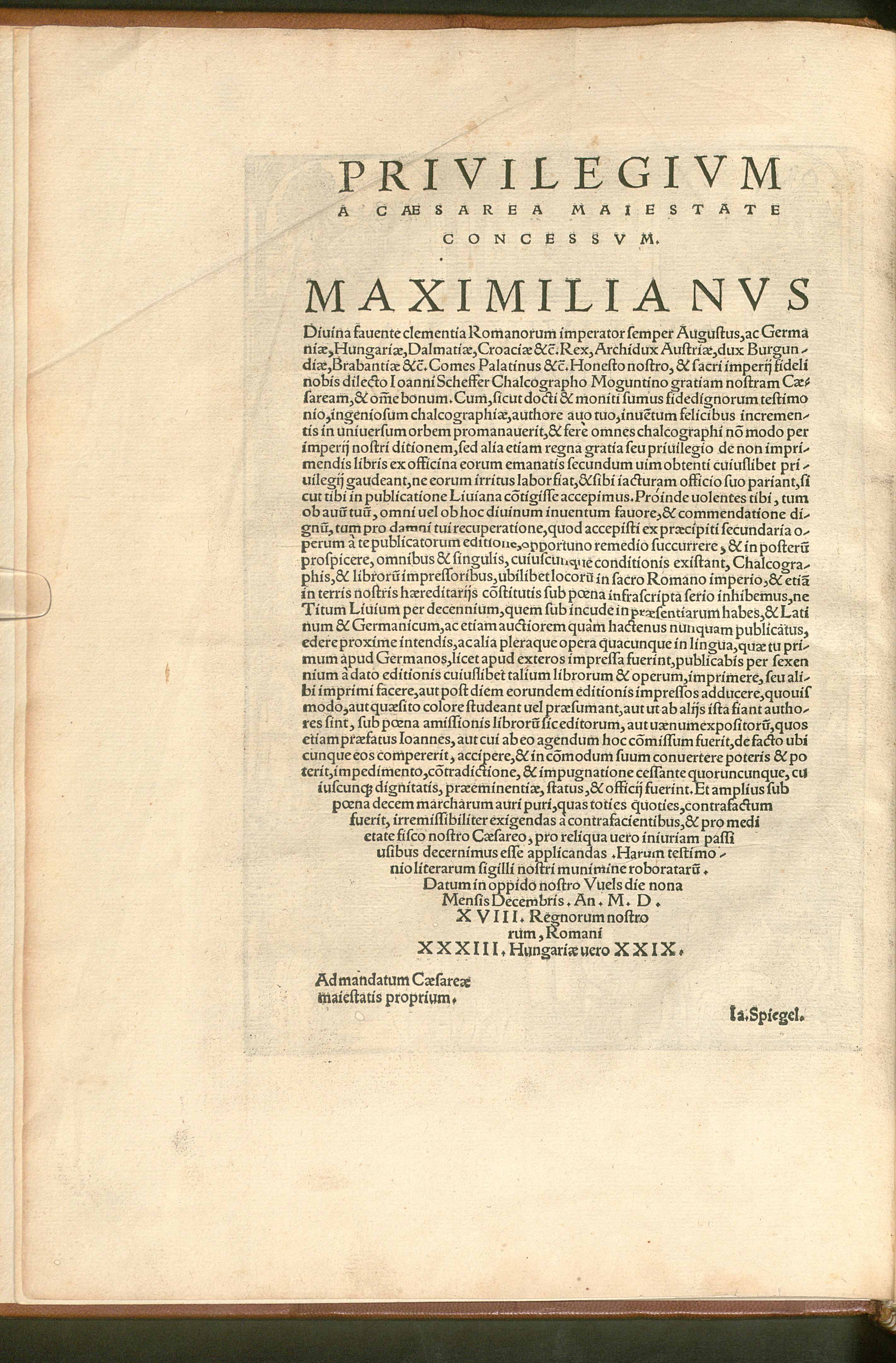
Privilegium page of the 1519 Editio Moguntina of Livy, imperial privilege granted by Maximilian I to Johannes Scheffer of Mainz — Bayerische Staatsbibliothek, Munich, Res/2 A.lat.b. 422

Ab Urbe Condita, Volume X: Books 35–37

Reading companion and full text of Livy's Ab Urbe Condita, Volume X (Books 35–37), translated by Evan T. Sage — the war with Antiochus III, from the Seleucid king's intervention in Greece through the Roman victories at Thermopylae and Magnesia that expelled him from Europe and Asia Minor.

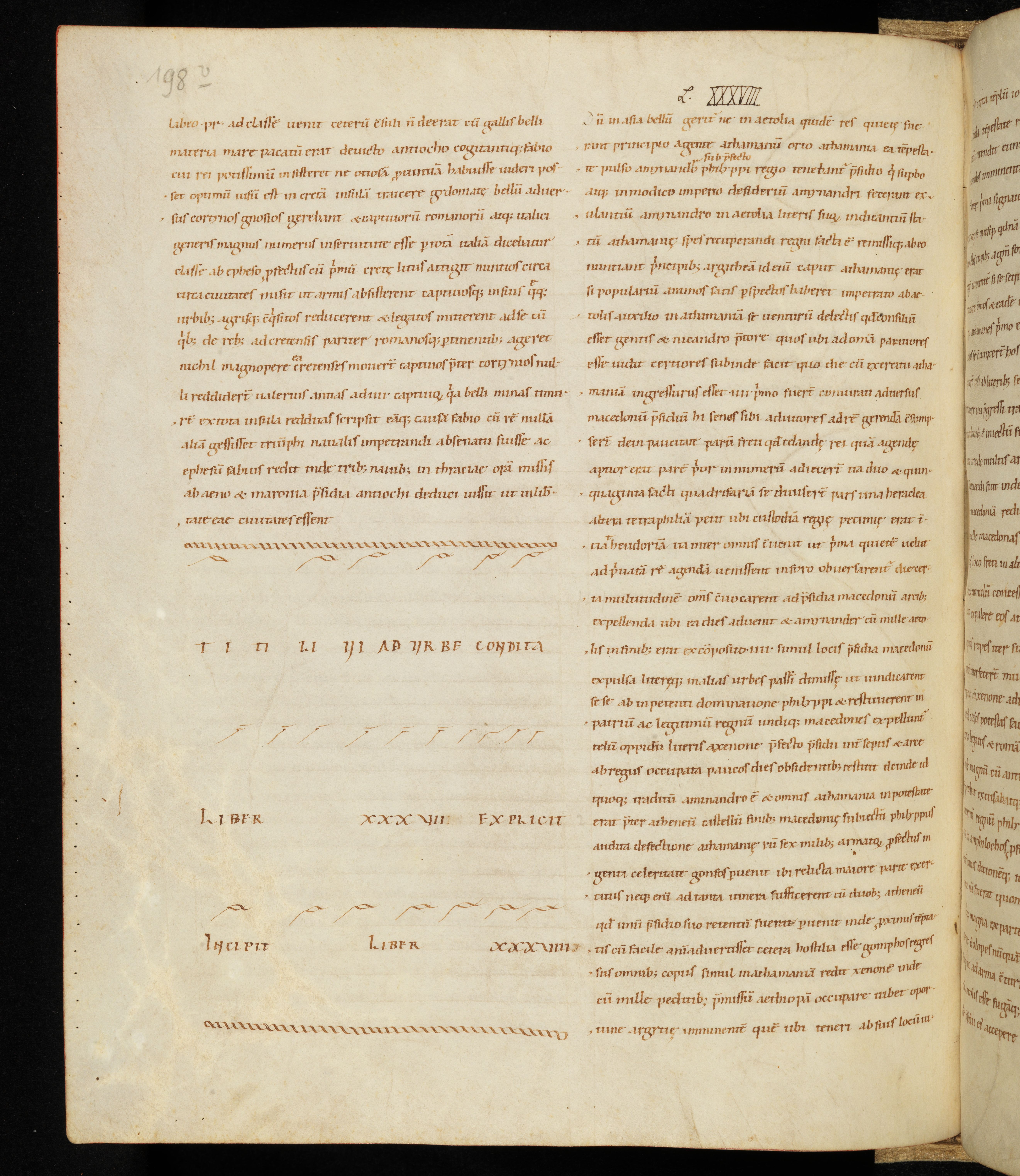
Bamberg, Staatsbibliothek, Msc.Class.35, fol. 198v — transition from Book 37 to Book 38 of Livy's Ab Urbe Condita, Caroline minuscule, medieval

Ab Urbe Condita, Volume XI: Books 38–39

Reading companion and full text of Livy's Ab Urbe Condita, Volume XI (Books 38–39), translated by Evan T. Sage — the settlement of the Syrian War and Manlius Vulso's campaign in Galatia, followed by the celebrated senatorial investigation into the Bacchanalian conspiracy of 186 BCE.

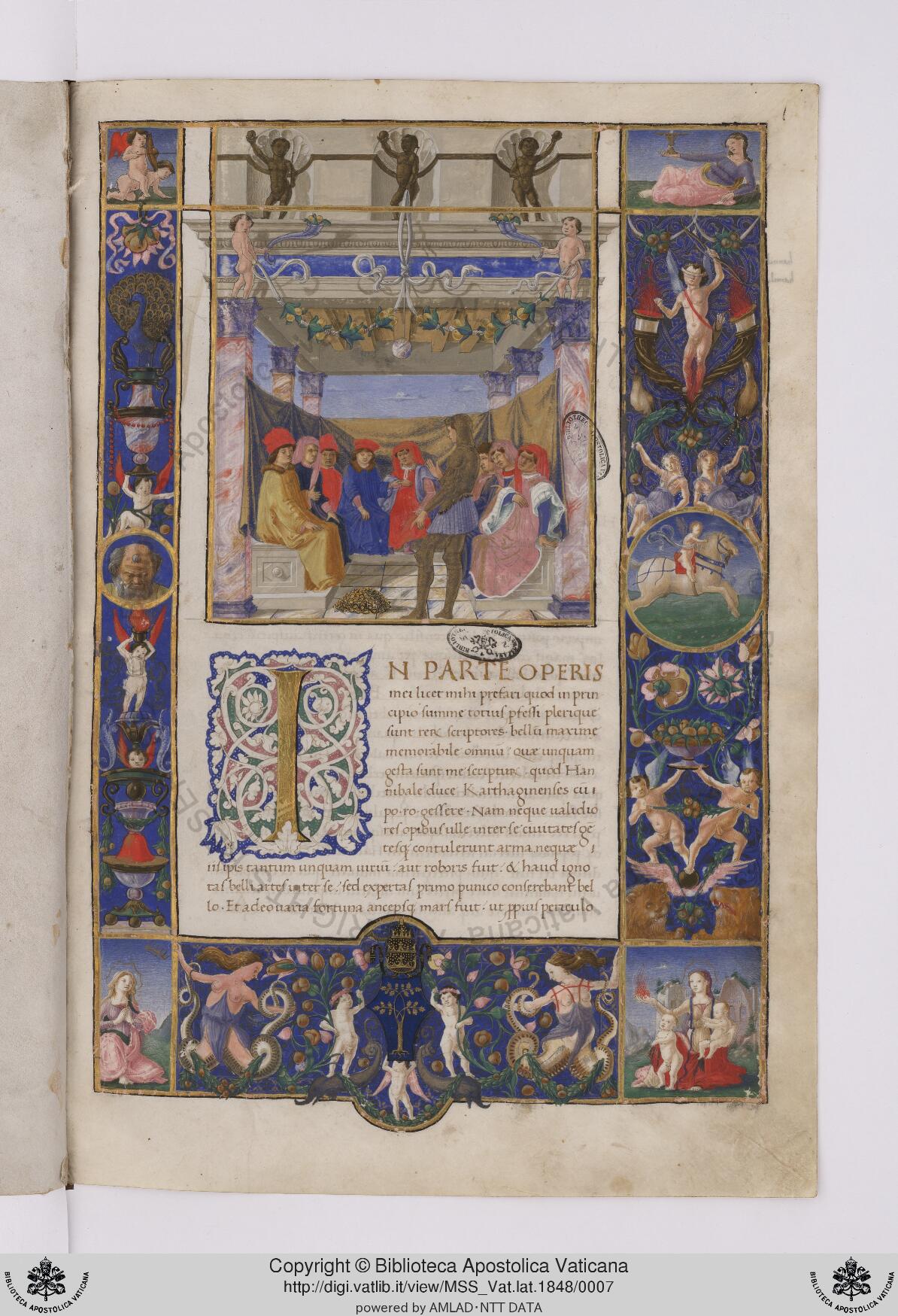
Biblioteca Apostolica Vaticana, Vat. lat. 1848, fol. 1r — incipit page of Livy's Third Decade, illuminated by Bartolomeo della Gatta, Rome, c. 1475–1480

Ab Urbe Condita, Volume XII: Books 40–42

Reading companion and full text of Livy's Ab Urbe Condita, Volume XII (Books 40–42), translated by Evan T. Sage and A. C. Schlesinger — the final years of Philip V, the accession of Perseus, and the opening moves of the Third Macedonian War.

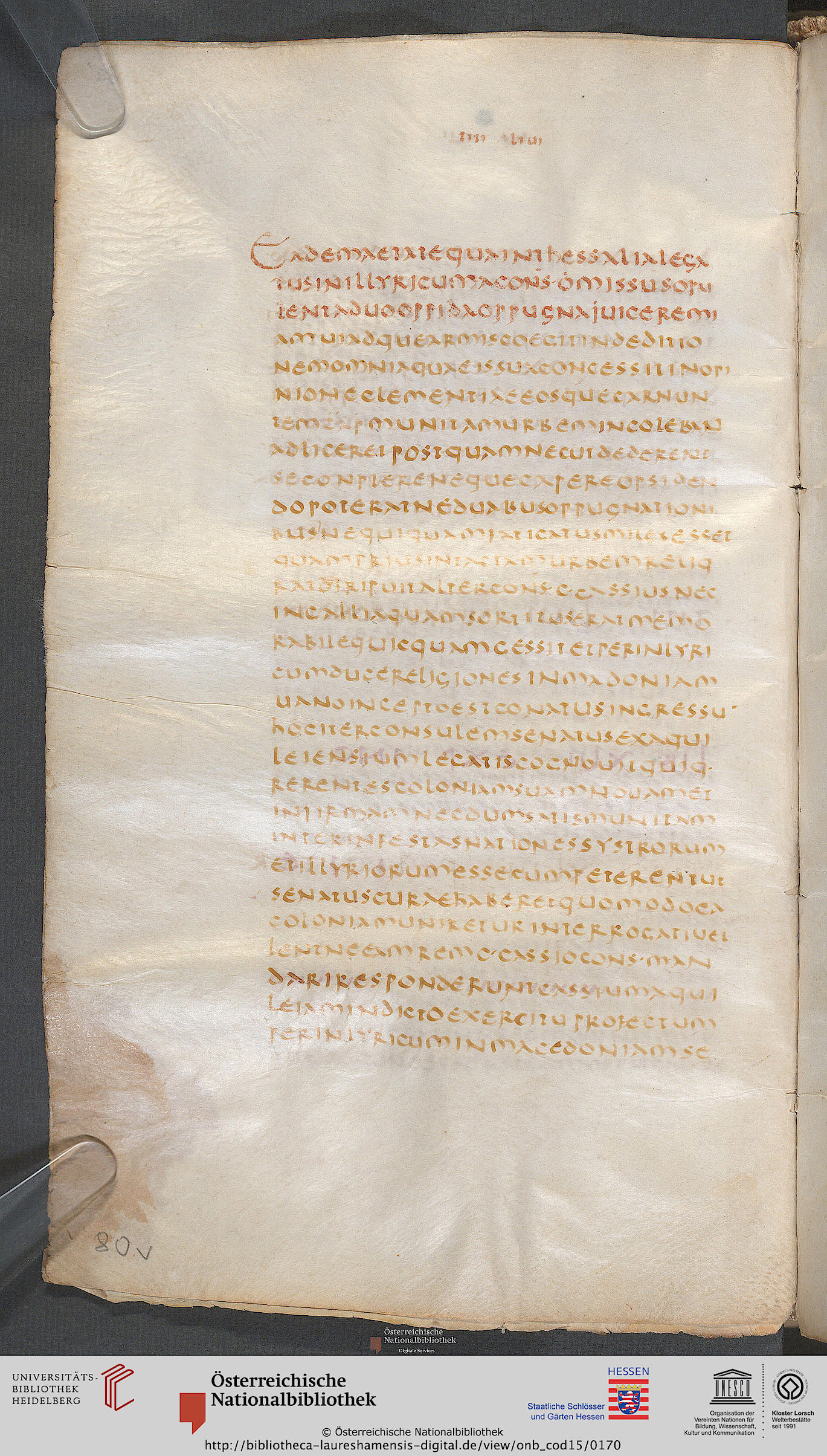
Vienna, Österreichische Nationalbibliothek, Cod. Vind. Lat. 15 (Codex Vindobonensis Lat. 15, the Lorsch Manuscript), fol. 80v — Book 42 text in Uncial script, 5th century

Ab Urbe Condita, Volume XIII: Books 43–45

Reading companion and full text of Livy's Ab Urbe Condita, Volume XIII (Books 43–45), translated by A. C. Schlesinger — the Third Macedonian War from its early campaigns through the decisive Battle of Pydna, the capture of Perseus, and the triumph of Lucius Aemilius Paullus, which ends both the war and the Macedonian monarchy.

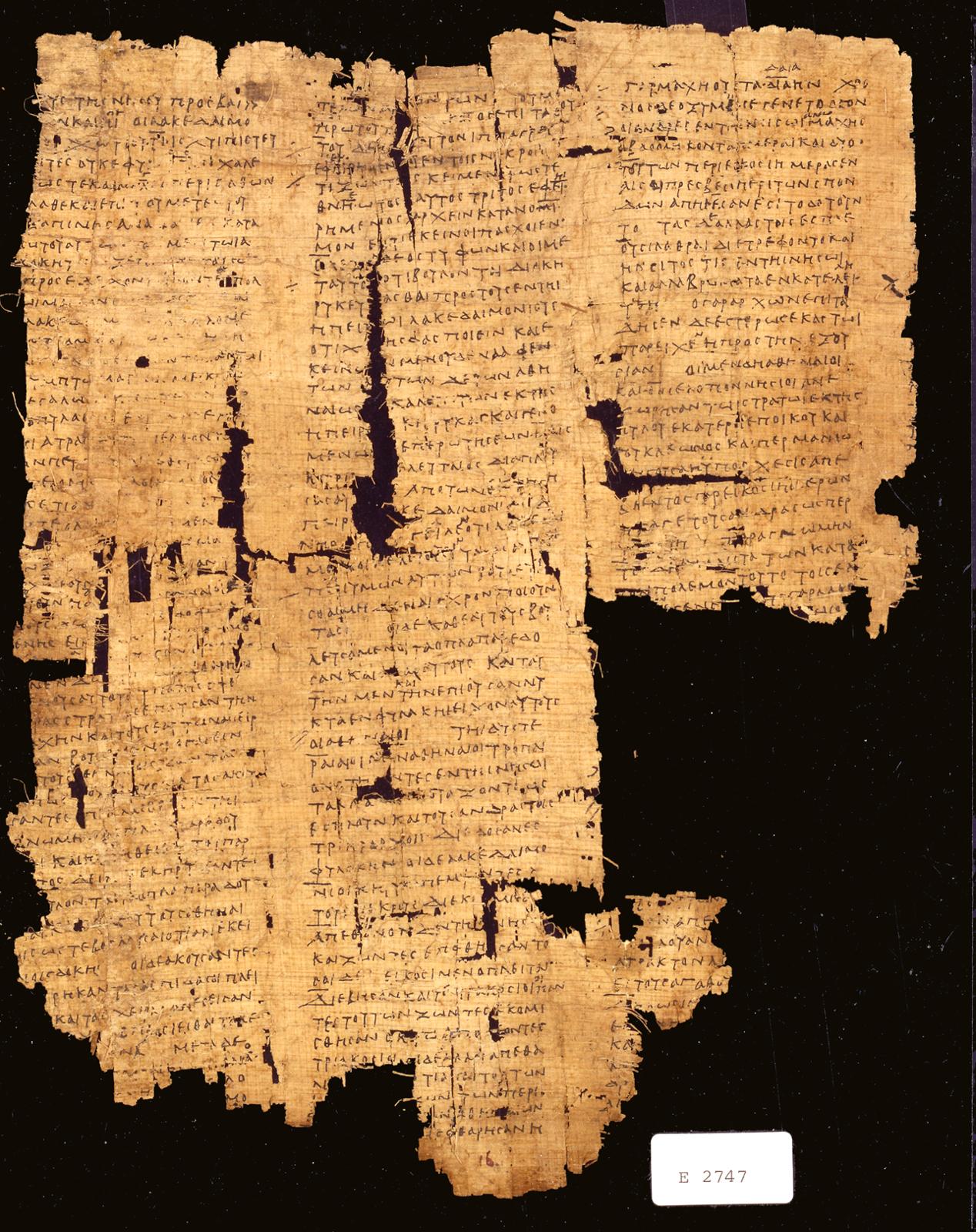
Nearly 2,300 years ago, a reader in provincial Egypt owned a copy of one of history's greatest works. This fragile papyrus preserves part of Thucydides' account of the Battle of Sphacteria — where a force of Spartan soldiers did the unthinkable and surrendered. Among the oldest manuscripts of Thucydides anywhere in the world, it bridges the ancient and modern transmission of a text that has never stopped being read. Thucydides, History of the Peloponnesian War, Book IV.36–41 · el-Hibeh, Egypt · Penn Museum, E 2747.

History of the Peloponnesian War

Reading companion for Thucydides's History of the Peloponnesian War — the foundational text of Western historiography.

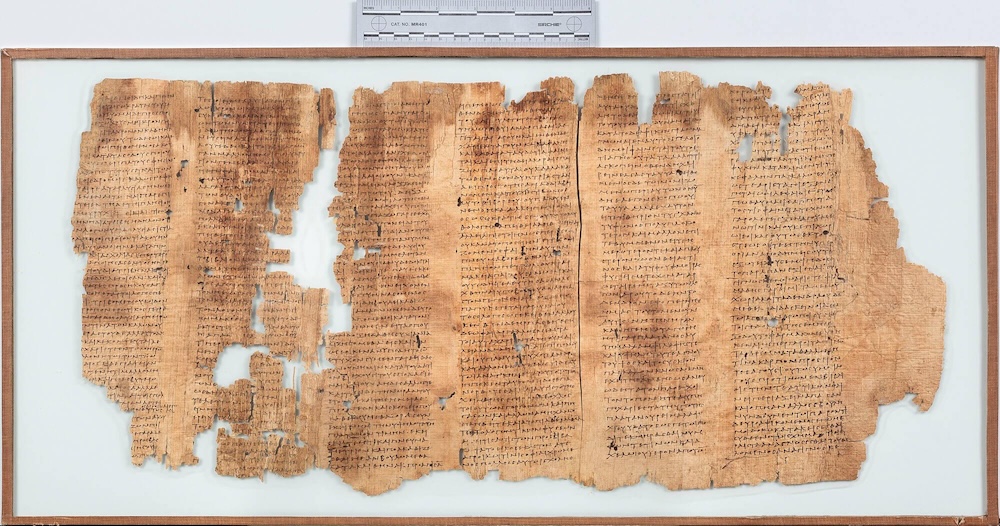
Papyrus Oxyrhynchus VII 1016 (P.Oxy. VII 1016), held at the Toledo Museum of Art (object no. 1915.38, gift of Edward Drummond Libbey), is a Greek papyrus excavated at Al-Bahnasa (ancient Oxyrhynchus), Egypt, dating to the mid-3rd century CE. It consists of four joined sheets measuring approximately 27.5 × 57.9 cm overall, written in India ink on papyrus. The reverse (Oxyrhynchus no. 1016) preserves six columns of the introduction to Plato's Phaedrus (sections 233c–234b and 242d–244c), covering the opening scene (227a–230e) in which Socrates meets Phaedrus outside the walls of Athens, and the two make their way to the banks of the Ilissus to discuss a speech by the orator Lysias on love and rhetoric. The obverse (Oxyrhynchus no. 1044) contains a tax list dated to 235 CE. Published by Arthur Hunt in volume VII of The Oxyrhynchus Papyri (1910).

Phaedrus

Reading companion and full text of Plato's Phaedrus, a Socratic dialogue exploring the nature of love, the immortality and structure of the soul, the requirements of true rhetoric, and the limits of written discourse.

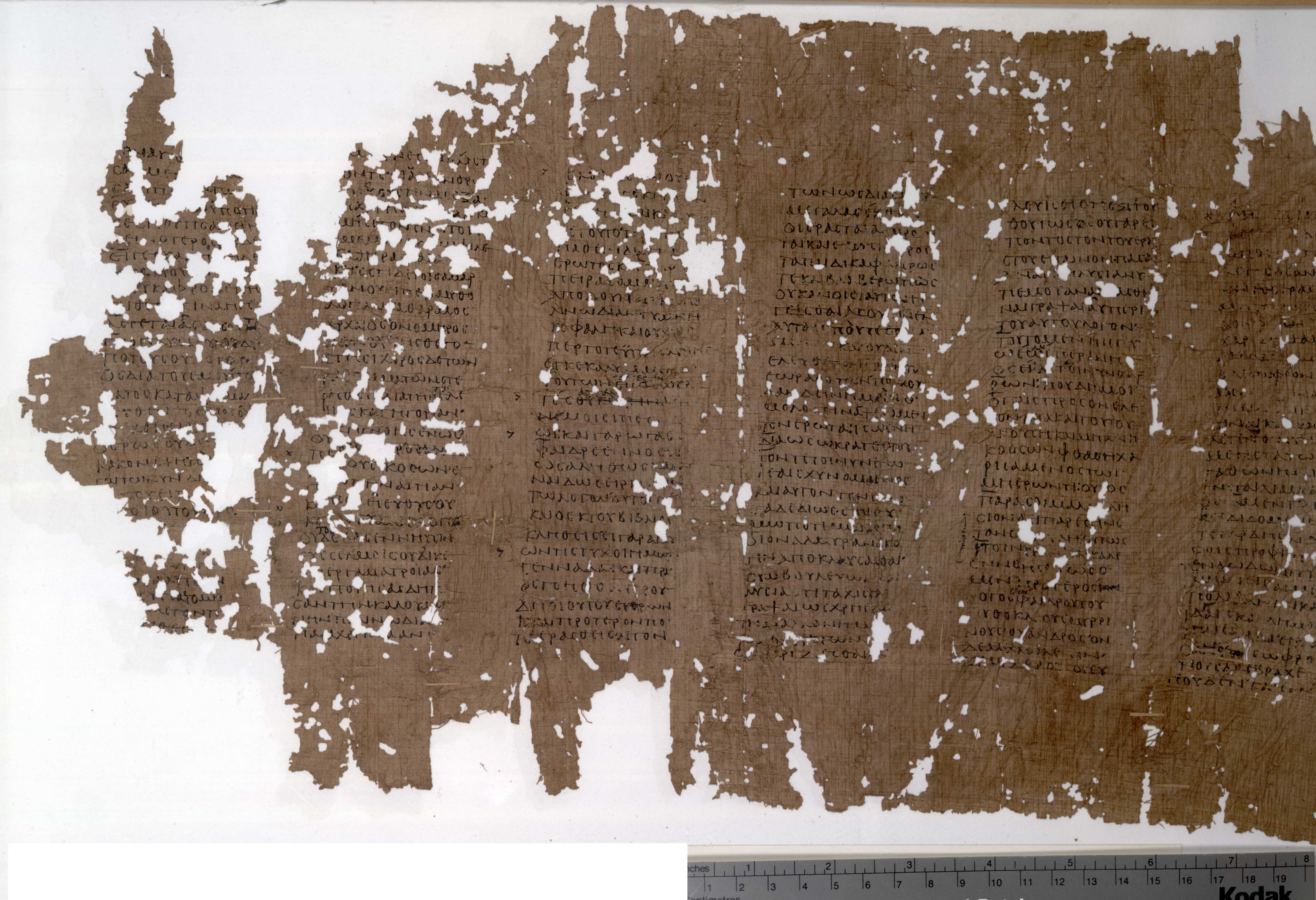
Papyrus Oxyrhynchus XVII 2102 (P.Oxy. XVII 2102), held at Oxford, is a Greek papyrus from Oxyrhynchus, Egypt, dating to the late second century AD — likely its second half — and one of three Oxyrhynchus witnesses to Plato's Phaedrus. This recto image shows nine consecutive columns (the last three very fragmentary) from a roll measuring 25.4 cm in height, written in a round, upright literary hand of medium size with short lines of approximately 5 cm set in columns 15 cm tall, slightly inclined to the right. A second hand is frequently in evidence, introducing corrections and variant readings from a different exemplar, inserting accents, breathings, marks of elision and quantity, and marginal signs; punctuation by high and medial dots, paragraphi, and colons marking changes of speaker is also largely secondary. A coronis at column v, line 21 marks the end of a section. The original scribe was careless and made numerous errors, most of which the corrector caught; despite this, the text is a reasonably good one, collated against Burnet's edition. It was discovered during the excavations of Bernard Grenfell and Arthur Hunt at Oxyrhynchus and published in volume XVII of The Oxyrhynchus Papyri.

Phaedo

Reading companion and full text of Plato's Phaedo, a Socratic dialogue set on the day of Socrates' death, in which he and his companions explore four arguments for the immortality of the soul.

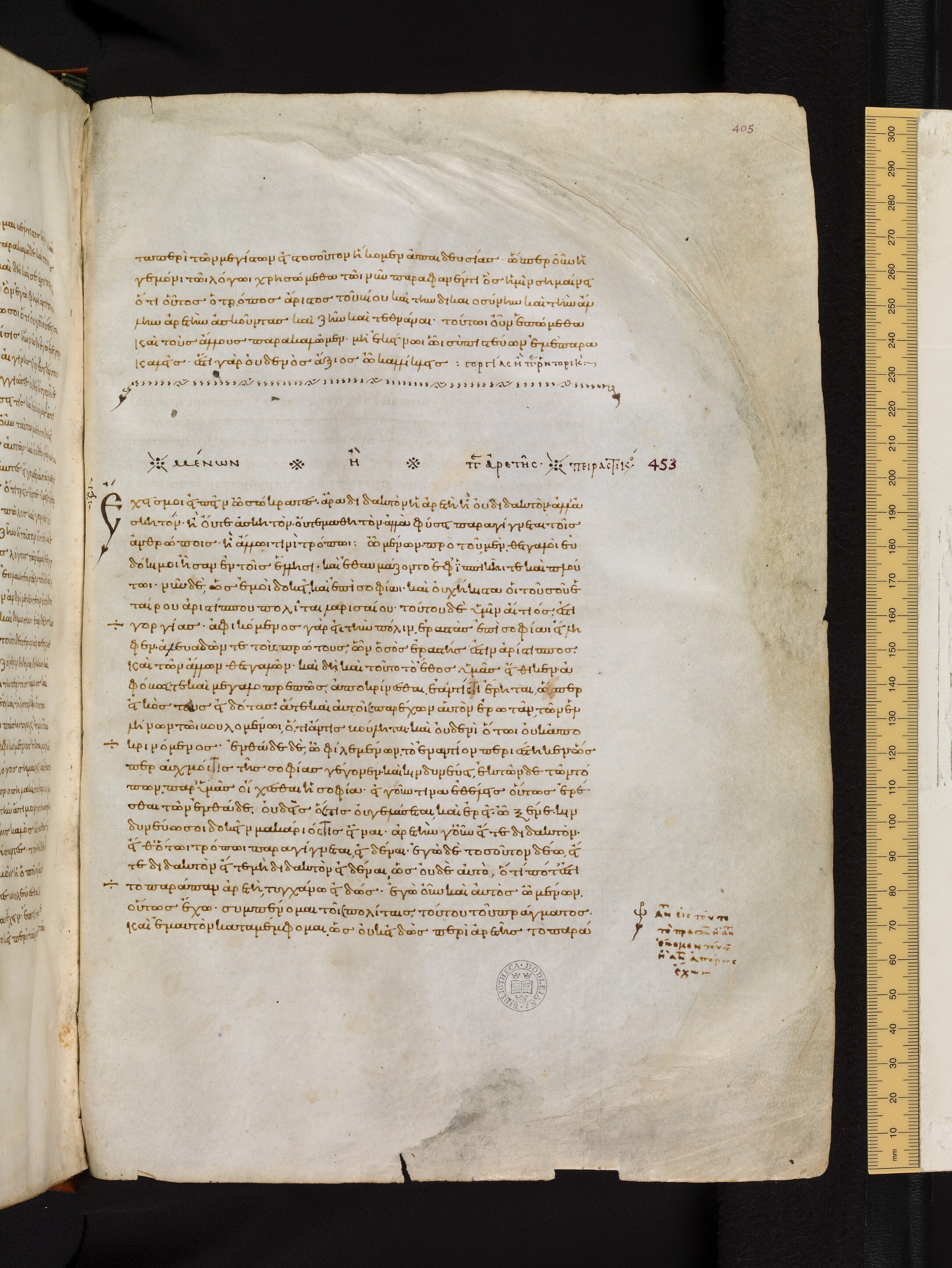
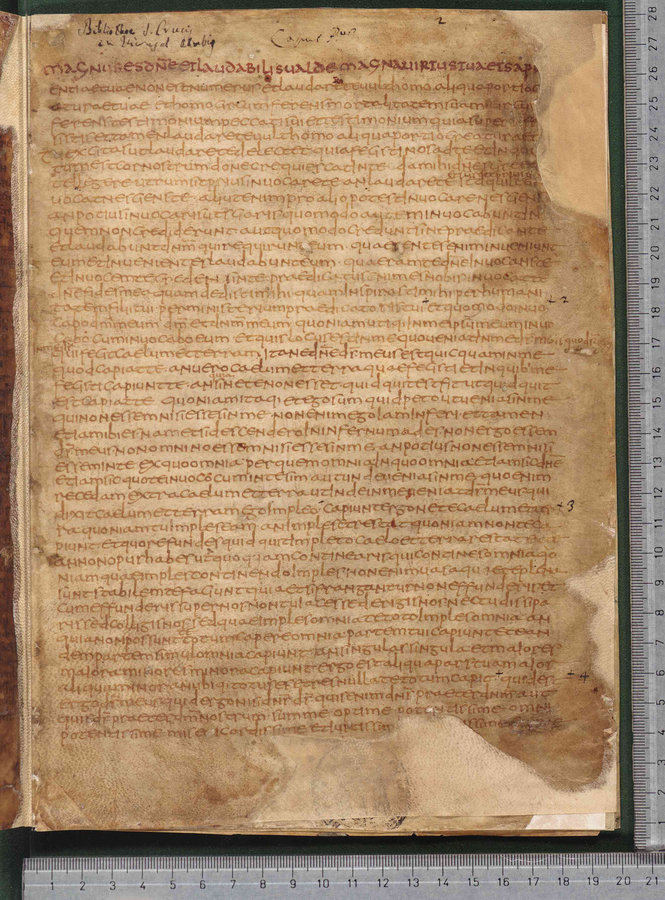
The Codex Clarkianus (Bodleian Library MS. E. D. Clarke 39), or Clarke Plato, is a crucial 9th-century Greek manuscript written in 895 AD in Constantinople for Arethas of Patrae by John the Calligrapher. As the oldest, most comprehensive witness for 24 of Plato's dialogues, it is central to reconstructing the text of Meno and other key works. This is the exact page where Plato's Meno begins. The top third of the page contains the conclusion of the Gorgias. You can see a decorative horizontal divider (a coronis) and a series of dots marking the end of that dialogue. Just below the divider, the title is written in red uncials: ΜΕΝΩΝ Η ΠΕΡΙ ΑΡΕΤΗΣ ΠΕΙΡΑΣΤΙΚΟΣ (Meno, or On Virtue, Tentative).

Meno

Reading companion and full text of Plato's Meno, a Socratic dialogue exploring whether virtue can be taught, and introducing the theory of recollection as a model of knowledge.

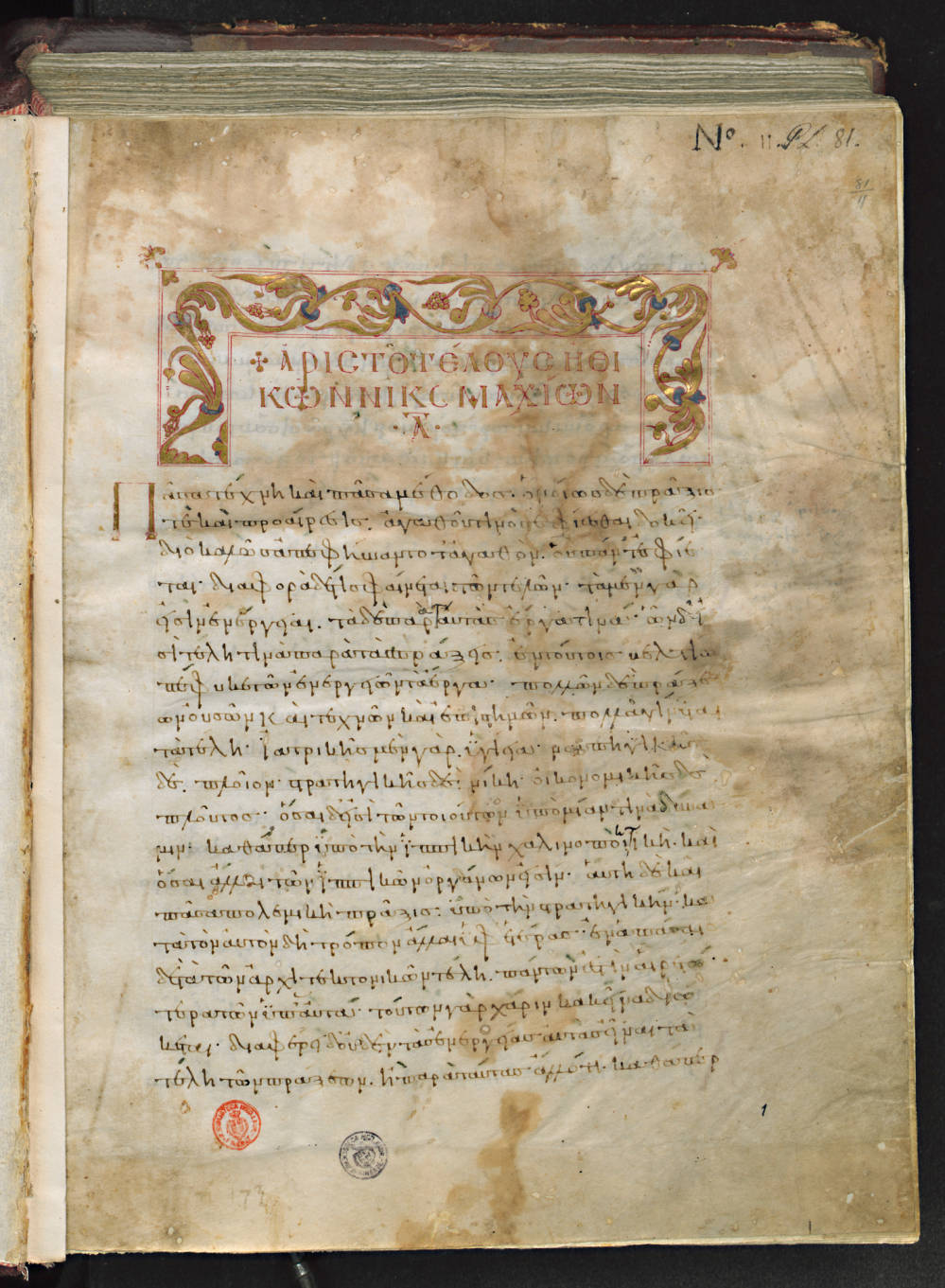
15th-century Byzantine Greek manuscript page of Aristotle's Nicomachean Ethics with a colorful decorated headpiece and cursive minuscule script.

Nicomachean Ethics

A reading companion for Aristotle’s Nicomachean Ethics — the seminal work exploring the nature of happiness and the cultivation of human excellence.

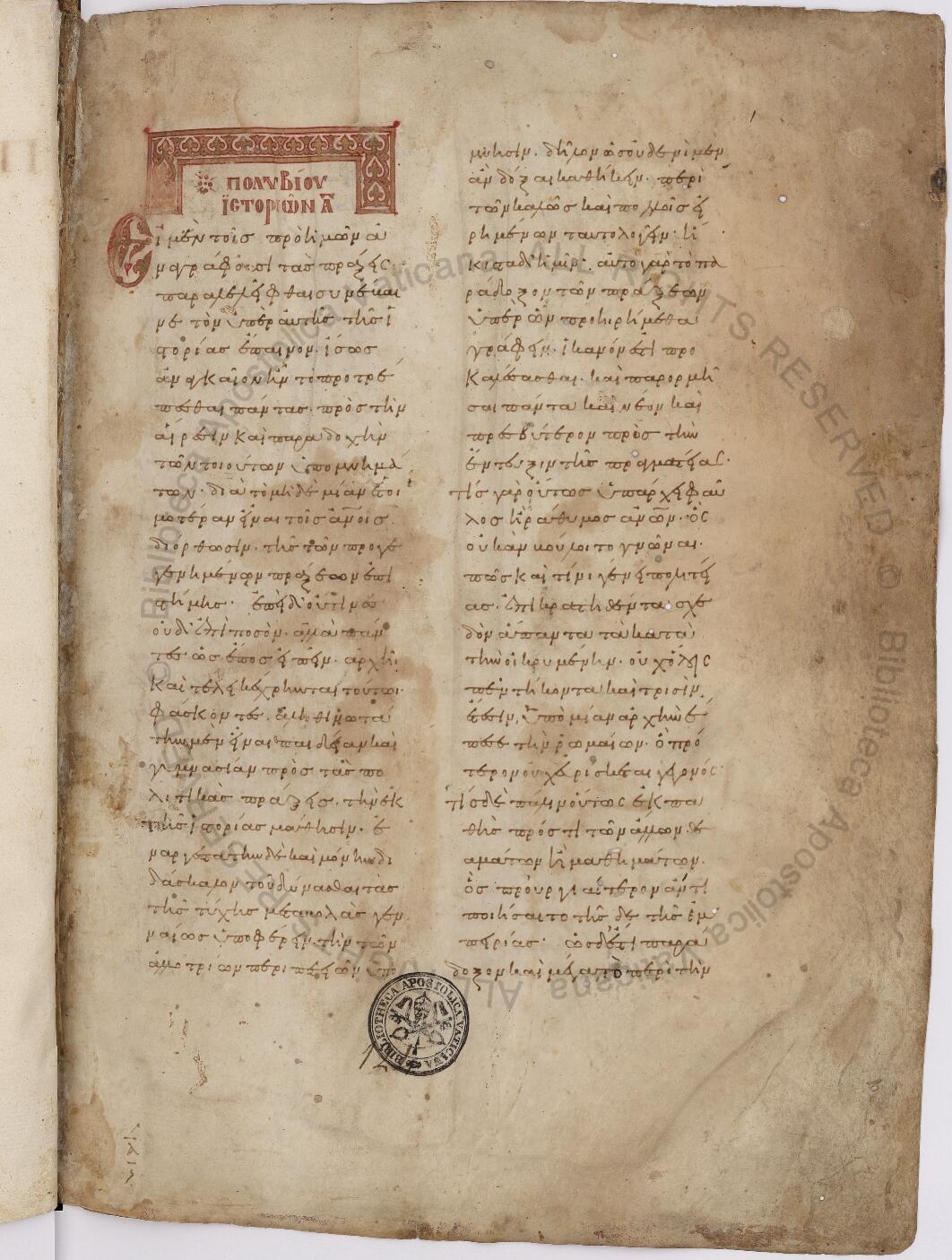
Vat. gr. 124, f. 1r. Opening of Polybius, Histories Book I, with ornamental title panel (ΠΟΛΥΒΙΟΥ ΙΣΤΟΡΙΩΝ Α) and decorated initial. Constantinople, 10th century. Biblioteca Apostolica Vaticana.

Histories

Reading companion for the Histories of Polybius, covering Rome's rise to Mediterranean dominance from the First Punic War to the destruction of Carthage.

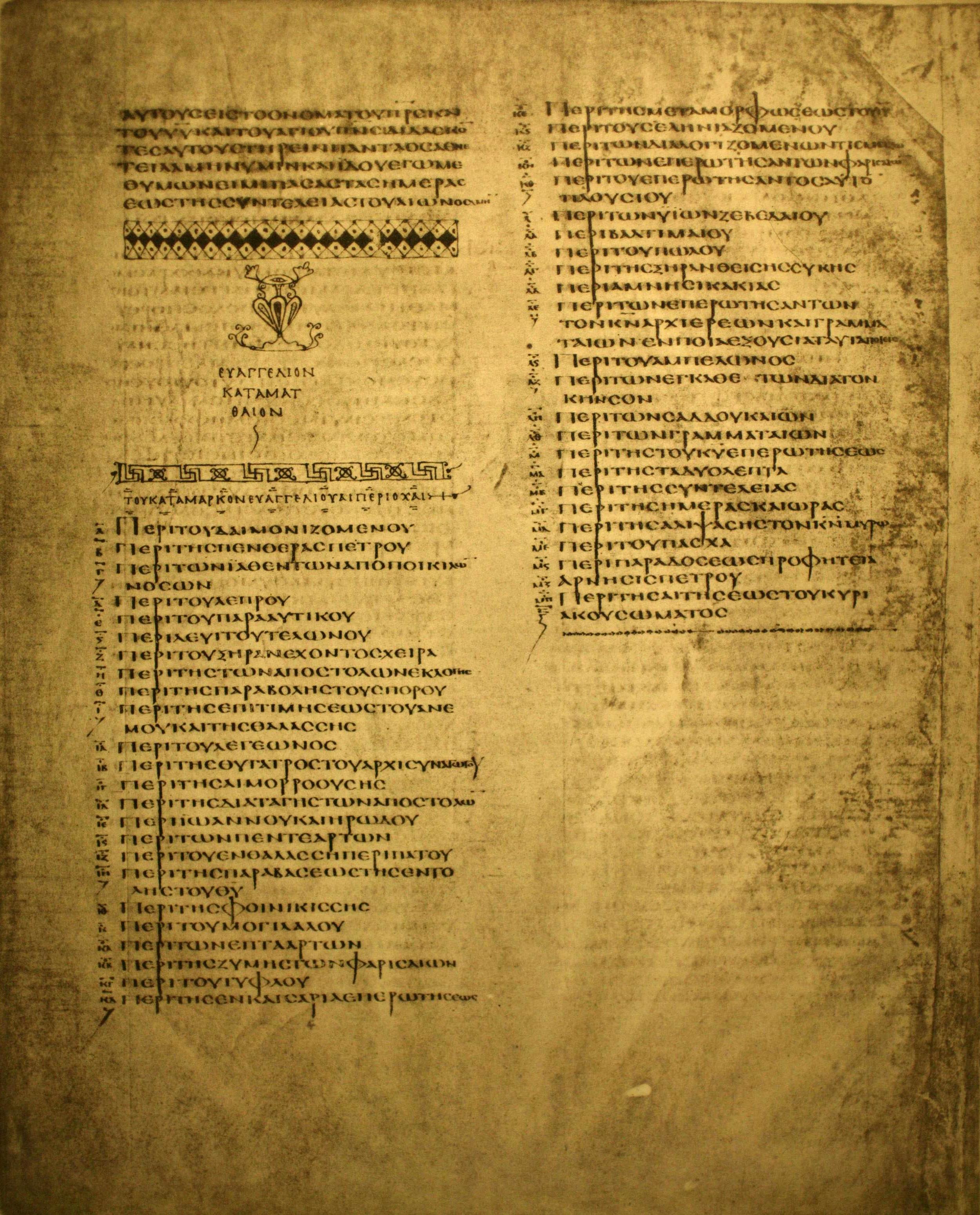
The Codex Alexandrinus (5th century AD) is a vital Greek manuscript of the Bible that includes 1, 2, 3, and 4 Maccabees within its Septuagint Old Testament. Housed in the British Library, it is particularly significant as the oldest manuscript containing 3 Maccabees and 4 Maccabees. The manuscript includes four books of Maccabees as part of its Septuagint section. It serves as the primary witness to the text of 3 and 4 Maccabees. It is written in a large, square uncial hand and is a largely complete Bible. The text includes 3 Maccabees, which describes Ptolemy IV Philopator's, king of Egypt, attempt to persecute the Jews, which was not traditionally in the Hebrew canon but is essential to this early Greek collection.

The Five Books of Maccabees in English

A seminal 19th-century scholarly assembly of the five distinct books detailing the Maccabean revolt and subsequent Jewish history, translated into English with extensive notes by Henry Cotton.

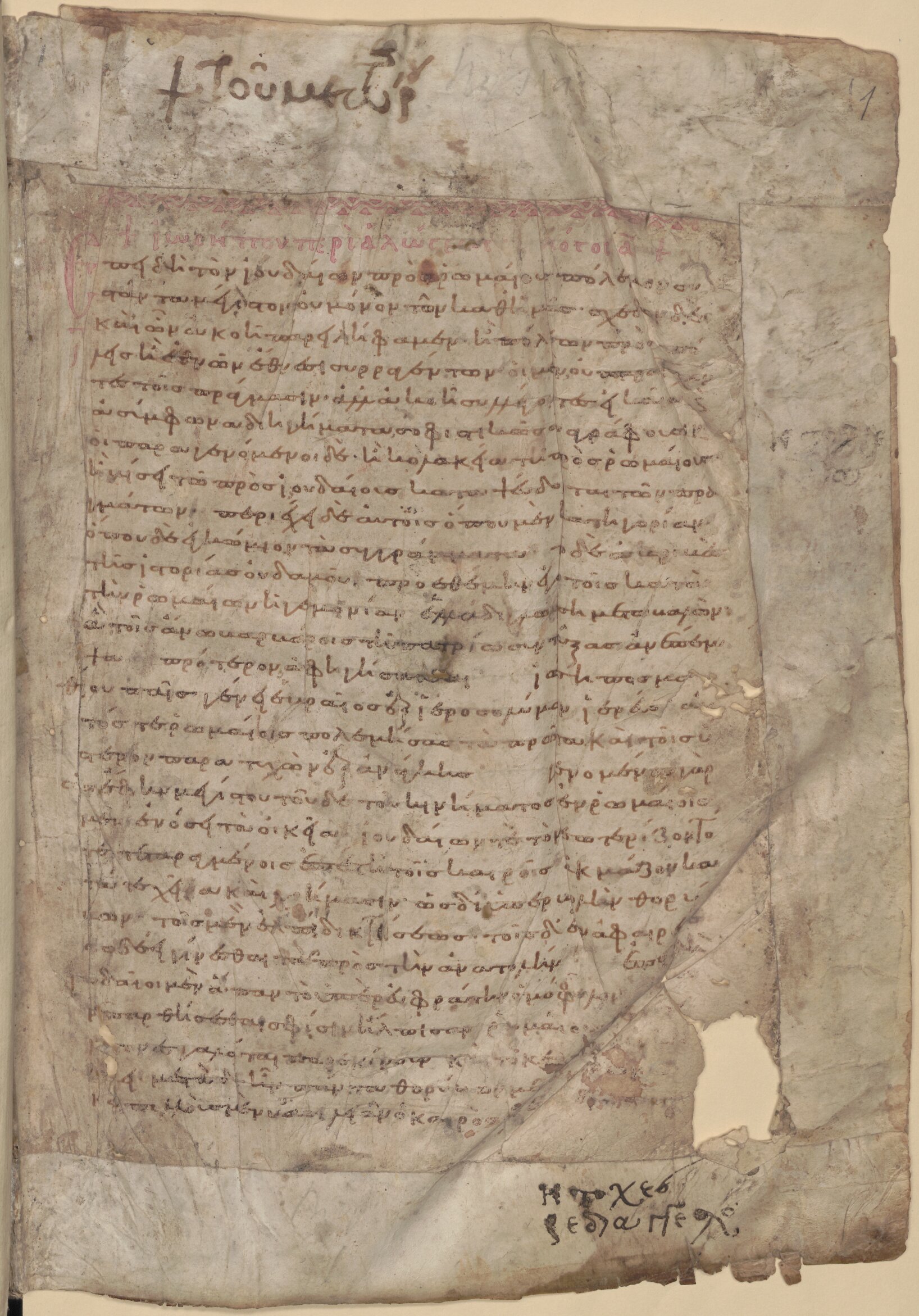
Fol. 1r of BSB Cod.graec. 639: the opening page of Josephus's Bellum Judaicum. The parchment is heavily worn and damaged, but the text is identifiable as the Proem (Preface) of the work.

The Jewish War

Reading companion for Bellum Judaicum — Josephus's eyewitness account of the Jewish revolt against Rome and the destruction of the Second Temple.

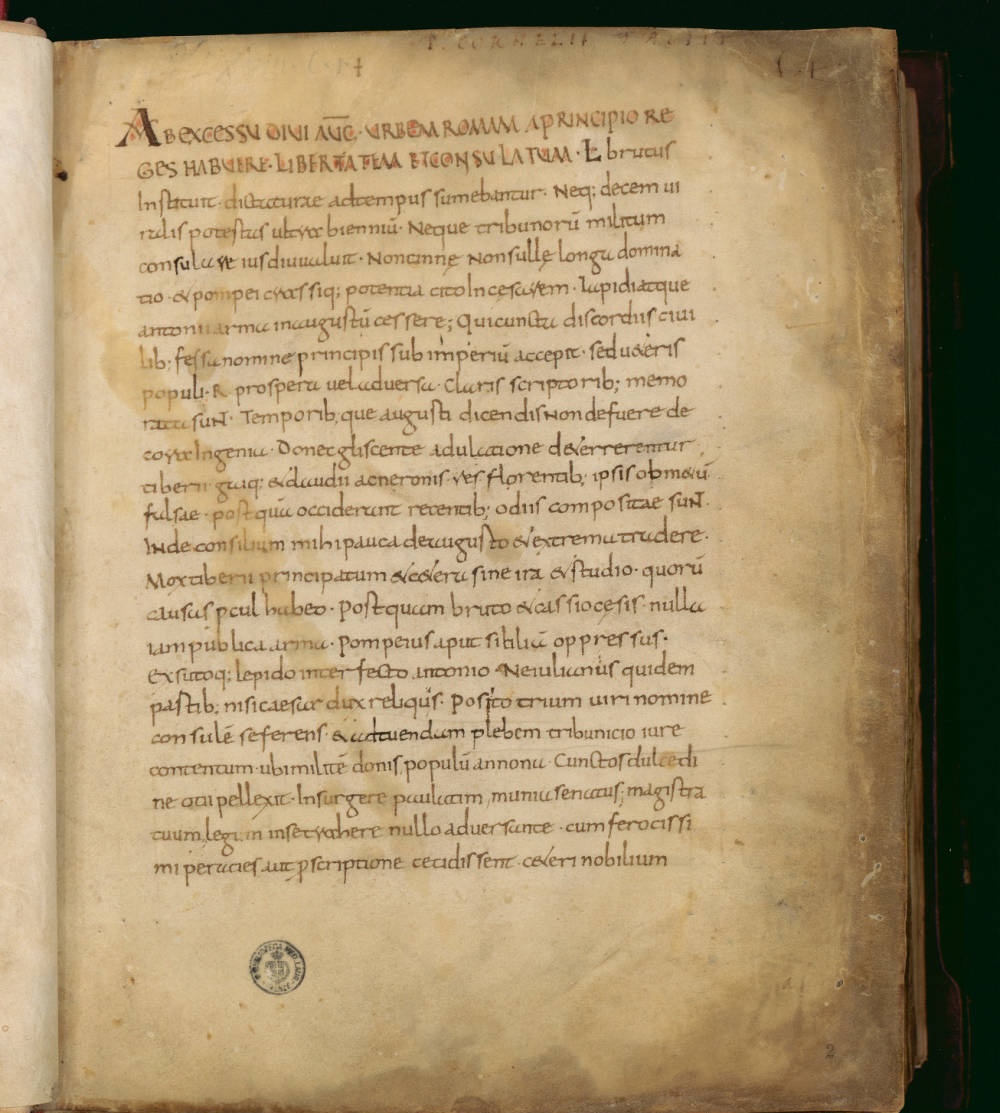
Manuscript of Cornelius Tacitus Annals (Plut. 68.1) at the Biblioteca Medicea Laurenziana, Florence — 11th century (1001–1100).

Annals

Reading companion for the Annals of Tacitus, covering the Julio-Claudian dynasty from the death of Augustus to the reign of Nero.

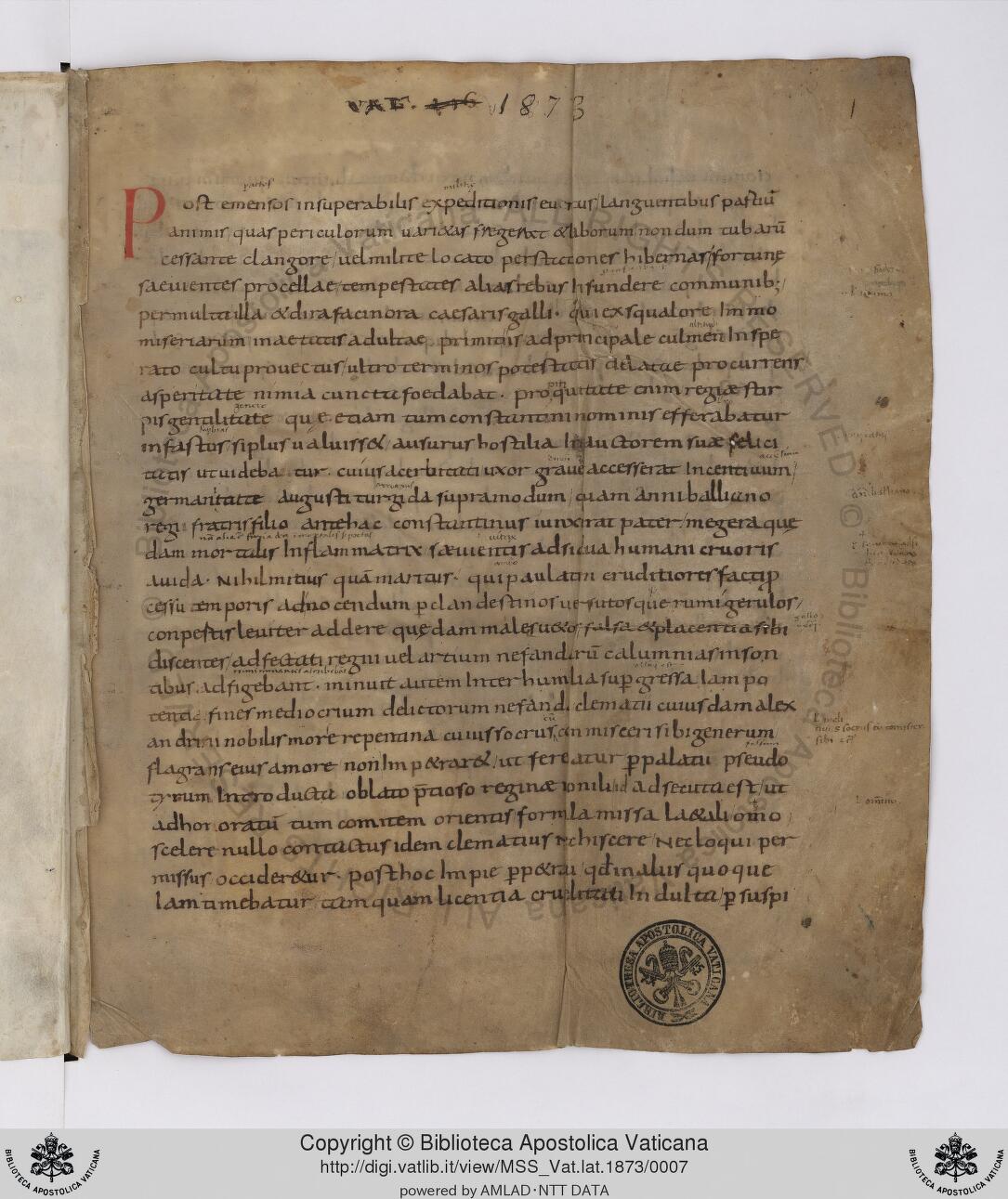
Folio 1r of the manuscript Vaticanus Latinus 1873, a 9th-century Carolingian codex of the Res Gestae by the Roman historian Ammianus Marcellinus. Known as the Codex Fuldensis (named for the Abbey of Fulda where it was rediscovered by humanist Poggio Bracciolini in 1417), it is the primary surviving source for the final 18 books of Ammianus’s history. This page marks the beginning of Book XIV, which chronicles the downfall of the Caesar Constantius Gallus. The large red initial P begins the word 'Post,' introducing the text: 'Post emensos insuperabiles expeditionum eventus...' ('After the outcome of insurmountable expeditions...'). The text is written in Carolingian minuscule, a clear and uniform script developed during the reign of Charlemagne to standardize European Latin texts. Because the first 13 books of Ammianus’s work are lost to history, this specific page represents the modern 'start' of one of the most important historical accounts of the late Roman Empire (covering 353–378 AD). You can see various marginal and interlinear notes (glosses) added by later scholars, including famous Renaissance humanists like Niccolò Niccoli and Giulio Pomponio Leto, who studied this exact volume to recover classical knowledge. Source: Biblioteca Apostolica Vaticana (Vat. lat. 1873)

Res Gestae (Ammianus Marcellinus, Rolfe Translation)

Full text of Ammianus Marcellinus' Res Gestae in the Loeb Classical Library edition (vols. 300, 315, 331), translated by John C. Rolfe — the standard 20th-century English rendering of the last great Latin historian of Rome.

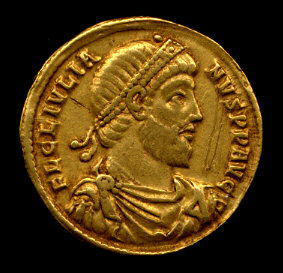
Gold Solidus of Julian (361–363), Byzantine, 361–363, Gold, The Metropolitan Museum of Art, New York — Gallery 301. Struck during the brief but consequential reign of Julian the Apostate, this gold solidus reflects the enduring power of Roman imperial coinage at a pivotal moment of transition. The emperor's portrait — rendered with classical precision on the obverse — evokes Julian's deliberate effort to revive pre-Christian Roman traditions, positioning himself as a philosopher-emperor in the mold of Marcus Aurelius. The solidus, introduced by Constantine I, had by this period become the backbone of Mediterranean commerce, its consistent gold purity a guarantee of imperial authority across vast distances. This coin stands as both a monetary instrument and a miniature monument — a gilded testament to a reign that lasted little more than two years, yet left an indelible mark on the history of the late Roman world.

Against the Galileans

Reading companion and full text of Contra Galilaeos — Emperor Julian's philosophical polemic against Christianity, preserved in fragments through Cyril of Alexandria's rebuttal.

9th-century semi-uncial Latin manuscript page of Augustine's Confessions, the oldest known witness, with large display capitals and dense cursive text on aged parchment.

Confessions

A reading companion for Augustine's Confessions — the foundational autobiography of the Western spiritual tradition, exploring memory, time, restlessness, and the soul's return to God.

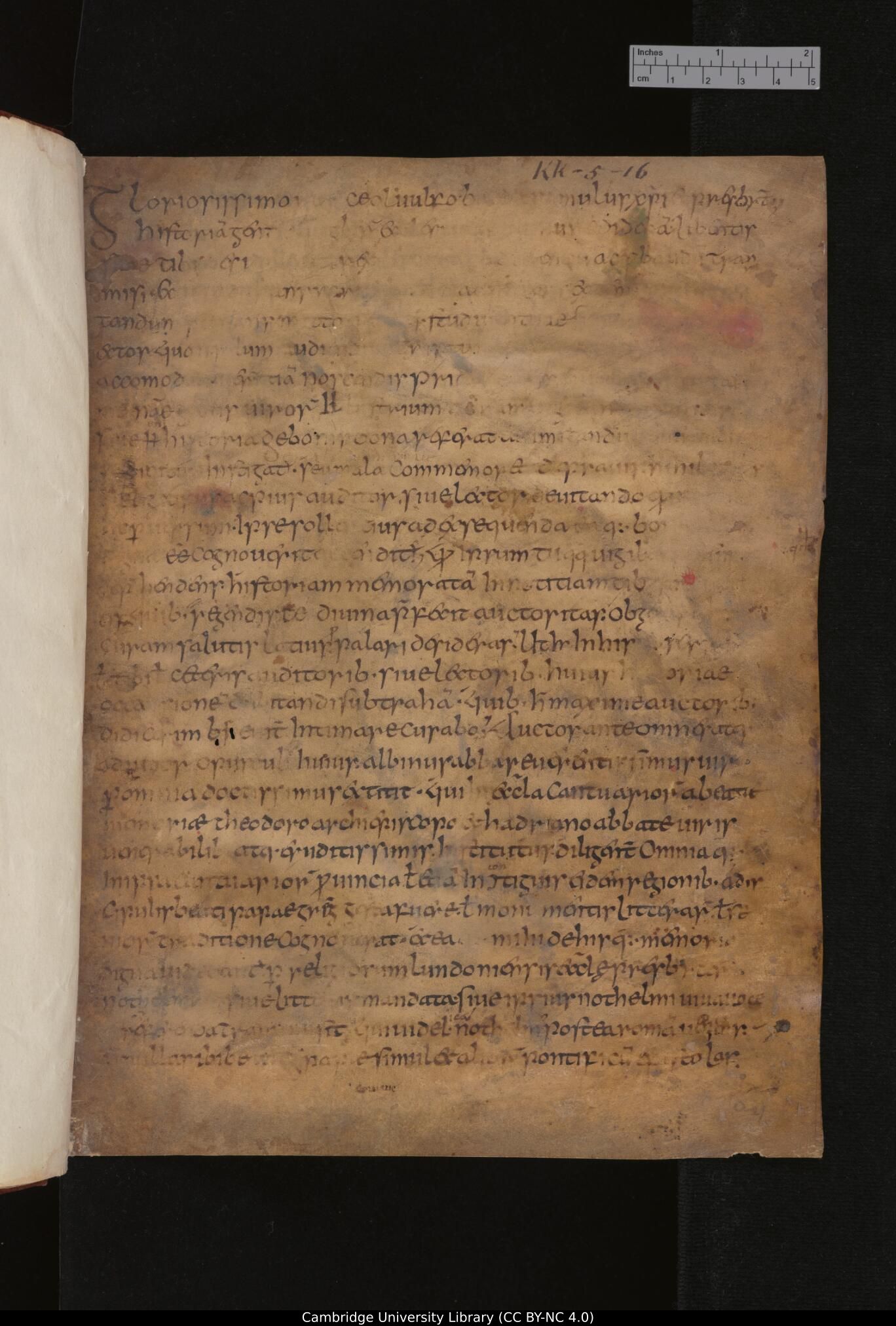
The Moore Bede, opening page of Bede's Historia Ecclesiastica Gentis Anglorum, Cambridge University Library MS Kk.5.16, fol. 1r, Northumbria, c. 737.

Historia Ecclesiastica Gentis Anglorum: Book I

Historia Ecclesiastica Gentis Anglorum — Bede's monumental ecclesiastical history of the English people, tracing the Christianisation of Britain from the Roman mission of Augustine of Canterbury to the early eighth century.