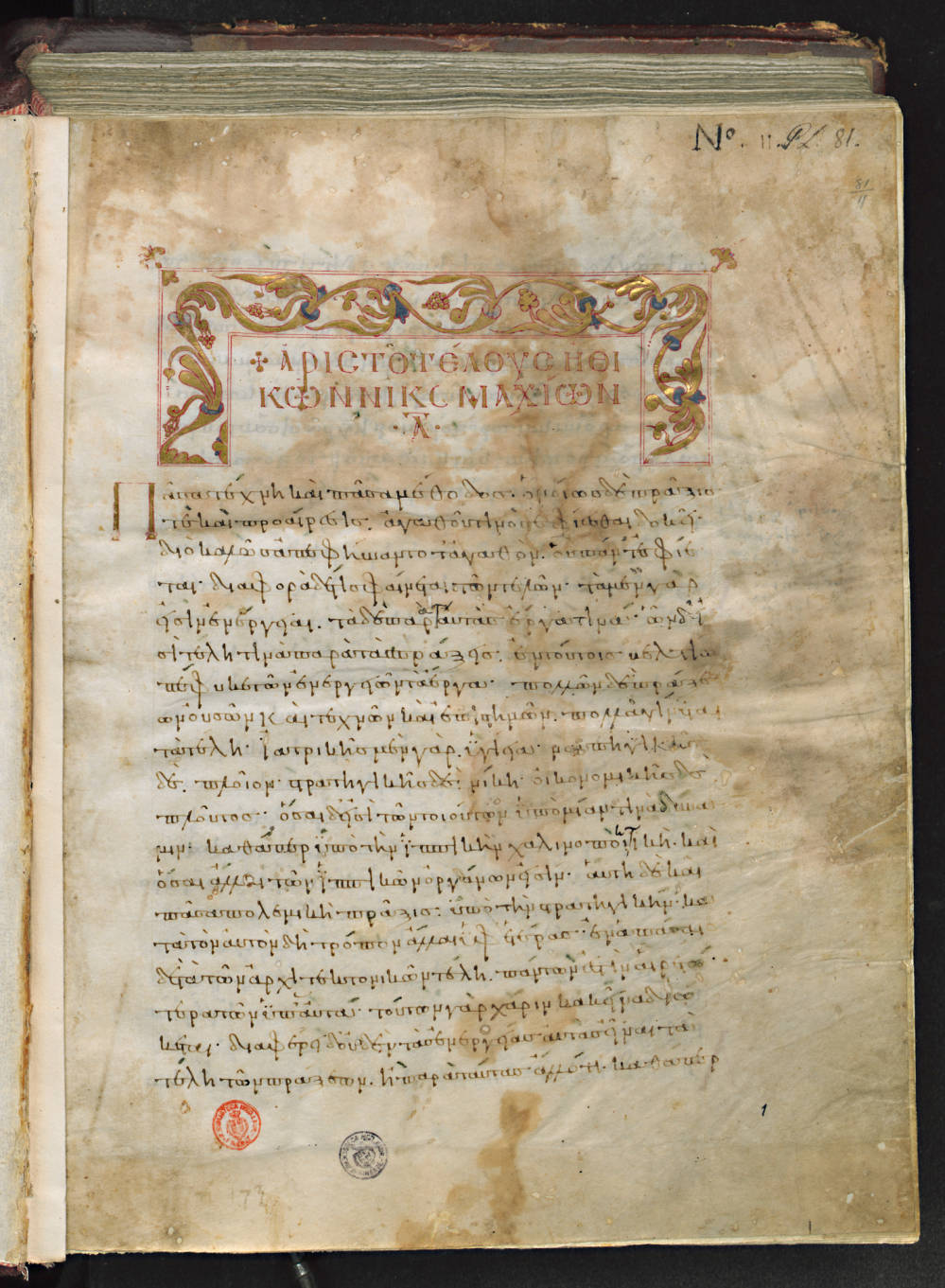
Unless otherwise noted, translations are from Terence Irwin's Nicomachean Ethics (Hackett, Third Edition). References follow standard Bekker numbering (e.g., 1094a1).
Overview
The Work
Somewhere around 350 BCE, in the Lyceum — the grove of trees outside Athens where Aristotle walked and taught — a set of lecture notes began to accumulate. They concerned a question that no one, before or since, has found easy to dismiss: how should a human being live? The Nicomachean Ethics is our best record of Aristotle's answers. It is not a treatise in the modern sense — polished, self-contained, addressed to a reading public. It is something stranger and more alive: a working investigation, full of false starts, self-corrections, and the occasional passage of such clarity that it stops you cold.
The title is ancient and its origin disputed. One tradition says the work was dedicated to Aristotle's son, Nicomachus; another, that it was edited by him after his father's death. Neither can be confirmed. What we can say is that among the several ethical works in the Aristotelian corpus — the Eudemian Ethics, the Magna Moralia — the Nicomachean Ethics is the most fully developed, the most carefully argued, and the one that has shaped every subsequent conversation about virtue, happiness, and the good life in the Western tradition.
The Ethics opens with a single sentence that contains, in compressed form, everything that follows:
Every craft and every discipline, and likewise action and decision, seems to seek some good—that is why some people were right to describe the good as what everything seeks. (1094a1–3)
This is not a neutral observation. It is a methodological commitment: that human life is teleological — oriented toward ends — and that the study of ethics is the study of which end is final, which good is worth pursuing for its own sake rather than for the sake of something else. The answer Aristotle arrives at is eudaimonia — a Greek word usually translated as happiness but better understood as flourishing, or living and doing well.
Why It Still Matters
The Nicomachean Ethics is not, primarily, a historical document. Its arguments press on us directly. When Aristotle asks whether happiness can be found in pleasure, or wealth, or honor, or whether it requires something more — the full exercise of our characteristic human capacities, sustained over a complete life, in the company of genuine friends — he is asking questions we have not stopped asking. When he describes a person of practical wisdom (phronesis), someone who perceives what each situation actually requires and responds to it well, he is describing something we recognize as real even though we rarely find a theory that captures it.
The Ethics also sits at the intersection of several large controversies in contemporary moral philosophy. It is the founding text of virtue ethics, which has staged a significant revival since the 1950s as a reaction against both Kantian deontology and utilitarian consequentialism. It contains the most developed ancient account of practical reason. Its treatment of moral weakness (akrasia) — how we can know what is right and still fail to do it — remains the most searching discussion of the problem in the literature. Its insistence that ethics cannot be separated from politics, that the good life requires a well-ordered community, speaks directly to contemporary debates about liberalism, communitarianism, and the relationship between individual flourishing and social institutions.
Above all, the Ethics is a serious book — one that takes seriously the difficulty of living well, refuses cheap consolation, and treats its reader as someone capable of genuine moral reflection. That remains rarer than it should be.
The Author
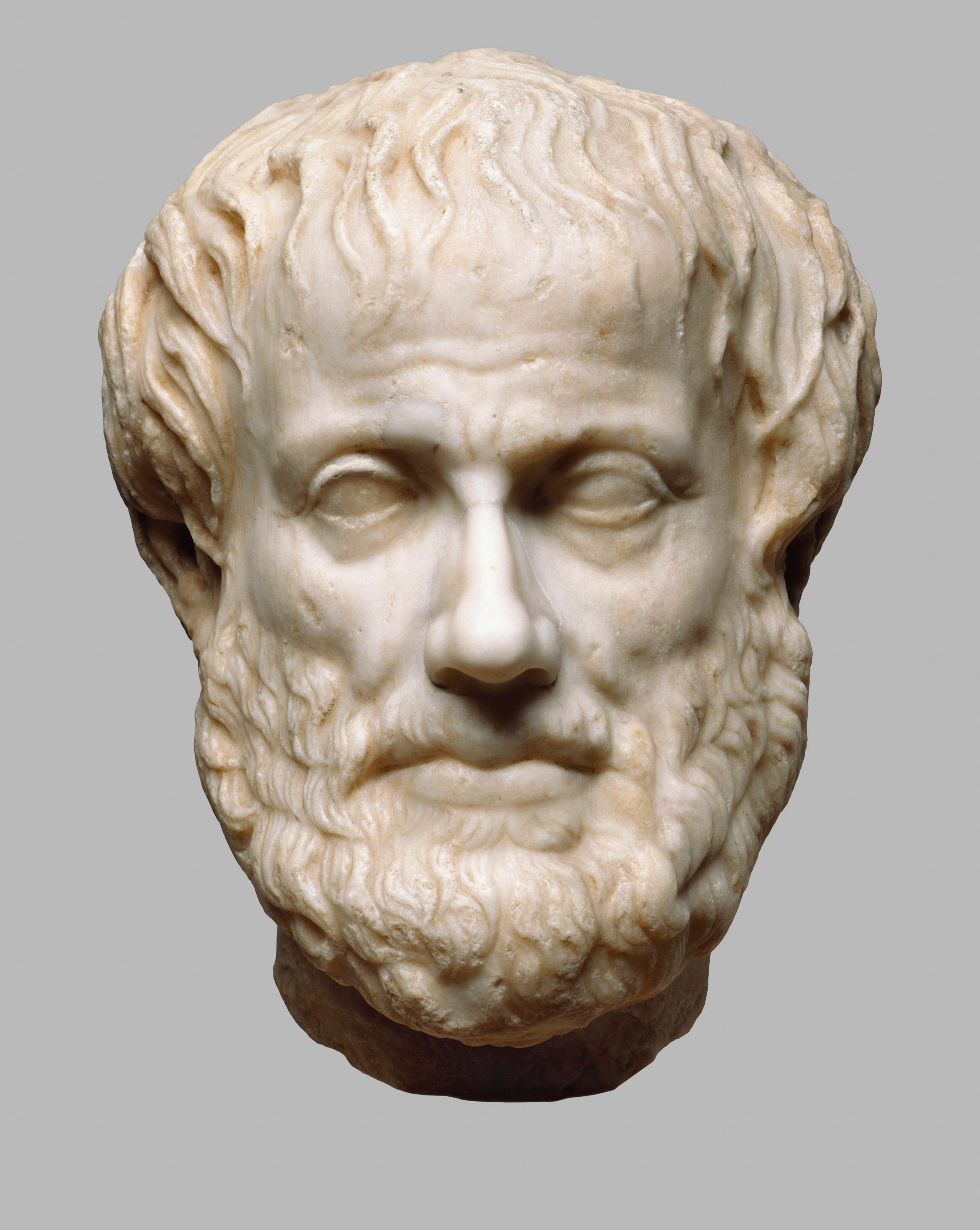
Aristotle was born in 384 BCE in Stagira, a small city in northern Greece, the son of Nicomachus — court physician to the Macedonian king Amyntas III. At seventeen he traveled to Athens and joined Plato's Academy, where he remained for twenty years, first as student and eventually as the Academy's most formidable critic from within. He was not a democratic insider; as a metoikos — a resident alien — he could not own property in Athens or participate in its political life. His perspective was always, in some sense, that of an analytic outsider.
After Plato's death in 347 BCE, Aristotle left Athens — whether forced out by anti-Macedonian sentiment or simply ready to work independently is unclear. He spent years in Asia Minor and Lesbos, conducting the biological research that produced some of his most remarkable observational science. In 343 BCE, Philip II of Macedon invited him to Pella to serve as tutor to his thirteen-year-old son, Alexander. Aristotle tutored the future Alexander the Great for three years. Whatever influence he exercised, the results were equivocal: Alexander built an empire Aristotle's politics would have found monstrous in scale and alien in spirit.
In 335 BCE, Aristotle returned to Athens and founded the Lyceum. He taught and wrote there for twelve years, producing works across virtually every field of inquiry — logic, physics, biology, psychology, metaphysics, rhetoric, poetics, politics, and ethics. When Alexander died in 323 BCE and Athens turned sharply anti-Macedonian, Aristotle left again, reportedly remarking that he would not allow Athens to sin twice against philosophy — an allusion to the execution of Socrates. He died in Chalcis, Euboea, in 322 BCE, at sixty-two.
None of the works we have from Aristotle were published in his lifetime in the sense we mean by publication. What we have are lecture notes, working texts, drafts — assembled into their present form by later editors, most importantly Andronicus of Rhodes in the first century BCE. The dialogues and polished literary works that ancient writers report admiring are lost. What survived is the workshop, not the showroom, and this has everything to do with why Aristotle's prose is so unlike Plato's — compressed, technical, digressive, repetitive, suddenly luminous.
Method and Innovation
A New Starting Point
The Nicomachean Ethics begins not with axioms or definitions but with a claim about structure: everything we do, we do for some reason, and those reasons terminate somewhere. There must be something we want for its own sake — something that is not merely a means to a further end — or the whole chain of human purpose hangs in the air. Aristotle is certain there is such a thing. He is uncertain, at first, exactly what it is. The Ethics is, among other things, the record of his attempt to find out.
This approach — beginning with widely shared beliefs (endoxa) and working by dialectical refinement toward more precise understanding — is distinctly Aristotelian. He calls it, in one of his methodological asides, beginning with what is "familiar to us" rather than what is "familiar without qualification." We start from where we are, not from where a pure rational reconstruction would require us to start. Ethics, for Aristotle, is not mathematics; you cannot derive a proof of how to live from self-evident first principles. You have to begin with the experienced texture of human life and reason carefully from there.
This has consequences for the kind of precision we should expect:
But our discussion will be adequate if we make things perspicuous enough to accord with the subject matter; for we should not seek the same degree of exactness in all sorts of arguments alike, any more than in the products of different crafts. (1094b12–14)
This is not a concession to sloppiness. It is a philosophical point about what rigor means in a domain where the evidence is human experience and the method is practical wisdom rather than demonstration. The person who demands geometric certainty from ethics has misunderstood what ethics is about.
The Role of Habit and Character
One of Aristotle's most consequential departures from Plato is his insistence that virtue is not primarily a matter of knowledge. Plato's Socrates had argued, in one form or another, that wrongdoing is always a form of ignorance — that if you truly understood the good, you would pursue it. Aristotle finds this psychologically naive. We have all had the experience of knowing what we should do and failing to do it. He takes this experience seriously.
For Aristotle, virtue (aretē) is a stable disposition of character (hexis) — not an act, not a feeling, not a belief, but a settled tendency to perceive situations correctly and to respond to them with the right emotional register and the right action. These dispositions are acquired through practice: we become courageous by doing courageous things, just by doing just things, temperate by practicing temperance. There is no shortcut through intellectual understanding:
We become just by doing just actions, temperate by doing temperate actions, brave by doing brave actions. (1103b1–2)
This has a corollary that Aristotle states with equal directness: what we become depends heavily on how we are raised. Character is not self-created from nothing; it is formed by habituation, by the examples we are given, by the communities we grow up in. The person who has been badly formed — who has been taught to want the wrong things, to find pleasure in cruelty, to take pride in vice — faces a much harder road to virtue than the person who began with good formation. Moral philosophy, for Aristotle, cannot be detached from education and politics.
Practical Wisdom and the Limits of Rules
The Ethics's central concept for moral epistemology is phronesis — practical wisdom, or prudence. It is the capacity to discern what each situation requires and to respond well. Practical wisdom is not a set of rules. It is more like a trained perception — the ability to see what is salient, to weigh competing considerations, to recognize the kind of situation you are in and what kind of action it calls for.
This means that the relationship between general moral principles and particular actions is not that of law to application. General principles — be courageous, be just, be honest — underdetermine action in any specific situation. The person of practical wisdom knows how courage looks in this situation, what honesty requires here, when justice demands severity and when it permits mercy. This perception cannot be codified. It is acquired through experience, refined through reflection, and cannot be downloaded from a textbook.
The Ethics's most striking analogy for this is the craftsman's eye:
The agents themselves must consider in each case what the opportune action is, as doctors and navigators do. (1104a7–8)
The navigator does not consult a rule-book when the weather changes. She reads the situation and responds. Moral life requires the same kind of skilled, flexible, experienced responsiveness.
Aristotle Against Plato on the Forms
The Ethics opens with a sustained polemic against Plato's theory of the Good — the view that there is a single Form of the Good, transcendent and universal, from which all particular goods derive their goodness. Aristotle's objections are multiple. Even if there were such a Form, he argues, it would not be useful to us:
For even if there is some one good predicated in common, or some separable good, itself in its own right, clearly that is not the sort of good a human being can achieve in action or possess; but that is the sort we are looking for now. (1096b32–34)
This is the move that sets the entire Ethics in motion. The good we are looking for is a human good — something achievable by human beings living human lives. Whatever its ultimate metaphysical status, the Good that matters for ethics must be realizable by creatures like us, with our particular capacities, vulnerabilities, and social nature. Aristotle keeps his eyes on that constraint throughout the work.
Structure of the Text
What We Have
The Nicomachean Ethics comes down to us in ten books — a division that, like Thucydides's eight books, is probably the work of later editors. Books V, VI, and VII of the Nicomachean Ethics appear verbatim in the Eudemian Ethics as well, and scholars have debated their proper home for centuries; the consensus tilts toward the Nicomachean. The text shows signs of a work assembled from multiple sets of lecture notes — there are duplicate discussions, cross-references that do not quite match, and at least one major topic (pleasure) treated twice, in Books VII and X, with different emphases.
None of this should discourage the reader. The repetitions and inconsistencies are traces of thinking in progress. The Ethics rewards non-linear reading more than most ancient texts: Books I, II, VI, VIII, IX, and X form a kind of spine; the chapters on justice (V), intellectual virtue (VI), and akrasia (VII) are best read as substantial modules; Books III and IV, which catalog the individual virtues, are more useful as reference than as continuous argument.
Book I — The Good and Happiness
The architecturally essential book. Aristotle establishes the teleological framework, argues for eudaimonia as the highest human good, criticizes Platonic theories of the Good, and offers his first sketch of what happiness consists in — the function argument. Just as a good knife is one that cuts well (performs its function excellently), a good human being is one who performs the characteristic function of human beings excellently. The characteristic function of human beings, Aristotle argues, is the exercise of the soul's capacities in accordance with reason. Happiness is the full, sustained exercise of these capacities — what he calls "activity of the soul in accordance with virtue."
Book I also contains what may be Aristotle's most quoted methodological remark, offered as consolation for the irreducible difficulty of the inquiry:
For the educated person seeks exactness in a given area to the extent that the nature of the subject allows. (1094b19–20)
Books II–IV — Virtue of Character
Book II lays the theoretical foundations for virtue ethics: the definition of virtue as a stable disposition (hexis), the doctrine of the mean, and the role of pleasure and pain in moral formation. Books III and IV work through the individual virtues and their corresponding vices: courage, temperance, generosity, magnificence, greatness of soul (megalopsychia), appropriate ambition, good temper, friendliness, truthfulness, wit, and shame.
These books are often skimmed by readers impatient to get to the famous discussions of practical wisdom and friendship. That is a mistake. The catalog of virtues is not pedantic taxonomy — it is an extended argument about what excellent human character looks like in practice, full of observations about social life that have not dated:
For a lover of the truth who is truthful even when nothing / is at stake will be still more concerned to tell the truth when something is at stake, since he will avoid falsehood as shameful when something is at stake, having already avoided it in itself when nothing was at stake. This sort of person is praiseworthy. (1127b1–5)
Book V — Justice
The most technically demanding book and, alongside the discussion of phronesis, the most influential in the history of philosophy. Aristotle distinguishes between general justice — complete virtue directed toward others — and particular justice, which divides into distributive justice (the fair allocation of goods in a community) and corrective justice (the rectification of unfair transactions). His analysis of proportionality in distribution — that just allocation tracks relevant differences, not mere equality — has generated two and a half millennia of argument about what counts as a "relevant difference."
The book concludes with discussions of natural and legal justice, equity (epieikeia) as a corrective to the inevitable imprecision of general rules, and the question of whether one can voluntarily do an injustice to oneself.
Book VI — Intellectual Virtue and Practical Wisdom
The philosophical heart of the work. Aristotle distinguishes five states by which the soul grasps truth: scientific knowledge (epistēmē), craft knowledge (technē), intuitive understanding (nous), theoretical wisdom (sophia), and practical wisdom (phronesis). The longest discussion is of practical wisdom — the master virtue of the moral life, the capacity that enables all other virtues to function well.
Aristotle's analysis of practical wisdom here is one of the most original contributions in all of moral philosophy. He argues that practical wisdom involves a perception of particular situations that is irreducible to the application of general principles, that it requires emotional attunement as well as cognitive clarity, and that it is the virtue that makes all other virtues genuinely virtuous rather than merely behavioral regularities. Without practical wisdom, courage becomes recklessness and justice becomes rigid rule-following:
Further, we fulfil our function insofar as we have prudence and virtue of character; for virtue makes the goal correct, and prudence makes the means to it correct. (1144a7–8)
Book VII — Pleasure, Self-Control, and Weakness of Will
Book VII opens with a discussion of three conditions below full virtue — brutishness (thēriōtēs), self-indulgence, and moral weakness (akrasia) — and then addresses the central puzzle of akrasia at length. How can someone act against their own best judgment? Aristotle's analysis distinguishes between universal and particular knowledge, between having knowledge and actively using it, and between the deliberate pursuit of wrong ends and the failure to follow through on acknowledged right ones. He argues that the akratic person has, in some sense, the right general belief but lacks the perceptual clarity, in the moment of temptation, to apply it.
The book ends with a second treatment of pleasure — less schematic than Book X's, more attentive to the role of pleasure in virtuous activity itself.
Books VIII–IX — Friendship
The most unexpected and, for many readers, the most moving section of the Ethics. Aristotle spends two full books on friendship (philia) — a term that covers everything from commercial relationships to the deepest bonds of mutual care. He argues that friendship is not merely pleasant or useful but constitutive of the good life: human beings are social creatures, and a self-sufficient life is not a solitary one. Even the happiest person needs friends.
Three types of friendship are distinguished: friendships of utility, friendships of pleasure, and friendships of virtue — friendships based on the recognition and appreciation of one another's character. Only the last is friendship in the fullest sense, and it is, predictably, rare:
These kinds of friendships are likely to be rare, since such people are few. Further, they also need time, to grow accustomed to each other; for, as the proverb says, they cannot know each other before they have shared their salt as often as it says, and they cannot accept each other or be friends until each appears lovable to the other and gains the other’s confidence. (1156b25–29)
Books VIII–IX also contain Aristotle's account of self-love, the relationship between friendship and justice, and the remarkable discussion of why the happy person nevertheless needs the activity of doing good — why virtuous action is not merely instrumental but constitutive of happiness itself.
Book X — Pleasure and the Highest Happiness
Book X opens with a revised account of pleasure — now analyzed as the completion (teleiotēs) of activities rather than as a process toward a goal — and closes with the question of what the highest form of human happiness is. Aristotle's answer is philosophically controversial and has generated intense disagreement: the highest happiness, he argues, is the life of theōria — contemplation, the sustained exercise of the highest human capacity (intellect) on the highest objects (eternal truths).
This seems to pull against everything that preceded it. The Ethics up to this point has emphasized practical wisdom, virtue of character, friendship, political community — all thoroughly human, social, embedded goods. The contemplative life seems to require a withdrawal from all of that. The tension is real and Aristotle does not quite resolve it. Book X, Chapter 7 is one of the most discussed passages in all of ancient philosophy.
The book closes with a transition — one of the most famous pivots in intellectual history — to the Politics: the claim that ethics requires politics, that the formation of character requires law and community, and that the philosopher must therefore become a student of legislation.
Key Themes
Eudaimonia and the Human Function
The argument of Book I culminates in what scholars call the function argument (ergon argument): if every craft and profession has a characteristic function, and if excellence consists in performing that function well, then the good for human beings must consist in performing the characteristic human function well. What is that function? Aristotle's answer is the active exercise of the soul's faculties in conformity with virtue — which, if there are several virtues, in conformity with the best and most complete.
Eudaimonia is, on this account, not a feeling of satisfaction or a state of subjective well-being. It is an activity — something you do, not something you have. And it requires the whole of a life: a single virtuous day no more constitutes happiness than one swallow makes a spring. This has the consequence, which Aristotle accepts with characteristic directness, that happiness admits of degrees and can be destroyed: the truly happy life requires not only virtue but adequate material resources, health, good fortune, and long life. Priam, Troy's king, was not happy — regardless of his character — because of what happened to him in old age.
The Ethics's refusal to insulate happiness from external fortune is one of its most distinctive features. Unlike the Stoics, who would insist that virtue is sufficient for happiness regardless of circumstances, Aristotle thinks that view simply gets the phenomenology wrong. We know, when we see a genuinely good person destroyed by catastrophe, that something bad has happened — not merely something unfortunate. The good person's life has gone worse. The Ethics is honest about this in a way that many philosophical accounts of happiness are not.
The Doctrine of the Mean
The doctrine of the mean (to meson) is Aristotle's most famous and most misunderstood contribution to virtue ethics. Each virtue, he argues, is a mean between two vices — one of excess and one of deficiency. Courage lies between recklessness and cowardice; generosity between prodigality and miserliness; proper self-assertion between vanity and excessive self-deprecation.
The mean is not the mathematical average between extremes. It is the amount that is "right for us" in each situation — which varies with circumstances, with the people involved, with what is at stake. Aristotle explicitly compares it to the trainer who prescribes the right amount of food for a particular athlete, not the same amount for everyone. The right response to an insult from a stranger differs from the right response to betrayal by a friend; the same action can be courageous in one context and reckless in another.
This is not moral relativism. It is a sophisticated account of context-sensitivity in ethics: the claim that right action cannot be read off from a formula but requires the kind of situation-sensitive judgment that is the mark of practical wisdom. The doctrine of the mean is less a theory than a heuristic for identifying what practical wisdom needs to navigate.
Moral Weakness (Akrasia)
The problem of akrasia — acting against one's better judgment, doing what one knows to be wrong — was one of the central puzzles of Socratic ethics. Plato's Socrates had denied it was possible: what looks like akrasia is always really ignorance. Aristotle thinks this is simply false to experience:
First of all, some say he cannot have knowledge at the time he acts. For it would be terrible—Socrates used to think—for knowledge to be in someone, but mastered by something else, and dragged around like a slave. (1145b25–28)
Aristotle's analysis distinguishes between knowledge as a general belief ("sweets are bad for me") and knowledge as active application to a particular case ("this is sweet"). In the moment of temptation, passion can disrupt the application of general knowledge to the particular case — the akratic person acts on a different, more particular judgment without thereby ceasing to hold the general belief. The general belief is, in the moment, inert.
This analysis opens onto some of the deepest questions in moral psychology: about the relationship between reason and desire, about whether motivational failure is always a failure of cognition, about what it means to "know" something in a practically effective sense. Aristotle's discussion remains the most searching treatment of these questions in the philosophical literature.
Friendship as Constitutive of the Good Life
Aristotle's treatment of friendship (philia) is unusual in the history of ethics because he insists that it is not merely instrumental to happiness but constitutive of it. The argument is not simply that friends are pleasant or useful, though they are both. The argument is that self-knowledge and self-development require a mirror — another person whose character we recognize as like our own, whose perceptions we trust, whose life illuminates our own:
The excellent person is related to his friend in the same way as he is related to himself, since a friend is another himself. (1170b6–7)
The implications extend in several directions. Friendship of virtue requires time — genuine mutual knowledge of character cannot be achieved quickly. It requires equality — not of social station, but of character and virtue. It is incompatible with a life of pure contemplative withdrawal. And it links ethics to politics: if friends are necessary for the good life, and genuine friendship requires a certain kind of community, then the political order is not merely the backdrop to the moral life but one of its conditions.
The discussion of friendship also contains Aristotle's most sustained account of what he calls "self-love" (philautia) in a non-pejorative sense — love of one's rational self, one's character, one's capacity for virtue — which he argues is the basis for all other love and is not to be confused with selfishness, which is love of the lower parts of oneself.
Politics as the Completion of Ethics
The Ethics and the Politics are, for Aristotle, parts of a single inquiry. The Ethics establishes the target — human flourishing, the excellent character — and the Politics examines the institutional conditions under which that target can be hit. The closing sentences of the Ethics are not a coda; they are a handoff:
Since, then, our predecessors have left the area of legislation uncharted, it is presumably better to examine it ourselves instead, and indeed to examine political systems in general, and so to complete the philosophy of human affairs, as far as we are able. (1181b12–15)
This is a claim most modern moral philosophers have resisted. We tend to think of ethics as the study of what individuals should do, and politics as a separate domain. Aristotle thinks this is a mistake. The individual cannot achieve the good life in isolation; human beings are political animals (zōon politikon) by nature, and a life conducted outside a political community is either subhuman or superhuman. The conditions for virtue — habituation, law, education, friendship, the material prerequisites of a decent life — are political conditions. Ethics without politics is, for Aristotle, an abstraction that mistakes a part of the inquiry for the whole.
Selected Passages
The Argument for Happiness as the Highest Good (Book I, 1–7)
The opening books of the Ethics are a sustained narrowing: from the observation that all action aims at some good, to the claim that some good must be final (wanted for its own sake rather than for something else), to the identification of eudaimonia as that good, to the function argument establishing what eudaimonia consists in.
The argument has a deceptive simplicity. Aristotle begins with examples so familiar as to seem obvious — the doctor aims at health, the general at victory, the builder at a house — and moves by careful steps to a conclusion that is genuinely surprising: that what we all really want, under all the particular things we want, is to live and fare well. The difficulty is not the conclusion but the middle term: what does living well actually require?
Aristotle surveys the candidates. Pleasure fails because it is the life of cattle, not human beings in their distinctiveness — or, less dismissively, because it identifies happiness with a sensation rather than an activity. Honor fails because it depends on the recognition of others, while happiness must be something more securely one's own. Wealth fails because it is obviously a means to something else. He settles, provisionally, on the exercise of the soul in accordance with virtue — and immediately hedges:
Further in a complete life — for one swallow does not make a spring, nor does one day, nor, similarly, does one day or a short time make us blessed and happy. (1098a18–20)
This qualification does a great deal of work. It ensures that happiness is a property of lives, not moments — and that it is therefore vulnerable to what happens to us over time in a way that a feeling of satisfaction is not.
The Doctrine of the Mean (Book II, 5–9)
The formal statement of the doctrine of the mean is preceded by a discussion of the role of pleasure and pain in virtue that is both philosophically precise and practically grounded. We are formed by pleasures and pains — what we enjoy and what we avoid shapes what we become — and the test of whether a person has achieved virtue is whether they take pleasure in virtuous action. The merely self-controlled person does what is right but doesn't enjoy it; the temperate person enjoys moderation. The difference matters.
The doctrine of the mean is introduced through the analogy of expert craft. Experts, Aristotle observes, aim at what avoids excess and deficiency:
That is why it is also hard work to be excellent. For in each case it is hard work to find the intermediate; for instance, not everyone, but only one who knows, finds the midpoint in a circle. So also getting angry, or giving and spending money, is easy and everyone can do it; but doing it to the right person, in the right amount, at the right time, for the right end, and in the right way is no longer easy, nor can everyone do it. Hence doing these things well is rare, praiseworthy, and fine. (1109a24–29)
The passage is among the most quoted in the Ethics because it captures something genuinely observed: the asymmetry between vice and virtue in terms of difficulty. Going wrong is easy; going right is hard; and the difficulty is precisely the kind of fine-grained situational attunement that practical wisdom makes possible.
On Practical Wisdom (Book VI, 5 and 12–13)
Book VI's treatment of practical wisdom (prudence) is the most concentrated piece of moral epistemology in ancient philosophy. Aristotle's definition is careful:
And so prudence must be a state grasping the truth, involving reason, and concerned with action about human goods. (1140b20–21)
The definition seems modest, but each word carries weight. It is a state — stable, reliable, not a lucky hit — grasping the truth — not merely believing correctly, but perceiving — involving reason — not instinct or passion alone — concerned with action — not pure theory — about human goods — particular, contextual, not eternal abstractions.
The chapters that follow distinguish practical wisdom from theoretical wisdom, clever calculation, and mere craft. The crucial distinction is from cleverness (deinotes): practical wisdom uses the same calculative capacities as cleverness but is distinguished from it by being in the service of genuinely good ends. A clever person can figure out how to get what they want; the person with practical wisdom both wants the right things and figures out how to get them. The Ethics's discussion of the relationship between virtue of character and practical wisdom is among its most delicate:
What we have said, then, makes it clear that we cannot be fully good without prudence, or prudent without virtue of character. (1144b30–32)
This mutual entailment — virtue requires practical wisdom, practical wisdom requires virtue — closes the possibility of moral short-cuts. You cannot be a good strategist in the service of bad ends; you cannot be genuinely virtuous without the practical intelligence to navigate the situations your virtue must address.
On Friendship (Books VIII–IX)
The most memorable passages in Books VIII–IX are not the taxonomic ones — the distinctions between types of friendship — but the phenomenological ones, where Aristotle describes what genuine friendship actually feels like from the inside:
Moreover, in loving their friend they love what is good for themselves; for when a good person becomes a friend he becomes a good for his friend. Each of them, therefore, loves what is good for himself, and repays in equal measure the wish and the pleasantness of his friend; for friendship is said to be equality. And this is true above all in the friendship of good people. (1157b33–35)
The discussion of whether we can be friends with ourselves — and what self-love, properly understood, consists in — anticipates centuries of debate:
For the excellent person is of one mind with himself, and desires the same things in his whole soul. Hence he wishes goods and apparent goods to himself, and achieves them in his actions, since it is proper to the good person to reach the good by his efforts. He wishes and does them for his own sake, since he does them for the sake of his thinking part, and that is what each person seems to be. Moreover, he wishes himself to live and to be preserved. And he wishes this for his rational part most of all. (1166a12–19)
On the Contemplative Life (Book X, 7–8)
The most philosophically contested passage in the Ethics — and the most revealing about Aristotle's own ranking of lives:
If happiness is activity in accord with virtue, it is reasonable for it to be in accord with the supreme virtue, which will be the virtue of the best thing. The best is understanding, or whatever else seems to be the natural ruler and leader, and to understand what is fine and divine, by being itself either divine or the most divine element in us. Hence complete happiness will be its activity in accord with the proper virtue; and it has been said that this activity is an activity of study. This seems to agree with what has been said before, and also with the truth. For this activity is supreme, since understanding is the supreme element in us, and the objects of understanding are the supreme objects of knowledge. Further, it is the most continuous activity, since we are more capable of continuous study than any continuous action. (1177a12–21)
The passage is immediately complicated by what follows: the acknowledgment that this is not the life appropriate to a human being but to "something divine" in us. The life Aristotle has been describing for nine books — of practical wisdom, courage, justice, friendship, and political engagement — is described as happiness "in a secondary way" (deuterōs, 1178a9). The tension between these two visions of the good life — the philosophically engaged, socially embedded life of Books I–IX, and the solitary contemplative life of Book X — is one of the great unresolved questions in Aristotelian scholarship.
Further Reading
Translations
Aristotle., Rackham, H. (translator). Aristotle: The Nicomachean Ethics, Translated by H. Rackham. United Kingdom: Harvard University Press, 1934.
Aristotle in 23 Volumes, Vol. 19, translated by H. Rackham. Cambridge, MA, Harvard University Press; London, William Heinemann Ltd. 1934. https://www.perseus.tufts.edu/hopper/text.jsp?doc=Perseus:text:1999.01.0054
Terence Irwin (Hackett, Second Edition, 1999) — the standard philosophical translation, used by most anglophone philosophy departments. Precise, consistent in rendering technical terms, and accompanied by an extensive commentary. Not always graceful, but philosophically reliable. The second edition improves significantly on the first in several contested passages.
W. D. Ross, revised by J. O. Urmson (Oxford, 1998) — the older Oxford translation, widely available and still useful, though subsequent scholarship has required corrections in several places. Ross's English captures the text's gravity better than some more recent versions.
C. D. C. Reeve (Hackett, 2014) — a more recent scholarly translation that benefits from several decades of post-Irwin scholarship. Reeve is particularly attentive to the Greek's syntactic structure and to places where translation choices embody substantive interpretive decisions.
David Ross (Penguin Classics, 1976; revised Ackrill and Urmson) — a more accessible version of the Ross translation, better suited to general readers than the Oxford edition. Still widely read and recommended as a starting point.
Joe Sachs (Focus Publishing, 2002) — philosophically distinctive for its refusal to use Latinized technical vocabulary, rendering eudaimonia as "happiness," aretē as "virtue" in its etymological sense, and logos with careful attention to context. Sachs's translations reward readers interested in Aristotle's Greek rather than his modern reception.
For the passages on phronesis (Book VI) and friendship (Books VIII–IX), reading Irwin, Reeve, and Ross side by side is particularly illuminating: the differences expose genuine philosophical ambiguities in the Greek.
Introductions and General Studies
Rosalind Hursthouse, On Virtue Ethics (Oxford, 1999) — the best single-volume introduction to contemporary virtue ethics as a philosophical project. Hursthouse develops a neo-Aristotelian position in dialogue with Kantian and consequentialist alternatives, and her opening chapters are the clearest account available of why virtue ethics revived when it did and what it claims to offer.
Julia Annas, The Morality of Happiness (Oxford, 1993) — situates Aristotle's ethics within the broader context of ancient ethical theory, comparing his approach to Stoic, Epicurean, and Platonic alternatives. Annas argues for the systematic coherence and contemporary relevance of ancient eudaimonism in a way that remains persuasive.
Sarah Broadie, Ethics with Aristotle (Oxford, 1991) — the most philosophically searching full-length engagement with the Ethics in English. Particularly strong on the doctrine of practical wisdom and the function argument. Not a commentary but a series of essays that follow the Ethics's argument while pressing its hardest questions.
Jonathan Lear, Aristotle: The Desire to Understand (Cambridge, 1988) — the best general introduction to Aristotle's philosophy as a whole, covering not only the ethics but the metaphysics, natural philosophy, and psychology that ground it. Lear writes with unusual clarity about difficult material.
Martha Nussbaum, The Fragility of Goodness (Cambridge, 1986; revised 2001) — a philosopher and classicist's account of how Greek tragedy and philosophy think about luck, virtue, and the good life. The chapters on Aristotle — particularly on the role of fortune in eudaimonia — are essential reading, and Nussbaum's engagement with the Ethics's claims about vulnerability and luck is some of the best writing on Aristotle in English.
Commentaries
Rowe and Broadie (Oxford, 2002) — Rowe's translation paired with Broadie's philosophical commentary. The commentary is more accessible than a full scholarly apparatus but philosophically serious. The best option for a reader who wants genuine philosophical engagement without specialist Greek.
Gauthier and Jolif (French, 1958–59) — the most exhaustive scholarly commentary on the Ethics in any language. Indispensable for specialists; not available in English.
Aspasios (2nd century CE) — the oldest surviving commentary on any Aristotelian text, covering Books I–IV and part of VII. Available in English translation (Konstan et al., Duckworth, 2006). A fascinating document in the history of Aristotle's reception, and occasionally illuminating on points where the Greek is obscure.
Aristotle in Contemporary Ethics
Philippa Foot, Natural Goodness (Oxford, 2001) — a late masterwork arguing for a naturalistic account of virtue grounded in human nature, in conscious dialogue with Aristotle. Foot's analysis of the relationship between natural function and ethical evaluation develops one strand of the function argument in a direction Aristotle himself did not pursue.
Alasdair MacIntyre, After Virtue (Notre Dame, 1981; Third Edition 2007) — the most influential modern argument for the recovery of Aristotelian ethics, framed as a critique of modern moral philosophy's failure to sustain a coherent account of virtue after the collapse of its teleological framework. MacIntyre's argument is contentious, but it set much of the agenda for virtue ethics scholarship in the last four decades.
Amartya Sen and Martha Nussbaum (eds.), The Quality of Life (Oxford, 1993) — the most significant attempt to develop Aristotelian ideas about human flourishing into a practical framework for development economics and policy. The Nussbaum-Sen "capabilities approach" has become one of the major frameworks in contemporary political philosophy and development economics, and this volume is its founding document.
Bernard Williams, Ethics and the Limits of Philosophy (Harvard, 1985) — not primarily an Aristotelian work, but Williams's critique of moral theory — his argument that systematic ethical theories distort rather than capture moral experience — draws heavily on Aristotelian themes and is indispensable for understanding why virtue ethics, with its emphasis on character and situation rather than principle and rule, has attracted so much recent interest.