MARCUS AURELIUS
Meditations
Translated by George Long · Introduction by W. L. Courtney
INTRODUCTION
Marcus Aurelius Antoninus (121–180 CE) was Roman Emperor for nineteen years, from 161 until his death on campaign at Vindobona (modern Vienna) in 180. He is the last of the Five Good Emperors, the last in the line of Nerva, Trajan, Hadrian, and Antoninus Pius, and by the universal verdict of ancient and modern admirers the most philosophically serious of them all. He governed an empire at its greatest territorial extent, fought wars on two fronts simultaneously — against the Parthians in the east and the Germanic tribes on the Danube frontier — presided over a devastating pandemic that killed millions across the Roman world, and wrote, in the evenings and the early mornings of a life otherwise entirely consumed by duty, a series of private notes to himself in Greek that have never since ceased to be read. He did not name them. He wrote them in a language that was not his administrative language and probably did not expect or intend that anyone besides himself would ever read them.
The notes exist now in twelve books. The first book is unlike the rest: it is a list of debts, a systematic acknowledgement of what Marcus learned from the people who formed him — his grandfather, his father's memory, his mother, his great-grandfather, various teachers, and above all the Emperor Antoninus Pius under whom he served for twenty years as adopted heir before assuming power. Books II through XII are the working notebooks: shorter or longer reflections, injunctions to himself, quotations from Stoic philosophers and poets, arguments addressed to his own tendency to distraction or self-pity or resentment or ambition, reminders of what matters and what does not. Book II carries a heading in the manuscript — "Written among the Quadi, on the river Gran" — and Book III carries "Written at Carnuntum," locating at least some of the writing in the military camps of the Danube campaign. The books have no overall argument, no narrative, no development toward a conclusion. They are exercises in the literal sense: a man practising, repeatedly, the same movements of mind.
The Books in This Volume
Book I stands apart from everything that follows. Its mode is gratitude, its form a catalogue, and its subject the education of a Roman Emperor by the people around him. From his grandfather, gentleness and the control of temper. From his father's memory, modesty and a manly character. From his mother, piety, beneficence, and abstinence not only from evil deeds but from evil thoughts. From his great-grandfather, the lesson that private tutors are worth more than public schools. From Diognetus, the first teacher to suggest that philosophy was worth pursuing seriously. From Rusticus, the decisive gift: a copy of the lectures of Epictetus, which Marcus read in manuscript. From Epictetus himself — mediated through Arrian's records — the substance of the Stoic philosophy that the Meditations attempt to practice. From Antoninus Pius, the long lesson of what a ruler looks like when he governs without display or self-congratulation, taking everything seriously and making nothing a spectacle.
Book I is the only book in which Marcus addresses persons rather than himself, and the only book whose tone is consistently warm. It serves as an acknowledgement of the tradition he is working within and the people who made it accessible to him — a preamble that prevents the rest from being read as entirely solitary. Marcus did not arrive at his philosophy alone.
Books II and III establish the characteristic register of the Meditations: the injunction framed in the second person singular (addressed to himself), the reminder of what lies within the power of choice (prohairesis) and what does not, the recurrent return to the themes of death, impermanence, and the smallness of human ambition viewed against the scale of time and the universe. Book II opens with one of the most famous passages in the entire collection — the morning preparation for the day's encounters: the warning to himself that he will meet the busybody, the ungrateful, the arrogant, the deceitful, the envious, and the unsocial, and the instruction to remember that all of them share his rational nature and that anger toward them is pointless and self-defeating. Book III presses harder: whatever time remains is short; do not waste it on what does not matter.
Books IV through IX are the fullest and most philosophically varied section of the Meditations. They range across the full extent of Stoic ethical teaching — the indifference of external things, the sufficiency of virtue, the rational structure of the universe and the individual's place within it, the proper treatment of those who wrong you, the right relationship to pain and illness, the transience of fame — and they include some of the passages most quoted by later readers. The image of the river of time that carries everything away. The observation that Alexander the Great and his muleteer came to the same end. The injunction to confine yourself to the present moment, since the past is gone and the future is not yet yours. The argument that whatever comes from nature cannot be shameful, since nature makes nothing shameful. The reminder that the obstacle to action becomes the action: that the impediment to the way is the way.
Books X through XII are shorter and denser, and many readers find in them a change of register — a certain accumulated urgency, as though the arguments that earlier books rehearsed at length are being compressed into their most essential form. Book XII, the last, closes not with a formal conclusion but with a cluster of reflections on the soul, its divine origin, its relationship to reason, and the composure with which a rational being ought to face death. The final words of the Meditations as they survive — the manuscript breaks off rather than ending — are an injunction to depart willingly, as a ripe olive falls, grateful to the tree that bore it and the season that brought it to ripeness.
Marcus Aurelius and Stoicism
The Stoicism of the Meditations is practical and personal rather than systematic and technical. Marcus does not explain the Stoic theory of the lekton or the mechanics of the pneuma; he does not argue against the Epicureans or the Sceptics in philosophical detail. What he returns to, obsessively and in constantly varied form, are the three disciplines that the Stoic teacher Epictetus had identified as the core of philosophical practice: the discipline of desire (wanting only what is in one's power); the discipline of action (acting for the common good, with reservation, without attachment to outcomes); and the discipline of assent (not letting impressions run ahead of reason, not judging what merely appears terrible to actually be so).
The relationship to Epictetus is explicit, intimate, and acknowledged in Book I. Marcus is in many ways the ideal reader of Epictetus — a man who read the Discourses not as a student but as a practitioner, not in a schoolroom but in a campaign tent, not once but across decades, and who wrote the Meditations in part as a record of how far he was succeeding and how often he was failing. The Meditations are not the notes of a sage but of a person trying, and the gap between the philosophy Marcus espouses and the frustrations, vanities, and irritabilities he confesses to — the vanity of ambition he cannot quite stop feeling, the anger at courtiers he cannot quite suppress — gives the work its peculiar humanity and its permanent accessibility.
Marcus is also the last of the great Stoics. His Meditations were written while the philosophical schools of Athens were still functioning and Stoic teachers were still active in Rome, but the Meditations themselves mark, in retrospect, a boundary. The systematic Stoicism of the Hellenistic period had already given way, in the Roman tradition, to the practical and ethical Stoicism of Seneca, Epictetus, and Marcus himself. After Marcus's death in 180, the philosophical tradition moved in other directions, and the Stoic school ceased to exist as a living institutional presence within a generation or two. The Meditations are the last great document of a school that Marcus did not know was ending.
Transmission
The survival of the Meditations is among the most contingent and narrowly averted losses in the history of classical literature. Marcus wrote for himself, circulated nothing, and left no instruction for the preservation of his notes. By what means the twelve books survived the third century — the century of crisis that shattered the political and cultural continuity of the Roman world — is entirely unknown. By what means they survived into the Byzantine period is only slightly less obscure.
The earliest concrete evidence for the existence of the Meditations comes from around 900 CE, when Arethas of Caesarea (c. 850–944 CE) — the Byzantine bishop and classical bibliophile whose connection with the transmission of Epictetus's Discourses is noted in that entry — encountered a manuscript of Marcus, had it recopied at his own expense, and mentioned it with admiration in his letters and scholarly works. Arethas implies that the text was not unknown before him, but all surviving Byzantine references to the Meditations postdate his encounter with it. His copy has not survived, but it is generally believed to be the ancestor, direct or indirect, of the two manuscripts on which the modern text rests.
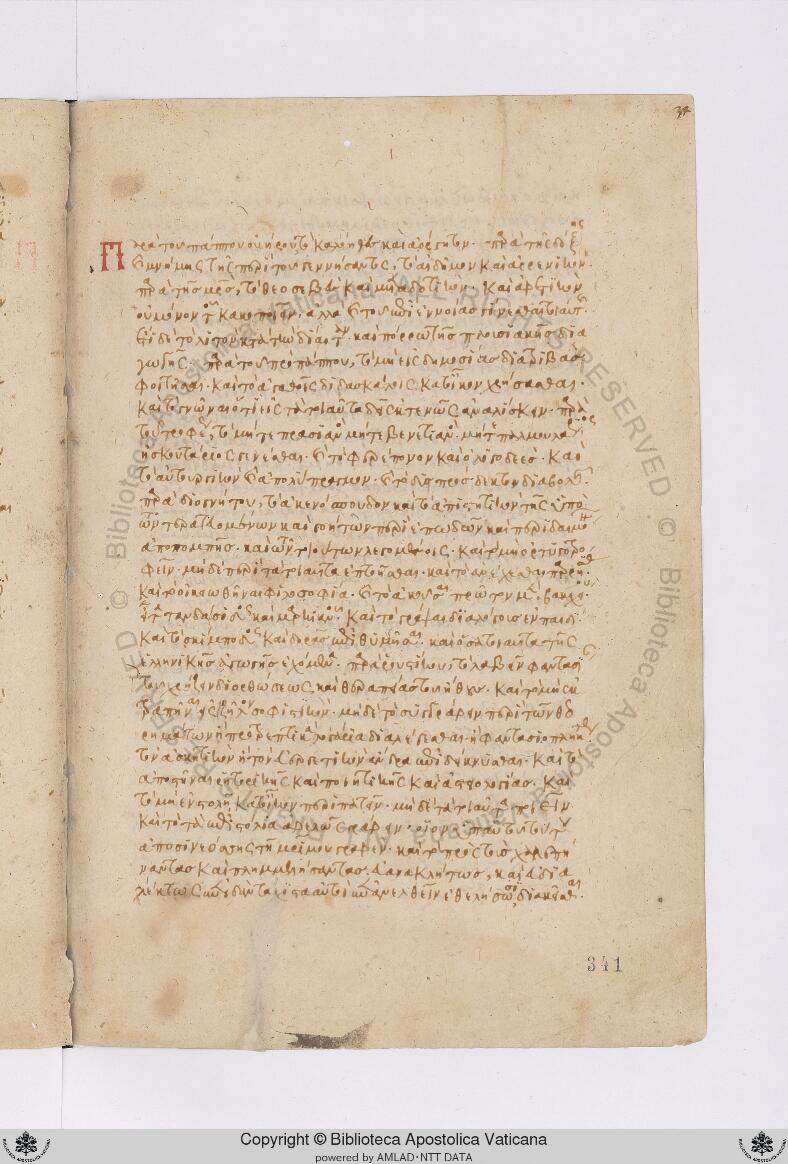
Those two manuscripts are the Codex Vaticanus Graecus 1950 (designated A in critical editions) and the Codex Palatinus, also known as the Codex Toxitanus (designated T or P), which was used for the editio princeps — the first printed edition, produced at Zurich in 1558–59 under the auspices of Conrad Gesner, with a Latin translation by Wilhelm Xylander — and is now lost. The Vatican Codex (A), a fourteenth-century manuscript in Greek minuscule, passed to the Biblioteca Apostolica Vaticana in 1683 from the collection of Stefano Gradi, a scholar from Ragusa (modern Dubrovnik) who served as a Vatican librarian. It is the only complete surviving manuscript: Xylander noted that the Codex Palatinus was mutilated at the end, and since the Palatinus itself has vanished, the Vatican Codex is the sole textual authority for the portions it preserves in full. The folio shown in the cover of this edition, Vat. gr. 1950, fol. 341r, opens the Marcus Aurelius section of the manuscript — the Meditations run from fol. 341r to fol. 392v within a larger manuscript miscellany — and is the earliest surviving witness to the opening of the work.
The modern critical edition of the Greek text is that of A. S. L. Farquharson (Marcus Aurelius: Meditations, Clarendon Press, 1944), which remains the standard scholarly reference and includes the fullest discussion of the manuscript tradition in English.
This Translation
The translation is that of George Long (1800–1879), published in 1862 — the same Long whose Epictetus translation appears elsewhere in this series, and whose characteristic virtues as a translator of the Roman Stoics are the same in both: directness, fidelity to the Greek, and an absence of paraphrase or embellishment that allows the weight and plainness of Marcus's own prose to come through without Victorian ornamentation. Long was among the first English translators to make the Meditations readily accessible to a general reading public, and his version was reprinted many times, appearing eventually in the second volume of the Harvard Classics.
The introduction is by W. L. Courtney (William Leonard Courtney, 1850–1928), philosopher, journalist, and from 1894 until his death the editor of The Fortnightly Review. Courtney taught moral philosophy at New College, Oxford, from 1876 to 1890, where he was known as an unusually clear and effective teacher, a follower of T. H. Green's Oxford neo-Hegelianism who nevertheless had a wide sympathy for ancient moral philosophy. His introduction places the Meditations in the context of Stoic thought and of Marcus's historical situation as Emperor, and is written in the accessible expository prose of a professional philosopher who has become a professional journalist — a combination that serves a volume intended for the general reader rather than the classical scholar. The edition was published by Blackie and Son, London. The translation and introduction are in the public domain.
FULL TEXT
Book I: Debts
[Book I is unique in the Meditations: unlike the reflective self-address of Books II through XII, it takes the form of a formal acknowledgement of the people whose example and instruction formed Marcus. It is the only section in which he addresses persons rather than himself. Sections are numbered as in Long's translation.]
I. From my grandfather Verus1 I learned to be gentle and meek, and to refrain from all anger and passion.
II. From the fame and memory of my father,2 modesty and a manly character.
III. From my mother,3 piety and beneficence, and abstinence, not only from evil deeds, but even from evil thoughts; and further, simplicity in my way of living, far removed from the habits of the rich.
IV. From my great-grandfather,4 not to have frequented public schools, and to have had good teachers at home, and to know that on such things a man should spend liberally.
V. From my governor,5 to be neither of the green nor of the blue party at the games in the Circus, nor a partizan either of the Parmularius or the Scutarius at the gladiators' fights; from him too I learned endurance of labour, and to want little, and to work with my own hands, and not to meddle with other people's affairs, and not to be ready to listen to slander.
VI. From Diognetus,6 not to busy myself about trifling things, and not to give credit to what was said by miracle-workers and jugglers about incantations and the driving away of daemons and such things; and not to breed quails for fighting, nor to give myself up eagerly to such things; and to endure freedom of speech; and to have become intimate with philosophy; and to have been a hearer, first of Bacchius, then of Tandasis and Marcianus; and to have written dialogues in my youth; and to have desired a plank bed and skin, and whatever else of the kind belongs to the Grecian discipline.
Bibliography
Long, George, trans. The Meditations of Marcus Aurelius. London: Blackie and Son Ltd. [with Introduction by W. L. Courtney].
Long, George, trans. The Meditations of Marcus Aurelius Antoninus. London: George Bell and Sons, 1862.
Farquharson, A. S. L., ed. and trans. Marcus Aurelius: Meditations. 2 vols. Oxford: Clarendon Press, 1944.
Haines, C. R., trans. Marcus Aurelius. Loeb Classical Library 58. Cambridge, MA: Harvard University Press, 1916.
Hays, Gregory, trans. Marcus Aurelius: Meditations. New York: Modern Library, 2002.
Hadot, Pierre. La citadelle intérieure: introduction aux Pensées de Marc Aurèle. Paris: Fayard, 1992. Translated by Michael Chase as The Inner Citadel: The Meditations of Marcus Aurelius. Cambridge, MA: Harvard University Press, 1998.
Rutherford, R. B. The Meditations of Marcus Aurelius: A Study. Oxford: Clarendon Press, 1989.
Birley, Anthony R. Marcus Aurelius: A Biography. Revised edition. London: Batsford, 1987.
Courtney, W. L. Studies in Philosophy: Ancient and Modern. London: Rivingtons, 1882.
Footnotes
-
Annius Verus, Marcus's maternal grandfather, who raised him after his father's early death. Marcus was born Marcus Annius Verus; the name Marcus Aurelius Antoninus was assumed when he was adopted into the Antonine dynasty by the Emperor Hadrian's chosen successor, Antoninus Pius. ↩︎
-
Marcus's father, Annius Verus the younger, died when Marcus was still a small child. He knew him only through his memory and reputation; the eulogy is for a man he did not have time to know. ↩︎
-
Domitia Lucilla, a wealthy woman of distinguished family who exercised a sustained influence on Marcus's character and education. She appears several times in the letters Marcus exchanged with his teacher Fronto, and the Meditations return to her with evident warmth. ↩︎
-
The great-grandfather mentioned is generally identified as Catilius Severus, who served as tutor to the young Marcus and gave him his earliest intellectual formation. The preference for home tutors over public schools reflects both the wealth of Marcus's family and an educational philosophy — common among the Roman aristocracy — that took seriously the moral as well as intellectual dimensions of early education. ↩︎
-
The "governor" (paidagogos) is the slave or freedman responsible for the boy Marcus's daily supervision and conduct. The details that follow — his indifference to circus factions and gladiatorial partisanship, his capacity for hard work and physical self-sufficiency — sketch the character of a man whose example in small things outweighed many a larger philosophical lesson. ↩︎
-
Diognetus was a painting master and, it seems, the first person to direct Marcus toward serious philosophy. The "Grecian discipline" to which the section alludes is a form of philosophical asceticism associated with Cynic practice — sleeping on a hard board, wearing a rough cloak — that Marcus evidently adopted in adolescence before Antoninus Pius discouraged him from a way of life incompatible with his public role. ↩︎