EPISTULAE MORALES AD LUCILIUM
Volume VI: Epistles 93–124
by Seneca
Translated by Richard M. Gummere
INTRODUCTION
The Epistulae Morales ad Lucilium (Moral Letters to Lucilius) are the last and longest of Seneca's philosophical works, and in the opinion of many readers — ancient and modern — his greatest. One hundred and twenty-four letters survive, addressed to Gaius Lucilius Junior, a man of equestrian rank and literary ambitions who was serving as a procurator in Sicily when Seneca began writing to him in approximately 62 CE. Whether Lucilius was a real correspondent or a literary device, whether the letters were in any sense actually sent, is a question that has occupied scholars without reaching consensus; what is not in doubt is that the letters as we have them form a carefully shaped philosophical autobiography, a sustained record of a man educating himself and his reader simultaneously in how to live and, above all, how to die. Seneca was forced to commit suicide by Nero in 65 CE, probably within months of writing the last surviving letter. He did not outlive his correspondence by long.
Volume VI of the Loeb Livy edition of the Epistulae Morales — Loeb Classical Library 77 — contains Epistles 93 through 124, the concluding portion of the letter-collection as it has come down to us. These are among the most philosophically dense and personally searching of all Seneca's letters. They were written by a man who knew, or suspected, that his position at Nero's court was becoming untenable, that time was short, and that the Stoic philosophy he had been expounding across the earlier letters now needed to be lived rather than merely articulated. The tone across this final third of the collection is correspondingly urgent — more willing to confront paradox, more direct about death, more impatient with philosophical equivocation — than the letters that precede it.
The Letters in This Volume
Epistles 93 through 124 cover a remarkable range of ethical, psychological, and meta-philosophical questions. Several of the individual letters are among the best known in the entire collection.
Epistle 93 opens the volume with what amounts to a thesis for much of what follows: the question is not how long a life is, but how well it has been used. Writing of a friend who is gravely ill, Seneca insists that a life completed — one in which virtue has been fully exercised — is not diminished by its brevity. The measure of a life is its quality, not its quantity; a wise person lives as much as he ought, not as much as he can.
Epistles 94 and 95 form a closely linked pair on one of the enduring debates in ancient ethics: whether philosophical instruction should take the form of specific precepts (praecepta) or of general principles (decreta). Epistle 94 argues for the value of precepts — practical rules of conduct, admonitions, reminders — against those who dismiss them as philosophically superficial. Epistle 95 qualifies this: precepts are necessary but not sufficient; without the underlying philosophical principles that give them coherence, they cannot produce genuine virtue. Together the two letters constitute the fullest discussion in the Latin tradition of the relationship between moral theory and moral practice.
Epistle 99 is an extended consolation addressed to a friend who has lost a young son — one of the most searching of Seneca's treatments of grief, notable for its frank acknowledgment that the Stoic injunction not to grieve is easier to formulate than to honour, and that the proper goal is not the suppression of feeling but its moderation by reason.
Epistle 102 engages with questions of personal identity and posthumous survival: whether the goods we expect after death — reputation, the judgment of future generations — are genuine goods at all. The argument weaves between Stoic and Epicurean positions with a dialectical subtlety characteristic of Seneca's later letters.
Epistle 108 is among the longest and most autobiographical in the collection. Seneca recalls his youth, his early exposure to Pythagoreanism and vegetarianism under the philosopher Sotion, his study of rhetoric under Papirius Fabianus, and his gradual formation as a Stoic. The letter becomes a meditation on how philosophy is absorbed over a lifetime — not through formal instruction alone but through the accumulation of heard speeches, remembered books, and chance encounters with ideas at the right moment.
Epistle 114 argues that style is an index of character — that the way a man writes or speaks reveals the state of his mind. Slack or ornate prose reflects a slack or disordered soul; the clarity and force of genuine Stoic writing is not merely aesthetic but moral. The letter is Seneca's most extended piece of literary self-reflection, and his implicit defence of his own distinctive style against critics who preferred Ciceronian periodicity.
Epistle 121 takes up the Stoic doctrine of oikeiôsis — the instinct by which every creature recognises and pursues its own constitution. Seneca uses this principle to argue against the Epicurean reduction of the good to pleasure: every creature, including the newly born, acts not merely to avoid pain but to maintain and develop the specific form of life appropriate to it.
Epistle 122 is one of the most vivid social sketches in the collection: a polemic against those who invert the natural order of day and night, sleeping through the morning and living by lamplight. The letter uses this inversion as an emblem of a broader moral disorder — the willingness to organise one's life around novelty and sensation rather than reason.
Epistle 124, the last surviving letter, is also in some respects the most explicitly philosophical. It takes up the question of whether the good is a matter of perception or of reason — whether, that is, Stoic virtue is accessible to animals and infants or only to the rational being who can grasp it intellectually. Seneca argues for the latter position and closes with a defence of the study of philosophy as the only activity that is fully and unambiguously good. It is not an obvious climax for a collection of 124 letters — there is no formal closing, no valediction to Lucilius — and the text breaks off in a way that suggests either that more letters were written and lost, or that Seneca's death overtook a work still in progress.
Seneca and Lucilius
The fictional — or semi-fictional — addressee of the letters deserves mention. Gaius Lucilius Junior is attested independently: he wrote a poem on Sicily and appears in inscriptions, and Pliny the Elder knew him. He was younger than Seneca, a keen student of Epicureanism before his correspondence with Seneca, and the letters return repeatedly to the project of weaning him from Epicurean pleasure-seeking toward Stoic virtue. Whether this project was conducted through real letters, through a literary device, or through some combination of the two, the figure of Lucilius serves a precise formal function in the collection: he is the reader in the text, the man who asks the questions, raises the objections, and makes the slow progress toward wisdom that Seneca is simultaneously claiming to be making himself. The later letters of this volume address Lucilius less as a pupil and more as a fellow student; the pedagogical distance narrows as the end of the collection approaches.
Seneca and Stoicism
The Epistulae Morales are Stoic in orientation but not sectarian in temper. Seneca quotes Epicurus with approval more often than any other single philosopher, and he is capable of reaching across school boundaries when the argument demands it. His Stoicism is practical and ethical rather than logical or physical: the letters say almost nothing about Stoic logic or the theory of the lekton, and engage with Stoic physics (the doctrine of the pneuma, the ekpyrôsis, the nature of the soul) primarily when these bear on questions of death and survival. What concerns Seneca throughout — and especially in the later letters of this volume — is the question of how a rational being should inhabit its brief life: how to cultivate the equanimity that neither dreads death nor courts it, how to maintain genuine friendship without the emotional vulnerability that friendship brings, how to distinguish the things that are genuinely good (virtue alone) from those that are merely preferred (health, wealth, reputation). The letters do not resolve these questions so much as enact the process of living with them.
Transmission
The textual transmission of Epistles 89–124 — the portion of the Epistulae Morales represented in this volume — is distinct from, and in some respects more precarious than, that of Epistles 1–88. The two halves of the collection circulated separately throughout the medieval period, and the manuscript traditions that carry them, while overlapping at points, are largely independent.
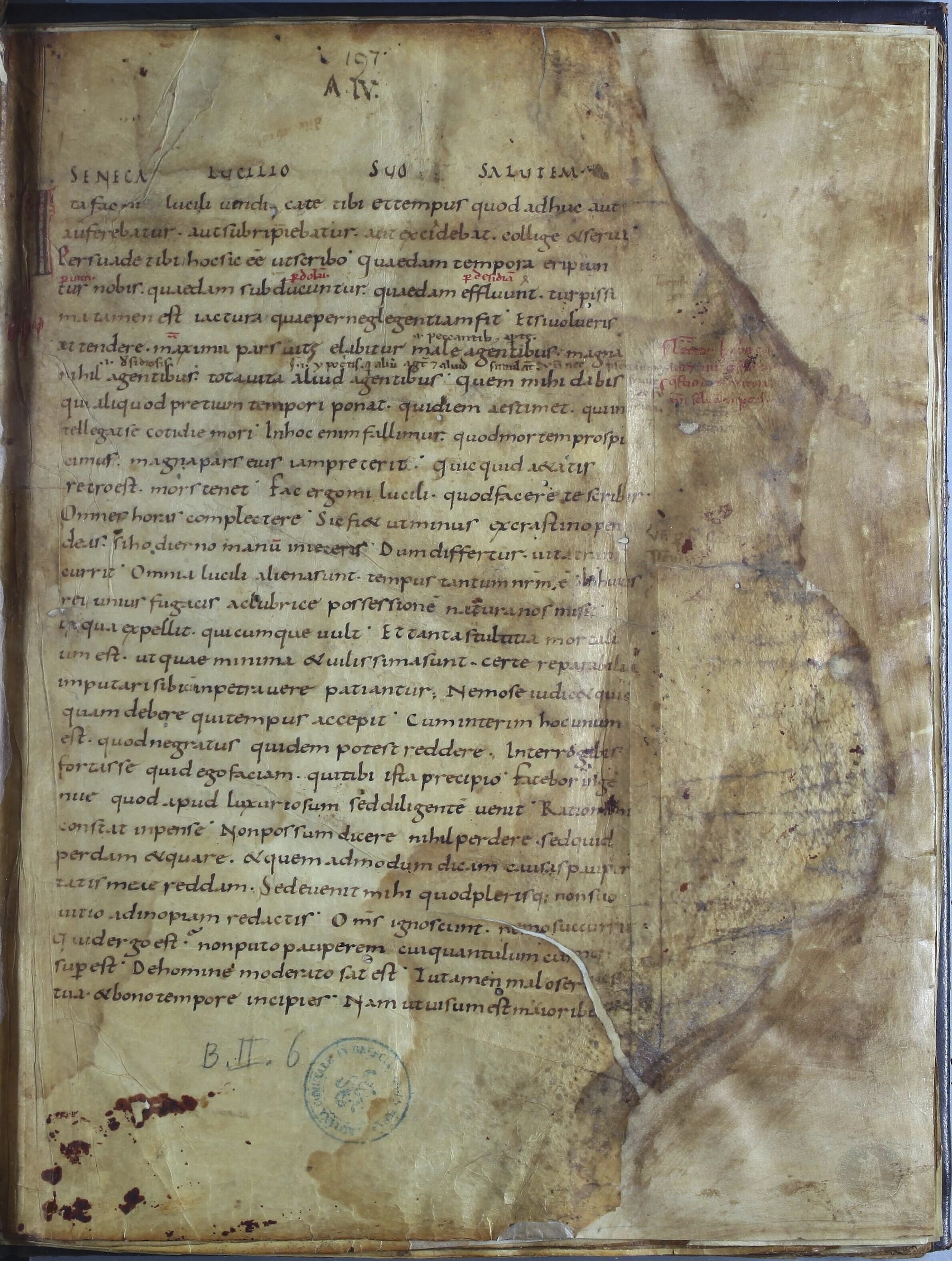
The primary witness to the second collection is the Codex Quirinianus (Q), now Brescia, Biblioteca Queriniana, ms. B.II.6, a late eleventh- or early twelfth-century manuscript written in Caroline minuscule, almost certainly of North Italian origin. It is the oldest and most authoritative manuscript for Epistles 89–124, and its readings constitute the baseline text for this portion of the collection in all modern editions. A second family of manuscripts (designated p in the critical tradition) derives from a related but independent exemplar and provides a check on Q's readings, though it is generally considered of inferior authority.
No ancient manuscript of the Epistulae Morales survives. Unlike Cicero's De Re Publica, whose text was preserved in a Vatican palimpsest, or Livy's Books 41–45, whose single manuscript was found at Lorsch in 1527, Seneca's letters reached the Renaissance through a relatively continuous, if tangled, medieval tradition. The collection was known to Jerome, to Lactantius, and — through the celebrated though spurious exchange of letters between Seneca and St. Paul — to a wide Christian readership that regarded its moral content as proto-Christian in spirit. This notoriety may have assisted the survival of the collection where purer classical texts perished.
The principal modern critical edition, on which Gummere's translation draws, is that of Otto Hense (L. Annaei Senecae Epistulae Morales, Teubner, 1914), whose reconstruction of the text from the Q and p families remains the standard, supplemented by L. D. Reynolds's Clarendon Press edition of 1965. Reynolds's discussion of the manuscript tradition of the Epistulae Morales is set out in his chapter in Texts and Transmission: A Survey of the Latin Classics (Oxford: Clarendon Press, 1983), pp. 357–361.
This Translation
The translation is that of Richard M. Gummere, published as Volume VI of the Loeb Classical Library edition of Seneca's Epistles (Loeb Classical Library 77; London: William Heinemann; Cambridge, MA: Harvard University Press, 1925). Gummere presents the Latin text on facing pages with his English translation and provides an index of proper names and subjects. The translation is in the public domain.
FULL TEXT
Epistle 93: On the Quality, as contrasted with the Length, of Life
[Seneca writes to Lucilius on the occasion of a mutual friend's grave illness, using it as the starting point for a reflection on whether the duration of a life has any bearing on its completeness.]
While reading the letter in which you were lamenting the death of the philosopher Metronax as if he might have, and indeed ought to have, lived longer, I missed the spirit of fairness which abounds in all your discussions concerning men and things, but is lacking when you approach one single subject, —as is indeed the case with us all. In other words, I have noticed many who deal fairly with their fellow-men, but none who deals fairly with the gods. We rail every day at Fate, sayıng: "Why has A. been carried off in the very middle of his career? Why is not B. carried off instead? Why should he prolong his old age, which is a burden to himself as well as to others?"
But tell me, pray, do you consider it fairer that you should obey Nature, or that Nature should obey you? And what difference does it make how soon you depart from a place which you must depart from sooner or later? We should strive, not to live long, but to live rightly; for to achieve long life you have need of Fate only, but for right living you need the soul. A life is really long if it is a full life; but fulness is not attained until the soul has rendered to itself its proper Good," that is, until it has assumed control over itself. What benefit does this older man derive from the eighty years he has spent in idleness? A person like him has not lived; he has merely tarried awhile in life. Nor has he died late in life; he has simply been a long time dying. He has lived eighty years, has he? That depends upon the date from which you reckon his death! Your other friend, however, departed in the bloom of his manhood. But he had fulfilled all the duties of a good citizen, a good friend, a good son; in no respect had he fallen short. His age may have been incomplete, but his life was complete. The other man has lived eighty years, has he? Nay, he has existed eighty years, unless perchance you mean by "he has lived" what we mean when we say that a tree "lives."
Pray, let us see to it, my dear Lucilius, that our lives, like jewels of great price, be noteworthy not because of their width but because of their weight.c Let us measure them by their performance, not by their duration. Would you know wherein lies the difference between this hardy man who, despising Fortune, has served through every campaign of life and has attained to life's Supreme Good, and that other person over whose head many years have passed? The former exists even after his death; the latter has died even before he is dead.
Bibliography
Gummere, Richard M., trans. Seneca: Epistles 93–124. Loeb Classical Library 77. London: William Heinemann; Cambridge, MA: Harvard University Press, 1925.
Hense, Otto, ed. L. Annaei Senecae Epistulae Morales. 3 vols. Leipzig: Teubner, 1914.
Reynolds, L. D., ed. L. Annaei Senecae Ad Lucilium Epistulae Morales. 2 vols. Oxford: Clarendon Press, 1965.
Reynolds, L. D. "Seneca." In L. D. Reynolds, ed., Texts and Transmission: A Survey of the Latin Classics. Oxford: Clarendon Press, 1983. Pp. 357–361.
Fantham, Elaine. Seneca's Troades: A Literary Introduction with Text, Translation, and Commentary. Princeton: Princeton University Press, 1982.
Griffin, Miriam T. Seneca: A Philosopher in Politics. Oxford: Clarendon Press, 1976.
Motto, Anna Lydia. Seneca Sourcebook: Guide to the Thought of Lucius Annaeus Seneca. Amsterdam: Adolf M. Hakkert, 1970.
Wilson, Emily. The Greatest Empire: A Life of Seneca. Oxford: Oxford University Press, 2014.