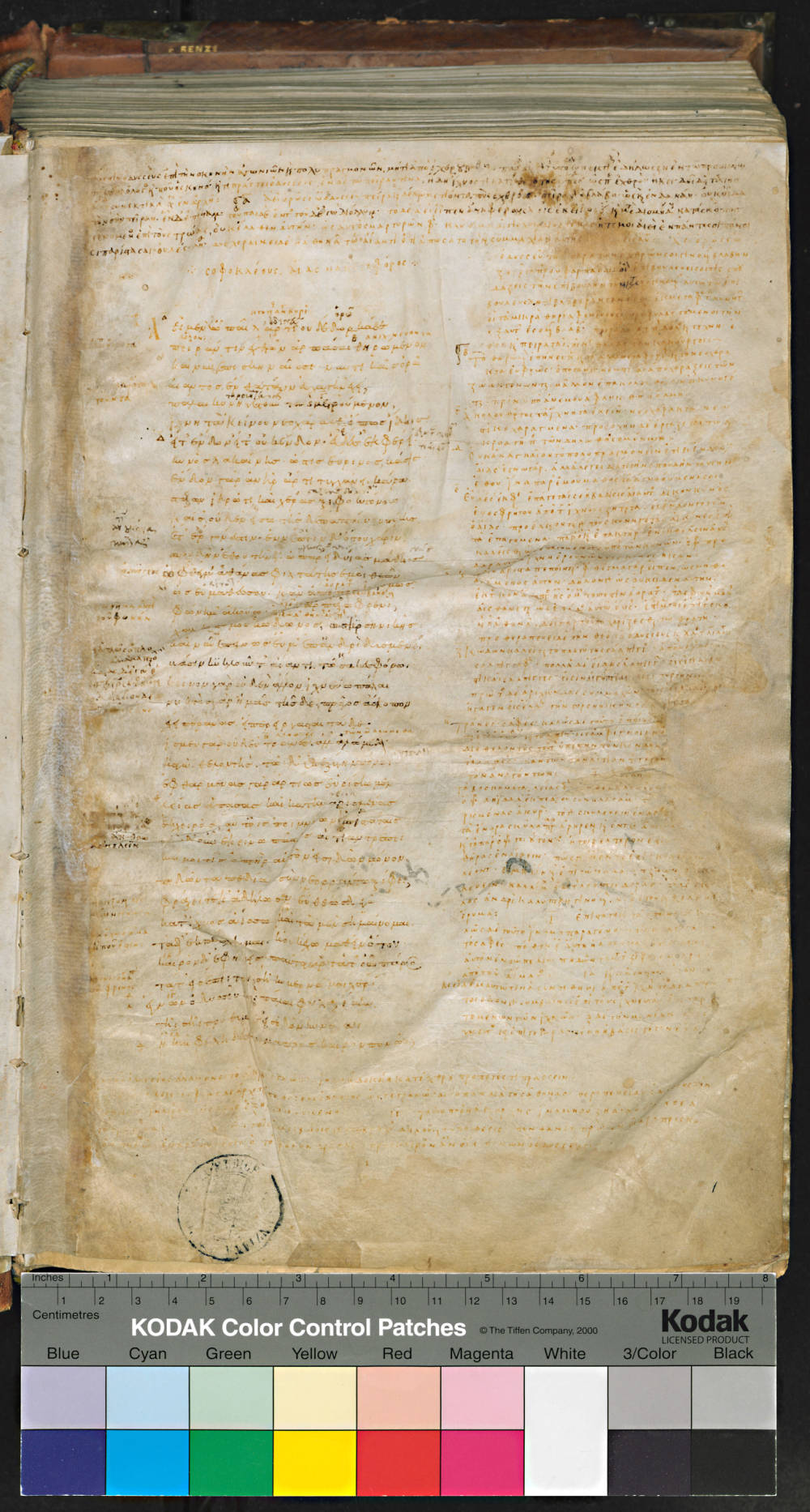
SOPHOCLES
Volume I: Oedipus the King · Oedipus at Colonus · Antigone
Translated by F. Storr
INTRODUCTION
Sophocles occupies a position in the history of Greek literature that is difficult to overstate and nearly impossible to define without recourse to the superlative. Born around 497 or 496 BCE at Colonus, a deme just north of Athens — the very place to which his Oedipus will come to die — he competed in the tragic festival of the City Dionysia from perhaps 468 BCE until his death around 406 BCE, a career of exceptional length spanning the entire arc of Athenian cultural pre-eminence. Ancient sources credited him with some 120 to 123 plays; seven survive complete, constituting the whole of his extant dramatic output. He won first prize at the Dionysia approximately eighteen times, never falling below second — a record that prompted ancient commentators to speak of him as the most successful of all the tragedians and that has been confirmed, in its essentials, by the unanimous verdict of subsequent readers.
The three plays gathered in this volume — Oedipus the King, Oedipus at Colonus, and Antigone — are among the most celebrated of the seven survivors, and they share a mythological setting: the royal house of Thebes, and specifically the catastrophic lineage of Laius and Oedipus. They are not, however, a trilogy in the formal sense: they were written across the span of Sophocles' career, in an order that inverts their mythological sequence, and they were never performed as a connected unit. Antigone, which dramatises the events immediately following the death of Oedipus's sons, was probably composed around 441 BCE and is among the earliest of the surviving plays. Oedipus the King, the central work of the collection in every sense, is usually dated to approximately 429 BCE. Oedipus at Colonus, which takes place between the two, was written last of all: Sophocles died before it could be staged, and it was produced posthumously in 401 BCE by his son Iophon. They appear in this volume in the order established by the manuscript tradition rather than in chronological order of composition or of mythological narrative — a sequence that places the greatest of the three plays, and perhaps the greatest of all Greek tragedies, first.
The Plays in This Volume
Oedipus the King (Oidipous Tyrannos) is the play that Aristotle, writing some three generations after its first performance, treats in the Poetics as the model of what tragedy can achieve. Its structure enacts with terrible precision the process of discovery: Oedipus, king of Thebes, son of Laius (though he does not know it), husband of his own mother Jocasta (though he does not know this either), sets out to investigate the murder of his predecessor and pursues the inquiry with such relentless energy and intelligence that the investigation becomes, step by step, the revelation of his own guilt. The dramatic irony that attends every stage of this process — in which the audience knows, or can guess, what Oedipus does not — is so perfectly managed that it creates a sensation unlike anything else in classical literature: the feeling that what is happening cannot be stopped, that each new fact disclosed will only be another turn of the same screw, and that the catastrophe has been built into the foundations of the story from the beginning.
Aristotle identified the key dramatic mechanism as anagnorisis — recognition, the movement from ignorance to knowledge — combined with peripeteia, the reversal by which the pursuit of one goal produces its exact opposite. In Oedipus the King these two mechanisms are perfectly fused: the recognition and the reversal are the same event. But the play's power is not merely architectural. It raises, and leaves unresolved, the most difficult questions that tragedy can pose: what is the relationship between fate and choice, between the oracle's determination and Oedipus's agency? Is Oedipus guilty of the crimes he has committed in ignorance? Does the plague that afflicts Thebes reflect a moral or merely a ritual pollution? The play provides no answers, and the final image — Oedipus blinded, his children clinging to him, begging Creon to let him stay — refuses the comfort of resolution.
Oedipus at Colonus (Oidipous epi Kolônôi) is the longest of the surviving Sophoclean plays and in many respects the most difficult to place. It begins where Oedipus the King leaves off: the blinded, exiled king arrives, led by his daughter Antigone, at the grove of the Eumenides at Colonus, just outside Athens. He has been wandering for years and is near death. The play that follows is less a drama of action than of presence and of claim: whose claim to Oedipus's body and grave will prevail? Creon comes from Thebes demanding that Oedipus return; his son Polynices comes to ask for his blessing before the war that will kill him. Oedipus refuses both, cursing Polynices with a ferocity that has disturbed commentators ever since. Theseus, the king of Athens, grants him sanctuary. Oedipus dies off stage, in mysterious circumstances that Theseus will not fully reveal, his grave becoming a source of strength and protection for Athens in perpetuity.
The play is saturated with Sophocles' own biography: Colonus is his birthplace, and the famous ode to Colonus (kalliston parion) — its description of the white colonnades, the nightingales, the narcissus and crocus, the olive and the vine — reads as an old man's farewell to the landscape of his childhood. Oedipus at the moment of his death is not the broken figure of Oedipus the King but something more enigmatic: a man whose suffering has somehow transformed him into a source of power, whose anger and blessings alike carry divine force, and whose mysterious end suggests that what looked like ruin may have been, all along, a form of election.
Antigone is the earliest of the three plays by date of composition and the last in mythological sequence. Oedipus is dead; his sons Eteocles and Polynices have killed each other in the war of the Seven against Thebes; Creon, now king, has declared that Eteocles shall have burial with full honours and Polynices shall be left to rot, unburied, on the plain. Antigone, the daughter of Oedipus, refuses to accept this decree and buries her brother in defiance of Creon's order. The confrontation that follows is one of the most searching explorations of political and moral obligation in Western literature: the clash between Creon's claim that the state's law must be obeyed absolutely and Antigone's claim that there are divine laws — the unwritten laws (agraphoi nomoi) that govern the proper treatment of the dead — which no human authority can override.
The play does not simply adjudicate this conflict in Antigone's favour. Creon is not a pure tyrant from the outset; his reasoning about political necessity is not entirely without force; and his eventual destruction — the deaths of his son Haemon and his wife Eurydice following Antigone's suicide in the cave where Creon has entombed her — is presented as the consequence of his rigidity and his deafness to counsel, not merely of his injustice. The figure of Teiresias, the blind prophet who appears in all three plays, issues his warning with terrible authority. Creon yields too late. The play ends with a lyric reflection on wisdom and piety that refuses to sentimentalise the catastrophe it has described.
Sophocles and Athens
Sophocles was not only a dramatist. He held civic office — he served as hellenotamias, treasurer of the Delian League, in 443/442 BCE, and as one of the ten strategoi (generals) alongside Pericles, probably in 441/440 BCE, around the time of the Samian revolt. He was elected a proboulos (emergency commissioner) after the Sicilian disaster of 413 BCE. He was a close associate of Herodotus, whom he celebrated in a lyric poem; he is said to have introduced the cult of Asclepius to Athens and to have sheltered the god's sacred snake in his own house while a sanctuary was prepared. Ancient tradition presents him as a man of extraordinary charm, ease, and social grace — the contrast with the difficult, demanding Euripides was a favourite subject of ancient anecdote — and as someone who wore his learning and his art without the austerity that marked Aeschylus or the restless heterodoxy that made Euripides controversial.
What Sophocles did for tragedy, technically and formally, is substantial. He increased the number of speaking actors from two to three, a change that transformed the range of dramatic situations available to the playwright. He introduced painted scenery (skenographia). He is said to have reduced the size and increased the polish of the tragic chorus. He broke with Aeschylus's practice of composing in connected trilogies, making each play a self-contained dramatic unit capable of standing alone. These formal innovations are inseparable from his thematic concerns: the three-actor drama is a drama of competing claims and irreconcilable positions, and the self-contained play is one in which the catastrophe must be internally generated rather than distributed across a sequence.
Transmission
The seven surviving plays of Sophocles — out of the 120 or more he wrote — owe their survival to a process of Byzantine selection and copying whose details are only partially recoverable. The most likely explanation for why these seven and not others survived is that they were selected for use in Byzantine schools, probably in the ninth or tenth century CE, as a set of canonical educational texts. Within that selection, three plays — Ajax, Electra, and Oedipus the King — appear to have constituted a more narrowly used pedagogical subset, known as the Byzantine triad, which is why they survive in a larger number of manuscripts than the remaining four.
The primary manuscript of the entire surviving corpus is the Codex Laurentianus Plut. 32.9 (designated L in modern editions), held in the Biblioteca Medicea Laurenziana in Florence. Written in Byzantine minuscule in the tenth or eleventh century CE, it preserves all seven plays and was brought to Italy by the Greek scholar and book-hunter Giovanni Aurispa in the early fifteenth century as part of the enormous import of Greek manuscripts that fuelled the Florentine Renaissance. It subsequently entered the Medici collection and thence the Laurenziana. For the four plays that fall outside the Byzantine triad — including Oedipus at Colonus and Antigone, both of which appear in this volume — L is the sole or principal ancient authority, and its readings carry weight that cannot be independently checked against a parallel tradition. The second major family of manuscripts (the Triclinian recension, named after the fourteenth-century Byzantine scholar Demetrius Triclinius, who edited and in places emended the text) provides valuable supplementary evidence and useful corrections but is generally considered secondary to L.
The modern critical edition on which Storr's text draws is that of Richard Jebb, whose monumental edition with commentary of all seven plays (Cambridge University Press, 1883–1896) remains the starting point for any serious study of Sophocles in English. The subsequent Teubner text of A. C. Pearson (1924) and, for recent scholarship, the Oxford Classical Texts edition of H. Lloyd-Jones and N. G. Wilson (1990) are the standard references.
This Translation
The translation is that of Francis Storr (1839–1919), published as Volume I of the Loeb Classical Library edition of Sophocles (Loeb Classical Library 20; London: William Heinemann; New York: The Macmillan Co., 1912). It was one of the inaugural Loeb volumes, appearing in the series' founding year, and Storr's facing-page Greek and English remained the standard Loeb Sophocles for decades. The translation renders dialogue and speech in a stately English verse — broadly iambic in movement, though without rigid metrical regularity — and the choral odes in lyric measures that reflect the varied metres of the original. The translation is in the public domain.
FULL TEXT
Oedipus the King
[The play opens before the palace of Oedipus at Thebes. Suppliants of all ages — children, priests, young men — have assembled and seated themselves at the altar, bearing olive branches wound with wool: the signs of formal supplication. Oedipus enters from the palace and addresses them.]
OEDIPUS: My children, latest nurslings of old Cadmus,1 why throng you here before me in this wise, with wreathed boughs of supplication dressed? The city reeks with incense, rings with hymns and cries of pain together. I have judged it wrong, my children, to receive these tidings from a messenger, and come myself — I, Oedipus, whom all men call the Great. Tell me, then, aged sir, since it is meet that thou shouldst speak for these: what fear, what need has brought you to my door? I am prepared to give you all the aid I can. I were a man most callous, were I not moved by a supplication such as this.
PRIEST: O king, thou seest how we stand before thine altars — we here, fledglings not yet strong of wing, and these the elders, heavy with their years; the young men, too, have gathered — priests of Zeus among them — and I am priest of Zeus, their chief. The city is sick, too deep for speech, with blight upon her crops, her herds, her children yet unborn. The death-god walks among us, not with plague alone but with the sword of fire, driving Thebes before him till the house of Cadmus stands half empty and the black realm of the dead grows full of lamentation.
PRIEST (cont.): We have not come to thee as to a god — we know that well — but as the first of men in common trials and in dealings with the powers above. It was thou who came to Thebes and freed us from the Sphinx,2 that cruel singer, and that deliverance thou wroughtest with no foreknowledge given thee by us, with no instruction. A god was with thee — so we all believe — when thou didst lift us up. Come, then, most powerful of men, find help for us again. Some rumour of divine response, or knowledge of a human way, thou mayest have. For those who have shown their worth in former times — in those men's counsels rescue comes most often.
OEDIPUS: My unhappy children, known to me, not unknown, is the longing wherewith ye have come. That you all suffer — that I know right well — yet, suffering as you do, there is not one of you whose suffering is as mine. Your grief is single, each of you mourns for himself alone; but my soul mourns at once for the city, for myself, and for you all. You therefore have not startled me from sleep: I have wept many tears, and trodden many paths of thought. And the one remedy that I found after long considering — I have already acted on it. I have sent Creon, Menoikeus' son, my own wife's brother, to the Pythian house of Phoebus, to learn what I must do or say to save the city.3
Bibliography
Storr, F., trans. Sophocles, Volume I: Oedipus the King. Oedipus at Colonus. Antigone. Loeb Classical Library 20. London: William Heinemann; New York: The Macmillan Co., 1912.
Jebb, Richard C., ed. and trans. Sophocles: The Plays and Fragments. 7 vols. Cambridge: Cambridge University Press, 1883–1896. [Individual volumes: Oedipus Tyrannus (1883); Oedipus Coloneus (1885); Antigone (1891).]
Lloyd-Jones, Hugh, and N. G. Wilson, eds. Sophoclis Fabulae. Oxford Classical Texts. Oxford: Clarendon Press, 1990.
Pearson, A. C., ed. Sophoclis Fabulae. Oxford Classical Texts. Oxford: Clarendon Press, 1924.
Dawe, R. D., ed. Sophocles: Oedipus Rex. Cambridge Greek and Latin Classics. Cambridge: Cambridge University Press, 1982.
Knox, Bernard M. W. Oedipus at Thebes: Sophocles' Tragic Hero and His Time. New Haven: Yale University Press, 1957.
Reinhardt, Karl. Sophokles. Frankfurt: Vittorio Klostermann, 1933. Translated by Hazel Harvey and David Harvey as Sophocles. Oxford: Blackwell, 1979.
Segal, Charles. Tragedy and Civilization: An Interpretation of Sophocles. Cambridge, MA: Harvard University Press, 1981.
Winnington-Ingram, R. P. Sophocles: An Interpretation. Cambridge: Cambridge University Press, 1980.
Footnotes
-
Cadmus: the legendary founder of Thebes, who slew a dragon and sowed its teeth in the earth; the armed men who sprang from the teeth were the ancestors of the Theban nobility. To be called a nursling of Cadmus is to be identified as a Theban by birth and blood. ↩︎
-
The Sphinx: a winged monster with the head of a woman and the body of a lion, sent to afflict Thebes. She posed a riddle — what walks on four legs in the morning, two at noon, and three in the evening? — and devoured those who could not answer. Oedipus answered correctly (the answer is man, who crawls in infancy, walks upright in adulthood, and uses a staff in old age), and the Sphinx destroyed herself. It was this feat, performed by a stranger of unknown parentage who arrived at the city gate, that made the Thebans give Oedipus their kingship and the hand of the widowed queen Jocasta — his own mother, as the play will reveal. ↩︎
-
The Pythian house of Phoebus: the oracle of Apollo at Delphi, where the Pythia, the god's priestess, delivered responses to questions put to her by suppliants from across the Greek world. The oracle's pronouncements on the fate of Oedipus lie at the foundation of the entire plot: it was a Delphic oracle that told Laius he would be killed by his own son, and another that told Oedipus he would kill his father and marry his mother. Both came true, and Oedipus's present inquiry — what must be done to end the plague? — will set in motion the process by which both oracles are finally confirmed. ↩︎