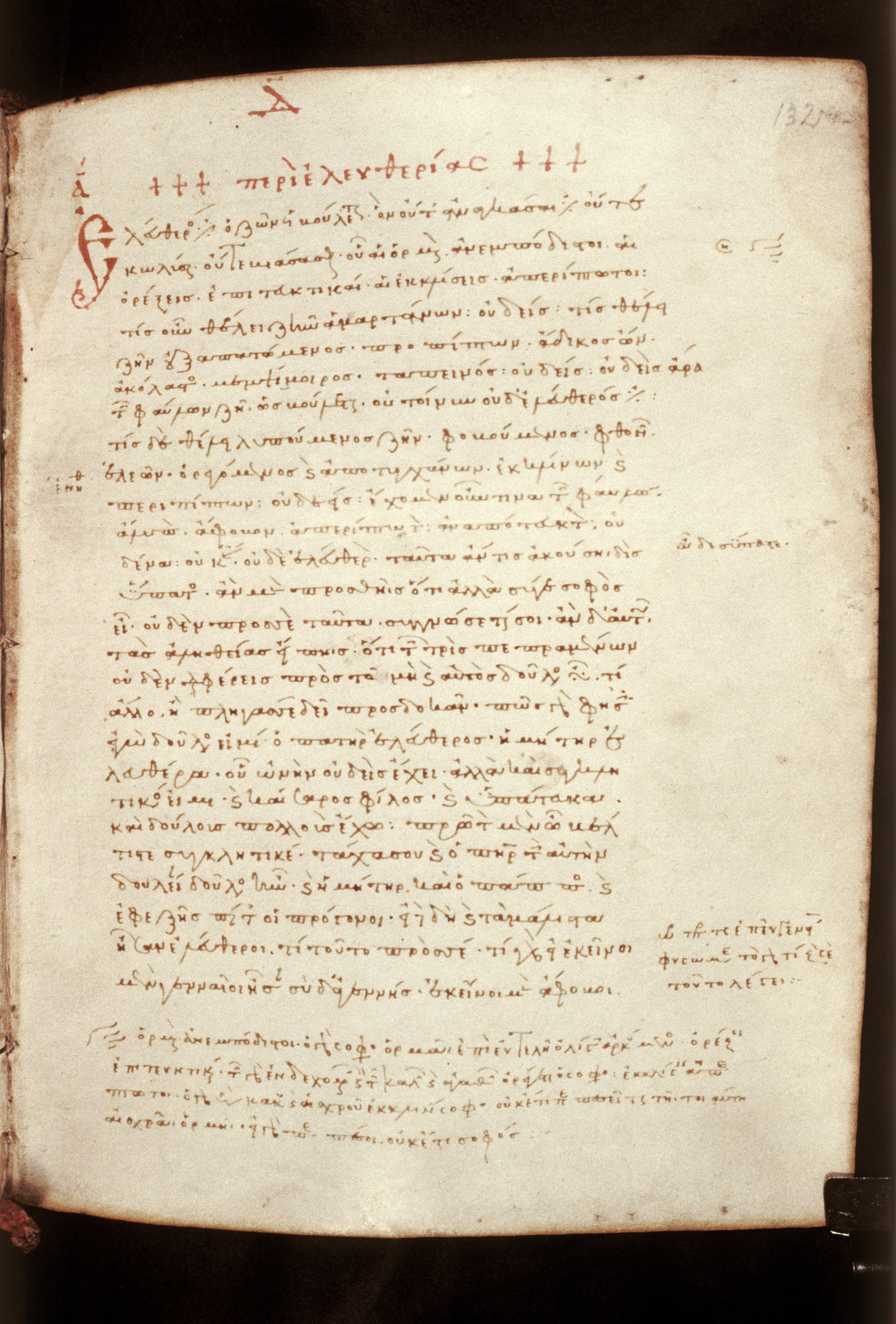
Oxford, Bodleian Library, MS. Auct. T. 4. 13, fol. 132r — opening of Discourses IV.1, On Freedom, in Greek minuscule, 11th century

Discourses, Books I–II

Reading companion and full text of Epictetus: Discourses, Books I–II, translated by W. A. Oldfather — Loeb Classical Library volume 131, first published in 1925 by Harvard University Press and William Heinemann, presenting the first two of the four surviving books of Arrian's record of Epictetus's classroom teaching, with the original Greek on facing pages, notes, and a substantial introduction to the philosopher's life and thought.
Oxford, Bodleian Library, MS. Auct. T. 4. 13, fol. 132r — opening of Discourses IV.1, On Freedom, in Greek minuscule, 11th century

Discourses, Books III–IV · Encheiridion · Fragments

Reading companion and full text of Epictetus: Discourses, Books III–IV, with the Encheiridion and Fragments, translated by W. A. Oldfather — Loeb Classical Library volume 218, first published in 1928 by Harvard University Press and William Heinemann, completing the four surviving books of Arrian's record of Epictetus's teaching and adding the Encheiridion and the principal surviving fragments, with Greek text on facing pages and editorial notes throughout.

Oxford, Bodleian Library, MS. Auct. T. 4. 13, fol. 132r — opening of Discourses IV.1, On Freedom, in Greek minuscule, 11th century

A Selection from the Discourses, with the Encheiridion

Reading companion and full text of A Selection from the Discourses of Epictetus, with the Encheiridion, translated by George Long — drawn from Long's complete 1877 translation and presented here in the 1890 G. P. Putnam's Sons edition, gathering the most essential of the surviving discourses alongside the complete Encheiridion, the brief handbook of Stoic principles that Arrian distilled from his teacher's classroom and that has never ceased to be read.

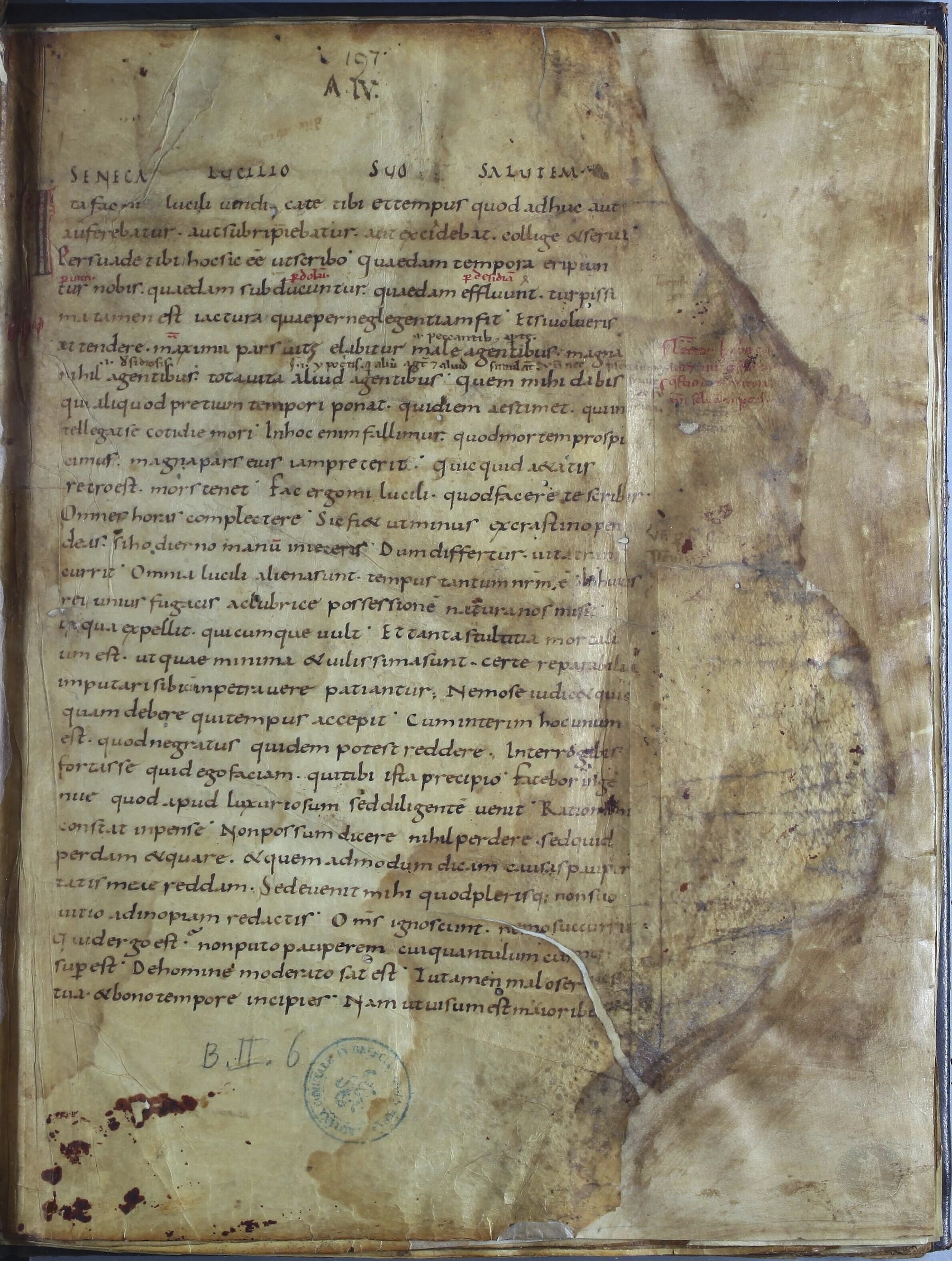
Brescia, Biblioteca Queriniana, ms. B.II.6 (Codex Quirinianus), fol. 1r — opening of the second collection of the Epistulae Morales, 11th–12th century

Epistles 93–124

Reading companion and full text of Seneca's Epistulae Morales ad Lucilium, Volume VI (Epistles 93–124), translated by Richard M. Gummere — the concluding portion of Seneca's great letter-collection, written in the final years of his life under Nero, addressing questions of death, virtue, the good life, the value of precepts, and the relationship between philosophy and action.

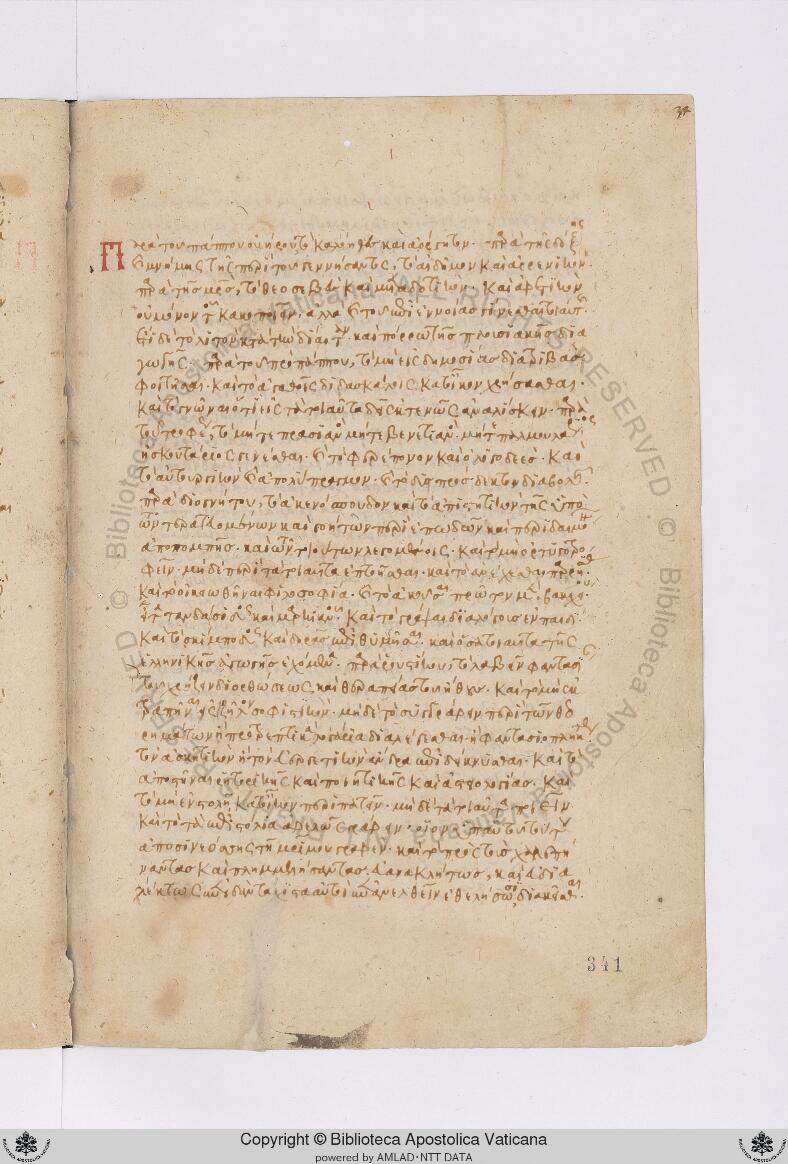
Vatican City, Biblioteca Apostolica Vaticana, Vat. gr. 1950, fol. 341r — opening of the Meditations of Marcus Aurelius, 14th century

Meditations

Reading companion and full text of the Meditations of Marcus Aurelius, translated by George Long and introduced by W. L. Courtney, in the Blackie and Son edition — twelve books of private philosophical notes written in Koine Greek by the Roman Emperor during the last decade of his life, never intended for publication, and representing the most intimate record of Stoic practice in the ancient world.

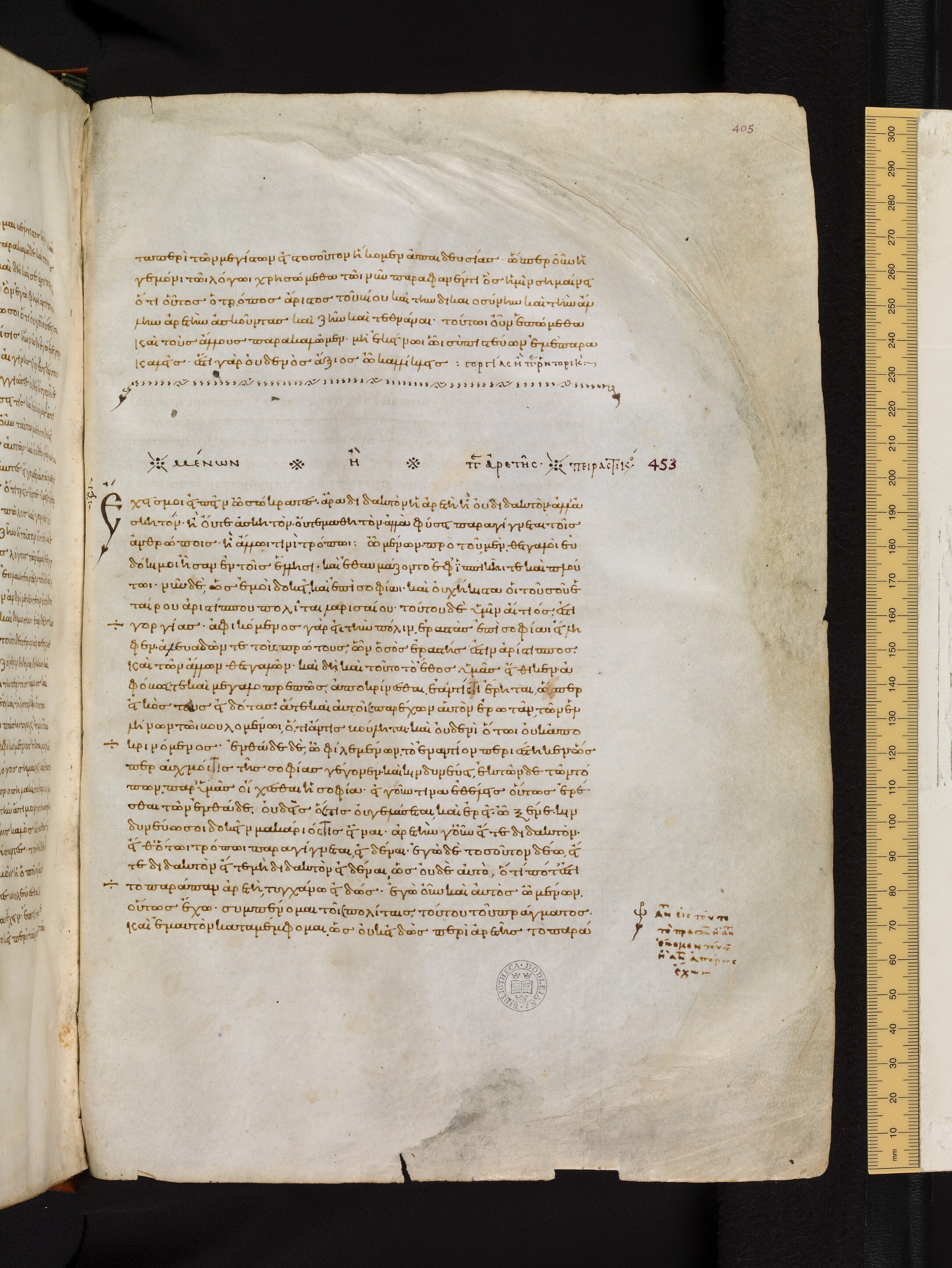
The Codex Clarkianus (Bodleian Library MS. E. D. Clarke 39), or Clarke Plato, is a crucial 9th-century Greek manuscript written in 895 AD in Constantinople for Arethas of Patrae by John the Calligrapher. As the oldest, most comprehensive witness for 24 of Plato's dialogues, it is central to reconstructing the text of Meno and other key works. This is the exact page where Plato's Meno begins. The top third of the page contains the conclusion of the Gorgias. You can see a decorative horizontal divider (a coronis) and a series of dots marking the end of that dialogue. Just below the divider, the title is written in red uncials: ΜΕΝΩΝ Η ΠΕΡΙ ΑΡΕΤΗΣ ΠΕΙΡΑΣΤΙΚΟΣ (Meno, or On Virtue, Tentative).

Meno

Reading companion and full text of Plato's Meno, a Socratic dialogue exploring whether virtue can be taught, and introducing the theory of recollection as a model of knowledge.