EPICTETUS
Discourses · Books III–IV · Encheiridion · Fragments
Translated by W. A. Oldfather
Loeb Classical Library 218 · Harvard University Press · 1928
INTRODUCTION
This volume — Loeb Classical Library 218 — completes W. A. Oldfather's two-volume edition of the surviving Epictetan corpus. Where the first volume (Loeb 131, 1925) presented Books I and II of the Discourses, this second volume, published three years later in 1928, brings together the remaining two books of the Discourses with the complete Encheiridion and the principal surviving fragments: everything Arrian recorded and distilled from the teaching of the philosopher whom the Stanford Encyclopedia of Philosophy describes as "notable for the consistency and power of his ethical thought and for effective methods of teaching."1 Together the two volumes constitute the most important scholarly English edition of Epictetus produced in the first half of the twentieth century, and they remain indispensable.
Epictetus was born around 50 CE in Hierapolis in Phrygia, in what is now south-western Turkey, and he was born a slave. His master in Rome was Epaphroditus, a freedman of the Emperor Nero who served as an imperial secretary. It was in that household that Epictetus came to know Stoic philosophy through the teaching of Musonius Rufus. Obtaining his freedom — the circumstances are unrecorded — he began teaching in Rome until the Emperor Domitian's edict of 89 CE expelled philosophers from the Italian peninsula. Epictetus then settled at Nicopolis in Epirus and taught there until his death around 135 CE. He never wrote a word: everything we have comes through his student Arrian of Nicomedia, who attended the school around 108 CE and set down what he heard, producing both the extended Diatribai — the Discourses — and the compressed Encheiridion, the handbook that has never ceased to be read.
Books III and IV
The third and fourth books of the Discourses are in some respects the most ambitious of the four that survive. Where Books I and II lay the philosophical foundations — the distinction between what is and is not in our power, the nature of prohairesis or rational volition, the correct use of impressions — Books III and IV press those foundations into harder territory: the social and political obligations of the Stoic, the question of what a life given entirely to philosophy would look like, and the meaning of freedom in the most uncompromising sense the word can bear.
Discourses III.22 (On the Cynic) is the most extended and philosophically ambitious piece in the surviving corpus. Epictetus here takes up the figure of the ideal philosophical missionary — the Cynic in the ancient sense, who has stripped away all the encumbrances of ordinary social life and devoted himself entirely to the examination and reformation of others. The portrait is not an endorsement of Cynicism as a school but a meditation on what total freedom from attachment would demand. The true Cynic has no country, no home, no property, no family: his bed is the ground, his cloak his only possession, and he loves those who treat him badly. Epictetus makes clear that such a life is not a human choice but a divine vocation — not the abandonment of social obligation but its complete transformation by a higher one. The discourse is a searching test of how far the Stoic commitment to indifference to externals can actually be taken, and it does not flinch from what the answer costs.
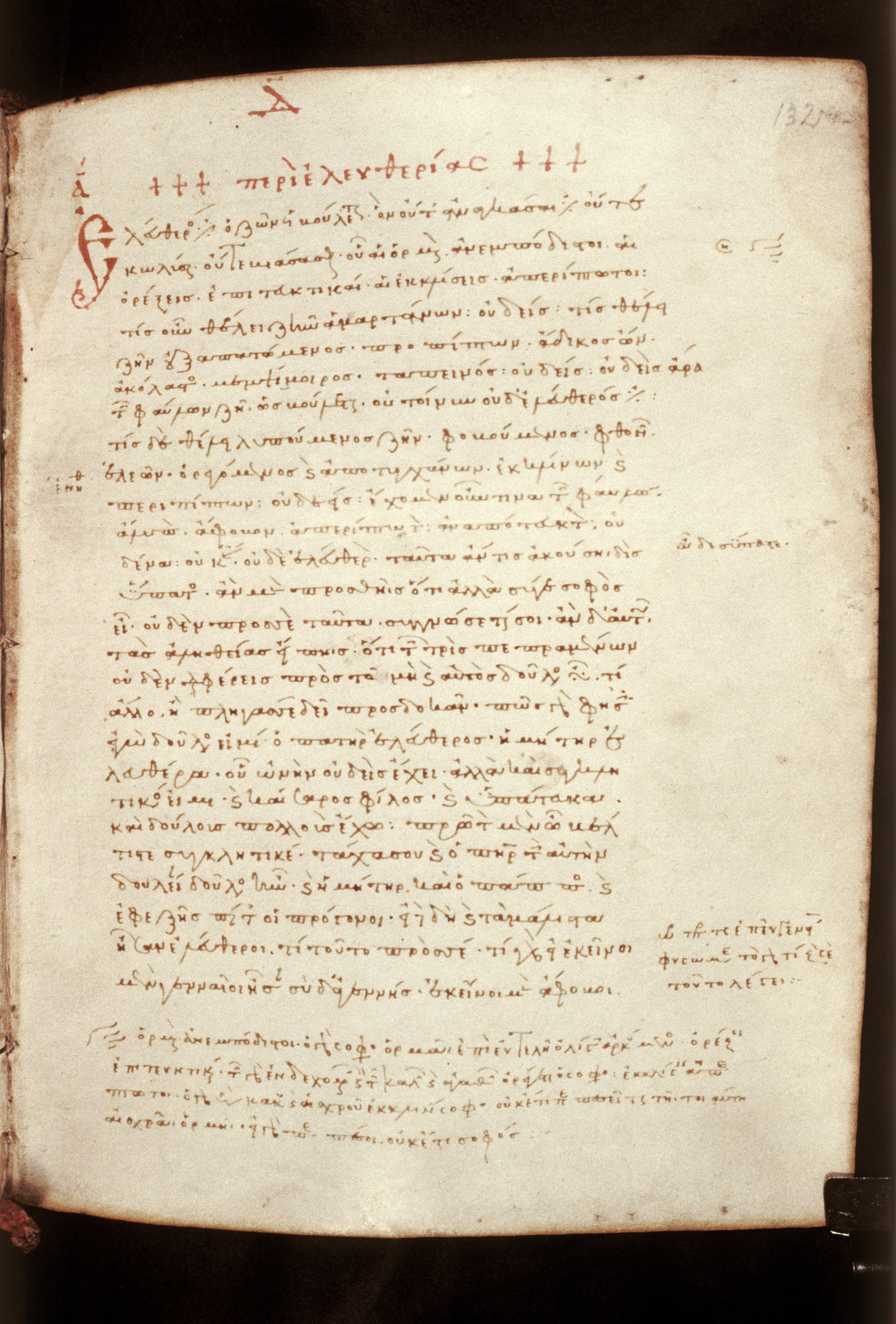
Discourses IV.1 (On Freedom) is the longest single discourse in the surviving text — and the one whose opening in the Bodleian Codex is reproduced as the cover image of this edition and of its companion volume. It takes the concept of freedom entirely away from its conventional political and legal sense and relocates it within the domain of the will. External power — the master, the tyrant, the emperor — can constrain the body, take the property, impose the punishment. It cannot compel assent, cannot make one want what one does not want, cannot force one to place one's good in what one has identified as indifferent. No external power can enslave a free mind; no legal freedom liberates an enslaved one. The discourse builds this argument through a long accumulation of examples — the rich man enslaved to his patrons, the senator enslaved to his reputation, the king enslaved to his fear — arriving at the conclusion that the only truly free person is the one who desires only what is genuinely in their power to obtain and avoids only what is genuinely in their power to avoid.
Together these two discourses represent the fullest realisation of what the Stanford Encyclopedia describes as Epictetus's concern with "self-cultivation and autonomy": the conviction that the examined life, properly understood, is not a retreat from the world but the only position from which the world can be honestly and effectively engaged.2
The Encheiridion
The Encheiridion — from the Greek ἐγχειρίδιον, literally "that which is held in the hand" — is the short handbook that Arrian compiled from the Discourses, distilling for portable use the principles most essential to Epictetan Stoicism. Its opening sentence states the whole philosophy: some things are in our power, and others are not. The fifty-three chapters that follow move from this foundational distinction through its practical applications — in dealing with loss, with illness, with the death of loved ones, with social obligations, with ambition, with the behaviour of other people — accumulating into a portrait of a form of life rather than a set of propositions.
The Encheiridion's relationship to the Discourses is, as the Stanford Encyclopedia observes, somewhat misleading taken on its own: as "a brief abridgment of the Discourses," it "offers a much attenuated account which is of little independent value for the understanding of Epictetus's thought and which at some points gives a misleading impression of his philosophical motivations."3 Its value, and it is very great, is practical rather than expository: the handbook strips away the arguments and the dialectical complexity and gives only the conclusions, in forms compact enough to be memorised and repeated to oneself in the moments of difficulty that philosophical training is meant to address. It was designed, in other words, not to be studied but to be used — and that is how it has been used for nearly two thousand years.
The Encheiridion was among the most widely copied texts of late antiquity. It circulated not only as a philosophical handbook but in at least two adapted versions for Christian monastic use, in which the figure of Socrates was replaced by the Apostle Paul and references to the Platonic dialogues were substituted by references to scripture — adaptations that testify to the text's practical authority and to the readiness of Christian readers to find in Epictetan Stoicism something compatible with, and reinforcing of, their own ascetic commitments.
The Fragments
The fragments gathered in this volume are the remains of the portions of the Discourses that did not survive: quotations preserved by Aulus Gellius, Stobaeus, Marcus Aurelius, and other ancient authors from books and passages no longer extant. They are fragmentary and uneven, but several — notably those numbered 8, 9, and 14 in Schenkl's edition — are, as the Stanford Encyclopedia notes, "useful supplements to our knowledge of Epictetus." They offer glimpses of the lost books and confirm that the surviving four are not aberrant samples but representative specimens of a consistent and coherent body of teaching.
Epictetus and His Influence
The influence of Epictetus on subsequent thought runs through channels too various for easy summary. Marcus Aurelius, writing the Meditations during his campaigns in the 170s CE, drew on the Discourses throughout — producing what is in many respects the most searching record we have of what it meant to attempt to live by Epictetan principles, and how often that attempt fell short of the ideal. The early Christian apologists found in Epictetus a moral seriousness they could respect even where they disagreed with its metaphysical foundations. The Encheiridion was translated into Latin, adapted for monastic use, printed among the earliest Greek texts in the Renaissance, read by Descartes in the seventeenth century, and carried — in at least one recorded instance — into a prisoner-of-war camp in the twentieth, where it served as a resource for enduring what could not be escaped.
The Stanford Encyclopedia's entry on Epictetus traces this influence and situates his philosophy within the broader history of Stoicism, from its Chrysippean origins through its distinctive Epictetan reformulation: a reformulation that, as the entry argues, is not merely practical moralising but philosophically serious enough to qualify Epictetus as "an important philosopher in his own right."4
The Loeb Edition
W. A. Oldfather (1880–1945), classicist at the University of Illinois and the foremost American scholar of Epictetan studies in the first half of the twentieth century, produced this two-volume Loeb edition of the complete Epictetan corpus across three years of work. The Loeb Classical Library format — Greek on the left, English on the right — makes the edition useful both to readers who require only the translation and to scholars who wish to compare it continuously against the original. Oldfather's translation is close to the Greek, precise in its handling of technical vocabulary, and undecorated in its prose: qualities appropriate both to the scholarly character of the edition and to the directness that Arrian presented as Epictetus's own characteristic register.
Oldfather's broader contribution to Epictetan scholarship extended well beyond this edition. His Contributions toward a Bibliography of Epictetus (University of Illinois, 1927), with its posthumous supplement of 1952, remains a foundational work of reference. The care with which these two volumes were prepared reflects a scholar who had devoted a substantial part of his career to a single philosopher — and who understood, as the Discourses themselves repeatedly insist, that philosophy is not an academic exercise but a way of living.
Transmission
The transmission of the Discourses is among the more dramatic stories in the manuscript history of ancient philosophy. Eight books were known to Aulus Gellius in the second century CE; four survive. The process by which Books V through VIII were lost is not recoverable.
The earliest and most important surviving manuscript is the Bodleian Codex — MS. Auct. T. 4. 13 (also Cod. graec. Misc. 251) — an eleventh-century parchment manuscript now in the Bodleian Library, Oxford, described in the Bodleian's own catalogue as the archetype of all existing manuscripts of the work. Written throughout in Greek minuscule in red ink, the codex is thought to be connected with Arethas of Caesarea (c. 850–944 CE), the Byzantine bishop and classical scholar who was responsible for preserving and transmitting a remarkable range of Greek texts. Marginal annotations have been identified as in Arethas's own hand. The manuscript was subsequently part of the Saibante collection of Verona before its acquisition by the Bodleian Library.
The folio reproduced as the cover image of both this volume and its companion — fol. 132r — shows precisely the opening of Book IV, Discourse 1, On Freedom: the longest and most searching piece in the four surviving books, and the one that gives the most complete statement of what Epictetan freedom means and demands. Its heading, ΠΕΡΙ ΕΛΕΥΘΕΡΙΑΣ, is clearly legible in red above the body text of the page — a reminder that the text in this volume was never only a scholarly document, but a record of a way of life.
FULL TEXT
[Loeb Classical Library 218: Epictetus, The Discourses as Reported by Arrian, Books III–IV; the Manual; and Fragments. Greek text with facing English translation by W. A. Oldfather. Harvard University Press and William Heinemann, 1928. The full text below is embedded from the Internet Archive.]
Bibliography
Oldfather, W. A., trans. Epictetus: The Discourses as Reported by Arrian, the Manual, and Fragments. Vol. 2: Books III–IV, the Manual, and Fragments. Loeb Classical Library 218. Cambridge, MA: Harvard University Press; London: William Heinemann, 1928.
Oldfather, W. A., trans. Epictetus: The Discourses as Reported by Arrian, the Manual, and Fragments. Vol. 1: Books I–II. Loeb Classical Library 131. Cambridge, MA: Harvard University Press; London: William Heinemann, 1925.
Oldfather, W. A. Contributions toward a Bibliography of Epictetus. Urbana: University of Illinois, 1927. Supplement, 1952.
Schenkl, Heinrich, ed. Epicteti Dissertationes ab Arriano digestae. Leipzig: Teubner, 1916.
Long, George, trans. The Discourses of Epictetus; with the Encheiridion and Fragments. London: George Bell and Sons, 1877.
Dobbin, Robert, trans. Epictetus: Discourses and Selected Writings. Penguin Classics. London: Penguin, 2008.
Hard, Robin, trans. Epictetus: Discourses, Fragments, Handbook. Oxford World's Classics. Oxford: Oxford University Press, 2014.
Long, A. A. Epictetus: A Stoic and Socratic Guide to Life. Oxford: Clarendon Press, 2002.
Hijmans, B. L. Askēsis: Notes on Epictetus' Educational System. Assen: Van Gorcum, 1959.
Sorabji, Richard. Emotion and Peace of Mind: From Stoic Agitation to Christian Temptation. Oxford: Oxford University Press, 2000.
Footnotes
-
The Stanford Encyclopedia of Philosophy's entry on Epictetus, authored by Margaret Graver and last revised in 2025, provides a reliable and authoritative overview of his life, works, and philosophy: https://plato.stanford.edu/entries/epictetus/. ↩︎
-
On self-cultivation and autonomy as central themes of Epictetus, see SEP §4.7. The key point is that autonomy for Epictetus is not independence from others but independence from the opinions and circumstances one cannot control — a form of sovereignty that is paradoxically most available to those, like Epictetus himself, who have the least external power. ↩︎
-
SEP §1. The observation is a caution for readers who come to the Encheiridion first: its compression, while useful for practical purposes, omits the dialectical complexity and the explicit philosophical argumentation that the Discourses provide. The Encheiridion tells one what to think; the Discourses argue for why one should think it. ↩︎
-
SEP introduction. Epictetus's philosophical seriousness is perhaps most evident in his sustained engagement with the Stoic theory of impressions and assent — the claim that emotional disturbance arises not from events but from our judgements about events, and that those judgements are in our power to revise. This is not a truism but a philosophically substantive position with real consequences for how one lives. ↩︎