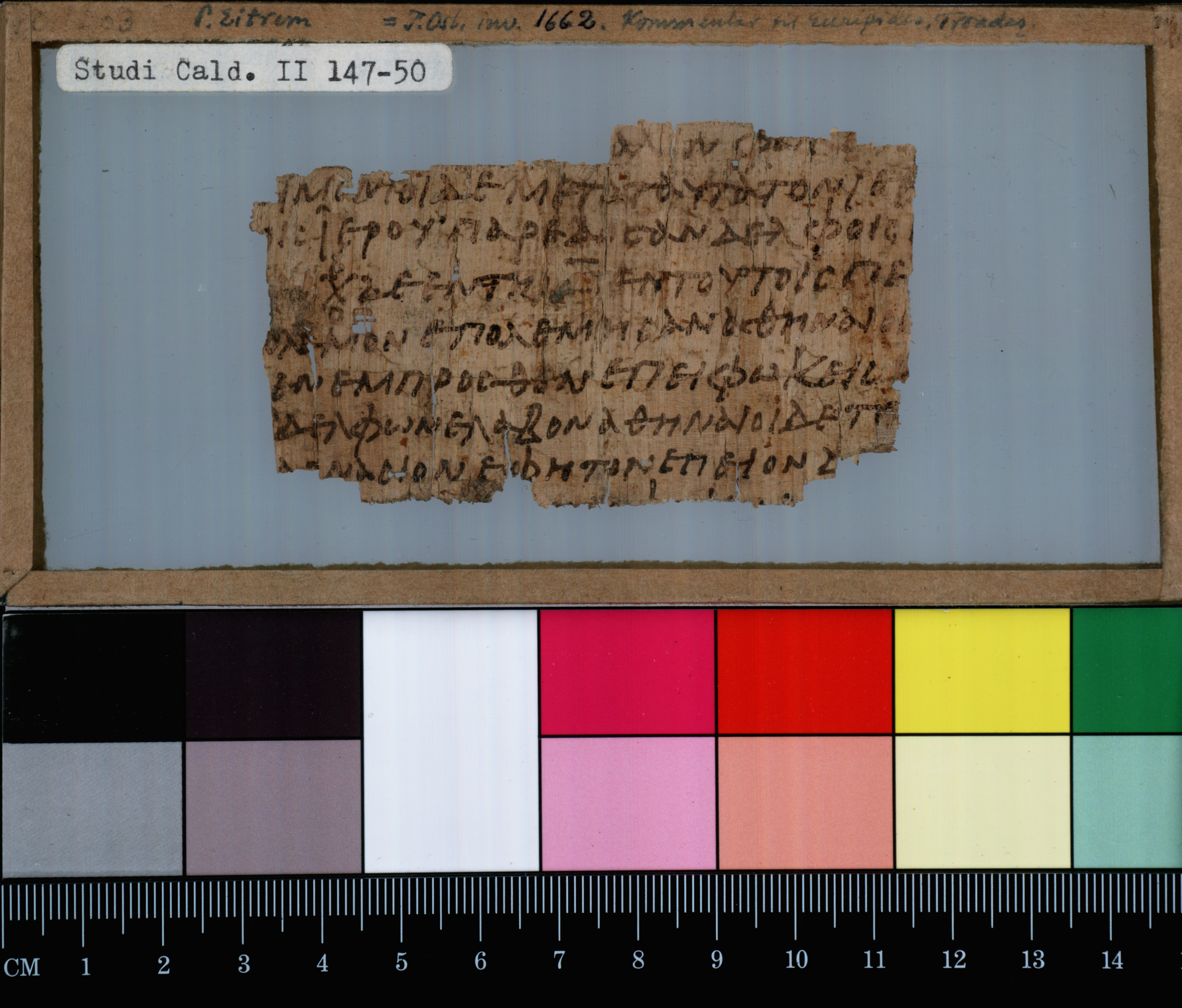
THREE PLAYS OF EURIPIDES
Trojan Women · Iphigenia among the Taurians · Ion
Translated by Arthur S. Way
The three plays gathered here span the full arc of Euripidean possibility. Trojan Women (Troiades, 415 BCE) is the most unrelenting tragic statement in the ancient repertoire: a series of devastations visited on the women of conquered Troy, with no reversal, no recognition, no comfort — only the smoke of the burning city rising at the end. It was performed alongside two lost plays, Alexandros and Palamedes, as part of a connected trilogy on the consequences of the Trojan War, and took second prize at the Great Dionysia. Iphigenia among the Taurians (Iphigeneia he en Taurois, probably 414–412 BCE) is something altogether different: a drama of escape, recognition, and providential rescue, in which Iphigenia — transported to the Crimean coast by Artemis on the very altar where she was to be sacrificed — discovers that the stranger she is about to kill is her own brother Orestes. Ion (probably 410–408 BCE) turns to Apollo and the origins of the Athenian people: a young temple servant at Delphi discovers, through a sequence of near-catastrophes and reversals, that he is the son of Apollo and an Athenian princess, and so the ancestor of the Ionian Greeks.
What these plays share is a fascination with the gap between divine intention and human experience — and with the violence, suffering, and sheer contingency that occupy that gap. In Trojan Women, the gods' quarrel (dramatized in the opening colloquy between Poseidon and Athena) authorizes the destruction of Troy, but its weight falls entirely on women who had no part in Paris's choice. In Iphigenia among the Taurians, Apollo's oracle sets in motion a chain of events that almost destroys both siblings before the goddess Athena intervenes to impose a resolution. In Ion, Apollo's seduction of Creusa produces a son he cannot acknowledge, a foundling raised in ignorance of his own identity, and a reunion accomplished only after Creusa has tried to poison him and he has nearly had her killed in turn. Divine purposes are real in Euripides — unlike in, say, the rationalist readings that dominated earlier twentieth-century scholarship — but they operate at a distance that makes them, for most of the action, indistinguishable from indifference.
Together, the three plays represent a defining range of what Euripides could do: devastating elegy, sophisticated melodrama, and something close — in Ion — to tragicomedy, a form that would not be named for another two centuries but that the play already inhabits fully.
Further Reading
Translations
David Kovacs (Loeb Classical Library, vols. I–VI, 1994–2002) — the standard modern bilingual edition, with Greek text on facing pages. Kovacs is a conservative textual scholar and his translations, in prose, are accurate and unobtrusive rather than literary; his introductions and textual notes are indispensable for students working closely with the Greek. His treatment of disputed lines and interpolations is often stricter than other editors, and not universally accepted.
Richmond Lattimore and William Arrowsmith, eds., The Complete Greek Tragedies: Euripides (University of Chicago Press, 1955–1959) — the collaborative Chicago edition remains widely taught. Lattimore translated Trojan Women himself, in verse that communicates something of the plays' percussive grief; Iphigenia in Tauris is by Witter Bynner, Ion by Ronald F. Willetts. The volumes vary in quality and interpretive emphasis but remain the most accessible complete set.
James Morwood (Oxford World's Classics, 2000–2001) — clear, reliable prose translations with useful introductions. Morwood is particularly good at preserving the argumentative texture of Euripidean dialogue, including the formal rhetorical debates (agones) that structure so much of the drama. His volume pairing Trojan Women with Bacchae, Iphigenia at Aulis, and Cyclops is especially useful.
Emily Wilson, Trojan Women (W. W. Norton, 2016; in Greek Plays in Translation) — Wilson's version is the most accomplished recent English rendering of Troades, written in flexible verse that captures the play's tonal range from formal lamentation to bitter irony. Her introduction engages seriously with the politics of staging the play today.
Anne Carson, Grief Is the Thing with Feathers (forthcoming translation of Troades) — Carson has spoken in interviews of working on the play; no full published translation yet exists under her name, though her engagement with Euripidean extremity in Nox and other works is relevant context.
Introductions and General Studies
Bernard Knox, "Euripides: The Poet as Prophet," in Word and Action: Essays on the Ancient Theater (Johns Hopkins, 1979) — a brilliant account of Euripides' relationship to the political and intellectual climate of late fifth-century Athens. Knox is particularly illuminating on how Trojan Women engages with the Athenian conquest of Melos, which had occurred just months before the play's first performance.
Helene Foley, Ritual Irony: Poetry and Sacrifice in Euripides (Cornell, 1985) — the most important study of how Euripides uses the language and structure of Greek religious ritual — and specifically sacrifice — to generate dramatic and moral complexity. Essential for all three plays, each of which turns on an impending or averted killing framed as ritual action.
Froma Zeitlin, "Euripides' Hekabe and the Somatics of Dionysiac Drama," in Playing the Other (Chicago, 1996) — though focused on Hecuba, Zeitlin's analysis of Euripidean dramaturgy and the politics of the female body in his Trojan plays bears directly on Trojan Women. Her broader argument about Euripides as the most theatrically self-conscious of the tragedians is the essential critical framework.
Pietro Pucci, The Violence of Pity in Euripides' Medea (Cornell, 1980) — indispensable for understanding Euripides' manipulation of audience sympathy and his interest in characters who are simultaneously perpetrators and victims. The arguments extend beyond Medea to the complex moral positions of Hecuba, Iphigenia, and Creusa.
A. P. Burnett, Catastrophe Survived: Euripides' Plays of Mixed Reversal (Oxford, 1971) — the book that most persuasively reclaimed Iphigenia among the Taurians and Ion as coherent dramatic achievements rather than failed tragedies or proto-romantic entertainments. Burnett's analysis of their formal structure — the "mixed reversal" in which catastrophe is averted at the last possible moment — remains the starting point for all subsequent readings.
Desmond Conacher, Euripidean Drama: Myth, Theme and Structure (Toronto, 1967) — a comprehensive survey, methodical rather than inspired, but valuable as an orientation to each play's relationship to its mythological sources and to the range of Euripidean dramatic technique. Still widely cited and useful as a reference.
Commentaries
Shirley Barlow, Euripides: Trojan Women (Aris & Phillips, 1986) — the standard English-language commentary for students and scholars, with facing Greek text, introduction, and detailed notes. Barlow is especially strong on the play's choral odes and on the formal rhetoric of the agon between Hecuba and Helen.
P. T. Stevens, Euripides: Andromache (Oxford, 1971) — though focused on the related Andromache, Stevens's treatment of Euripidean dramatic language and the problem of Euripidean pathos is essential reading for all the Trojan plays.
Martin Cropp, Euripides: Iphigenia in Tauris (Aris & Phillips, 2000) — the best modern commentary on Iphigenia among the Taurians, combining close philological attention with strong engagement with the play's theatrical strategies, its relationship to the Odyssey, and its complex treatment of recognition (anagnorisis).
K. H. Lee, Euripides: Ion (Aris & Phillips, 1997) — careful and thorough, with particular attention to the theological problems the play raises: Apollo's conduct toward Creusa, the reliability of the oracle, and the question of whether the play's resolution is genuinely comic or deeply ironic. Lee argues for a reading that takes both possibilities seriously.
A. M. Dale, Euripides: Helen (Oxford, 1967) — though focused on Helen, Dale's introduction to the late Euripidean romantic plays, with their emphasis on recognition, disguise, and escape, provides indispensable context for Iphigenia among the Taurians and Ion, which share that dramatic world.
The Plays in Performance and Reception
Edith Hall, Inventing the Barbarian: Greek Self-Definition through Tragedy (Oxford, 1989) — fundamental for understanding how Trojan Women and Iphigenia among the Taurians construct and interrogate the boundary between Greek and barbarian. Hall's account of the Taurians in the Iphigenia is particularly illuminating.
Michael Cacoyannis, The Trojan Women (film, 1971) — the most significant modern production of the play, with Katharine Hepburn as Hecuba and Vanessa Redgrave as Andromache. Cacoyannis situates the play explicitly as anti-war statement in the context of Vietnam. However one judges its cinematic liberties, the film established the terms in which Trojan Women has been received and performed ever since.
Karelisa Hartigan, Greek Tragedy on the American Stage: Ancient Drama in the Commercial Theater, 1882–1994 (Greenwood, 1995) — traces the performance history of all three plays in the anglophone tradition, with useful documentation of production choices, reception contexts, and the shifting political meanings the plays have been made to carry.