EPICTETUS
A Selection from the Discourses · with the Encheiridion
Translated by George Long
INTRODUCTION
No philosopher in the ancient world came from further outside its centres of power than Epictetus, and no ancient philosopher has been more continuously read. He was born around 50 CE in Hierapolis, a city in Phrygia in what is now south-western Turkey, and he was born a slave. His master in Rome was Epaphroditus, a freedman of the Emperor Nero who served as an imperial secretary and who was later put to death by Domitian for the role he had played in Nero's death. It was in Epaphroditus's household that Epictetus encountered Stoic philosophy, studying under the distinguished teacher Musonius Rufus. By what means and at what moment Epictetus obtained his freedom is not recorded with certainty; that he did so is established by the life he subsequently led. Around 89 CE, when the Emperor Domitian expelled philosophers from Rome, Epictetus settled at Nicopolis in Epirus — the city founded by Augustus to commemorate his victory at Actium — and there opened the school in which he taught for the rest of his long life. He died around 135 CE. He never married, as Lucian reports, and he never wrote a word.
Everything we have of Epictetus comes to us through his student Arrian of Nicomedia — the same Arrian who wrote the Anabasis, the standard Greek account of Alexander the Great's campaigns. Arrian attended Epictetus's school in Nicopolis around 108 CE and recorded his teacher's spoken words, explaining in a prefatory letter that he had not composed the texts but had simply written down what he heard, as closely as he could, wishing to preserve the quality of Epictetus's speech. From these records Arrian produced two works. The first, and longer, is the Diatribai — the Discourses — which originally ran to eight books of classroom conversations, arguments, and extended reflections; four books survive. The second is the Encheiridion — the Handbook or Manual — a shorter compendium of key principles drawn from the Discourses and arranged by Arrian for readers who needed a portable distillation of the philosophy rather than the full record of its exposition.
This volume, published by G. P. Putnam's Sons in 1890, brings together a selection from the surviving Discourses with the complete Encheiridion, using the translation George Long had published in full in 1877. It is not a comprehensive edition of the Discourses — Long's complete translation, with fragments and notes, appeared separately in a single volume from George Bell and Sons — but a gathering of those discourses most likely to be useful and intelligible to a general reader, presented alongside the Encheiridion whose compact authority has never required editorial selection.
The Encheiridion
The Encheiridion is the entry point to Epictetan Stoicism for most readers, and with reason: its opening sentence states the whole philosophy. There are things in our power (eph' hēmin) and things not in our power (ouk eph' hēmin). In our power are opinion, impulse, desire, aversion — the movements of our own minds. Not in our power are the body, property, reputation, office — everything that depends on external circumstances and the actions of others. The Stoic project, as Epictetus formulates it, is the rigorous and lifelong work of keeping this distinction clear: of training oneself not to direct longing or aversion toward things that lie outside one's control, and of reserving the full force of desire and will for the only domain in which they can be effective and unconstrained — one's own judgements and responses.
This is not a passive philosophy. The Encheiridion is shot through with the awareness that the distinction is easy to state and extraordinarily difficult to maintain: that we are constantly tempted to care about things we cannot control, that our emotions are constantly running ahead of our reason into territory where they can only be frustrated, and that the work of philosophy is not an intellectual exercise but a daily discipline of attention. The fifty-three chapters of the Encheiridion move from the foundational distinction through its applications — in dealing with loss, with illness, with the death of loved ones, with social obligations, with ambition, with the behaviour of other people — accumulating into a portrait of a form of life rather than a set of propositions.
The Encheiridion was among the most widely copied and read texts of late antiquity and the Byzantine period. It circulated not only as a philosophical handbook but in at least two adapted versions for Christian monastic use, in which Socrates was replaced by the Apostle Paul and the Platonic dialogues by the scriptures — adaptations that testify both to the text's practical authority and to the readiness of Christian readers to find in Epictetan Stoicism something compatible with, and supportive of, their own ascetic ideals.
The Discourses
The four surviving books of the Discourses are vastly more expansive than the Encheiridion — longer, rougher, more dialectical, full of the energy of a spoken classroom — and they illuminate the Encheiridion in ways that the handbook's compressed form cannot fully explain. Where the Encheiridion gives principles, the Discourses give arguments: extended engagements with objections, conversations with students who fail to understand or apply what they have been taught, meditations on historical exemplars, and occasional passages of rhetorical intensity that rise to something close to moral exhortation.
Several of the discourses selected in this volume are among the most celebrated in the entire corpus. Discourses I.1 (On Things in Our Power and Not in Our Power) establishes the foundational distinction of the Encheiridion in its argumentative context, exploring what it means to say that the faculty of choice (prohairesis) is truly ours while the body and external circumstances are not. Discourses I.2 (How a Man May Preserve His Proper Character in Every Thing) extends this into questions of vocation and role: how does the commitment to virtue interact with the obligations of one's particular station and relationships? Discourses II.1 (That Confidence is Not Inconsistent with Caution) addresses the apparent paradox that the Stoic sage is neither reckless nor timid — that genuine confidence comes not from certainty about external outcomes but from certainty about one's own intentions.
Discourses III.22 (On the Cynic) is the most sustained and philosophically ambitious piece in the surviving books. Epictetus here takes up the figure of the ideal philosophical missionary — the Cynic, in the ancient sense, who has shed all the obligations of ordinary social life (marriage, property, political office) and devotes himself entirely to the examination and reformation of others. The portrait is not an endorsement of Cynicism as a school but a meditation on what it would mean to be fully free of all attachments: neither country nor home nor land nor slave, his bed the ground, his cloak his only possession, loving those who treat him badly. Epictetus makes clear that such a life is a divine vocation, not a human choice — that it requires not the abandonment of social obligation but its complete transformation by a higher one.
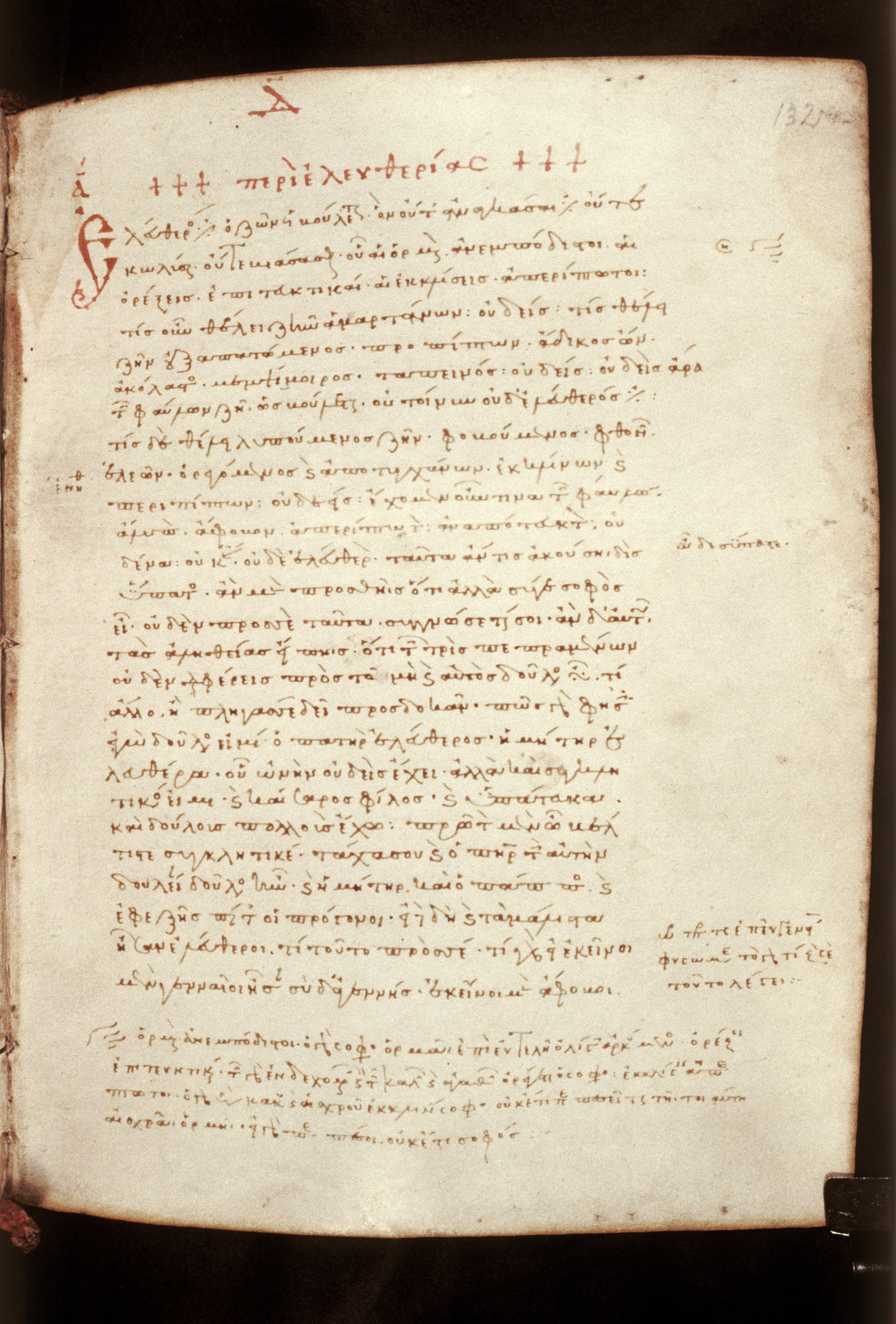
Discourses IV.1 (On Freedom) — the longest single discourse in the surviving text, and the one whose opening is visible in the manuscript image reproduced here — takes the concept of freedom away from its conventional political sense and relocates it entirely within the domain of the will. No external power can enslave a free mind; no legal freedom liberates an enslaved one. The discourse builds this argument through a long series of examples — the rich man who is a slave to his patrons, the senator who is a slave to his reputation, the king who is a slave to his fear — arriving at the proposition that the only truly free person is the one who wants only what is in their power to have and refuses only what is in their power to avoid.
Epictetus and the Tradition
The influence of Epictetus on subsequent thought is difficult to overstate and runs through channels so various as to resist summary. Marcus Aurelius, who was Emperor of Rome while Epictetus's school was still in living memory, drew on the Discourses throughout the Meditations — the private notebook of a Stoic practitioner who had absorbed Epictetus's teaching and spent his life attempting, not always successfully, to live by it. The early Christian apologist Justin Martyr and, later, Augustine found in Epictetus a moral seriousness they respected even where they disagreed with its metaphysical foundations. The Encheiridion was translated into Latin and read throughout the medieval period. In the Renaissance it was among the first Greek texts to be printed. In the seventeenth century it shaped the ethics of Descartes; in the eighteenth, the politics of the American founders; in the twentieth, it was carried into prisoner-of-war camps and emerged as one of the intellectual resources by which some of their inhabitants endured what they could not escape.
Transmission
The transmission of the Discourses is among the more dramatic stories in the manuscript history of ancient philosophy. Epictetus wrote nothing; Arrian recorded what Epictetus said and circulated the texts; eight books were known to Aulus Gellius in the second century CE; four survive today. The process by which Books V through VIII were lost — whether gradually through the attrition of copying, or through some more specific catastrophe of destruction — is not recoverable.
The earliest and most important surviving manuscript of the Discourses is the Bodleian Codex — MS. Auct. T. 4. 13 (also Cod. graec. Misc. 251) — an eleventh-century parchment manuscript now in the Bodleian Library, Oxford, and described in the Bodleian's own catalogue as the archetype of all existing manuscripts of the work. It is written throughout in a Greek minuscule in red ink, and the folio reproduced as the cover of this edition (fol. 132r) shows the opening of the longest surviving discourse, Book IV.1, On Freedom — its heading, ΠΕΡΙ ΕΛΕΥΘΕΡΙΑΣ, clearly visible in red above the columnar text, flanked by decorative cross-marks.
The manuscript is thought to be connected with Arethas of Caesarea (c. 850 – c. 944 CE), the Byzantine bishop, scholar, and tireless collector of classical manuscripts who was responsible for preserving and transmitting a remarkable range of Greek texts — including the Meditations of Marcus Aurelius. Marginal annotations in MS. Auct. T. 4. 13 have been identified as in Arethas's own hand. Whether the Bodleian manuscript is itself Arethas's copy or a copy made from his exemplar, the connection situates the survival of the Discourses within the broader project of Byzantine classical scholarship that preserved so much of ancient Greek literature through the otherwise dark centuries that followed the collapse of the western Empire.
The manuscript was subsequently part of the Saibante collection of Verona before its acquisition by the Bodleian Library, where it is held under restricted access. The first printed edition of the Discourses in Greek was published by Vettore Trincavelli at Venice in 1535, though the manuscript used for that edition was, in the judgment of subsequent scholars, full of errors. The modern critical text rests on Heinrich Schenkl's Teubner edition of 1916, which brought the full resources of manuscript collation to bear on a text that had required constant emendation since its first printing.
The Encheiridion had a wider and more continuous manuscript tradition than the Discourses, circulating in several recensions — including the monastic adaptations — and reaching medieval European readers through paths independent of the main tradition of the Discourses.
This Translation
The translation is that of George Long (1800–1879), a British classical scholar who was among the most productive translators of Stoic philosophy into Victorian English. Long held the chair of Greek at University College London from 1828 to 1833 and subsequently devoted much of his scholarly career to the ancient moralists; his translation of Marcus Aurelius's Meditations (1862) went through numerous editions and remained a standard English text for generations. His complete translation of Epictetus — The Discourses of Epictetus; with the Encheiridion and Fragments, with notes, a life of Epictetus, and a survey of his philosophy — was published by George Bell and Sons, London, in 1877, the year before his death. The present G. P. Putnam's Sons edition of 1890 is a posthumous selection from that larger work, combining the Encheiridion in full with a curated gathering of the most essential and accessible of the Discourses. Long's prose is the product of a Victorian classical education: direct, measured, close to the Greek, and unafraid of the gravity of its subject. The translation is in the public domain.
FULL TEXT
The Encheiridion
[The Encheiridion — from the Greek ἐγχειρίδιον, literally 'that which is held in the hand' — is the short handbook of Stoic principles that Arrian compiled from Epictetus's Discourses for readers who required a portable summary of the philosophy. Its opening chapter states the foundation on which everything else rests.]
I. Of things, some are in our power, and others are not. In our power are opinion, movement toward a thing, desire, aversion; and, in a word, whatever are our own acts. Not in our power are the body, property, reputation, office, and, in a word, whatever are not our own acts. And the things in our power are by nature free, not subject to restraint nor hindrance; but the things not in our power are weak, slavish, subject to restraint, in the power of others. Remember, then, that if you think the things which are by nature slavish to be free, and the things which are in the power of others to be your own, you will be hindered, you will lament, you will be disturbed, you will blame both gods and men. But if you think that only which is your own to be your own, and if you think that what is another's, as it really is, belongs to another, no man will ever compel you, no man will hinder you, you will never blame any man, you will accuse no man, you will do nothing involuntarily, no man will harm you, you will have no enemy, for you will not suffer any harm.1
II. If then you desire things so great and so excellent, remember that you must not lay hold of them with a small effort; you must leave alone some things entirely, and postpone others for the present. But if you wish for these things also, and power and wealth, perhaps you will not gain even these latter, because you aim at the former too; and certainly you will fail of the former, by which alone happiness and freedom are secured. Straightway, then, practise saying to every harsh-looking appearance, You are an appearance, and in no manner what you appear to be. Then examine it by those rules which you have, and first and chiefly by this: whether it concerns the things which are in our own power, or those which are not; and if it concerns anything which is not in our power, be ready to say that it does not concern you.2
III. Remember that desire carries with it the profession of gaining what you desire; and the profession of aversion is that you will not fall into that which you would avoid; and he who fails in his desire is unfortunate; he who falls into that which he would avoid is unhappy. If then you attempt to avoid only the things contrary to nature which are among the things in your power, you will not fall into any of the things which you would avoid. But if you attempt to avoid disease or death or poverty, you will be unhappy. Remove, then, aversion from all things which are not in our power, and transfer it to the things contrary to nature which are among the things in our power.
Bibliography
Long, George, trans. A Selection from the Discourses of Epictetus, with the Encheiridion. New York: G. P. Putnam's Sons, 1890.
Long, George, trans. The Discourses of Epictetus; with the Encheiridion and Fragments. London: George Bell and Sons, 1877.
Schenkl, Heinrich, ed. Epicteti Dissertationes ab Arriano digestae. Leipzig: Teubner, 1916.
Oldfather, W. A., trans. Epictetus: The Discourses as Reported by Arrian, the Manual, and Fragments. 2 vols. Loeb Classical Library 131, 218. Cambridge, MA: Harvard University Press, 1925–1928.
Oldfather, W. A. Contributions toward a Bibliography of Epictetus. Urbana: University of Illinois, 1927.
Dobbin, Robert, trans. Epictetus: Discourses and Selected Writings. Penguin Classics. London: Penguin, 2008.
Hard, Robin, trans. Epictetus: Discourses, Fragments, Handbook. Oxford World's Classics. Oxford: Oxford University Press, 2014.
Hijmans, B. L. Askēsis: Notes on Epictetus' Educational System. Assen: Van Gorcum, 1959.
Sorabji, Richard. Emotion and Peace of Mind: From Stoic Agitation to Christian Temptation. Oxford: Oxford University Press, 2000.
Footnotes
-
The Greek term rendered here as "in our power" is eph' hēmin — literally "up to us" or "dependent on us." The complementary term ouk eph' hēmin — "not up to us" — governs the list of external things that follow. This distinction, stated at the opening of the Encheiridion and restated throughout the Discourses, is the axis around which the whole of Epictetus's moral philosophy turns. The translation here, and throughout, is Long's. ↩︎
-
The phrase translated "harsh-looking appearance" renders the Greek phainomenon — an impression or presentation to the mind. The Stoic theory of impressions (phantasiai) holds that the disturbance we feel on encountering a difficult situation is not caused by the situation itself but by the judgement we make about it: we assent to the impression that this thing is terrible, and only our assent — not the thing itself — produces the emotional response. The practice of pausing and examining the impression before assenting to it is the practical exercise to which Epictetus returns most frequently in both the Encheiridion and the Discourses. ↩︎