EPICTETUS
Discourses · Books I–II
Translated by W. A. Oldfather
Loeb Classical Library 131 · Harvard University Press · 1925
INTRODUCTION
No philosopher in the ancient world came from further outside its centres of power than Epictetus, and no ancient philosopher has been more continuously read. Born around 50 CE in Hierapolis, a city in Phrygia in what is now south-western Turkey, he was born a slave — a fact that his philosophy neither conceals nor treats as incidental, but transforms into one of its central arguments. His master in Rome was Epaphroditus, a freedman of the Emperor Nero who served as an imperial secretary. It was in that household that Epictetus encountered Stoic philosophy, studying under the distinguished teacher Musonius Rufus. By what means he obtained his freedom is not recorded with certainty; that he did so is established by the life he subsequently led. Around 89 CE, when the Emperor Domitian expelled philosophers from Rome, Epictetus settled at Nicopolis in Epirus — the city Augustus had founded to commemorate his victory at Actium — and there opened the school in which he taught for the rest of his long life. He died around 135 CE. He never wrote a word.
Everything we have of Epictetus comes through his student Arrian of Nicomedia — the same Arrian who wrote the Anabasis, the standard Greek account of Alexander the Great's campaigns. Arrian attended Epictetus's school around 108 CE and recorded his teacher's spoken words, explaining in a prefatory letter that he had not composed the texts but had simply written them down as he heard them, wishing to preserve the quality of Epictetus's speech. From these records Arrian produced two works. The first, and longer, is the Diatribai — the Discourses — which originally ran to eight books of classroom conversations, arguments, and extended reflections; four books survive. The second is the Encheiridion — the Handbook — a shorter compendium of key principles drawn from the Discourses. As the Stanford Encyclopedia of Philosophy's overview of Epictetus notes, the Discourses are "not the writing of Epictetus but are ghostwritten by the essayist and historiographer Arrian of Nicomedia in an effort to convey the personal impact of his instruction" — and we have good reason to trust that they reflect Epictetus's thought rather than Arrian's own, both because the language is common Greek rather than the sophisticated literary dialect of Arrian's other writings, and because the brusque precision of the philosophical vocabulary is quite different from anything Arrian produced elsewhere.1
This volume — Loeb Classical Library 131, first published in 1925 — presents Books I and II of the Discourses, with the original Greek on the left-hand page and Oldfather's English translation facing it on the right, accompanied by notes and a substantial introduction. Its companion volume, Loeb 218, completes the Discourses with Books III and IV and adds the Encheiridion and surviving fragments.
The Philosophy
Epictetus's philosophical project is at once simple to state and extraordinarily difficult to execute. Its axis is a single distinction: some things are eph' hēmin — up to us, in our power — and others are ouk eph' hēmin — not up to us, not in our power. In our power are our judgements, our impulses, our desires and aversions: the operations of our own rational faculty. Not in our power are the body, reputation, property, and office — everything that depends on external circumstances and the actions of others. The Stoic life, as Epictetus conceives it, is the sustained and effortful practice of maintaining this distinction: refusing to desire or fear what lies outside one's control, and directing the full force of one's rational will only toward what is genuinely one's own.
The linchpin of this philosophy is what Epictetus calls prohairesis — variously translated as volition, will, or moral purpose — the capacity for rational choice that he regards as both distinctively human and the only domain in which genuine freedom is possible. As the Stanford Encyclopedia's entry on Epictetus explains, the philosopher is "chiefly concerned with integrity, self-management, and personal freedom, which he advocates by demanding of his students a thorough examination" of this capacity and of what he calls "the correct use of impressions (chrēsis tōn phantasiōn)."2 The correct use of impressions means pausing before accepting as true the judgements that automatic emotional responses press upon us — recognising that it is not events themselves but our assent to impressions of those events that produces suffering, fear, desire, and anger.
This is not a passive or quietist philosophy. The Discourses are shot through with urgency, challenge, and what can fairly be called moral ferocity. Epictetus addresses students who have come to hear philosophy but who have not yet decided to live it, and he returns again and again to the gap between understanding the argument and being transformed by it. The classroom of the Discourses is not a place of comfort but of sustained examination, in the Socratic sense: Epictetus presses his interlocutors not toward any external achievement but toward clarity about what they actually value and why.
Books I and II
The first two books of the Discourses establish the philosophical foundations on which Books III and IV will build, and they include several of the most celebrated and frequently discussed pieces in the entire corpus.
Discourses I.1 (On the Things in Our Power and Not in Our Power) states the foundational distinction in its fullest argumentative form. Epictetus here confronts the question of what it means to be free: not in any political or legal sense, but in the only sense that finally matters — freedom from the domination of desires and fears directed at things one cannot control. The tyrant threatens the prisoner's body; he cannot threaten the prisoner's judgement about whether submission or resistance is worth the cost. The argument is not simply that inner freedom compensates for outer constraint; it is that inner freedom is the only freedom there has ever been.
Discourses I.2 (How a Man May Preserve His Proper Character in Everything) extends this into questions of role and vocation: the Stoic commitment to virtue does not abolish the particular obligations of one's station, relationships, and circumstances, but it provides the framework within which those obligations are properly fulfilled. The discourse is a subtle engagement with the question of how universal principles become particular lives.
Discourses II.1 (That Confidence Is Not Inconsistent with Caution) addresses a potential misreading of Stoic equanimity: the argument that because the Stoic is indifferent to external outcomes, the Stoic must be either reckless or passive. Epictetus shows that genuine confidence is not the absence of care but the right direction of it — certainty about one's own purposes rather than about the way the world will respond to them.
Discourses II.17 (That Logic Is Necessary) and the discourses that surround it in the second book move into the technical architecture of Stoic philosophy — the role of formal argument, the nature of assent, the relationship between logic and ethics — revealing the intellectual rigour underlying the moral urgency of Epictetus's teaching. He is not, despite his reputation, merely a moralist: his resystematisation of Stoic ethics is philosophically serious and demands to be read as such.
The Loeb Edition
The Loeb Classical Library was established by the banker and philanthropist James Loeb in 1911, with the explicit aim of making the classical literatures of Greece and Rome accessible to educated readers who had not maintained, or never had, the facility to read them in the original. Each volume presents the original Greek or Latin on the left-hand page and an English translation on the right — a format that invites comparison, corrects misreadings, and keeps the original perpetually present without requiring exclusive reliance on it.
W. A. Oldfather (1880–1945) was a classicist at the University of Illinois and one of the foremost American scholars of Epictetan studies in the first half of the twentieth century. His two-volume Loeb edition of the Discourses, published in 1925 and 1928, remained the standard English scholarly text for a generation and is still widely used. Oldfather also produced Contributions toward a Bibliography of Epictetus (1927, with a supplement in 1952), a work of reference that demonstrates the breadth of his command of the secondary literature. His translation is close to the Greek, accurate, and deliberately restrained in its literary ambitions — qualities appropriate to a scholarly edition, and appropriate also to the plain speech that was, according to Arrian, the characteristic register of Epictetus himself.
Transmission
The transmission of the Discourses is among the more dramatic stories in the manuscript history of ancient philosophy. Epictetus wrote nothing; Arrian recorded what Epictetus said and circulated the texts; eight books were known to Aulus Gellius in the second century CE; four survive today. How Books V through VIII were lost — whether gradually through the attrition of copying or through some more specific catastrophe — is not recoverable.
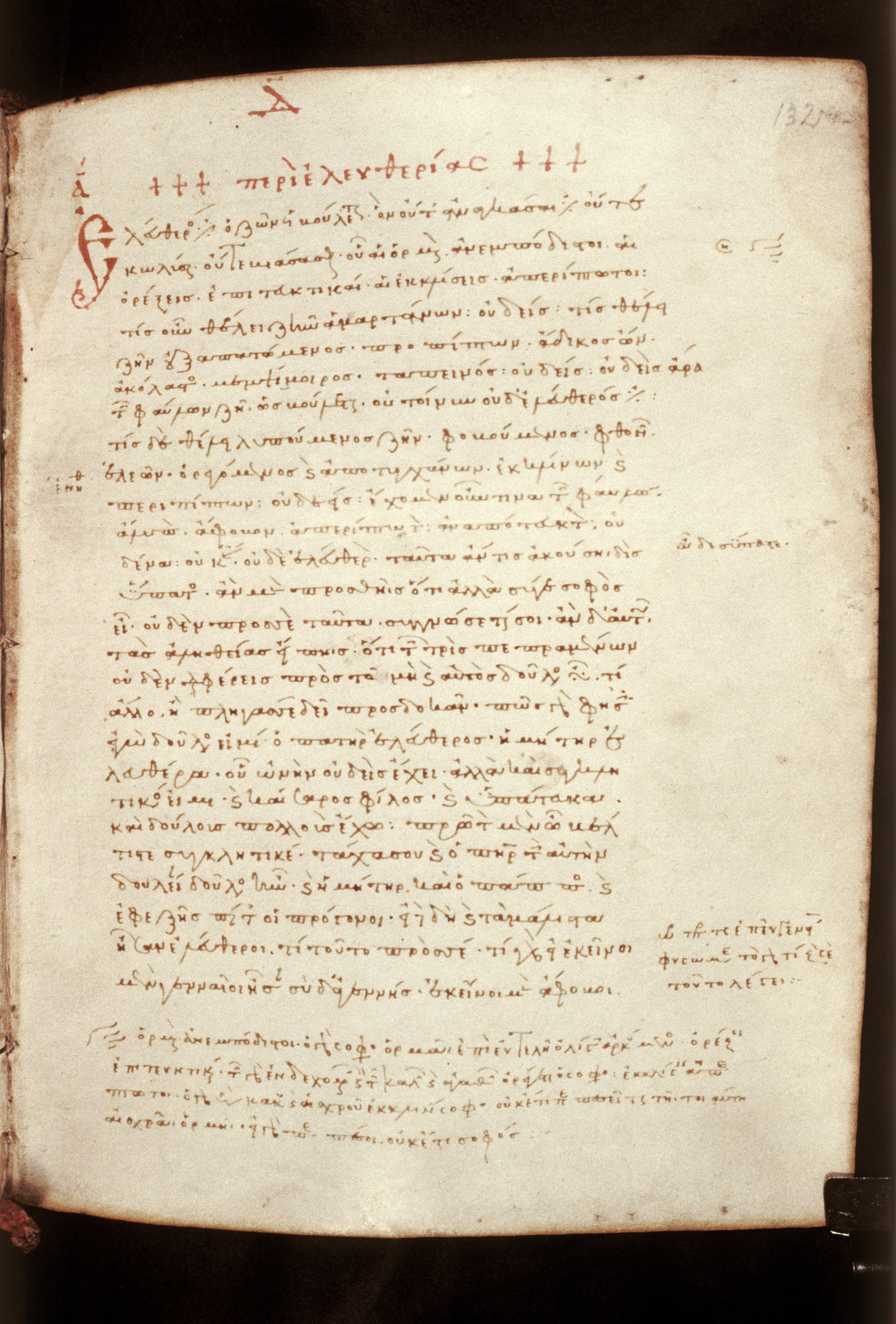
The earliest and most important surviving manuscript is the Bodleian Codex — MS. Auct. T. 4. 13 (also Cod. graec. Misc. 251) — an eleventh-century parchment manuscript now in the Bodleian Library, Oxford, described in the Bodleian's own catalogue as the archetype of all existing manuscripts of the work. Written throughout in Greek minuscule in red ink, the manuscript is thought to be connected with Arethas of Caesarea (c. 850–944 CE), the Byzantine bishop and classical scholar who was responsible for preserving and transmitting a remarkable range of Greek texts, including the Meditations of Marcus Aurelius. Marginal annotations in the codex have been identified as in Arethas's hand. The manuscript was subsequently part of the Saibante collection of Verona before its acquisition by the Bodleian Library, where it is now held under restricted access.
The first printed edition of the Discourses in Greek was published by Vettore Trincavelli at Venice in 1535. The modern critical text rests on Heinrich Schenkl's Teubner edition of 1916, which brought the full resources of manuscript collation to bear on a text that had required constant emendation since its first printing. Oldfather's Loeb edition works within and builds upon Schenkl's text.
FULL TEXT
[Loeb Classical Library 131: Epictetus, The Discourses as Reported by Arrian, Books I–II. Greek text with facing English translation by W. A. Oldfather. Harvard University Press and William Heinemann, 1925. The full text below is embedded from the Internet Archive.]
Bibliography
Oldfather, W. A., trans. Epictetus: The Discourses as Reported by Arrian, the Manual, and Fragments. Vol. 1: Books I–II. Loeb Classical Library 131. Cambridge, MA: Harvard University Press; London: William Heinemann, 1925.
Oldfather, W. A., trans. Epictetus: The Discourses as Reported by Arrian, the Manual, and Fragments. Vol. 2: Books III–IV, the Manual, and Fragments. Loeb Classical Library 218. Cambridge, MA: Harvard University Press; London: William Heinemann, 1928.
Oldfather, W. A. Contributions toward a Bibliography of Epictetus. Urbana: University of Illinois, 1927. Supplement, 1952.
Schenkl, Heinrich, ed. Epicteti Dissertationes ab Arriano digestae. Leipzig: Teubner, 1916.
Long, George, trans. The Discourses of Epictetus; with the Encheiridion and Fragments. London: George Bell and Sons, 1877.
Dobbin, Robert, trans. Epictetus: Discourses and Selected Writings. Penguin Classics. London: Penguin, 2008.
Hard, Robin, trans. Epictetus: Discourses, Fragments, Handbook. Oxford World's Classics. Oxford: Oxford University Press, 2014.
Long, A. A. Epictetus: A Stoic and Socratic Guide to Life. Oxford: Clarendon Press, 2002.
Graver, Margaret R. Stoicism and Emotion. Chicago: University of Chicago Press, 2007.
Sorabji, Richard. Emotion and Peace of Mind: From Stoic Agitation to Christian Temptation. Oxford: Oxford University Press, 2000.
Footnotes
-
The Stanford Encyclopedia of Philosophy's entry on Epictetus, authored by Margaret Graver and revised in 2025, is an authoritative overview of his life, works, and philosophy: https://plato.stanford.edu/entries/epictetus/. ↩︎
-
The term prohairesis — rendered by Oldfather as "moral purpose" and by some later translators as "volition" or "will" — is Epictetus's most distinctive philosophical coinage and the concept around which his reworking of Stoic ethics turns. It denotes not mere preference or intention but the whole faculty of rational choice as the seat of moral identity: the domain that is irreducibly and unconditionally one's own, and therefore the only domain in which genuine freedom is both possible and obligatory. ↩︎