IBN KHALDUN
Muqaddimah: An Introduction to History · Volume I
Translated from the Arabic by Franz Rosenthal
INTRODUCTION
Abu Zayd Abd al-Rahman ibn Muhammad ibn Khaldun al-Hadrami (أبو زيد عبد الرحمن ابن محمد ابن خلدون الحضرمي) was born in Tunis on 27 May 1332 into a family of Andalusian Arab origin — the al-Hadrami in his name linking his lineage to Hadramaut in Yemen, though the family had lived in Andalusia for centuries before the fall of Seville drove them east to North Africa. He was educated in the classical Islamic curriculum — the Quran, Arabic grammar and rhetoric, the jurisprudence of the Maliki school, the rational sciences — and at an early age demonstrated the intellectual ambition that would mark his entire life. He entered government service in his early twenties, navigated the turbulent politics of the Hafsid, Marinid, and Ziyanid dynasties of North Africa and Andalusia, suffered imprisonment and exile, held high office and lost it repeatedly, negotiated with rulers and with Timur (Tamerlane) himself outside the walls of Damascus in 1401, and died in Cairo in 1406 while serving as Grand Qadi of the Maliki school. His life was the raw material for his theory.
The Muqaddimah — the word means simply "introduction" or "prolegomena" — was written with extraordinary speed at the Qal'at Ibn Salama, a remote castle in what is now north-western Algeria, where Ibn Khaldun had retreated in 1375 from the dangers of court politics. He completed the first draft in approximately five months in 1377, then spent the rest of his life revising and expanding it. It was conceived as the introduction to a universal history, the Kitab al-Ibar (كتاب العبر, "Book of Lessons"), which traced the history of the Arabs, Berbers, and other peoples of the Islamic world from pre-Islamic times. But the introduction outgrew its frame: the Muqaddimah is now read as a work complete in itself, and the Kitab al-Ibar as the body of evidence assembled in support of its arguments.
What the Muqaddimah argues — and the argument is what makes it unlike anything else in the medieval historiographical tradition — is that the events recorded by historians are not accidents or the product of divine caprice but the expression of underlying regularities in human social organisation that can be studied scientifically. The science Ibn Khaldun proposes is the science of 'umran — a word meaning civilisation, urbanisation, or the settled habitation of human beings — and it is the first systematic attempt in any language to develop what we would now call a sociology of history.
This Volume
The three volumes of Franz Rosenthal's translation cover the complete Muqaddimah. Volume I contains Rosenthal's extended translator's introduction — itself a major scholarly document running to over a hundred pages, discussing the manuscripts, the textual tradition, Ibn Khaldun's life and works, and the intellectual context of the Muqaddimah — followed by Ibn Khaldun's own preface, his three preliminary discussions, and the first two of the six chapters into which the Muqaddimah is divided.
The Author's Preface announces Ibn Khaldun's project and situates it within the history of Arabic historiography. It opens with praise of God and the Prophet, then delivers one of the most remarkable critical assessments of a scholarly tradition ever written from within it: a systematic enumeration of the errors that have corrupted the historical record, from the uncritical acceptance of reports to the desire to flatter the powerful to the failure to understand how human civilisation actually works. The cure for these errors is the science of 'umran: a framework that allows the reader to test the plausibility of historical reports against what can be known about the conditions under which human societies actually function.
The Three Preliminary Discussions establish the foundations of the science. The first argues for the excellence and dignity of historiography as a field of knowledge when properly conducted. The second analyses in detail the sources of error in historical writing — anachronism, partisanship, the uncritical transmission of implausible reports, the failure to recognise that past conditions differed from present ones. The third — the most philosophically significant of the three — introduces the concept of 'umran itself as the proper subject of a genuine science of history, and sketches the terrain that the six chapters of the Muqaddimah will cover.
Chapter One is the longest and most philosophically rich section of the entire work, and it occupies most of Volume I. It examines human civilisation in its most general aspects. It opens with the proposition that human beings are by nature social animals — that the individual human being cannot survive alone — and proceeds to examine the implications of this sociality for the rise and fall of political authority, the formation of dynasties, the patterns of economic life, and the moral character of different forms of social organisation.
At the centre of Chapter One is Ibn Khaldun's most original and celebrated concept: 'asabiyya (عصبية), usually translated as "group feeling," "social solidarity," or "tribal solidarity." 'Asabiyya is the bond of mutual loyalty and collective self-assertion that holds a human group together, that makes it willing to fight for itself and its members, and that provides the energy required to establish political authority. It is strongest among nomadic and tribal peoples — the Bedouin of the Arabian desert, the Berber tribes of the Maghreb — and weakest among the sedentary populations of established cities, where luxury and ease dissolve the habits of mutual support and self-reliance. The dynamic interaction between strong 'asabiyya and the temptations of sedentary civilisation is the engine of the cyclical theory of dynastic rise and fall that is the Muqaddimah's most durable contribution to the analysis of political history.
Chapter Two, which concludes Volume I, examines desert civilisation — the Bedouin way of life — as the source of the strongest 'asabiyya and therefore as the perennial origin of the political energy that founds and refounds states. Ibn Khaldun is neither romantic about Bedouin life nor dismissive of its virtues: he analyses it with the detached precision of a scientist examining a natural phenomenon, identifying the conditions that produce the qualities he observes.
'Asabiyya and the Theory of Dynastic Cycles
The cyclical theory that animates the Muqaddimah is not a pessimistic resignation to historical repetition but an explanatory framework of considerable subtlety. A tribe or confederacy with strong 'asabiyya conquers a settled region and establishes a dynasty. The dynasty's rulers, now in possession of wealth and power, begin to concentrate authority in their own hands, weakening the solidarity of the group that brought them to power. The population, drawn into city life, loses its hardiness and martial qualities. Luxury enervates; faction divides; the original 'asabiyya dissipates across three or four generations. The dynasty then falls to a new group from the desert or the margins, possessed of the strong solidarity that the rulers have lost, and the cycle begins again.
This is not a mechanical formula — Ibn Khaldun is keenly aware of the variations introduced by geography, religion, economy, and accident — but it is a model that generates testable predictions, and Ibn Khaldun applies it repeatedly to the historical record of the Arab, Berber, and Persian dynasties he knew. The model has been compared to Vico's cycles, to Toynbee's rise and decline of civilisations, and — in the twentieth century — to theories of political development from Marx to sociobiological accounts of group selection. Arnold Toynbee called the Muqaddimah "undoubtedly the greatest work of its kind that has ever been created by any mind in any time or place."
Ibn Khaldun Between Two Worlds
The Muqaddimah was written at the intersection of several major intellectual traditions. Ibn Khaldun was trained in the Maliki legal tradition and the classical Islamic sciences; he was deeply read in the Arabic philosophical tradition, including the works of al-Farabi and Ibn Rushd (Averroes); he knew the Greek philosophical heritage as it had been transmitted and transformed through Arabic; and he had firsthand experience of the political life of the North African and Andalusian courts, which gave his theory of dynasties a concreteness that purely speculative accounts could never have. He stood, as the Muqaddimah itself stands, at the end of the classical Islamic world and the beginning of its dissolution under the pressure of the Black Death, the Mongol conquests, and the political fragmentation that would eventually lead to Ottoman and European dominance. The experience of watching civilisations fall — his own family had been driven from Andalusia; he had survived the plague that killed both his parents in 1349; he had negotiated with Timur outside a dying city — runs beneath the cool analytical surface of the Muqaddimah and gives it a gravity that no merely theoretical exercise could possess.
Transmission
The Muqaddimah circulated in manuscript form from the late fourteenth century, primarily in North Africa and Egypt. Ibn Khaldun himself prepared several revised versions of the text, and multiple autograph manuscripts are attributed to him — the most important of which Rosenthal studied at the Süleymaniye Library in Istanbul in preparation for his translation. The manuscript tradition is substantial, comprising dozens of witnesses across libraries in Istanbul, Paris, Cairo, Tunis, and elsewhere, and reconstructing the history of Ibn Khaldun's own revisions from among these witnesses was a major part of Rosenthal's editorial labour.
The first European engagement with the text came through the Flemish traveller and diplomat Michael Casiri, who described a manuscript of the Muqaddimah in the Escorial Library in his 1760 catalogue of Arabic manuscripts. The Orientalist Silvestre de Sacy quoted from it in 1806. The first translation into a Western language was the partial French rendering of William MacGuckin de Slane, published in the Notices et extraits des manuscrits de la Bibliothèque nationale between 1844 and 1862. De Slane also prepared an edition of the Arabic text (Paris, 1858), published in the same year as the landmark Bulaq/Cairo edition — the first printed Arabic edition of the complete Kitab al-Ibar of which the Muqaddimah is the introduction.
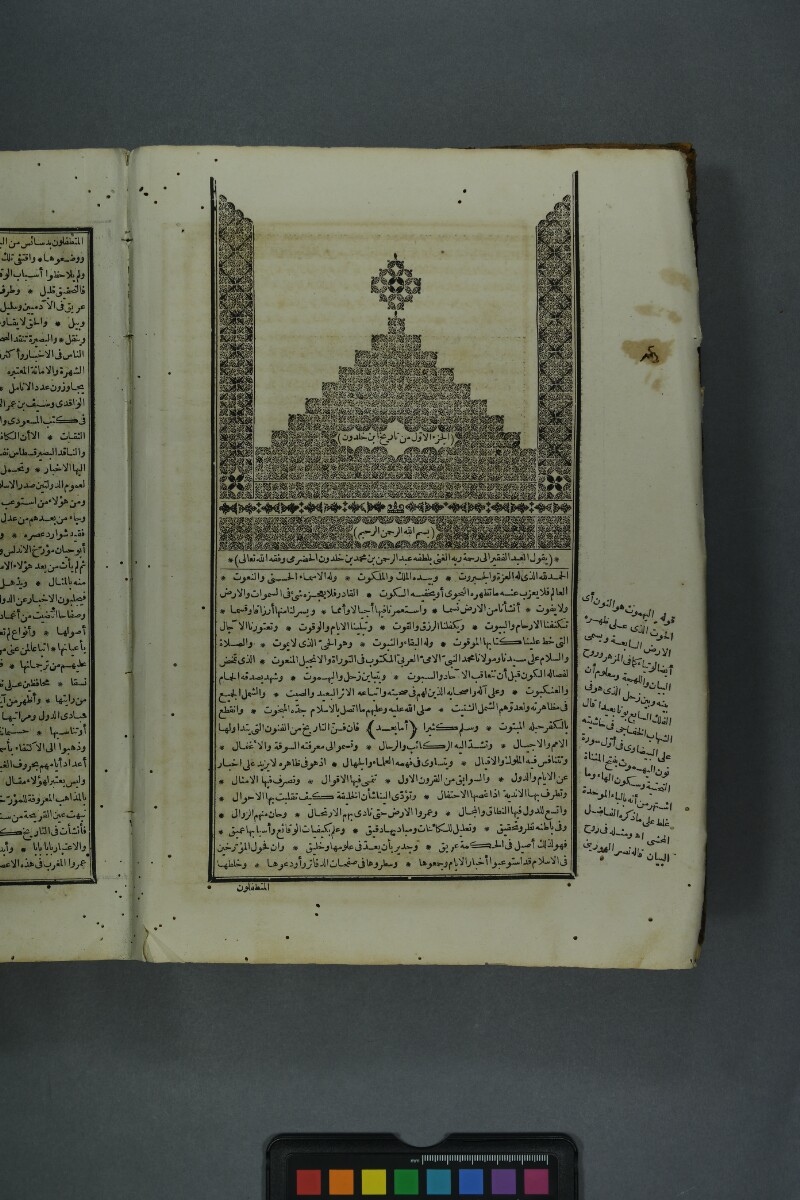
The Tunisian lithograph reproduced on the cover of this edition, dated Ṣafar 1274 AH (c. September 1857 CE) and prepared by the scribe Nasr al-Hurini, falls almost precisely contemporaneous with these first printed editions, representing the moment at which the Muqaddimah began its transition from a text circulating in hand-copied manuscripts to one available in the standardised, widely distributed form that enabled its modern reception. The lithograph medium — which reproduced a calligrapher's handwriting photographically rather than setting it in type — preserved the character of the manuscript tradition while multiplying copies on a scale no scriptorium could match.
This Translation
The translation is that of Franz Rosenthal (31 August 1914 – 8 April 2003), Sterling Professor Emeritus of Arabic at Yale University, one of the most accomplished Arabists of the twentieth century and, as his Yale colleagues observed at his death, among the last of a distinguished generation of scholars exiled from his homeland by Nazism. Born in Berlin in 1914 into a Jewish family, Rosenthal received his doctorate from the University of Berlin in 1935, fled to England in 1939, and came to the United States in 1940. During the Second World War he worked on Arabic translations for the Office of Strategic Services. He joined Yale in 1956 and became Sterling Professor of Arabic in 1967.
For the Muqaddimah translation, Rosenthal traveled to Istanbul and studied the manuscripts there, among them Ibn Khaldun's autographed copy. The three-volume translation, published as Bollingen Series XLIII by Pantheon Books, New York, in 1958 — the same year Rosenthal's History of Muslim Historiography appeared — was the first complete English rendering of the Muqaddimah and was received immediately as a landmark of Orientalist scholarship. A second edition, with corrections and an augmented bibliography, was published by Princeton University Press in 1967. An abridged one-volume edition, prepared by N. J. Dawood, appeared in 1969 and has remained the standard accessible version. Rosenthal's annotated three-volume edition remains, more than sixty years after its publication, the standard scholarly text. The translation is in copyright.
FULL TEXT
Author's Preface
[The Muqaddimah opens after the basmala — the invocation بسم الله الرحمن الرحيم ('In the name of God, the Most Gracious, the Most Merciful') — with Ibn Khaldun's formal announcement of himself and his project. What follows paraphrases the opening of Rosenthal's translation of the author's preface and preliminary discussions.]
I. The author speaks: Abd al-Rahman ibn Khaldun, may God grant him success. Know that the writing of history is a discipline with a noble purpose and many uses. Through it, knowledge of the conditions of past nations is conveyed to us in the character of their peoples and the biographies of their prophets, and in the dynasties and policies of their rulers — so that those who seek to emulate what is good in the past may have guidance, and those who would avoid what was harmful may have warning. History requires many sources and varied knowledge; it requires a sound mind to lead the enquirer to truth and save him from errors and stumbling.1
II. But most historians have been negligent in their work. The errors that corrupt historical records are many, and they creep in by several routes. There is the tendency to accept what has been transmitted without examining whether it is plausible. There is the inclination to favour those in power, and to record what flatters them. There is the ignorance of how civilisation actually works — of the transformations that come upon human conditions, so that the historian projects the present onto the past and supposes that things were always as they are now. There is, too, the appetite for the marvellous and the strange, which leads people to repeat whatever is surprising without asking whether it could be true.2
III. The antidote to these errors is a science. When the historian knows the nature of human civilisation — the conditions of human social organisation, of political authority, of livelihood, of the crafts and sciences, and all the other conditions that arise from the nature of human society — then the historian possesses a standard by which reports can be tested. Whatever conforms to the nature of civilisation may be accepted; whatever contradicts it may be doubted and examined further. This is the science I have undertaken in the present work: the science of human civilisation, of 'umran. It is a science new and original, as far as I know, a discipline that no previous thinker has isolated and made the subject of independent investigation.3
Bibliography
Rosenthal, Franz, trans. The Muqaddimah: An Introduction to History. 3 vols. Bollingen Series XLIII. New York: Pantheon Books, 1958. Second edition with corrections: Princeton: Princeton University Press, 1967.
Dawood, N. J., ed. (abridged). The Muqaddimah: An Introduction to History. Princeton: Princeton University Press, 1969. New edition with introduction by Bruce B. Lawrence, 2004.
Ibn Khaldun. Muqaddimah. Ed. Étienne Marc Quatremère. 3 vols. Paris, 1858.
De Slane, William MacGuckin, trans. Les Prolégomènes d'Ibn Khaldoun. 3 vols. Notices et extraits des manuscrits de la Bibliothèque nationale 16–21 (1844–1862).
Rosenthal, Franz. A History of Muslim Historiography. Leiden: Brill, 1952. Second revised edition, 1968.
Mahdi, Muhsin. Ibn Khaldun's Philosophy of History. London: George Allen and Unwin, 1957.
Lacoste, Yves. Ibn Khaldoun: naissance de l'histoire, passé du tiers monde. Paris: Maspero, 1966. Translated by David Macey as Ibn Khaldun: The Birth of History and the Past of the Third World. London: Verso, 1984.
Al-Azmeh, Aziz. Ibn Khaldūn: An Essay in Reinterpretation. London: Frank Cass, 1982.
Irwin, Robert. Ibn Khaldun: An Intellectual Biography. Princeton: Princeton University Press, 2018.
Footnotes
-
The opening announcement of the Muqaddimah is both a formal Islamic statement of identity — the scholar identifying himself before God and the reader — and a statement of disciplinary ambition. By positioning his work as a corrective to a corrupt tradition, Ibn Khaldun is doing something intellectually aggressive: he is announcing that previous historians have failed and that he has a method that can succeed. ↩︎
-
The enumeration of historical errors in the preliminary discussions of the Muqaddimah is one of the earliest and most sophisticated exercises in the critical evaluation of historical sources in any intellectual tradition. Ibn Khaldun's analysis anticipates — and in some cases surpasses — the source-critical methods developed by European historians from the sixteenth century onward. His insistence that the historian must understand the nature of the world being described before accepting reports about it is the germ of what would later be called the sociology of knowledge. ↩︎
-
The claim to originality is one Ibn Khaldun makes explicitly and repeatedly. The science of 'umran — human civilisation as a proper object of systematic enquiry — had, he insists, no predecessor. Whether this claim is entirely accurate has been debated by scholars of Islamic intellectual history, but there is broad agreement that nothing quite like the Muqaddimah existed before it: not in scope, not in method, and not in the ambition to derive general laws of social behaviour from the observation of historical patterns. ↩︎