ARISTOTLE
Parts of Animals · Movement of Animals · Progression of Animals
Parts of Animals translated by A. L. Peck
Movement of Animals and Progression of Animals translated by E. S. Forster
INTRODUCTION
Aristotle (384–322 BCE) is the most prolific natural scientist of the ancient world, and the biological treatises gathered in this Loeb volume represent the part of his output that most clearly displays that distinction. He was born at Stagira in Chalcidice, the son of Nicomachus, who served as physician to King Amyntas of Macedon, and his early exposure to a medical household may have shaped the empirical and anatomical orientation of his later scientific work. At eighteen he joined Plato's Academy in Athens and remained there for twenty years, until Plato's death in 347. He then spent approximately five years at Assos and on the island of Lesbos — years that represent the most intensive period of his biological fieldwork — before being called to Macedon to tutor the young Alexander. He returned to Athens in 335 and founded the Lyceum, the school whose name would become synonymous with his philosophical tradition, and there taught and wrote until forced to leave for Chalcis in 323, where he died the following year.
The biological treatises — the Historia Animalium (History of Animals), the De Partibus Animalium (Parts of Animals), the De Generatione Animalium (Generation of Animals), the De Motu Animalium (Movement of Animals), and the De Incessu Animalium (Progression of Animals) — together constitute what has been called the first systematic zoology in any language. Aristotle observed, described, and in many cases dissected some five hundred species; his account of the development of the chick embryo was not bettered until the seventeenth century; his description of the placenta of the smooth dogfish (Mustelus laevis) was confirmed by modern naturalists only in the nineteenth. The biologist D'Arcy Wentworth Thompson, who reviewed this very Loeb volume in The Classical Review, described Aristotle as "incomparably the greatest naturalist of antiquity" and as a figure whose scientific imagination ran consistently ahead of his means of verification.
The three texts in Loeb 323 form a philosophically and empirically interlocking set. Parts of Animals examines why animals have the parts they have — addressing method as much as substance, and offering the most developed statement in Aristotle's work of the role of teleological explanation in natural science. Movement of Animals turns to the general causes of locomotion at the level of soul and body: what makes an animal move at all, and how the soul's desire is converted into the body's motion. Progression of Animals examines how that motion is realised in practice across the full diversity of the animal kingdom — why some animals have four limbs and some two, why snakes can move without any limbs at all, what principles govern the geometry of the body in locomotion.
The Texts in This Volume
De Partibus Animalium (Parts of Animals, PA) consists of four books. Book I stands apart from the rest: it is a sustained methodological argument for the proper conduct of biological inquiry, and it is one of the most important philosophical texts in Aristotle's entire corpus. Its central claims are that natural science must appeal to final causes — to the purposes that parts serve — and not merely to material or efficient ones; that the form of a living thing, not its matter, is what the biologist must primarily understand; and that the study of animals, however humble their subject matter, is a form of rational enquiry that deserves the same dignity as the study of the stars. The famous argument of PA I.5 — that even animals whose parts seem unpleasant to examine deserve the naturalist's attention, because everywhere in nature there is something of wonder — encapsulates the spirit of the whole biological programme.
Books II through IV carry out the programme in practice. They move systematically through the parts that are common to all blooded animals — blood, bones, flesh, marrow, fat — and then through the principal organs and their functions: brain, heart, lungs, liver, spleen, kidneys, bladder, stomach, intestines. They examine the blood vessels in detail, discuss the anatomy of sense organs, and then move outward through the external parts and their variation across species. The governing question throughout is not merely what each part is, but what it is for: the heart is the seat of the vital heat; the lung is for cooling; the spleen is what it is because the liver requires a counterpart. The teleological architecture is pervasive and explicit, grounded in the principle that nature does nothing in vain.
De Motu Animalium (Movement of Animals, MA) is a short but philosophically rich work of eleven chapters that addresses a question of great generality: what is the proximate cause of animal locomotion? Aristotle's answer draws together elements from his psychology, his physics, and his biology into an account of how desire (orexis) — which is always directed at some imagined or perceived object — produces alterations in the central organ that are converted by the vital pneuma into the mechanical movements of the limbs. The unmoved mover is invoked, at the level of cosmology, as the ultimate explanation for why the universe contains movement at all; but the immediate explanation for why this animal moves now is the animal's own desire and the physical chain of events it initiates.
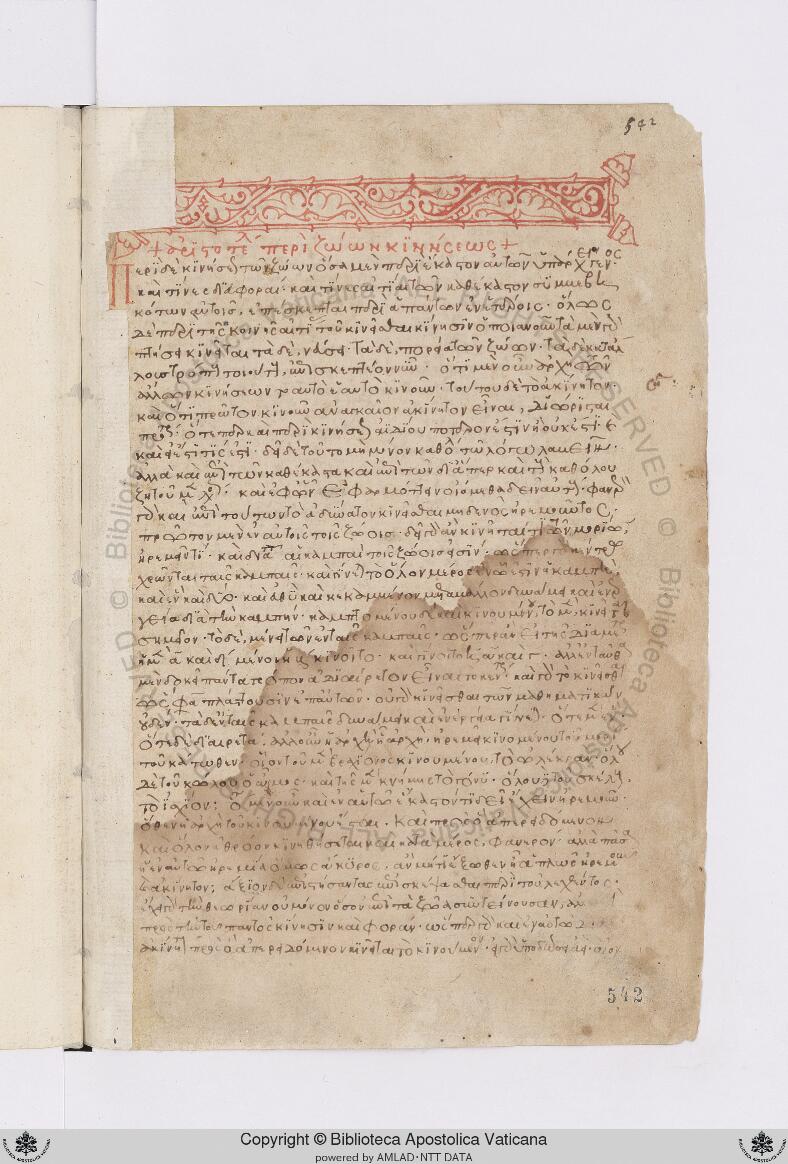
The De Motu was for a long time considered of doubtful authenticity — a note in the Loeb volume records that it "has been generally considered a spurious work, though recent opinion has favoured its genuineness" — and the debate continued through the twentieth century. The 2023 critical edition by Oliver Primavesi firmly establishes the text's authenticity and its place in the Aristotelian corpus, treating it as a key link between Aristotle's psychology in the De Anima and the practical biology of the Progression. The text appears in Vat. gr. 1950 at fols. 542r–545v, the same fourteenth-century Byzantine codex that preserves the only complete text of Marcus Aurelius's Meditations — the opening of its De motu animalium section being the folio reproduced on the cover of this edition.
De Incessu Animalium (Progression of Animals, IA) consists of nineteen chapters addressing the empirical diversity of animal locomotion: why do animals that move need at least two points of support? Why is the number of limbs always even? Why do blooded animals have at most four limbs, while bloodless animals may have more? Why can snakes, eels, and worms move without limbs at all? The answers draw on both mechanical and teleological considerations — on what the geometry of locomotion requires and on what nature, given its materials, can achieve. The Progression is in some ways the most concrete of the three texts, its arguments rooted in observation of how animals actually hold and move their bodies, and it provides an illuminating companion to the more abstract treatment of locomotion in the Movement.
Aristotle and the Biological Sciences
The significance of the biological works extends well beyond their content. In methodology, they represent Aristotle's fullest application of the principle that understanding requires not just description of what is the case but explanation of why it must be so — and specifically the claim that in the case of living things, the teleological explanation (in terms of function and purpose) is irreducible to purely mechanical terms. This is the central philosophical claim of Parts of Animals Book I, and it has generated continuous debate from antiquity to the present: whether Aristotle's teleology implies conscious design, whether it is compatible with Darwinian natural selection, and whether functional explanation in biology is genuinely distinct from causal explanation.
In practice, the biological works display an empirical rigour that has repeatedly surprised modern scientists reading them carefully. Aristotle's account of the four-chambered heart (though he misidentified the number of ventricles), his description of the function of the epiglottis, his account of cephalopod anatomy — in particular the hectocotylus arm of the octopus, whose role in reproduction was disputed until the nineteenth century — all represent genuine observational achievement. His mistakes are equally instructive: his insistence that the brain is a cooling organ for the blood, while the heart is the seat of intelligence, reflects the limits of observation without dissection of the nervous system.
The biological works were almost unknown in the Latin West through the early medieval period, surviving only in fragments and summaries. Their recovery came first through Arabic: the ninth-century Baghdad translators rendered the Historia Animalium and related texts into Arabic, from which Michael Scot produced the Latin translations that made Aristotle's biology available to Albert the Great and thence to the wider scholastic tradition in the thirteenth century. Direct translations from the Greek, by William of Moerbeke, followed shortly after. The first printed edition of the biological works in any language was Theodorus Gaza's Latin translation of 1476 (Venice: Johann de Colonia and Johannes Manthen); the first Greek text appeared in the Aldine Aristotle of 1497–98.
Transmission
The transmission of the biological works is considerably more complex than that of Aristotle's logical or ethical treatises, partly because the texts themselves constitute a large corpus and partly because their medieval reception proceeded through two largely independent channels — the Arabic and the Greek — before converging in the Renaissance.
The manuscript tradition of De Partibus Animalium alone runs to some fifty Greek codices, an Arabic translation from the ninth century, and two medieval and two Renaissance Latin translations, all of which require consideration for establishing the text. The reconstruction of the stemma reveals two lost late-antique hyparchetypes (designated α and β) whose readings are recoverable through the agreement of independent witnesses. The De Motu Animalium, meanwhile, is preserved in forty-seven known Greek manuscripts, a number that reflects its transmission in close association with the De Incessu and with the broader Aristotelian corpus in both Byzantine and Latin traditions.
The standard modern critical text for most of the biological works is that of Immanuel Bekker (Berlin, 1831), whose edition established the reference system — work, book, chapter, and Bekker number — used in all modern scholarship. For De Partibus Animalium, the Teubner text of Hermann Joachim Dittmeyer (1907) and the Budé edition of Pierre Louis (1956) have served as critical baselines; the manuscript tradition is now the subject of a comprehensive new study by Peter Isépy (De Gruyter, 2026). For De Motu Animalium, the 2023 Oxford edition by Oliver Primavesi represents the most thorough critical text yet produced, collating all forty-seven known manuscripts against each other and against the Latin tradition.
The Vatican manuscript Vat. gr. 1950 — the same fourteenth-century Byzantine codex that preserves the only complete text of Marcus Aurelius's Meditations (fols. 341r–392v) and whose fol. 542r is reproduced on the cover of this edition — is one such witness, transmitting the De motu animalium at fols. 542r–545v within a large philosophical miscellany that passed to the Biblioteca Apostolica Vaticana from Stefano Gradi's collection in 1683. That a single Byzantine codex should contain both Marcus Aurelius's private Stoic notebook and Aristotle's treatise on animal locomotion is a reminder of how capaciously the Byzantine scholarly tradition drew on the classical inheritance.
This Translation
Parts of Animals is translated by Arthur Leslie Peck (1902–1974), Fellow of Christ's College, Cambridge. Peck brought to the biological texts a combination of philosophical precision and scientific alertness unusual among classical translators of his generation; his introduction to Parts of Animals in this volume, running to over a hundred pages, is a major scholarly document in its own right, addressing the teleological methodology of Book I in depth and providing a systematic account of Aristotle's biological terminology. His translation is accompanied by the Greek text on facing pages, following the standard Loeb format.
Movement of Animals and Progression of Animals are translated by Edward Seymour Forster (1879–1950), Lecturer in Classics at the University of Sheffield, who also contributed translations to other Loeb Aristotle volumes. His versions of the two shorter texts are careful and readable, though the Movement of Animals in particular has benefited from more recent critical and philosophical attention — especially Martha Nussbaum's 1978 edition with essays and commentary (Princeton University Press), which transformed the scholarly reception of the text and whose discussion of the relationship between the Movement and Aristotle's broader psychology remains essential reading.
The volume was published by William Heinemann (London) and Harvard University Press (Cambridge, MA) in 1937. It is Loeb Classical Library 323. The translation is in copyright.
FULL TEXT
Parts of Animals · Book I
[Book I of the Parts of Animals is not a study of animal parts but a methodological prolegomenon to the whole biological programme. Chapter 1 opens by identifying the two kinds of competence a student of any subject should possess, before arguing for the distinctiveness and dignity of teleological explanation in natural science. The Bekker reference for the opening of Book I is 639a1.]
THERE are, as it seems, two ways in which a person may be competent in respect of any study or investigation, whether it be a noble one or a humble: he may have either what can rightly be called a scientific knowledge of the subject; or he may have what is roughly described as an educated person's competence, and therefore be able to judge correctly which parts of an exposition are satisfactory and which are not. That, in fact, is the sort of person we take the "man of general education" to be; his "education" consists in the ability to do this. In this case, however, we expect to find in the one individual the ability to judge of almost all subjects, whereas in the other case the ability is confined to some special science; for of course it is possible to possess this ability for a limited field only. Hence it is clear that in the investigation of Nature, or Natural science, as in every other, there must first of all be certain defined rules by which the acceptability of the method of exposition may be tested, apart from whether the statements made represent the truth or do not. I mean, for instance, should we take each single species severally by turn (such as Man, or Lion, or Ox, or whatever it may be), and define what we have to say about it, in and by itself; or should we first establish as our basis the attributes that are common to all of them because of some common character which they possess?—there being many attributes which are identical though they occur in many groups which differ among themselves, e.g. sleep, respiration, growth, decay, death, together with those other remaining affections and conditions which are of a similar kind. I raise this, for at present diseussion of these matters is an obseure business, lacking any definite scheme. However, thus much is plain, that even if we discuss them species by species, we shall be giving the same descriptions many times over for many different animals, since every one of the attributes i mentioned occurs in horses and dogs and human beings alike. Thus, if our description proceeds by taking the attributes for every species, we shall be obliged to describe the same ones many times over, namely, those which although they occur in different species of animals are themselves identical and present no difference whatever. Very likely, too, there are other attributes, which, though they come under the same general head, exhibit specific differences; -for example, the locomotion of animals: of which there are plainly more species than one—e.g. flight, swimming, walking, creeping.
Bibliography
Peck, A. L., trans. Aristotle: Parts of Animals. Forster, E. S., trans. Movement of Animals. Progression of Animals. Loeb Classical Library 323. London: William Heinemann; Cambridge, MA: Harvard University Press, 1937.
Bekker, Immanuel, ed. Aristotelis Opera. 2 vols. Berlin: Reimer, 1831.
Dittmeyer, Hermann Joachim, ed. Aristotelis De Animalibus Historia. Leipzig: Teubner, 1907.
Louis, Pierre, ed. and trans. Aristote: Les Parties des animaux. Paris: Les Belles Lettres (Budé), 1956.
Nussbaum, Martha C., ed. Aristotle's De Motu Animalium: Text with Translation, Commentary, and Interpretive Essays. Princeton: Princeton University Press, 1978.
Primavesi, Oliver, ed. Aristotle, De Motu Animalium: A New Critical Edition of the Greek Text. Trans. Benjamin Morison. Oxford: Oxford University Press, 2023.
Isépy, Peter. A Study on the Manuscript Transmission of Aristotle, De partibus animalium I: With a New Text Based on the Entire Greek, Arabic and Latin Tradition. Berlin: De Gruyter, 2026.
Balme, D. M., ed. and trans. Aristotle: De Partibus Animalium I and De Generatione Animalium I. Oxford: Clarendon Press, 1972.
Thompson, D'Arcy Wentworth. Review of Loeb Classical Library 323. The Classical Review 52.1 (1938): 14–16.
Lennox, James G. Aristotle's Philosophy of Biology: Studies in the Origins of Life Science. Cambridge: Cambridge University Press, 2001.
Footnotes