BOETHIUS
The Theological Tractates · The Consolation of Philosophy
Theological Tractates translated by H. F. Stewart and E. K. Rand
Consolation of Philosophy in the English translation of "I. T." (1609), revised by H. F. Stewart
INTRODUCTION
Anicius Manlius Severinus Boethius was born around 477 CE into one of the oldest and most distinguished families of the Roman senatorial aristocracy, the Anicii, whose lineage stretched back through consuls and emperors to the earliest centuries of the Republic. He was raised in the household of Symmachus — himself a scion of a family whose name recalled the great fourth-century pagan senator who had argued with Ambrose over the Altar of Victory — and later married Symmachus's daughter Rusticiana. His education was thorough and ambitious: he read Greek with rare facility in a Latin West where that competence was rapidly disappearing, and he set himself a project of unusual scope — the translation into Latin of the entirety of Aristotle's logical works, along with Plato's dialogues, followed by a demonstration that the two philosophers' thought was fundamentally in agreement. He completed the Aristotle translation in full; the Plato translation was never begun.
Under Theodoric the Ostrogoth, who ruled Italy from Ravenna as the representative of an arrangement with the emperor in Constantinople that satisfied nobody and was always understood to be temporary, Boethius rose to the summit of available honours. He saw his two sons both appointed consuls simultaneously in 522 — an occasion he described, in a passage of the Consolation written from prison, as the happiest day of his life. In the same year he himself was appointed magister officiorum, the chief administrative officer of Theodoric's court. The following year he was arrested.
The charges against him, as they appear in the surviving sources, combined accusations of treason against Theodoric with accusations of complicity with the Emperor in Constantinople in schemes against Ostrogothic rule in Italy. Whether any of these accusations had substance is impossible now to determine. Boethius maintained in the Consolation, written in prison at Pavia while awaiting a verdict that was not in doubt, that he was innocent; and the dignity with which the Consolation presents its argument has persuaded most subsequent readers to take this at face value. He was executed in 524, probably by being clubbed to death — a method of execution reserved for those whose high rank spared them the sword but not the violence. Symmachus was killed shortly after.
The Theological Tractates
The five opuscula sacra — the short theological treatises gathered as the first part of this Loeb volume — are unlike almost everything else that survives from the period. They are the work of a man who was simultaneously a professional philosopher in the late Platonic tradition and a Christian who took the theological controversies of his day seriously enough to bring philosophical argument to bear on them. The combination was not unprecedented — the tradition of Latin Christian Platonism runs through Augustine — but the manner was new: terse, technically precise, dependent on categories drawn from Aristotle's logic rather than the rhetoric of the sermon or the exegetical tradition.
Tractate I (De Trinitate) addresses the Trinity not through Scripture or patristic authority but through the Aristotelian analysis of substance and predication. If God is one, how can the three persons of the Trinity be meaningfully distinguished? The answer draws on the Categories: the distinction between absolute and relative predication means that "Father," "Son," and "Spirit" can be genuinely distinct without implying separate substances. The argument is dense and has been both celebrated and criticised — celebrated for its rigour, criticised for importing philosophical categories that, as later scholastics would discover, bring their own difficulties.
Tractate II (Utrum Pater et Filius et Spiritus Sanctus de Divinitate Substantialiter Praedicentur) extends the analysis of predication in the Trinity, asking whether the three names are predicated of the divine substance or of something else.
Tractate III (De Hebdomadibus, or Quomodo Substantiae in eo quod Sint Bonae Sint cum non Sint Substantialia Bona) is in some respects the most purely philosophical of the five. It addresses a paradox latent in Christian Platonism: if the highest good is God, and creatures participate in the good, are they good in the same sense that God is good? The answer introduces the famous regulae — axiomatic propositions from which the argument proceeds — in a manner that anticipates the formal deductive methods of scholastic theology. Thomas Aquinas commented on this tractate at length.
Tractate IV (De Fide Catholica) is a straightforward statement of Catholic Christian belief whose authorship has sometimes been questioned — it is less technically philosophical than the others — but which is now generally accepted as genuine.
Tractate V (Contra Eutychen et Nestorium) engages the Christological controversies of the fifth century, defending the Chalcedonian definition of Christ's two natures against both the Nestorian insistence on separation and the Eutychian insistence on fusion. It is the most explicitly polemical of the five, and its careful analysis of the terms person and nature — persona and natura — contributed definitions that remained standard in Western theology for centuries.
The 1918 Loeb translation of the Theological Tractates by Stewart and Rand, which drew extensively on the medieval commentaries of John Scottus Eriugena and Gilbert de la Porrée, was the first complete English rendering of these texts.
The Consolation of Philosophy
The Consolatio Philosophiae was composed in prison, in Pavia, in the months between Boethius's arrest and his execution. It is written in the form of a prosimetrum — alternating sections of prose and verse, a form derived from the Menippean satire tradition and used by Martianus Capella in the generation before Boethius — and it is, as has often been observed, among the most unusual objects in world literature: a deeply learned, formally elaborate philosophical dialogue composed by a man who knew he was going to die.
The work opens with Boethius writing elegiac verses lamenting his fall from fortune's favour when a woman of majestic appearance — Lady Philosophy, the embodiment of philosophy itself — appears at his prison cell. She dismisses the Muses of poetry who have been assisting his lament as parasites on genuine misery, and begins the long course of instruction that constitutes the five books of the Consolation. The progression is carefully structured. Philosophy first diagnoses Boethius's condition — he has forgotten what he truly is and what constitutes true happiness — and then begins the treatment, moving from a discussion of Fortune and her wheel through an analysis of true and false goods, an account of Providence and its relationship to human suffering, and finally a treatment of free will and divine foreknowledge that constitutes the philosophical climax of the work.
Book I establishes the situation: the appearance of Philosophy, the diagnosis of Boethius's confusion, and Philosophy's initial comfort.
Book II contains the most celebrated section of the Consolation: Philosophy's personification of Fortune speaking in her own voice. What has Fortune done to Boethius that she has not done to countless others? Fortune's very nature is to turn — the wheel, the most famous image associated with Boethius throughout the medieval period, is her defining attribute. The goods she distributes — wealth, power, reputation, the simultaneous consulship of two sons — are not real goods, and their loss is accordingly not a real injury. The book closes with an extended discussion of what genuine happiness requires and why it cannot be found in any external thing.
Book III moves to the highest philosophical argument: where is the true good to be found? All human striving for wealth, power, fame, pleasure, and honour is striving, however misdirected, for the one thing — the summum bonum — that alone constitutes genuine happiness. That one thing is God, in whom all partial goods find their unity and from whom all created goods derive whatever reality they possess.
Book IV confronts the apparent injustice of providence: if God governs the universe and the good is always rewarded while evil is always punished, why do the wicked prosper and the good suffer? The answer turns on the Platonic argument that virtue is its own reward and vice its own punishment — the wicked are punished by becoming more thoroughly what they are — and on an account of how providence, seen from within time, appears as fate, while seen from the divine perspective it is perfectly ordered.
Book V addresses the problem of free will and divine foreknowledge: if God knows what we will do before we do it, how can our choices be genuinely free? Boethius's answer — one of the most celebrated in the history of philosophy — distinguishes between the mode of knowing and the mode of being known. God's knowledge is eternal, not merely everlasting: it is not a temporal foreknowledge but a present awareness of all times at once, from a standpoint outside time. Our choices are free because they are genuinely ours; God's knowledge of them does not constrain them any more than our knowledge of a present event constrains the event.
The Consolation raises, and has always raised, a question that the text itself refuses to resolve directly: where is Christianity? Boethius was a Christian, the Theological Tractates are explicitly Christian, and the Consolation is addressed to a Christian man facing a Christian death. Yet the Consolation invokes no scripture, no Christ, no resurrection. Philosophy speaks the language of Plato and the Stoics, not of the Gospels or the Epistles. Whether this represents a deliberate philosophical choice — a demonstration that reason alone can bring a person to the threshold of divine truth — or a significant omission, is a question that has divided readers from the Carolingian period to the present.
Boethius Between Antiquity and the Middle Ages
Boethius has been called, with some justice, the last of the Romans and the first of the scholastics. The first title reflects his situation: his translations of Aristotle's logical works, his commentaries on Porphyry and on Cicero, his own logical treatises, and the Consolation itself are all, in different ways, attempts to preserve the inheritance of ancient philosophy and transmit it to a Latin-speaking world that was losing its access to Greek. The second title reflects the consequence: the categories and methods he preserved and the problems he formulated — above all, the problem of universals implicit in his commentary on Porphyry, and the problem of free will and foreknowledge in the Consolation — became the foundational problems of Latin scholastic philosophy.
The influence of the Consolation specifically is difficult to overstate. It was read, glossed, copied, and translated throughout the medieval period with an intensity matched only by the Bible and a small number of major patristic texts. King Alfred of Wessex translated it into Old English in the late ninth century, adapting it for an Anglo-Saxon Christian readership. Notker Labeo translated it into Old High German around 1000 CE. Chaucer translated it — Boece — in the fourteenth century and drew on it repeatedly in the Troilus and Criseyde and the Canterbury Tales. Dante placed Boethius in the Heaven of the Sun alongside Thomas Aquinas and other great intellects. Jean de Meun incorporated a substantial portion into the Roman de la Rose. Elizabeth I made her own translation in the last years of her life, completing it in a very short time as a demonstration of her facility with Latin.
Transmission
The manuscript tradition of the Consolation of Philosophy is among the richest and most complex in Latin literature: more than four hundred manuscripts survive, distributed across libraries throughout Europe, from the Carolingian period to the Renaissance. The oldest witnesses date to the ninth century; the text was clearly being copied within a generation or two of Boethius's death and remained in continuous circulation thereafter.
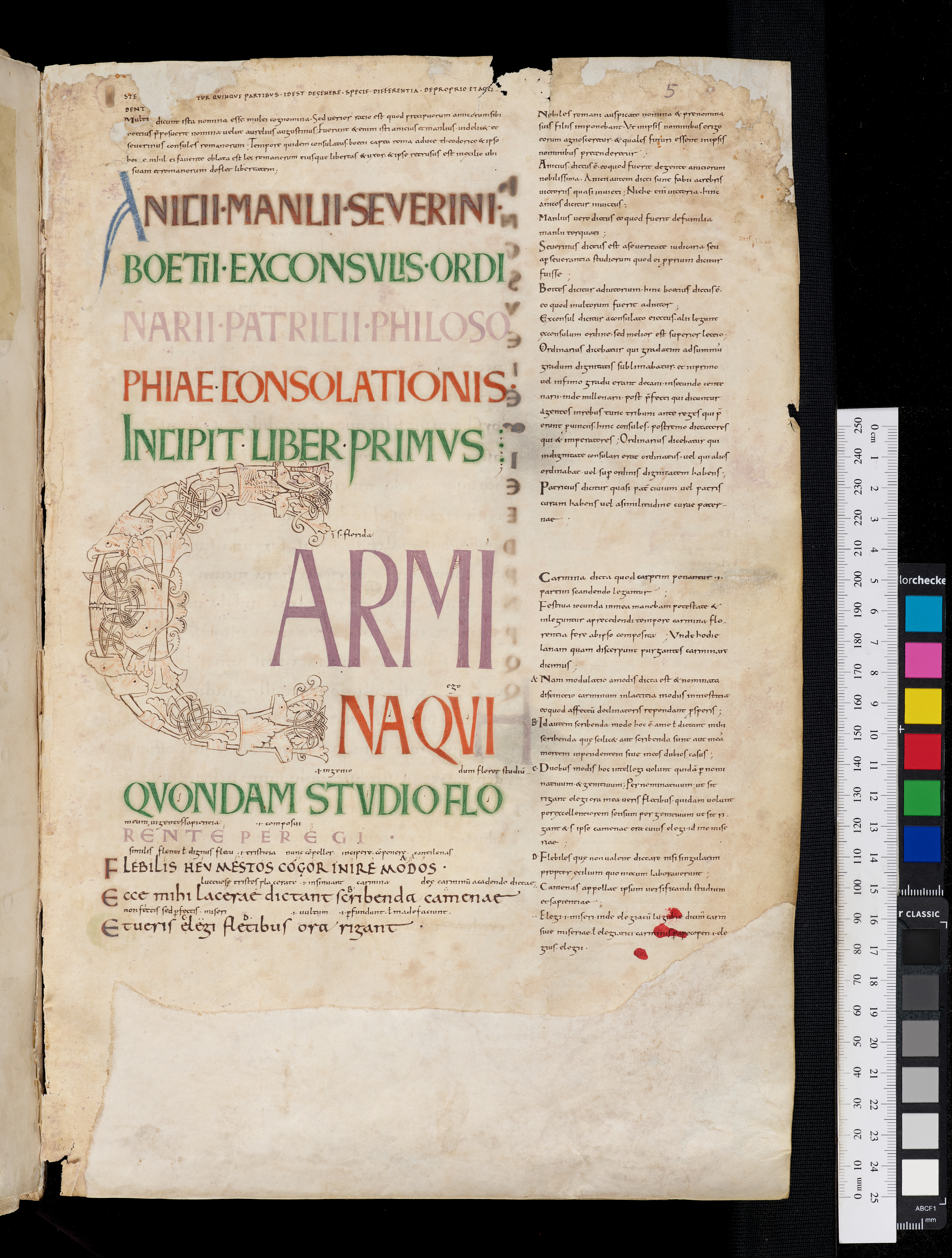
The manuscript reproduced on the cover of this edition, Oxford, Bodleian Library, MS. Auct. F. 1. 15, is among the older surviving English copies. Written at the Abbey of St. Augustine's in Canterbury in the late tenth century, it preserves the text with commentary and gloss — the format through which the Consolation was primarily received in the Carolingian and immediately post-Carolingian period, as teachers surrounded the central text with the accumulated interpretive apparatus of Remigius of Auxerre and others. The manuscript subsequently entered the collection of Bishop Leofric of Exeter (d. 1072), who gave it to Exeter Cathedral Library — the same act of benefaction through which the Exeter Book, the largest surviving collection of Old English poetry, passed into cathedral care. It came to the Bodleian Library in 1602 as part of the gift of the Dean and Chapter of Exeter, making it one of the library's earliest acquisitions.
The text used in preparing the Loeb edition rests on Rudolf Peiper's Teubner edition (Leipzig, 1871) for the Consolatio and on the editorial work of Rudolf Schurr and earlier scholars for the Tractates. The standard modern critical text is that of Ludwig Bieler in the Corpus Christianorum, Series Latina, xciv (Turnhout, 1957).
This Translation
The Theological Tractates are translated by H. F. Stewart (Hugh Fraser Stewart, 1863–1948), Fellow of Trinity College, Cambridge in 1918, later Fellow and Dean of St John's College, Cambridge, and E. K. Rand (Edward Kennard Rand, 1871–1945), Professor of Latin at Harvard University. Rand was one of the foremost Boethius scholars of the early twentieth century, whose Founders of the Middle Ages (1928) remains a classic account of the late antique intellectual tradition. The 1918 Stewart-Rand translation of the Tractates, which drew extensively on the commentaries of John Scottus Eriugena and Gilbert de la Porrée, was the first complete English rendering.
The Consolation of Philosophy is presented in the English translation attributed to "I. T." (1609), revised by H. F. Stewart. The 1609 translation, whose author's full identity has not been definitively established — the initials alone appear on the title page — is a rendering in the Elizabethan-Jacobean literary idiom, mixing prose and verse, that captures something of Boethius's own alternation between the two registers. Stewart's revision brings the language closer to early-twentieth-century norms while preserving much of the texture of the original. The decision to revise rather than replace the 1609 translation reflects both its literary quality and its historical position as part of the long English tradition of translating Boethius that runs from King Alfred through Chaucer and Queen Elizabeth I to the present.
The volume was first published by William Heinemann (London) and G. P. Putnam's Sons (New York) in 1918, and reprinted many times. It is Loeb Classical Library 74. The translation is in copyright in its revised form.
FULL TEXT
The Consolation of Philosophy · Book I
[The Consolation opens with Boethius writing verses of lament in his prison cell at Pavia. As he writes, a woman of commanding presence appears — Lady Philosophy herself. The Meters (verse sections) and Proses (prose sections) alternate throughout all five books. The following renders Meter I and the opening of Prose I from the "I. T." translation as revised by Stewart.]
Meter I.
I who once wrote songs with keen delight Am driven now, alas, by grief's hard might To take in hand the melancholy art. Lo, torn Muses tell me what to say, And elegies bedew my face all day With tears that are no fiction of the heart.
These none at least could conquer with affright, Companions of my way by day and night: They were my glory once; they stay with me, An old man now, to witness what I bore. Old age hath come before its time; the more My sufferings hasten what should slowly be.
My head is white before the years have brought Their natural snow; slack skin hangs all distraught Upon these limbs the dry flesh clings to still. Happy is death that in the years of sweet Does not intrude, yet comes the sad to meet And answers to the mourner's prayer and will.
With what deaf ear doth Fortune turn away From wretched men, and will not deign to stay The cruel tide of tears! And yet, I say, While yet she stood and let her fickle wheel Not quite turn round, she nearly broke the seal Of life, the hour so darkened all the day.1
Prose I.
While I was revolving these things within myself and giving vent to my sorrow with the help of my pen, I became aware of a woman standing over me. She was of awe-inspiring height; her eyes were radiant and keen beyond the ordinary power of men, and of a colour to kindle reverence rather than desire; her colour was full of life; and yet she seemed so old that no one could think her of our time. Her stature was of doubtful kind: at one moment she shrank to the size of a common woman, at another she seemed to touch with her crown the very heavens; and when she lifted her head higher still, she penetrated the sky itself and was lost to the sight of men.2
Her robe was made of threads of finest workmanship, of the most delicate material, and these she had woven with her own hands, as I afterwards learned from her own lips. A kind of dinginess had come over it, like a statue long neglected; and at the lower hem could be read the embroidered Greek letter Π, while at the upper Θ — and between the two letters, in the manner of steps, there were certain degrees marked, by which the ascent could be made from the lower letter to the higher.3 Yet violent hands had torn this robe asunder and had seized such pieces as each was able. In her right hand she carried certain writings, and in her left a sceptre.
Bibliography
Stewart, H. F., and E. K. Rand, trans. Boethius: The Theological Tractates. The Consolation of Philosophy. Loeb Classical Library 74. London: William Heinemann; New York: G. P. Putnam's Sons, 1918.
Stewart, H. F., E. K. Rand, and S. J. Tester, trans. Boethius: The Theological Tractates. The Consolation of Philosophy. Revised edition. Loeb Classical Library 74. Cambridge, MA: Harvard University Press, 1973.
Bieler, Ludwig, ed. Anicii Manlii Severini Boethii Philosophiae Consolatio. Corpus Christianorum, Series Latina, xciv. Turnhout: Brepols, 1957.
Rand, Edward Kennard. Founders of the Middle Ages. Cambridge, MA: Harvard University Press, 1928.
Walsh, P. G., trans. Boethius: The Consolation of Philosophy. Oxford: Clarendon Press, 1999.
Relihan, Joel C., trans. Boethius: Consolation of Philosophy. Indianapolis: Hackett, 2001.
Chadwick, Henry. Boethius: The Consolations of Music, Logic, Theology, and Philosophy. Oxford: Clarendon Press, 1981.
Marenbon, John. Boethius. Oxford: Oxford University Press, 2003.
Patch, Howard R. The Tradition of Boethius: A Study of His Importance in Medieval Culture. Oxford: Oxford University Press, 1935.
Gibson, Margaret, ed. Boethius: His Life, Thought and Influence. Oxford: Blackwell, 1981.
Footnotes
-
Meter I of Book I is written in elegiac couplets — the metre of lamentation used by Ovid in his exile poetry — establishing from the outset the literary tradition within which Boethius is writing. The Muses of poetry who accompany his grief and whom Philosophy will shortly dismiss are not merely decorative: they represent the consolation of literary form that Boethius is already using, and which Philosophy will argue is inadequate to genuine philosophical consolation. ↩︎
-
The ambiguous stature of Philosophy — now human-sized, now reaching to the heavens — is a standard attribute of allegorical figures, but it also has specific philosophical meaning: philosophy addresses both the everyday concerns of human life and the highest cosmological and theological questions. The Π and Θ on her robe (see footnote 3) make this explicit. ↩︎
-
The Greek letters Π (pi) and Θ (theta) stand for praktikē (practical philosophy) and theōrētikē (theoretical or contemplative philosophy) respectively — the two divisions of the philosophical life that Boethius inherited from the Platonic tradition. That Philosophy's robe is torn — seized by various hands — alludes to the history of philosophical schools, each of which has claimed some part of the total philosophical inheritance while losing sight of the whole. ↩︎