FOUR COMEDIES OF ARISTOPHANES
Lysistrata · Thesmophoriazusae · Ecclesiazusae · Plutus
Translated by Benjamin Bickley Rogers
The four comedies gathered here trace Aristophanes across the long arc of his career, from the height of Old Comedy in the war years to the threshold of the very different form that would succeed it. The first two belong to a single season: Lysistrata and Thesmophoriazusae were both produced in 411 BCE, at the lowest ebb of Athenian fortunes in the Peloponnesian War, in the months surrounding the oligarchic coup of the Four Hundred. The last two are the latest of Aristophanes's surviving plays — Ecclesiazusae (Assemblywomen, probably 392 BCE) and Plutus (Wealth, 388 BCE) — and they show Old Comedy already dissolving: the chorus receding, the personal and political invective fading, the fantastical premise turning inward toward society and economics rather than outward at named contemporaries. Together they offer a compressed history of the genre, from its most exuberant ferocity to its quieter, more allegorical close.
What binds them, beyond chronology, is a recurring comic instrument: the fantasy of the world turned upside down, and women as the agents of its turning. In Lysistrata, the women of all Greece seize the Acropolis and withhold sex from their husbands until the men make peace — a single outrageous premise pressed to its logical and obscene conclusion, and the most famous antiwar gesture in ancient literature. In Thesmophoriazusae, the women of Athens convene at their festival of Demeter to put the tragedian Euripides on trial for slandering their sex, and Euripides smuggles in a kinsman in drag to plead his case, launching a riot of paratragic parody in which scene after scene of Euripidean tragedy is hijacked for escape. In Ecclesiazusae, the women disguise themselves as men, pack the Assembly, and vote themselves into power, instituting a regime of communal property, communal sex, and the abolition of the household. In Plutus, the premise is economic rather than sexual: the blind god of Wealth has his sight restored, and the consequences of a world in which riches at last reward the deserving rather than the wicked are followed out with deadpan rigor.
Each play stages a thought experiment that is also a joke, and the joke does not exempt the fantasy from scrutiny — the redistributions of Ecclesiazusae and Plutus are dreamed and then deflated, the peace of Lysistrata won only by reducing statecraft to appetite. Aristophanes is at once the great utopian of the Athenian stage and its most unsparing realist about why utopias do not hold. In the four plays here, that double vision finds its fullest range: the sexual politics of the war comedies, the literary self-consciousness of the festival travesty, and the social and economic fantasies of the late work that point ahead, past the death of Old Comedy, toward everything the European comic tradition would become.
Further Reading
Translations
Jeffrey Henderson (Loeb Classical Library, 5 vols., 1998–2007) — the standard modern bilingual edition, with Greek text on facing pages, and the one that supersedes Rogers for scholarly use. These four plays fall across volumes III (Birds, Lysistrata, Women at the Thesmophoria, 2000) and IV (Frogs, Assemblywomen, Wealth, 2002). Henderson is the leading authority on Aristophanic obscenity, and his translations restore the sexual and scatological directness that earlier renderings, Rogers's among them, softened or suppressed.
Alan H. Sommerstein, The Comedies of Aristophanes (Aris & Phillips, 11 vols., 1980–2002) — text, facing translation, and commentary for every surviving play, and the indispensable resource for serious study. The relevant volumes are Lysistrata (1990), Thesmophoriazusae (1994), Ecclesiazusae (1998), and Wealth (2001). Sommerstein's translations are accurate and stage-aware, and his introductions and notes engage closely with textual, historical, and political problems. His selections also appear in more accessible Penguin Classics volumes.
Benjamin Bickley Rogers (Loeb Classical Library, 1924; reprinted) — the translation reproduced here, and the standard English Aristophanes for the first half of the twentieth century. Rogers renders the verse into fluent, metrically inventive English, occasionally into dialect, with real wit; his version of the Spartan choral ode in Lysistrata is justly admired. The price is Edwardian decorum: the obscenity that drives so much of the comedy is paraphrased, euphemized, or omitted, so that the plays read more politely than Aristophanes wrote them.
Stephen Halliwell, Aristophanes: Birds and Other Plays (Oxford World's Classics, 1998) — verse translations of Birds, Lysistrata, Assembly-Women, and Wealth, by a major scholar of Greek comedy. Halliwell combines fidelity to tone with readability and supplies introductions attentive to the formal and theatrical workings of each play; the volume is the best single-volume entry point for these works in English.
Paul Roche, Aristophanes: The Complete Plays (New American Library, 2005) — a complete modern verse translation in a single volume, lively and uninhibited, pitched at the general reader and at performance. Less precise than Henderson or Sommerstein, but useful for reading the eleven plays together and for getting a sense of Aristophanes's range at speed.
Introductions and General Studies
Kenneth Dover, Aristophanic Comedy (California, 1972) — the standard general introduction to the eleven plays, lucid and authoritative, with a chapter on each. Dover's account of the conventions of Old Comedy — its structure, its relationship to the festival, its mode of political reference — remains the foundation on which later criticism builds, and his readings of the individual plays are still routinely cited.
Cedric Whitman, Aristophanes and the Comic Hero (Harvard, 1964) — an influential study organized around the figure of the Aristophanic protagonist and the quality Whitman called ponēria, the resourceful, amoral cunning by which the comic hero overturns the established order. Dated in places, but a genuinely illuminating account of what gives the plays their imaginative shape, and especially suggestive for Lysistrata and the late utopian comedies.
Douglas M. MacDowell, Aristophanes and Athens: An Introduction to the Plays (Oxford, 1995) — a clear, reliable, play-by-play introduction that situates each comedy in its political and historical moment. MacDowell is particularly good on dating, on the contemporary controversies the plays engage, and on the practical realities of Athenian law and politics that the comic fantasies presuppose.
Jeffrey Henderson, The Maculate Muse: Obscene Language in Attic Comedy (Yale, 1975; 2nd ed., Oxford, 1991) — the fundamental study of Aristophanic obscenity, cataloguing and analyzing the sexual and scatological vocabulary that pervades the comedies and that older translations concealed. Essential for Lysistrata and Thesmophoriazusae above all, where the obscene is not ornament but the very engine of the plot.
A. M. Bowie, Aristophanes: Myth, Ritual and Comedy (Cambridge, 1993) — reads the plays through the structures of Greek myth and ritual, arguing that their fantasies are organized by patterns of inversion, festival, and reintegration drawn from religious practice. The chapters on the women's plays — where the action turns on festivals and the suspension of ordinary order — are particularly rewarding.
Lauren K. Taaffe, Aristophanes and Women (Routledge, 1993) — a focused study of the three "women's plays" (Lysistrata, Thesmophoriazusae, Ecclesiazusae), attentive to the fact that these female characters were created by men, performed by men, and watched by a largely male audience. Taaffe analyzes the theatrical mechanics of cross-dressing and impersonation and what they reveal about Athenian anxieties over gender.
Froma Zeitlin, "Travesties of Gender and Genre in Aristophanes' Thesmophoriazousae," in Playing the Other (Chicago, 1996) — the essential reading of the Thesmophoriazusae, analyzing how the play's layered impersonations — men playing women playing the roles of Euripidean heroines — make it a sustained meditation on theatrical illusion, gender, and the nature of mimesis itself. Indispensable for understanding why the play is far more than a string of parodies.
Commentaries
Jeffrey Henderson, Aristophanes: Lysistrata (Oxford, 1987) — the standard scholarly commentary on the play, with introduction, Greek text, and detailed notes. Henderson is authoritative on the play's language and staging and especially on its sexual humor, and his introduction is among the best short accounts of the comedy's politics in the context of 411 BCE.
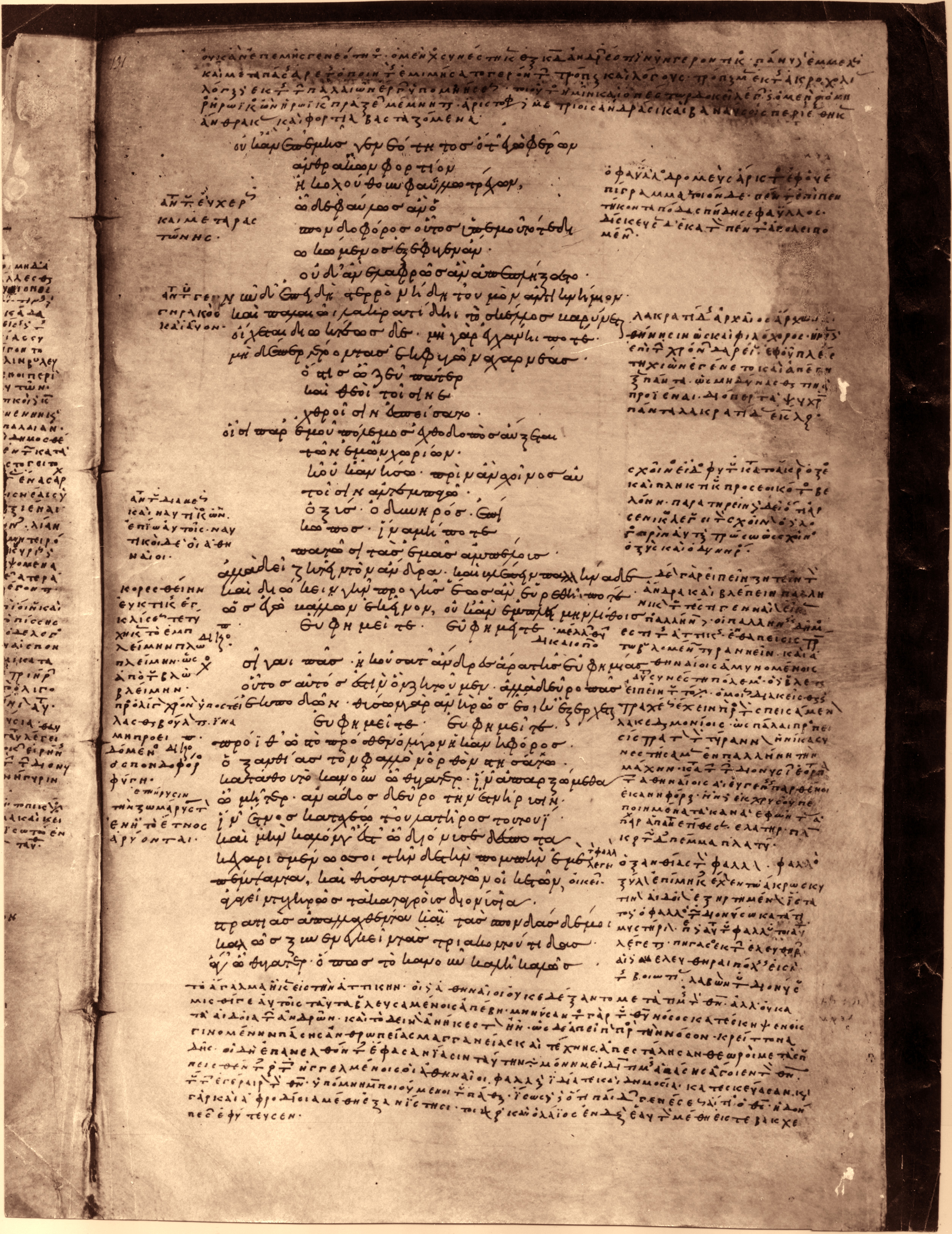
Colin Austin and S. Douglas Olson, Aristophanes: Thesmophoriazusae (Oxford, 2004) — the major modern commentary on the play, exhaustive on text, language, and the dense web of Euripidean parody on which the comedy depends. Where the play's transmission "hangs by a single thread" — the Ravenna manuscript — Austin and Olson are the surest guide to the resulting textual difficulties.
R. G. Ussher, Aristophanes: Ecclesiazusae (Oxford, 1973) — the standard commentary on the Ecclesiazusae, careful on the play's language and metre and on the political and economic fantasy at its center. Ussher's introduction remains a valuable treatment of the play's place at the end of Aristophanes's career and its relation to fourth-century Athenian politics.
Alan H. Sommerstein, Wealth (Aris & Phillips, 2001) — the most useful modern commentary on the Plutus, with facing translation and notes, treating the play's allegorical structure and its standing as the last surviving comedy of Aristophanes and a key witness to the transition toward Middle Comedy. Sommerstein's companion volumes on Lysistrata, Thesmophoriazusae, and Ecclesiazusae make his series the natural starting point for all four plays.
The Plays in Performance and Reception
Gonda Van Steen, Venom in Verse: Aristophanes in Modern Greece (Princeton, 2000) — a landmark study of how Aristophanes has been staged, censored, and mobilized in modern Greek political life, from the nineteenth century through the dictatorship and beyond. Van Steen shows how the comedies' satirical energy made them dangerous and useful to successive regimes, with particular attention to the contested afterlife of Lysistrata.
Edith Hall and Amanda Wrigley, eds., Aristophanes in Performance 421 BC–AD 2007 (Legenda, 2007) — a wide-ranging collection on the performance history of Aristophanic comedy from antiquity to the present, documenting how plays built on topical Athenian reference have been repeatedly reinvented for new audiences. Useful for tracing the modern stage life of these works and the interpretive choices each revival requires.
The Lysistrata Project (2003) — not a book but a phenomenon: on a single day in March 2003, more than a thousand staged readings of Lysistrata took place in some sixty countries as a coordinated protest against the imminent invasion of Iraq. The event crystallized the play's modern identity as the canonical antiwar comedy and is itself now a significant chapter in the reception history, illustrating how completely a 411 BCE sex-strike farce has been absorbed into contemporary political theatre.