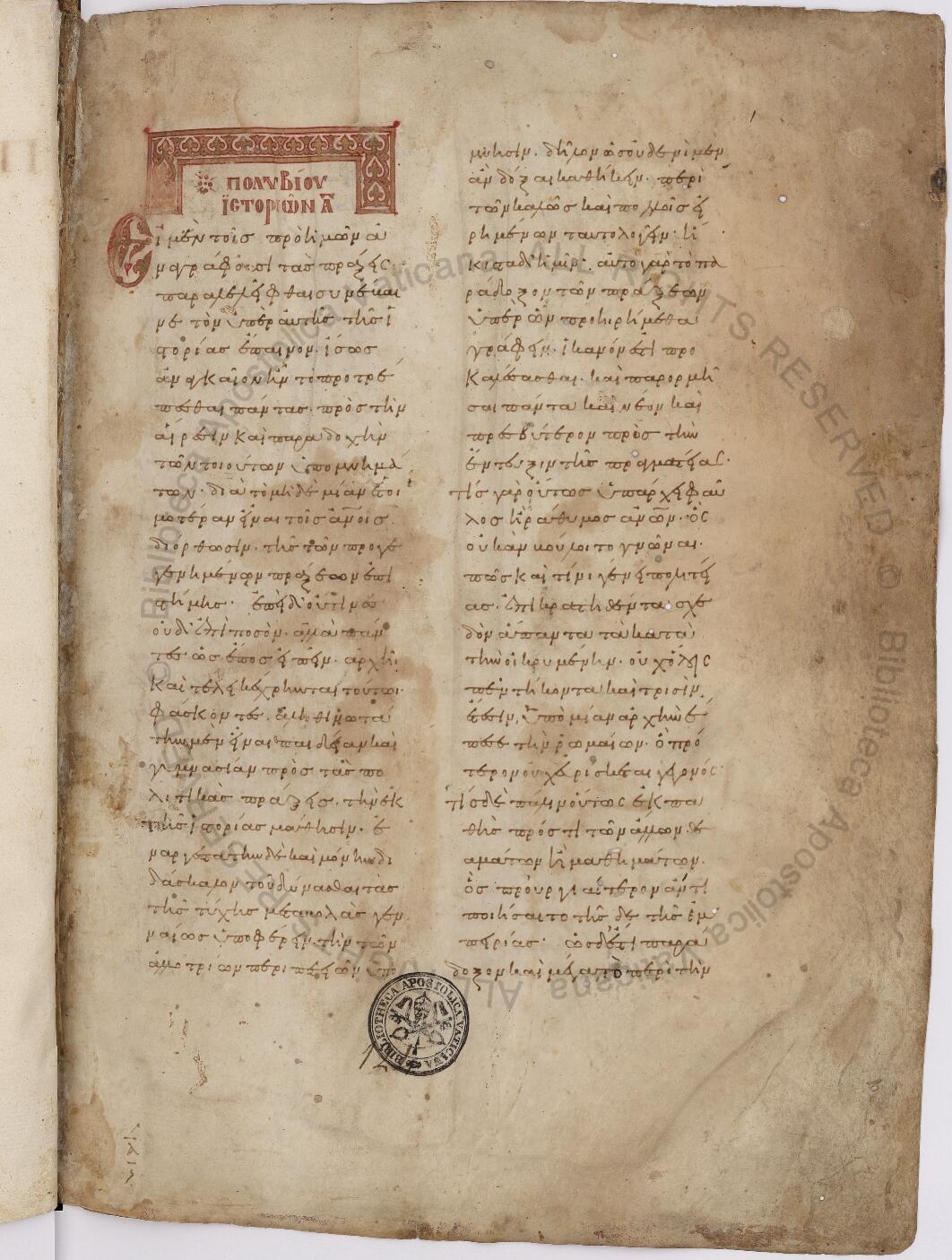
Overview
The Histories (Historiai) of Polybius is the most important historical work to survive from the Hellenistic period and the indispensable ancient source for Rome’s emergence as a world power. Composed in the second century BC, probably between c. 167 and 118, it sets out to explain a single commanding question: how and by what kind of constitution did the Romans, in less than fifty-three years, bring nearly the whole of the inhabited world under their sole rule? The work originally comprised forty books, spanning — in its expanded form — from the First Punic War (264 BC) to the destruction of Carthage and Corinth in 146 BC. Of these, only Books I–V survive complete; the remainder exist as fragments of varying length, many preserved in the Byzantine Excerpta compiled under the emperor Constantine VII Porphyrogennetos in the tenth century AD. Despite this state of preservation, the Histories remains the fullest ancient account of the Punic Wars, the Macedonian Wars, and the political integration of the Greek East into Rome’s orbit, and its theoretical ambitions — a self-conscious programme of pragmatic or analytical history — make it unique in the ancient tradition.
The Author
Polybius was born c. 200 BC at Megalopolis in Arcadia, the son of the Achaean statesman Lycortas. He rose to prominence in the Achaean League and served as hipparch, the League’s second-highest military office, in 170/169 BC. His political career was cut short in 167 BC, when he was among the thousand Achaean hostages deported to Rome following the Third Macedonian War — a collective punishment imposed on the League for its ambiguous conduct during Rome’s war against Perseus of Macedon. In Rome he entered the household of Lucius Aemilius Paullus and formed a close, lasting friendship with Paullus’s son Scipio Aemilianus, the future destroyer of Carthage. This relationship gave Polybius privileged access to the Roman governing class at the height of its power and drew him into the circle of the Scipionic group — the most intellectually distinguished milieu in mid-Republican Rome. He was present with Scipio at the sack of Carthage in 146 BC and reportedly wept alongside him at the sight of the burning city. After the settlement of 146, Polybius traveled widely across the western Mediterranean and North Africa, pursuing geographical research that fed directly into his historical work. He died, according to one tradition, at the age of eighty-two after a fall from a horse. His is, in a precise sense, the biography of a man caught between two worlds: a Greek who became Rome’s most penetrating analyst, and a political hostage who made of his displacement an incomparable vantage point.
Structure and Survival
The Histories is organized broadly by Olympiad year, with Polybius himself dividing his subject into a proem (Books I–II, covering the period 264–220 BC as background) and the main history proper, which opens with Book III at the year 220 BC and proceeds to the destruction of Carthage in 146. Within each year Polybius typically moves between the major theatres — Italy, Spain, Africa, Greece, Asia — in a systematic way that reflects his conviction that Mediterranean history from this point onward must be understood as a unified whole rather than a collection of separate regional narratives.
Books I–V survive in their entirety, transmitted through the medieval manuscript tradition. These cover the First Punic War (Book I), preliminary Achaean and Illyrian affairs (Book II), the causes of the Hannibalic War and Hannibal’s invasion of Italy (Book III), the second year of that war including Trasimene and Cannae (Book III–IV), and the complex of events across Greece, Asia, and Egypt that Polybius weaves into the same analytical frame (Books IV–V). Books VI survives in substantial fragments and contains the famous analysis of the Roman constitution and the theory of anacyclosis (the cyclical succession of constitutions) — arguably the most influential political theorizing in the Histories. Books VII–XVIII survive in varying states of incompleteness, with important fragments covering the later Hannibalic War, the death of Hieronymus of Syracuse, Philip V’s treaty with Hannibal, operations in Spain under the Scipios, and the battles of the Metaurus and Zama. Books XIX–XL are increasingly fragmentary, with substantial losses across the sections dealing with the Third Macedonian War, the Achaean War, and the final destruction of Carthage. The loss of the narrative of 146 BC in full is particularly grievous, since Polybius was a direct eyewitness to those events.
Books
Books I–II — Proem: The First Punic War and Its Aftermath
Polybius is explicit that Books I and II serve as a proem or preface, necessary to equip readers unfamiliar with Western history for the main narrative. Book I covers the First Punic War (264–241 BC) in its entirety: the origins of the conflict in Sicily, the surprising growth of Roman naval power, the campaigns in Africa under Regulus and his catastrophic defeat, and the final Roman victory at the Aegates Islands. Polybius treats his predecessors’ accounts of this war — particularly that of Philinus of Agrigentum and Fabius Pictor — with critical severity, establishing at the outset his commitment to the documentary verification of sources. Book II then covers the Gallic invasions of Italy, the Illyrian Wars, and the events in Greece that form the background to the wider Hellenistic world. A sustained account of Achaean League history, colored by understandable pride, traces the League’s revival under Aratus of Sicyon — a portrait that is frank about Aratus’s military limitations while generous to his political gifts.
Book III — The Causes of the Hannibalic War
Book III is among the most analytically rigorous in the Histories. Polybius distinguishes sharply between the causes (aitiai) and the beginnings (archai) of the Hannibalic War — a methodological move that allows him to locate the war’s true origins in the unresolved grievances of Carthage after the First Punic War rather than in the proximate dispute over Saguntum. Hannibal’s march from New Carthage across the Pyrenees and the Alps is narrated in the most famous passage in the book: Polybius claims to have traversed the Alpine route himself in order to verify the topography, and his account — controversially precise about the route taken — has exercised the ingenuity of scholars ever since. The book closes after the early Roman disasters of the Ticinus and Trebia rivers, with Hannibal established in northern Italy and the Roman Republic bracing for a war of unprecedented severity.
Book IV — Greece and the Social War
Book IV widens the focus dramatically, weaving together events in Greece, the Aegean, and the Near East that are contemporaneous with the opening of the Hannibalic War. The Social War among the Greek states — the conflict between the Macedonians and Aetolians on one side and the Achaean League on the other — receives sustained treatment, as do the affairs of Sparta under the reforming king Cleomenes and the complex politics of the Ptolemaic and Seleucid kingdoms. Polybius is at his most structurally ambitious here, demonstrating his thesis that events across the Mediterranean from 220 BC onward form a single interconnected history that cannot be understood in isolation. His analysis of Aetolian political culture — accusatory, bordering on contemptuous — is one of his most pointed exercises in comparative ethnography.
Book V — Raphia and the East
Book V continues the parallel narrative of Eastern affairs and brings it to a provisional close with the Battle of Raphia (217 BC), in which Ptolemy IV defeated Antiochus III — a Seleucid defeat that Polybius regards as squandered by Ptolemaic incompetence and luxury. The book also contains the striking scene in which the Greek statesmen assembled at Naupactus are addressed by Agelaus of Naupactus, who warns them to settle their quarrels before the clouds gathering in the West descend upon them — a famous proleptic image of Roman power. Book V closes with the death of the young Ptolemy V’s predecessor and a survey of the Seleucid-Ptolemaic compact that will remake the Levant. The transition sets up the long middle section of the work.
Book VI — The Roman Constitution (Fragmentary)
Book VI is the theoretical heart of the Histories and the most philosophically consequential section of the work. In fragments of considerable length, Polybius sets out his theory of anacyclosis — the natural cycle through which constitutions degenerate from kingship to tyranny, from aristocracy to oligarchy, from democracy to ochlocracy (mob rule), before beginning again — and argues that Rome’s mixed constitution, combining monarchical, aristocratic, and democratic elements in the consuls, Senate, and assemblies respectively, explains both its internal stability and its capacity for military success. The analysis draws on Platonic and Aristotelian political philosophy while departing from them in important ways; its direct influence on later political thought, from Cicero’s De Re Publica through Montesquieu and the framers of the American Constitution, can hardly be overstated. The book also contains a detailed account of Roman military organization — the legion’s structure, the arrangement of the camp, the disciplinary system — that remains the foundational ancient source for Republican military history.
Books VII–XI — The Hannibalic War Continued (Fragmentary)
The middle books of the Histories cover the most dramatic phase of the Hannibalic War. Major surviving fragments narrate the Roman catastrophe at Cannae (216 BC) in analytical rather than merely narrative terms — Polybius is concerned above all with the tactical intelligence of Hannibal’s double envelopment — the fall and recapture of Tarentum, the complex diplomacy of Sicily including the long Roman siege of Syracuse, and the rise of the Scipios in Spain. The death of Hieronymus of Syracuse, whose brief flirtation with Carthage brought Roman vengeance down on the city, is treated with psychological acuity. Philip V’s alliance with Hannibal (Book VII) is presented as a catastrophic miscalculation: Philip gains nothing and hands Rome a pretext for involvement in Greek affairs from which it will never withdraw. The battle of the Metaurus (207 BC), where Hasdrubal’s relief army was destroyed before it could join his brother in Italy, is narrated as the turning point of the western war.
Books XII and XXXIV — Methodology and Geography
Two books deserve special notice for their subject matter rather than their narrative position. Book XII, substantially preserved, is an extended and fierce critique of the historian Timaeus of Tauromenium — the dominant predecessor for Sicilian and Western Greek history. Polybius attacks Timaeus for relying on library research rather than personal experience, for rhetorical distortion, for inaccurate geography, and for misrepresenting documents. The polemic, however intemperate in places, is the fullest surviving ancient statement of Polybius’s historiographical method: that history requires personal military experience, geographical investigation, and the critical examination of documents and eyewitness testimony. Book XXXIV, almost entirely lost but attested in fragments and citations, dealt with the geography of the inhabited world — an attempt to synthesize Eratosthenes and correct the geographical errors of earlier historians through autopsy and research conducted during Polybius’s own extensive travels.
Books XVIII and XXXVI — Cynoscephalae and the Road to 146
Book XVIII contains the account of the battle of Cynoscephalae (197 BC), where the Roman general Flamininus defeated Philip V and effectively ended Macedonian power in Greece. Polybius’s tactical analysis of why the Roman legion defeated the Macedonian phalanx — the legion’s flexibility against the phalanx’s rigidity on broken ground — is a celebrated passage in ancient military writing. The subsequent declaration of Greek freedom at the Isthmian Games of 196 BC is treated with the ambivalence that characterizes Polybius’s understanding of Roman hegemony: the gesture is genuine but its implications for Greek autonomia are ominous. Book XXXVI covers the lead-up to the Third Punic War and exists only in fragments; but those fragments reveal Polybius wrestling with the Roman decision to destroy Carthage, which he evidently found morally difficult to justify while being politically comprehensible.
Key Themes
The unity of history. Polybius’s most original structural claim is that from 220 BC onward, events in Italy, Africa, Greece, and Asia must be understood as parts of a single interconnected process rather than as separate regional histories. The symploke — the interweaving or entanglement of affairs — is both an observed historical fact and a formal principle of his narrative organization. He is the first ancient historian to attempt a genuinely universal or ecumenical history in this analytical sense.
The mixed constitution and Roman stability. The theory of Book VI — that Rome’s durability and success flow from a constitution that balances and checks its three components — is the work’s most politically influential idea. Polybius is not naive about Roman power; he sees clearly that Roman hegemony often works in the interests of Rome rather than of its allies. But he believes the constitutional analysis is genuinely explanatory: the mixed constitution prevented the internal convulsions that destroyed other states and channeled Roman energy outward.
Pragmatic history and the education of statesmen. Polybius distinguishes his own pragmatic or political history from two inferior varieties: history written for entertainment, and history written as a repository of moral exempla divorced from analytical rigor. His intended audience is the statesman or general who must make decisions under uncertainty — and who can learn from a history that explains causes and assigns responsibility rather than merely narrating events. This utilitarian conception of historiography is both a rhetorical claim and a genuine intellectual commitment that shapes every page of the Histories.
Tyche and historical causation. Tyche — Fortune, chance, the unpredictable — is a persistent presence in the Histories, and Polybius’s attitude toward it is complex and sometimes inconsistent. He frequently appeals to Tyche to explain reversals and surprises, while also insisting that good historical writing must identify rational causes. The tension between providential Fortune and analytical explanation is never fully resolved, and scholars have read it variously as a philosophical inconsistency and as a deliberate acknowledgment of the limits of historical understanding.
The ambivalence of Roman power. Polybius admires Rome deeply and has personal reasons to be grateful to the Roman aristocracy. But he does not flinch from recording Roman brutality, broken faith, and the nakedness of interest beneath the language of justice. His account of the destruction of Carthage and Corinth in 146 BC — the climax of the work — is marked by evident discomfort at what Roman power, in its full extension, actually looks like. The Histories is not a simple panegyric; it is the analysis of a man who has understood Rome intimately enough to see both why it won and what winning cost.
Autopsy and the criticism of sources. Running through the entire work is Polybius’s methodological insistence on the priority of personal experience and documentary evidence over literary tradition. He disparages predecessors who wrote from their libraries rather than from the field, and he repeatedly claims to have traveled to the sites he describes, consulted participants, and examined inscriptions and treaties. This empiricist self-presentation is partly rhetorical, but it corresponds to a genuine practice: Polybius’s geographical and topographical observations, wherever they can be checked, are more reliable than those of most ancient historians.
Selected Excerpts
The programmatic preface (Histories I.1–4): The opening of the Histories announces its scope with deliberate grandeur. Polybius asks whether any person of serious purpose could remain indifferent to a history that traces how the Romans subjected nearly the whole inhabited world to their power in fewer than fifty-three years. The preface introduces the concept of symploke — the interweaving of events across all theatres — and distinguishes between the mere pleasure of reading history and its practical utility for those who must govern. These pages establish the terms on which the entire work proceeds.
Agelaus at Naupactus (Histories V.104): Speaking to assembled Greek statesmen in 217 BC, Agelaus urges them to settle their internecine quarrels by invoking a famous image: those watching the clouds gathering in the West should fear that the victor — Roman or Carthaginian — will not rest content with dominating Italy and Africa but will extend his ambitions further. The speech is one of the most celebrated moments of political foresight in ancient historiography: a Greek statesman warning his contemporaries of what Polybius’s entire work goes on to narrate.
The theory of anacyclosis (Histories VI.3–9): The fullest surviving ancient account of constitutional cycle theory. Polybius traces the natural progression from kingship through its degenerations and back, argues that the mixed constitution interrupts and suspends the cycle, and demonstrates through Roman history how this constitutional form produces stability. The analysis has been controversial since antiquity — Cicero adapted it, later constitutionalists drew on it — but its analytical ambition is undeniable. Whatever its philosophical debts, no ancient writer had previously applied constitutional theory to historical explanation with this degree of systematic rigor.
The battle of Cannae (Histories III.113–117): Polybius’s account of Cannae (216 BC) is not the most vivid in antiquity — Livy’s version is far more dramatic — but it is the most analytically precise. Polybius reconstructs Hannibal’s tactical dispositions with care, explains the mechanics of the double envelopment, and calculates casualties with the dispassion of a man who had commanded armies himself. His analysis of why the Romans lost — not through cowardice but through being tactically outgeneralled — is the basis of almost every subsequent understanding of the battle.
The Roman legion against the Macedonian phalanx (Histories XVIII.28–32): One of the most technically impressive passages in ancient military writing. Polybius argues that the phalanx is irresistible on flat, even ground but vulnerable to the legion’s flexible tactical unit — the maniple — on broken terrain. The argument draws on his analysis of Cynoscephalae but is stated here as a general theorem. Its influence on Renaissance and early modern military thought was considerable, and it remains a point of reference in the historiography of ancient warfare.
On the destruction of Carthage (Histories XXXVI.9, fragment): In a fragment preserved by later authorities, Polybius records that Scipio Aemilianus, watching Carthage burn, quoted Homer on the fall of Troy and wept — then, turning to Polybius, expressed the fear that Rome might one day suffer the same fate. The scene is the emotional climax of the Histories and one of the most extraordinary recorded conversations in ancient historiography: a Roman general, at the moment of his greatest triumph, invoking the mutability of empires in the presence of the historian who has devoted his life to explaining Roman power.
Further Reading
Texts and Commentaries The standard critical text is that of T. Büttner-Wobst in the Teubner series (1889–1905), though F.W. Walbank’s three-volume A Historical Commentary on Polybius (Oxford, 1957–1979) remains the essential scholarly reference and effectively renders any earlier commentary obsolete. Walbank’s introductory volume to the commentary provides the fullest available treatment of Polybius’s life, sources, and method.
Translations W.R. Paton’s Loeb Classical Library translation (1922–1927; revised by F.W. Walbank and C. Habicht, 2010–2012) provides a reliable facing-text version. Robin Waterfield’s translation for Oxford World’s Classics (2010), accompanied by Brian McGing’s notes, is the most accessible modern rendering and the one recommended for general reading. Ian Scott-Kilvert’s earlier Penguin selection (1979), though incomplete, remains elegantly readable.
Secondary Literature F.W. Walbank’s Polybius (Berkeley, 1972) is the essential starting point: a compact intellectual biography that covers the historian’s life, methods, sources, and influence with unmatched authority. Arthur Eckstein’s Moral Vision in the Histories of Polybius (Berkeley, 1995) examines Polybius’s ethical framework and his ambivalent relationship to Roman power. Brian McGing’s Polybius’ Histories (Oxford, 2010) offers a lucid thematic survey suitable for readers approaching the text for the first time. For the political theory of Book VI, Kurt von Fritz’s The Theory of the Mixed Constitution in Antiquity (New York, 1954) remains the fullest treatment, though it should be read alongside the critique in Walbank’s commentary. On the Hannibalic War more broadly, Serge Lancel’s Hannibal (Oxford, 1998) and Adrian Goldsworthy’s The Fall of Carthage (2000) provide useful historical context. For Polybius’s place in the wider tradition of Greek historiography, John Marincola’s Authority and Tradition in Ancient Historiography (Cambridge, 1997) is indispensable, and his edited A Companion to Greek and Roman Historiography (Oxford, 2007) contains several important essays on Polybian method and reception.