Introduction
Completed in 731 AD at the monastery of Jarrow in Northumbria, Bede's Historia Ecclesiastica Gentis Anglorum — the Ecclesiastical History of the English People — is the foundational text of English historical writing. Its author, the monk Bede (c. 672–735), spent virtually his entire life within the twin monastery of Wearmouth-Jarrow, and yet produced a work of extraordinary geographical and intellectual range. Drawing on papal archives, conciliar records, hagiographies, oral testimony, and earlier chronicles, Bede constructed a history of the English church from the Roman conquest through to his own era — a span of nearly seven centuries — organised not merely as chronicle but as providential narrative. The Historia is at once a work of history, theology, hagiography, and political thought. To read it carefully is to encounter the intellectual world of early medieval England at its richest.
Bede and His World
The Monastery of Wearmouth-Jarrow
Bede was oblated to the monastery of St Peter at Wearmouth at the age of seven, and later transferred to its sister house of St Paul at Jarrow, where he would remain until his death. Founded by Benedict Biscop in 674 and 682 respectively, Wearmouth-Jarrow was among the most intellectually distinguished monasteries in early medieval Europe. Benedict Biscop made multiple journeys to Rome, returning with books, relics, and craftsmen — including glaziers who introduced stained glass to England. The library he assembled was exceptional by the standards of the age, and it was this library that made Bede's scholarship possible.
Jarrow was not a place of retreat from the world but of intense engagement with it. The monastery participated in the wider networks of the Northumbrian church, maintained correspondence with Rome and with continental scholars, and produced manuscripts of lasting importance — including, almost certainly, one of the two surviving pandects of the complete Latin Bible (the Codex Amiatinus), copied at Jarrow and sent to Rome as a gift to Pope Gregory II around 716.
Bede as Scholar
Bede was a prolific writer across an extraordinary range of disciplines. His works include scriptural commentaries (on Genesis, the Tabernacle, the Temple, the Acts of the Apostles, the Apocalypse, and many others), hagiographies (most notably the Life of St Cuthbert, in both prose and verse), computistical treatises (above all De Temporum Ratione, which systematised the calculation of Easter and introduced the convention of dating years from the Incarnation — anno Domini — into common historical use), grammatical works, and poetry. The Historia Ecclesiastica is the culmination of this career, drawing together his historical, theological, and rhetorical gifts into a single monumental work.
His scholarly method is notable for its rigour by medieval standards. In the preface to the Historia, Bede carefully identifies his sources, names his informants, and distinguishes between what he has read, what he has been told, and what he knows from personal knowledge — a degree of source-consciousness unusual in early medieval historiography.
The Text
Sources and Composition
Bede composed the Historia over many years, completing it in 731. His source base was wide and carefully assembled:
- Papal letters and Roman archives: Through his friend and abbot Albinus of Canterbury, and via the priest Nothhelm (later Archbishop of Canterbury), Bede gained access to letters from the papal registry, including Gregory the Great's correspondence with Augustine's mission.
- Earlier histories and chronicles: Bede drew on Gildas's De Excidio et Conquestu Britanniae, Eutropius's Breviarium, Orosius's Historiarum Adversum Paganos, Pliny's Natural History, Constantius's Life of Germanus, and the anonymous Life of Gregory the Great produced at Whitby.
- Oral testimony and regional informants: Bede solicited information from ecclesiastical contacts across England. Acca, Bishop of Hexham, provided material on Northumbrian saints. Daniel, Bishop of Winchester, supplied information on the West Saxon and South Saxon churches. The monastery of Lastingham provided material on Chad and Cedd.
- Personal knowledge: For events in Northumbria, particularly in the late seventh and early eighth centuries, Bede could draw on living memory and direct acquaintance with participants.
Structure and Argument
The Historia is divided into five books, but its architecture is more complex than a simple chronological progression.
Book I opens with a geographical and ethnographical description of Britain — its peoples, languages, and resources — before moving through the Roman period, the raids of the Picts and Scots, the appeal to Aetius, Vortigern's invitation to the Saxons, and Gildas's condemnation of British sinfulness. It then turns to the mission of Augustine, sent to England by Pope Gregory the Great in 596, and the early stages of the Christianisation of Kent.
Book II continues the story of the Kentish church and the mission's extension northward under Paulinus to the Northumbrian court of Edwin. Edwin's conversion, his baptism at York in 627, and his subsequent death in battle at Hatfield Chase in 632 are treated as exemplary moments in the providential history of the English. The book ends with the collapse of the northern mission following Edwin's fall.
Book III covers the re-Christianisation of Northumbria under Oswald and Oswiu, this time through the Irish mission from Iona under Aidan. It is here that the distinctive character of the northern church — its Irish affinities, its monastic organisation, its calculation of Easter — comes into focus. The book culminates in the Synod of Whitby (664), at which King Oswiu ruled in favour of the Roman method of calculating Easter, decisively aligning the Northumbrian church with Rome.
Book IV traces the consolidation of Roman ecclesiastical order under Archbishop Theodore of Tarsus (668–690), perhaps the most transformative figure in the history of the early English church. Theodore reorganised the episcopal structure of the English church, held the first general synod of the whole English church at Hertford in 672, promoted learning, and shaped the institutional framework that would endure for centuries. The book also contains the celebrated account of Caedmon, the cowherd of Whitby who received the gift of sacred song in a dream — the first named poet in the English language.
Book V brings the narrative to Bede's own time, covering events from the 680s to 731. It includes accounts of missionary activity in Frisia and among the continental Saxons, the conversion of the Isle of Wight (the last English province to receive Christianity), and a final summary of the state of the English church. It ends with a brief autobiographical note — Bede's account of his own life and works — which is at once a gesture of humility and a claim to authority.
The Providential Framework
The Historia is not secular history in any modern sense. Its organising principle is explicitly theological: the history of the English people is the history of God's dealings with them, and the conversion of the English is understood as an act of divine providence analogous to the conversion of Israel. Bede structures his narrative around a series of typological patterns drawn from scripture: the English, like the Israelites, are a people chosen by God and liable to punishment for their sins. Victories in battle, plague, schism, and political instability are read as divine judgements; conversions, holy lives, and ecclesiastical unity are signs of divine favour.
This framework gives the work its moral urgency. Bede is not simply recording what happened; he is arguing about what it means, and implicitly — often explicitly — warning his contemporaries about the consequences of apostasy and ecclesiastical disorder.
Key Themes
The Unity of the English Church
One of Bede's central concerns is the unity of the English church under Roman authority. The conflicts between the Roman and Irish traditions — focused most sharply on the calculation of Easter and the style of the monastic tonsure — are treated not as mere technical disputes but as threats to the integrity of the Christian community. The Synod of Whitby is accordingly one of the pivotal moments of the Historia: it represents the triumph of Roman order over Irish particularism, and the definitive alignment of the English church with the universal church of Rome.
Bede's treatment of the Irish is nuanced, however. He praises figures such as Aidan, Columba, and Cuthbert in the warmest terms, acknowledging the holiness of their lives even while criticising their Easter reckoning. His criticism is ecclesiological rather than personal: it is the disorder of division, not the sinfulness of individuals, that concerns him.
Sanctity and Miracle
A substantial portion of the Historia is hagiographical in character. Bede records the lives and miracles of numerous saints, drawing on existing Vitae and oral tradition. These accounts serve multiple functions: they demonstrate the presence of divine favour in the English church; they provide models of Christian virtue; and they legitimate the authority of particular monasteries and episcopal sees by associating them with proven sanctity.
The saints of the Historia form a remarkably diverse company: popes (Gregory the Great), missionaries (Augustine, Aidan, Cuthbert, Wilfrid), kings (Oswald, Ethelbert), abbesses (Hild of Whitby, Ethelburga of Barking), and humble visionaries (Caedmon, Drythelm the man who returned from the dead). The range reflects Bede's understanding of sanctity as accessible across social boundaries — a theological conviction with significant political implications.
The Role of Gregory the Great
Gregory I looms over the Historia as its presiding spirit. Bede's admiration for Gregory is unbounded: it was Gregory who conceived and authorised the Augustinian mission; Gregory whose theological writings Bede cites throughout; Gregory whose pastoral vision — expressed above all in the Regula Pastoralis — shaped Bede's own understanding of episcopal and priestly duty. The famous story of Gregory seeing Anglo-Saxon slave boys in the Roman market — Non Angli sed Angeli — is told in the Historia with evident delight.
Gregory's significance for Bede is partly theological, partly political. As the pope who sent Augustine to England, Gregory is the founder of the English church; the authority of Rome in English ecclesiastical affairs is grounded, for Bede, in this originary act of pastoral solicitude.
Kingship and Conversion
The Historia is acutely attentive to the relationship between political power and Christian mission. Conversion in Bede's account is rarely simply a matter of individual conscience: it is embedded in networks of royal patronage, dynastic politics, and military fortune. Edwin of Northumbria is baptised in part because of the influence of his Kentish Christian queen, Ethelburga; Oswald of Northumbria's victory at Heavenfield is presented as directly consequent on his erection of a wooden cross before battle. The fates of kingdoms are bound up with the fates of their churches.
This makes the Historia an invaluable source — and a complex one — for the political history of early Anglo-Saxon England. Bede is not a neutral observer of dynastic politics; his judgements of kings are consistently framed in terms of their relationship to the church. Kings who support the mission, protect monasteries, and live in accordance with Christian morality are celebrated; those who apostatize or persecute are condemned and, in Bede's providential scheme, punished.
People and Places
Key Figures
Gregory the Great (c. 540–604): Pope from 590 until his death, Gregory is the theological and institutional patron of the English mission. His letters to Augustine, preserved in the Historia, reveal a sophisticated pastoral intelligence — adaptable, pragmatic, and deeply concerned with the long-term formation of a Christian culture in England.
Augustine of Canterbury (d. c. 604): Leader of the mission sent by Gregory to England in 596. Augustine baptised King Ethelbert of Kent, established his see at Canterbury, and attempted — with limited success — to bring the existing British clergy into conformity with Roman practice. His failure to persuade the British bishops is one of the Historia's recurring themes.
Paulinus (d. 644): One of the Roman missionaries who accompanied a second wave sent by Gregory. Paulinus became the first Bishop of York and baptised King Edwin of Northumbria at York in 627 — an event Bede treats as a turning point in the history of the English people.
Aidan (d. 651): Irish monk from Iona who established the monastery of Lindisfarne at the invitation of King Oswald of Northumbria. Bede's portrait of Aidan is among the Historia's most affecting passages: a man of extraordinary holiness, generosity to the poor, and pastoral energy, whose only fault — in Bede's eyes — was his Easter reckoning.
Hild of Whitby (614–680): Abbess of the double monastery at Whitby, one of the most significant ecclesiastical figures of seventh-century England. The Synod of Whitby was held under her roof; she herself favoured the Irish position on Easter but accepted the synod's decision. Under her guidance, Whitby produced five bishops and was a major centre of learning.
Theodore of Tarsus (c. 602–690): Greek monk from Tarsus appointed Archbishop of Canterbury by Pope Vitalian in 668. Theodore's tenure transformed the English church: he reorganised its episcopal structure, presided over the first general synod of the English church at Hertford (672), promoted the study of Greek and Latin, and brought a new intellectual energy to Canterbury. Bede regards him as one of the greatest archbishops England had known.
Wilfrid of Hexham (c. 633–709): The most controversial figure in the Historia — a bishop of great ability, fierce ambition, and extraordinary longevity whose conflicts with successive Northumbrian kings and archbishops generated a decades-long series of appeals to Rome. Bede's treatment of Wilfrid is notably careful: he acknowledges his importance while avoiding an unqualified endorsement of his conduct.
Cuthbert (c. 634–687): Bishop of Lindisfarne, hermit of the Farne Islands, and the greatest saint of Northumbria. Bede wrote both a prose and a verse Life of Cuthbert before incorporating a version of his story into the Historia. Cuthbert represents for Bede the ideal fusion of the contemplative and the active life, the Irish monastic tradition and Roman ecclesiastical order.
Key Places
Canterbury: The metropolitan see of the English church, established by Augustine. Canterbury's primacy over the English church — and its subordination of York — is a point Bede handles with some care, given the sensitivities of his Northumbrian context.
York: The site of Edwin's baptism and the intended northern metropolitan see. The question of York's relationship to Canterbury — which Bede believed Gregory had intended as an independent province of equal dignity — was a live political issue in his own time.
Lindisfarne: The island monastery founded by Aidan off the Northumbrian coast, which became the spiritual centre of the Irish mission in northern England and the see of Cuthbert. Its scriptorium would produce the magnificent Lindisfarne Gospels (c. 715), perhaps the greatest surviving monument of Insular art.
Whitby: The double monastery ruled by Hild, site of the synod of 664 that resolved the Easter controversy in favour of Rome, and home of Caedmon.
Iona: The island monastery off the west coast of Scotland founded by Columba in 563, which served as the mother house of the Irish mission in northern Britain. Though geographically remote from Northumbria, Iona's spiritual authority over the northern church was decisive until Whitby.
The Question of Sources
Reading the Historia critically requires attention to the uneven quality of Bede's source base. His information about Kent and Canterbury is generally well-documented, thanks to his access to the papal archives. His knowledge of Northumbrian affairs is rich and detailed. But his coverage of Mercia, East Anglia, and the West Saxons is thinner, and his account of the British church is filtered through Gildas's polemical hostility.
The Historia's treatment of the British (i.e., native Romano-British Christian) church is particularly problematic. Bede portrays the British clergy as obstinate schismatics who refused to assist the Roman mission and whose failure to evangelise the Anglo-Saxon invaders constituted a dereliction of duty deserving of divine punishment — including the massacre of the British monks of Bangor-is-y-Coed, which Bede reads as a providential judgement. This is a partisan reading, shaped by Gildas and by Bede's Roman ecclesiological commitments. The British perspective, unsurprisingly, is not preserved.
The Historia and the Invention of England
The Historia Ecclesiastica is, among other things, a work of nation-making. Bede's concept of the gens Anglorum — the English people — is not simply a political or ethnic category: it is an ecclesiological one. The English are defined by their shared membership of a single church under Roman authority. This is a remarkable act of conceptual synthesis, given the political fragmentation of early eighth-century England into multiple competing kingdoms. Bede's Historia projects onto a politically divided landscape a unified ecclesiastical — and implicitly national — identity.
This idea proved immensely influential. Alfred the Great, who promoted a translation of the Historia into Old English as part of his programme of cultural renewal in the late ninth century, drew directly on Bede's vision of a unified English Christian people. The Historia thus stands at the origin not only of English historical writing but of English national identity itself.
Manuscript Tradition
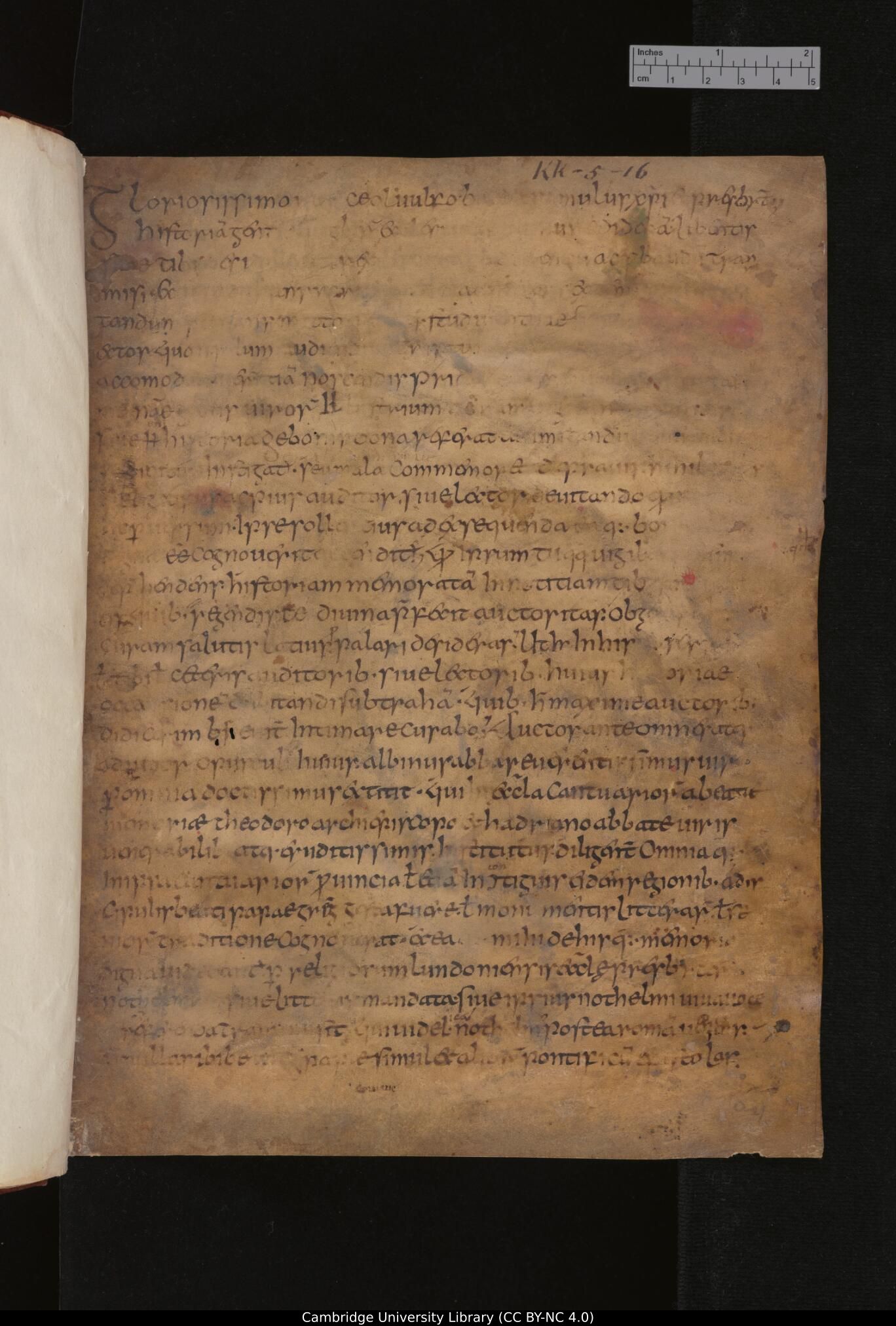
The Historia survives in more than 150 medieval manuscripts — a remarkable number that testifies to its prestige and wide circulation. Among the earliest and most important is the Moore Bede (Cambridge, University Library, MS Kk.5.16), copied in Northumbria around 737, within two years of Bede's death. It is named after John Moore, Bishop of Ely (1707–1714), whose library was purchased by George I and presented to Cambridge University Library in 1715. A second very early manuscript, the Leningrad Bede (St Petersburg, National Library of Russia, Lat. Q.v.I.18), was copied in 746 and provides a closely related text. Together these two manuscripts are the primary witnesses for establishing the text of the Historia.
Editions and Translations
Latin Text
- Plummer, Charles, ed. Venerabilis Baedae Opera Historica. 2 vols. Oxford: Clarendon Press, 1896. The standard critical edition for over a century, with extensive commentary. Still indispensable.
- Mynors, R.A.B., B. Colgrave, and R.A.B. Mynors, eds. Bede's Ecclesiastical History of the English People. Oxford Medieval Texts. Oxford: Clarendon Press, 1969. The standard modern critical edition, with facing English translation.
English Translations
- Colgrave, Bertram, and R.A.B. Mynors. Bede's Ecclesiastical History of the English People. Oxford: Clarendon Press, 1969. Accurate and scholarly; the standard reference translation.
- Sherley-Price, Leo, trans. Revised by R.E. Latham. Bede: Ecclesiastical History of the English People. Penguin Classics. London: Penguin, 1990. More accessible; a good starting point for general readers.
- McClure, Judith, and Roger Collins, eds. Bede: The Ecclesiastical History of the English People. Oxford World's Classics. Oxford: Oxford University Press, 1994. Includes Bede's Life of St Cuthbert and selections from his Lives of the Abbots.
Further Reading
Bede and His Scholarship
- Brown, George Hardin. Bede the Venerable. Boston: Twayne, 1987.
- DeGregorio, Scott, ed. The Cambridge Companion to Bede. Cambridge: Cambridge University Press, 2010. The essential collection of scholarly essays, covering all aspects of Bede's life, works, and context.
- Lapidge, Michael, ed. Bede and His World: The Jarrow Lectures, 1958–1993. 2 vols. Aldershot: Variorum, 1994.
- Ward, Benedicta. The Venerable Bede. London: Geoffrey Chapman, 1990.
Early English Christianity
- Blair, John. The Church in Anglo-Saxon Society. Oxford: Oxford University Press, 2005. The authoritative study of the institutional development of the Anglo-Saxon church.
- Campbell, James, ed. The Anglo-Saxons. London: Penguin, 1991. A richly illustrated introduction to Anglo-Saxon culture and history.
- Charles-Edwards, T.M. Early Christian Ireland. Cambridge: Cambridge University Press, 2000. Essential background to the Irish mission.
- Mayr-Harting, Henry. The Coming of Christianity to Anglo-Saxon England. 3rd ed. London: Batsford, 1991. The best single-volume account of the conversion.
- Stenton, Frank M. Anglo-Saxon England. 3rd ed. Oxford: Clarendon Press, 1971. The foundational political history; essential context for the Historia.
Historiography and Method
- Goffart, Walter. The Narrators of Barbarian History (A.D. 550–800). Princeton: Princeton University Press, 1988. Situates Bede within the broader tradition of post-Roman historical writing; provocative and important.
- Higham, N.J. (Re-)Reading Bede: The Ecclesiastical History in Context. London: Routledge, 2006.
- Wormald, Patrick. "Bede, the Bretwaldas and the Origins of the Gens Anglorum." In Ideal and Reality in Frankish and Anglo-Saxon Society, edited by Patrick Wormald et al. Oxford: Blackwell, 1983.
A Note on Reading
The Historia rewards reading in sequence. Bede's narrative gathers force as it proceeds: the patterns he establishes in the early books — the relationship between royal favour and ecclesiastical success, the providential meaning of plague and military defeat, the qualities of the ideal bishop — pay off in the later books, where his treatment of figures like Theodore, Cuthbert, and Wilfrid gains depth from the typological framework he has already laid down. Reading individual episodes in isolation, while perfectly possible, risks missing the cumulative argument of the whole.
It is equally worth reading the Historia alongside Bede's other works — particularly the Life of Cuthbert, the Lives of the Abbots of Wearmouth-Jarrow, and De Temporum Ratione — which illuminate the intellectual and spiritual commitments that underlie the Historia's historical argument. Bede is, in the end, less interested in what happened than in what it means; and what it means, for him, is inseparable from the whole sweep of salvation history within which he understood the conversion of the English to be inscribed.