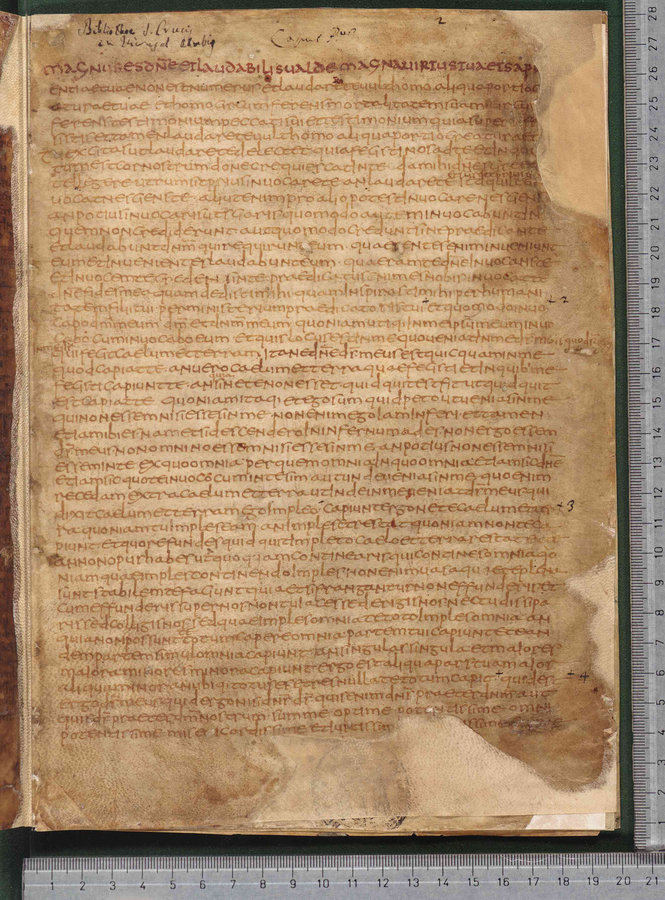
Unless otherwise noted, Latin quotations follow the Corpus Christianorum Series Latina text (CCSL 27). References cite book and chapter numbers in the standard form (e.g., 1.1).
Overview
The Work
Sometime around 397 CE, Augustine of Hippo — newly appointed bishop of a turbulent North African church, already the most formidable theological mind in the Latin West — sat down to write a book unlike anything that had existed before. He called it Confessiones. We call it the Confessions. Neither name quite prepares you for what it is.
It is not an autobiography in any modern sense, though it contains autobiographical narrative. It is not a philosophical treatise, though it contains some of the most searching philosophical reflection in ancient literature. It is not a prayer, though it is written entirely in the second person, addressed throughout to God — so that the reader is always, uncomfortably, an eavesdropper on a conversation that was not meant for them. It is all of these things at once, held together by a prose style of such rhythmic intensity and emotional range that no translation has yet fully captured it.
The Confessions opens with one of the most famous sentences in any language:
Magnus es, domine, et laudabilis valde — Great are you, Lord, and highly to be praised.
And then, almost immediately, the sentence that has stopped readers cold for sixteen centuries:
fecisti nos ad te et inquietum est cor nostrum, donec requiescat in te — you have made us for yourself, and our heart is restless until it comes to rest in you.
Everything in the Confessions is gathered in that sentence: the Neoplatonic restlessness of a soul displaced from its origin, the biblical certainty that the origin is personal and calls us by name, and the peculiar Augustinian fusion of the two that would shape Western Christianity, Western philosophy, and Western literature for a millennium and a half.
The work divides, roughly, into three parts: Books I–IX, the autobiographical narrative running from Augustine's birth to his mother Monica's death just after his conversion; Book X, a sustained philosophical meditation on memory as the site where the soul encounters God; and Books XI–XIII, an allegorical commentary on the opening verses of Genesis that explores the nature of time, creation, and divine eternity. Most readers come for the autobiography and are surprised — sometimes stunned — by what awaits them in Books X–XIII.
Why It Still Matters
The Confessions is, among other things, the founding document of the examined inner life in Western culture. Before Augustine, ancient literature had produced great narrative, great philosophy, and great poetry, but it had not produced anything quite like this sustained, restless, self-interrogating interiority. The first person singular of the Confessions is not the rhetorical "I" of an orator or the impersonal voice of a philosopher: it is an "I" that watches itself, distrusts itself, misremembers itself, and asks what it means to be a self at all.
This matters because the questions Augustine raises have not been settled. His account of memory in Book X anticipates modern debates about the relationship between consciousness and time. His analysis of the divided will — the will that wills and yet does not will, that commands itself and fails to obey itself — is the most searching account of inner conflict in ancient literature, and remains required reading for anyone thinking about weakness of will, moral psychology, or the phenomenology of addiction. His meditation on time in Book XI — "What, then, is time? If no one asks me, I know; if I want to explain it to someone who asks, I do not know" — is still one of the essential texts in the philosophy of time.
The Confessions is also the greatest account of intellectual and spiritual conversion in world literature. It is not a simple story of darkness and light. It is the story of a man of formidable intelligence who resisted the truth for years with every weapon his intelligence gave him, and who found, in the end, that the resistance itself was what the truth had to overcome. That story has never stopped being relevant.
The Author
Augustine was born on 13 November 354 CE in Thagaste, a small town in Numidia — what is now northeastern Algeria. His father, Patricius, was a pagan of modest means with ambitions for his brilliant son. His mother, Monica, was a devout Christian whose tenacious, sometimes overwhelming love for Augustine is one of the great presences of the Confessions. Their relationship — intellectually unequal, spiritually reversed, emotionally entangled — runs through the autobiography as its deepest human thread.
He was educated in rhetoric at Thagaste, Madaura, and finally Carthage, the great metropolis of Roman Africa. He was, by his own account and everyone else's, extraordinarily gifted — and aware of it in ways he would later find humiliating to recall. At eighteen, reading Cicero's Hortensius (now lost), he experienced the first of his intellectual conversions: a sudden hunger for wisdom that would not leave him for the rest of his life. He turned to the Christian scriptures and found them, at this point, inelegant and unworthy of his philosophical ambitions.
For nine years he was a Manichaean — an adherent of a Persian dualist religion that offered a sophisticated cosmological explanation of evil and a community of intellectual respectability. He taught rhetoric in Thagaste and Carthage, rose to a prestigious appointment in Milan as professor of rhetoric, and began, with growing discomfort, to see through Manichaeism. It was in Milan that the decisive encounters occurred: with the bishop Ambrose, whose allegorical reading of Scripture dissolved one of Augustine's chief objections to Christianity; with the works of "the Platonists" (almost certainly Plotinus and Porphyry in Latin translation), which gave him a philosophical framework for understanding God as immaterial and evil as privation; and with the figure of Anthony of Egypt, whose radical renunciation struck him with the force of a rebuke.
The conversion scene in Book VIII — Augustine in a Milan garden, weeping, hearing a child's voice chanting tolle, lege ("take up and read"), opening Paul's letter to the Romans at random, and feeling the light of certainty flood in — is one of the most analyzed passages in Western literature. Augustine would later insist that what happened in that garden was the culmination of a process that God had been conducting for years. He was thirty-one years old.
He withdrew from his professorship, retired with a small community of friends and his son Adeodatus to Cassiciacum, was baptized by Ambrose at Easter 387, and returned to Africa. His mother Monica died at Ostia, on the journey home. He never left Africa again. He was ordained a priest in 391, became bishop of Hippo Regius in 396, and served that difficult, diverse community for thirty-four years, writing without pause until his death in 430 as the Vandals besieged the city walls.
The Confessions was written within a few years of his becoming bishop. He was not writing for posterity, or not only for posterity. He was writing for his congregation, as an act of public self-disclosure designed to show what God had done with the wreckage of a life. That pastoral purpose is inseparable from the book's theology, its rhetoric, and its peculiar emotional nakedness.
Method and Style
The Address to God
The Confessions is written throughout in the second person. Augustine does not narrate his past to a reader; he confesses it to God. This is not a merely rhetorical device. It is the structural embodiment of the book's central claim: that the self cannot know itself except in relation to the One who made it and who knows it better than it knows itself. Every time Augustine turns to analyze his own past, he does so by addressing the One who was present in that past in ways Augustine himself was not.
The effect on the reader is strange and irreducible. We are not the intended audience. We read over God's shoulder, as it were — which means we read the text in a kind of permanent awareness that the most important thing being said is being said to someone else. Augustine uses this structure deliberately. The Confessions is a book about what happens when a soul finally stops talking to itself and begins talking to the One it has been running from. The form enacts the content.
Confession as a Triple Act
The Latin confessio carries three meanings that Augustine exploits simultaneously and that no English word captures alone. To confess is to admit wrongdoing (confessio peccati), to proclaim praise (confessio laudis), and to profess faith (confessio fidei). These three modes interweave throughout the text: Augustine confesses his sins, praises God for working through and despite them, and professes the faith he has come to hold. The Confessions is not primarily a catalogue of sins — Augustine's readers, ancient and modern, have sometimes been disappointed by how tame the transgressions are — but a theological argument conducted through the grammar of praise.
Scripture as the Medium of Thought
Augustine's prose is saturated with Scripture to a degree that modern readers, even devout ones, rarely appreciate. He does not quote the Bible; he thinks in it. Phrases from the Psalms, from Paul, from the Gospel of John surface constantly, not as citations but as the very texture of his language. The opening of Book I, for instance, weaves together Psalm 48, Psalm 145, Romans 10, and James 4 in fewer than a dozen lines — not as ornament but as argument. For Augustine, the words of Scripture are the words in which God has already addressed humanity; to think in those words is to bring one's own thought into alignment with a prior divine speech.
This has consequences for translation that are easily underestimated. The emotional and theological depth of the Confessions is partly the depth of the Psalms that are always just beneath its surface. A translator who does not hear that undertow will produce something accurate but flat.
Rhetoric and Philosophy
Augustine was, before his conversion, a professor of rhetoric — one of the most accomplished in the Latin West. He never stopped being one. The Confessions is shaped by every resource of classical Latin style: anaphora, chiasmus, rhythmic prose (cursus), rhetorical questions, apostrophe. These are not decorative. They are instruments of an argument addressed to the whole person — intellect, will, emotion — simultaneously. When he writes inquietum est cor nostrum, the rhythm of the Latin enacts the very restlessness the sentence describes.
At the same time, the Confessions is a work of serious philosophy. Books X–XIII engage with questions about memory, time, and creation that were live in the Platonic tradition Augustine inherited, and his treatments are original contributions, not merely appropriations. He knew Plotinus well and used him brilliantly — but he also, at crucial moments, departed from him. The departure is as important as the appropriation.
Structure of the Text
Books I–IV — Childhood, Adolescence, and Early Wandering
Book I opens before Augustine's birth, with the great invocation that establishes the book's theological grammar, and then moves through infancy, boyhood, and early education. Even here, Augustine is philosophically alert: he meditates on what it means to be an infant, on the origin of language, on the moral status of childhood. The famous theft of pears in Book II — Augustine and friends steal fruit from a neighbor's tree, not because they wanted the pears but apparently for the sheer pleasure of doing wrong — generates one of the book's most sustained analyses of evil: the will's mysterious capacity to choose nothing, to prefer absence to presence, darkness to light.
Book III covers his time as a student in Carthage, the seductions of the theater, his first serious love affair, his encounter with the Hortensius, and his nine years with the Manichaeans. Book IV narrates his early teaching career, the death of an unnamed friend that produces an extraordinary early passage on grief, and his first philosophical writings.
Books V–VII — Milan, Ambrose, and the Platonists
These are the books of Augustine's intellectual liberation. Book V describes his disillusionment with Faustus, the Manichaean bishop who could not answer his questions, and his departure from Africa to Rome and then Milan. Book VI introduces Ambrose — the preacher who will become one of the book's most enigmatic figures, always admired from a distance, never intimate — and narrates Augustine's growing uncertainty about everything he had believed.
Book VII is philosophically the most dense. It describes Augustine's encounter with Platonic philosophy and what he found there. He found a way to conceive of God as immaterial — not a vast, diffuse physical substance but a self-subsisting being beyond matter. He found the Johannine prologue ("In the beginning was the Word") in Platonic dress. But he did not find, in the Platonists, any account of the Word becoming flesh — of God entering history in a particular human life. That asymmetry, between what the Platonists could give him and what they could not, is the hinge of the book's intellectual argument.
Book VIII — The Conversion
The most read, most analyzed, most translated passage in the Confessions and one of the most consequential scenes in Western literature. Augustine narrates the events leading to his conversion in the Milan garden — the story of Victorinus, the story of Anthony, the paralysis of his divided will — with an intensity that two millennia of commentary have not exhausted.
The analysis of the divided will in Book VIII is Augustine's most original philosophical contribution in the Confessions. The will, he argues, commands itself and is not obeyed — not because there are two wills, pagan and Christian, fighting for control, but because the one will is not whole, is not fully itself, has not yet consented to its own deepest desire. The resistance to conversion is not intellectual but volitional: Augustine knows what he should choose before he chooses it. The conversion in the garden is not an enlightenment but a surrender.
Book IX — Baptism, Cassiciacum, and Monica's Death
The final autobiographical book moves rapidly through Augustine's resignation from his professorship, the months of philosophical retreat at Cassiciacum, his baptism at Milan, and the long journey home toward Africa. It ends with the death of Monica at Ostia — and with one of the book's great set-pieces: the vision Augustine and Monica share at the window overlooking the garden, in which they seem, together, to touch for a moment the eternal Wisdom that underlies all created speech.
Monica's death and Augustine's grief — his struggle not to weep publicly, his final weeping alone, his prayer for her soul — form the emotional climax of the autobiographical narrative. The relationship between them, with all its complexity and weight, is released here in a way that remains among the most moving passages in ancient prose.
Book X — Memory
The pivot of the entire work, and the section most surprising to first-time readers. Augustine has narrated his past; now he asks: what is the self that did all that? The answer he pursues runs through an extraordinary meditation on memory. Memory, for Augustine, is not a passive storehouse but a vast interior space — he calls it praesens de praeteritis, the present of past things — in which the entire accumulated experience of a life is somehow simultaneously held.
The philosophical stakes become clear when Augustine asks: where do we seek God? Not outside ourselves — the itinerary of the autobiographical books has established that God was always closer to Augustine than Augustine was to himself. We seek God in memory: in whatever it is in us that always already knows what we are looking for when we seek the good, the beautiful, the true. The meditation moves through different kinds of memory — sensory, emotional, intellectual — toward the question of whether God can be found in any of them, or whether God is the condition for memory itself.
Book X also contains a famous passage of penitential candor — Augustine's account of his continuing struggles with the temptations of sight, sound, smell, taste, and touch — that has been read as confessional and as deeply rhetorical, a pastoral demonstration to his congregation that the bishop who addresses them is not beyond the struggles they know.
Books XI–XIII — Time, Creation, and Rest
The final movement of the Confessions has puzzled every generation of readers. Why does a spiritual autobiography end with a philosophical commentary on Genesis? The answer is that Augustine has not left autobiography behind: he is asking where the restless soul ultimately comes to rest, and the answer requires him to think about what creation is, what time is, and what eternity is.
Book XI's meditation on time is the most philosophically distinguished section of the work. Augustine argues that time is neither in things nor in eternity but in the mind — specifically, in the mind's capacity to hold past, present, and future together in what he calls distentio animi, the "stretching out" of the soul across time. This is an early and powerful version of what philosophers now call the phenomenological account of time-consciousness. The contrast with God's eternity — in which all things are simultaneously present — drives the argument and points toward the rest that the whole book has been seeking.
Books XII and XIII pursue allegorical readings of Genesis 1, identifying the formless matter of creation with the soul not yet shaped by divine love, and the ordering of creation with the soul's formation toward its final rest in God. The Confessions ends not with dramatic conversion but with sabbath: the image of God resting in creation and creation resting in God. The restless heart of 1.1 has, in the final sentence, come to rest.
Key Themes
Restlessness and Return
The Confessions is structured around a single Neoplatonic movement: the soul's emanation from its divine source, its wandering in a world of multiplicity and change, and its eventual return. Augustine adapts this framework — inherited from Plotinus and Porphyry — with a crucial modification: the return is not achieved by philosophical ascent alone but by a historical, incarnate, particular act of divine love. The Word became flesh. The return is not the intellect's achievement; it is a gift.
This shapes everything in the book. Augustine's restlessness is not simple moral failure or philosophical confusion — it is the metaphysical condition of a soul that has not yet found the rest for which it was made. The famous inquietum est cor nostrum is not a diagnosis of neurosis but a description of ontology: the soul is constitutively incomplete until it reaches its source. All of Augustine's wandering — through Manichaeism, through sexual love, through philosophical ambition, through rhetorical success — is the restlessness of this condition seeking wrong satisfactions for a right desire.
The Interior Life and the Self
Before Augustine, ancient literature had not produced anything quite like sustained, reflexive self-interrogation as a literary form. The Confessions creates, or at least decisively shapes, the Western tradition of inwardness. Augustine's turn inward is not narcissism — it is theological. He goes inward because he has learned that God is to be found not in the external world but in the interior space that God makes possible. The famous formulation of Book X — tu autem eras interior intimo meo et superior summo meo, "you were more inward than my most inward part and higher than my highest" — describes God as the condition for the self's own interior life.
This has enormous consequences for the Western tradition. The Augustinian self — introverted, historically situated, temporally extended, capable of self-deception, knowable only in relation to what transcends it — is the ancestor of the modern self in ways that Descartes and Locke, whatever they thought they were doing, did not entirely escape.
The Divided Will
Augustine's analysis of what he calls the divided will — voluntas dividua — is the most original contribution of Book VIII and one of the most powerful pieces of moral psychology in ancient philosophy. He has been drawn to Christianity; he wills to convert; and yet he does not convert. He wills and does not will. He commands himself and is not obeyed.
His diagnosis is precise: this is not, as the Manichaeans claimed, the battle between two natures or two souls. It is the failure of a single will to be fully itself — to give its full consent to its own deepest desire. Part of him wants God; part of him wants to retain the habits of the old life. The habits have become second nature. He knows that freedom lies in surrender; he cannot yet surrender his attachment to the very thing that imprisons him. The paradox — that freedom requires submission, that the will is most itself when it gives itself away — is irreducibly Augustinian, and it runs through the Western tradition from Paul through Luther to Kierkegaard and beyond.
Memory as the Site of God
Book X's meditation on memory is Augustine's most original philosophical contribution and also, in retrospect, his most prophetic. He discovers that memory is not merely a repository of past experience but the form of the mind's encounter with truth as such: we recognize truth when we encounter it because something in us already knows what we are looking for. Mathematical truths, moral truths, and — most importantly — the truth about the Good are all met in memory as things recognized rather than learned for the first time.
This raises the question of how God can be in memory — whether God was placed there by creation, whether God is the condition for memory itself, whether the soul's seeking is always already a form of finding. Augustine does not answer this with analytical precision; he answers it by moving through a series of probings that enact the seeking they describe. The searching is itself the finding, partially, provisionally, until the final rest.
Time and Eternity
Book XI's inquiry into the nature of time begins from a theological puzzle — what was God doing before creation? — but quickly becomes one of the most sustained philosophical inquiries into temporal experience in the ancient world. Augustine's answer, in brief: time is not a property of the external world but a property of the mind. Past, present, and future are not three regions of objective reality but three modes of mental attention: memory, perception, and expectation. Time is the "distention of the soul" — its being stretched across what was, what is, and what will be.
The contrast with God's eternity — in which nothing passes away because all is simultaneously present — is not an escape from time but its clarification. We understand what time is only by contrast with what it is not. And we understand what our restlessness is — our temporal, distended, unsatisfied condition — only by contrast with the rest we do not yet have.
Selected Passages
The Great Invocation (Book I, 1)
Magnus es, domine, et laudabilis valde: magna virtus tua, et sapientia tuae non est numerus... fecisti nos ad te et inquietum est cor nostrum, donec requiescat in te.
This opening sentence has generated more commentary than perhaps any other in Christian literature. Its structure is circular: we want to praise God, but God must first arouse in us the desire to praise, because the very desire is already God's gift. The theological problem of prevenient grace — does the soul seek God, or does God always already seek the soul? — is folded into the syntax of the opening paragraph.
The famous inquietum est cor nostrum repays close attention to its grammar. Inquietum is the predicate adjective; cor is the subject; the construction is impersonal and universal. It is not that Augustine's heart was restless — it is that the heart, the human heart, is restless. The Confessions is offered as a particular story that illuminates a universal condition.
The choice of inquietum rather than agitatum or turbatum is significant. Restlessness (inquies) is not mere disturbance — it is the specific inability to be at rest, the state of something that has not yet reached its natural place. In Aristotelian physics, a stone moves toward the earth because that is where it naturally comes to rest; displaced from that resting place, it is in a condition of inquies. Augustine applies this physics to the soul: the soul moves toward God because that is where it naturally comes to rest; displaced, it is constitutively restless.
The Stolen Pears (Book II, 4–10)
The most philosophically troubling incident of the autobiographical narrative. Augustine and a group of friends steal pears from a neighbor's tree — not because they were hungry, not because the pears were particularly good, but apparently for no reason at all, or for the sake of the wrongdoing itself. He returns to this episode obsessively because it seems to reveal something about the will's capacity for pure, motiveless evil — evil chosen not as a substitute good but as nothing at all.
His analysis pushes toward a Neoplatonic conclusion: evil has no positive being; it is pure privation, the will's turning from being toward nothingness. But the phenomenology resists this conclusion. The stolen pears were enjoyed. The laughter of his companions was enjoyed. There was pleasure — not the pleasure of the pears but the pleasure of transgression shared with others, the pleasure of belonging to a group defined by its contempt for limits. Augustine cannot quite reduce this to nothing.
The passage has been read as philosophically confused, as pastorally self-serving, and as one of the most honest accounts ever written of how evil works: not as the dramatic choice of darkness over light but as the minor, social, almost jovial preference for the forbidden over the permitted, for belonging over solitude.
The Death of the Friend (Book IV, 4–9)
Before Monica, before Ambrose, there is an unnamed friend — a companion from childhood who was taken ill, baptized while unconscious, and then died. Augustine describes his grief with a frankness that remains startling:
I had become to myself a great riddle and I used to ask my soul, why it was sad, and why it disquieted me, and it could answer me nothing.
The grief exposes, retrospectively, a disordered love: Augustine had loved his friend as if he would live forever, had loved him in the way one should love only what does not perish. The loss is simultaneously a loss and a revelation. This early meditation on grief and disordered love anticipates the book's central argument: the soul is restless when it invests its love in things that cannot bear the weight placed on them.
The Vision at Ostia (Book IX, 10)
Augustine and Monica, in the days before her death, stand at a window overlooking a garden in Ostia and together reach, for a moment, something beyond all created things:
And while we spoke of the eternal Wisdom, longing for it and straining for it with all the heart, we did, for one instant, touch it.
The passage has been analyzed endlessly for its relationship to Plotinus's account of mystical ascent in the Enneads — the movement through sensation, through intellect, to a moment of union beyond all discursive thought. The Plotinian structure is unmistakable. But the differences are equally important: this is not a solitary ascent of the philosopher but a shared vision, a mother and son together; it is not permanent but instantaneous; and it is conducted through speech about Scripture, not through the intellect's silent turning on itself. Augustine's mysticism is irreducibly communal, historical, and verbal in ways Plotinus's is not.
The Analysis of the Will (Book VIII, 9–12)
The mind commands the body and is instantly obeyed. The mind commands itself and meets resistance.
This formulation crystallizes the argument of Book VIII. Augustine is not describing weakness of will in the ordinary sense — the akratic person who knows what is right and does otherwise because passion intervenes. He is describing something more radical: the will's alienation from itself, its failure to give its full consent to its own deepest desire. The analysis has no real predecessor in ancient philosophy and remains one of the most penetrating accounts of inner conflict ever written.
The resolution — when it comes, in the garden, with the reading of Romans 13 — is not an act of renewed willpower. It is a dissolution of resistance, a relaxation of the self-division that had made the will turn against itself. Augustine describes it not as achievement but as gift: noluisti amplius, he imagines God saying — "you did not wish any more" for the old life. The past tense is retrospective certainty; in the moment, it was simply that the burden of resistance was lifted.
The Meditation on Time (Book XI, 14–28)
What, then, is time? If no one asks me, I know; if I want to explain it to someone who asks, I do not know.
This is possibly the most quoted sentence in the Confessions outside of Book I, and it captures perfectly Augustine's method: beginning from the inarticulate familiarity of lived experience and pressing it until it becomes theoretically articulate or confesses its own perplexity. The meditation that follows is the most philosophically rigorous passage in the work, moving through the paradoxes of past, present, and future to the conclusion that time is a property of the mind's attention — not objective duration but subjective distension.
The argument has been compared to Husserl's phenomenology of time-consciousness, and the comparison illuminates both. Augustine anticipates, with less formal apparatus, Husserl's insight that temporal experience cannot be analyzed into a series of instantaneous "nows" but requires the mind's capacity to retain the just-past and anticipate the about-to-come within a single unified act of attention.
Further Reading
Translations
Maria Boulding, OSB (New City Press, 1997) — the most spiritually resonant translation in English, produced by a Benedictine nun whose decades of liturgical formation in the text show on every page. Boulding renders inquietum as "unquiet" — closer to the Latin than the more common "restless" and truer to the interiority Augustine describes. Her translation is somewhat liberal in places, adding theological nuance not strictly present in the Latin (notably her "drawn us to yourself" for fecisti nos ad te), but the additions almost always illuminate rather than distort. The translation of choice for devotional and theological reading.
Henry Chadwick (Oxford University Press, 1991) — the standard scholarly edition, widely used in university courses. Chadwick was among the foremost patristics scholars of the twentieth century, and his footnotes are exceptionally learned. He works somewhat in the tradition of Pierre Courcelle, giving considerable weight to Neoplatonic parallels throughout; readers should approach the apparatus with some critical awareness of this emphasis. As a translator, he is accurate, elegant, and occasionally stiff. His rendering of inquietum as "restless" is the most influential, if not the most literal, in English.
Sarah Ruden (Modern Library, 2017) — the most literarily ambitious recent translation, produced by a classicist and poet with an ear for the rhythmic texture of Augustine's Latin. Ruden's aim is to restore the musical and rhetorical quality of the prose — its cursus, its anaphoras, its sudden lyrical outbursts — in a way that most scholarly translations sacrifice for precision. The result is the most aesthetically distinctive English Confessions and the most useful for readers asking what the original sounds like rather than what it means. Recommended as a complement to Boulding or Chadwick, not a replacement.
Thomas Williams (Hackett, Signature Edition) — a philosophically precise translation by a professor of philosophy at the University of South Florida, in Hackett's series designed to pair careful translation with substantial scholarly apparatus. Williams's background in medieval philosophy of mind gives him particular sensitivity to the key conceptual terms — voluntas, memoria, intentio — that carry the book's philosophical argument. His English prose is clear and accurate, occasionally at the cost of devotional warmth. His "restless" for inquietum is standard; he captures the garden scene (VIII.12) and the time meditation (XI) with particular care.
F. J. Sheed (Sheed & Ward, 1943; revised edition) — the best of the older translations for general readers, written by a Catholic intellectual of considerable gifts. Sheed's prose has a lucidity and warmth that more recent scholarly translations sometimes lack, and he handles the rhetorical passages with more naturalness than Chadwick. Now somewhat dated in places but still a reliable and accessible entry point.
R. S. Pine-Coffin (Penguin Classics, 1961) — long the standard translation for general readers, readable and clear but now showing its age at several points where patristics scholarship has refined the understanding of difficult passages. Still widely circulated and useful as an introduction.
For readers with any Latin, reading the Confessions with a facing-text edition rewards the effort: the gap between even the best translations and the original is wider in this work than in most ancient texts.
Introductions and General Studies
Peter Brown, Augustine of Hippo: A Biography (University of California Press, 1967; revised 2000) — the greatest modern life of Augustine and one of the great scholarly biographies of the twentieth century. Brown situates Augustine's intellectual and spiritual development with extraordinary precision in the social, political, and cultural world of late antique Africa and Italy. The chapters on the Confessions are essential; the revised edition incorporates decades of subsequent scholarship. No serious reader of Augustine should miss this book.
Garry Wills, Augustine's Confessions: A Biography (Princeton, 2011) — a short, brisk, intellectually provocative guide to the Confessions by a classicist and cultural critic with a gift for readable scholarship. Wills is particularly good on the book's rhetorical structure and its relationship to the Psalms, and usefully skeptical of the Neoplatonist overdetermination that marks some older scholarship. Better as a supplement than as a primary introduction.
Rowan Williams, On Augustine (Bloomsbury, 2016) — a collection of essays by the former Archbishop of Canterbury, one of the most theologically sophisticated Augustine scholars writing in English. Williams's essay on the Confessions as a form of speech — on what it means to address a book to God — is among the best things written on the work's peculiar literary-theological structure. The essays on time and on the self are equally rewarding.
Carol Harrison, Rethinking Augustine's Early Theology (Oxford, 2006) — an important corrective to scholarship that overemphasizes Neoplatonic influence at the expense of Augustine's deep Pauline and Psalmic formation. Harrison argues that Augustine's theology was more thoroughly Christian from an earlier point than the Courcelle tradition suggests. Essential reading for understanding the interpretive debate about Book VII.
Brian Stock, Augustine the Reader (Harvard, 1996) — a study of reading, meditation, and self-formation in the Confessions, situating the book in the context of ancient practices of reading as a spiritual discipline. Stock's account of how Augustine reads the Platonists and Paul — not as texts to be analyzed but as presences to be inhabited — illuminates the book's unusual relationship to its literary sources.
Commentaries
James J. O'Donnell (Oxford, 1992, 3 volumes) — the greatest scholarly apparatus on the Confessions in English: a full text with introduction, and two volumes of detailed commentary. O'Donnell is philologically precise, historically learned, and interpretively independent — more skeptical of Neoplatonic overdetermination than Chadwick, attentive to the social and political contexts of late antique rhetoric. The commentary is available online and is the indispensable companion for any serious scholarly engagement with the text.
John Gibb and William Montgomery (Cambridge, 1908) — the older Cambridge commentary, still useful for philological detail in passages where O'Donnell is less expansive. Now superseded in most respects but worth consulting for its close attention to the Latin.
Augustine's Other Works
Augustine, On the Trinity (De Trinitate, Books VIII–X) — the psychological analogy for the Trinity in Books VIII–X develops the analysis of memory, understanding, and will begun in Confessions X into a full Trinitarian theology of the image of God in the soul. Reading these books alongside Confessions X illuminates both.
Augustine, City of God (Books XI–XIV, XIX) — the mature elaboration of the Confessions' account of two loves: love of God and love of self. Books XI–XIV explore the origins of the two cities in the angelic and human falls; Book XIX, on peace and the two cities' different relationships to temporal goods, is the political-theological climax of Augustine's mature thought.
Augustine, Confessions in Latin (Corpus Christianorum Series Latina 27) — for readers with Latin, there is no substitute. The rhythmic prose, the Scriptural undertow, and the precise theological vocabulary all lose something in even the best translation. The CCSL text is available online through several library databases.
Augustine in Later Thought
Hannah Arendt, Love and Saint Augustine (1929, translated 1996) — Arendt's doctoral dissertation, supervised by Karl Jaspers, on the concept of love in Augustine. A remarkable document in the history of twentieth-century thought: Arendt's later political philosophy is in many ways a lifelong argument with and against the Augustinian account of the self's relationship to the world. The English translation by Joanna Vecchiarelli Scott is reliable.
Charles Taylor, Sources of the Self (Harvard, 1989, Part I) — Taylor argues that the modern "inward turn" — the sense that the self is constituted by its interior life rather than its social roles or cosmological position — begins with Augustine. His analysis of Augustine's interiority and its transformation through Descartes is one of the most influential accounts of the Confessions' place in Western intellectual history.
Paul Ricoeur, Time and Narrative, Volume I (1984) — Ricoeur's reading of Augustine's Book XI meditation on time, in dialogue with Aristotle's account of plot in the Poetics, is one of the great modern philosophical engagements with the Confessions. Ricoeur argues that narrative is the form in which temporal experience becomes articulate — a claim that illuminates why Augustine's meditation on time is embedded in an autobiography rather than a philosophical treatise.